
Salim Green
Untitled, 2025
Oil on wool felt on wood panel
9 x 9 inches (23 x 23 cm)
Courtesy of the artist and François Ghebaly, Los Angeles, New York
text by Arlo Kremen
photos by Brad Farwell
Tucked away in a commercial complex on Grand Street, Ghebaly’s New York location holds two modest-sized rooms. In a departure from his expansive LA show this past fall, Salim Green showcases nine felt-on-wood paintings, each measuring 9 x 9 inches, in a series he has broadly titled Paintings. Simple and to the point, the exhibition’s name is a perfect descriptor. With each piece given plenty of space to breathe, the intimate gallery space is opened up into extended swaths of pure white paint, only to be ruptured by boxed contentions of felt and paint.
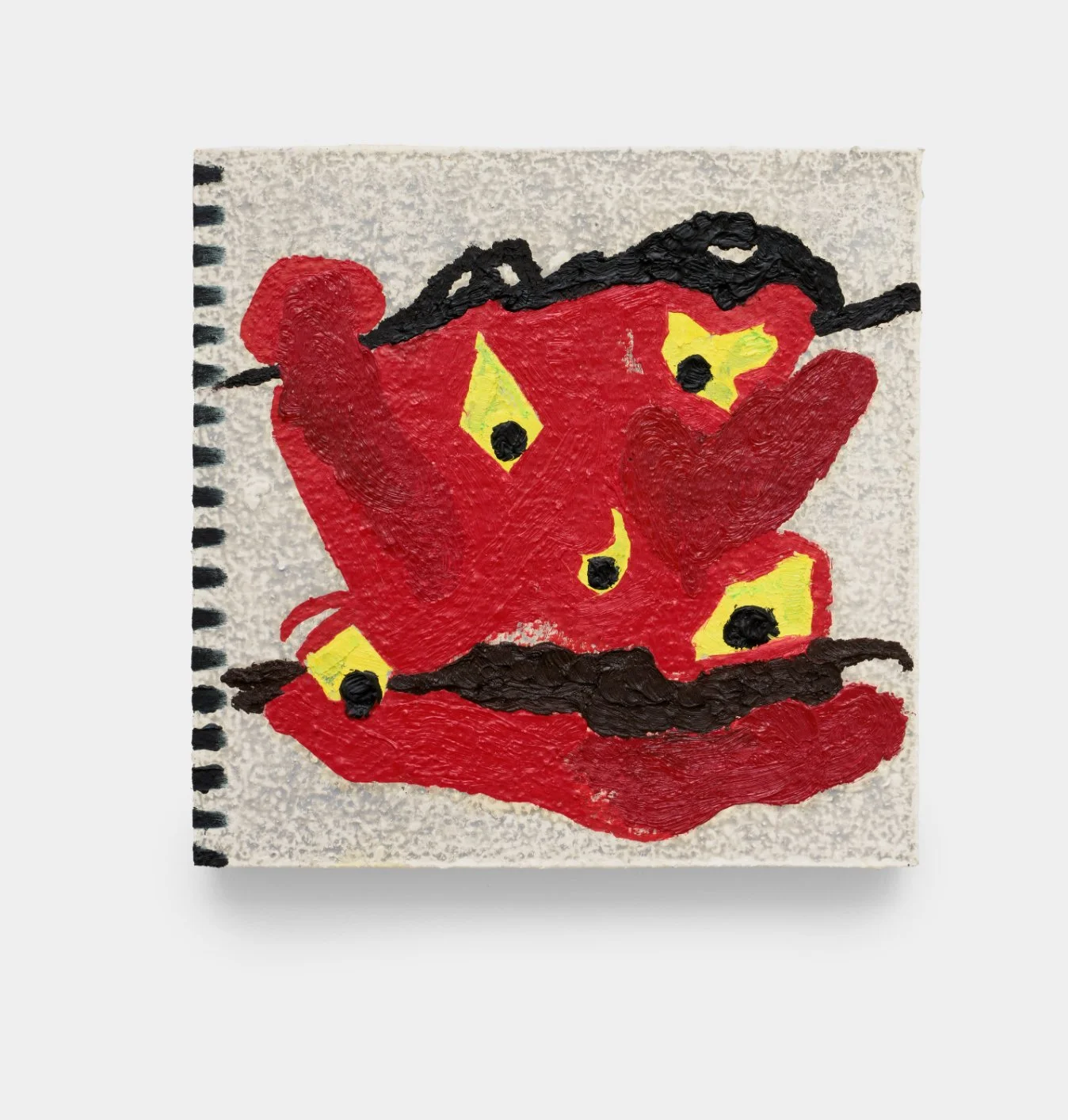
At first glance, Untitled, the show’s welcome team, sets a false tone. A melting and misshapen face in red, this painting is uniquely anthropomorphic. Cartoonish yellow geometries pool around black pupils. A nose, ear, and jaw might also be found in darker red protrusions jutting out of the head. The same might be said for the black formation at the top of the head, mirroring what could be the shadows of a mouth. But, whatever it is, its setting is evident. The left edge bears terse dark strokes, mimicking the ringlets of a notebook, and, when considered alongside the white and grey stuccoed background, Untitled’s allusion to doodling feels nearly certain. A notebook’s stark emptiness provides a decontextualized surface for discreet drawings, either spackled across a single page or as a processional flipping of figures and scenes. Untitled offers a curious reversal of Green’s predominant method of this set of paintings that results in similar ends. He utilizes figurative abstraction to reveal the complex legibility of the blank surface of notebook paper. A blank surface with remarkable similarity to that of the gallery wall. Although far from notebook drawings, Green’s Paintings revel in the negative space, like portals to new visions.
Salim Green
Untitled, 2025
Oil on wool felt on wood panel
9 x 9 inches (23 x 23 cm)
Courtesy of the artist and François Ghebaly, Los Angeles, New York
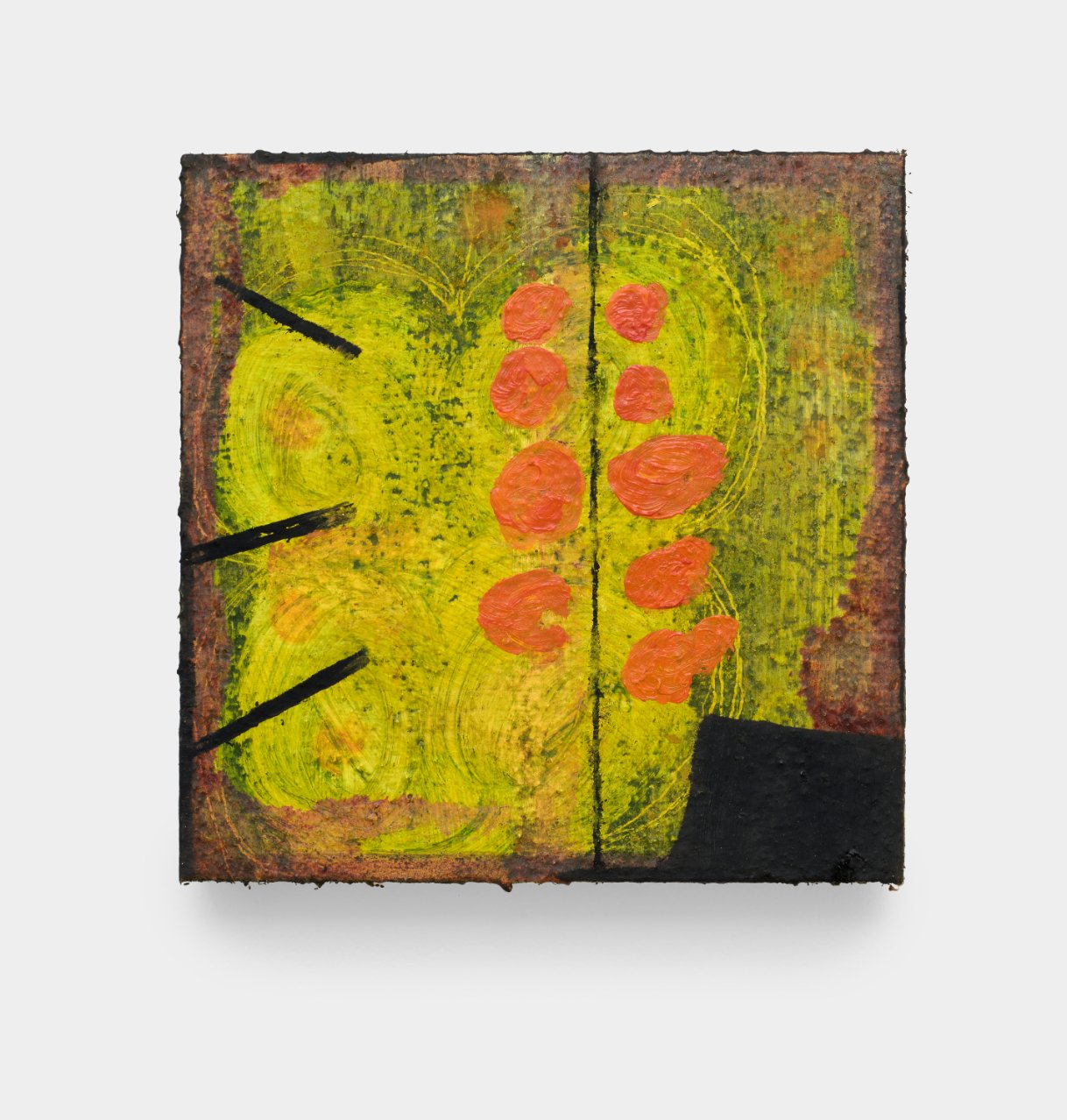
Another curious use of representation is figured in another untitled work that utilizes yellow and orange oil paints smeared within an unctuous brown. A black bifurcating line splinters the work just to the right of its perfect center, where nine orange circular blobs pair off across the divide with an abandoned marigold floating at the bottom-right. The work has an unmistakable resemblance to Portrait of Alfred Stieglitz, scored by Marius de Zayas in 1913. De Zayas’s absolute caricature bears a bifurcating line in the dead center of the composition with ten circles on either side—the middle pair are colored in dark, a nod to Stieglitz’s eyeglasses. Both works also include a frame within a frame that is subsequently intruded upon by the artwork. De Zayas’s line and top-most and bottom-most circles stretch beyond the confining rectangle he drew up to hold his caricature. Green seems to have done something similar, only in reverse. The brown border is smeared above, thus partially obfuscating yellow strokes. The bifurcating line extends into the outer border, as do three black marks on the left-end of the composition, mimicking de Zayas’s use of line in her visual lexicon. De Zayas’s idea behind his ‘absolute caricatures’ was a way of representing someone internally, capturing their spirit through line and shape, leaving visual codes readable to a knowledgeable viewer. Thus, much like Green, his absolute caricatures sit on the border of legibility, entirely abstract to an unknowing eye who has not seen or heard of Alfred Stieglitz.
Green might continue his allusion to the publishing of Portrait of Alfried Stieglitz in the quarterly Journal edited by Alfred Stieglitz, Camera Work, with the black shape in the bottom-right corner—a shadow behind a flipping page, prefiguring the left-to-right movement of its viewer. A painting registering its own serial status, just one of several paintings.
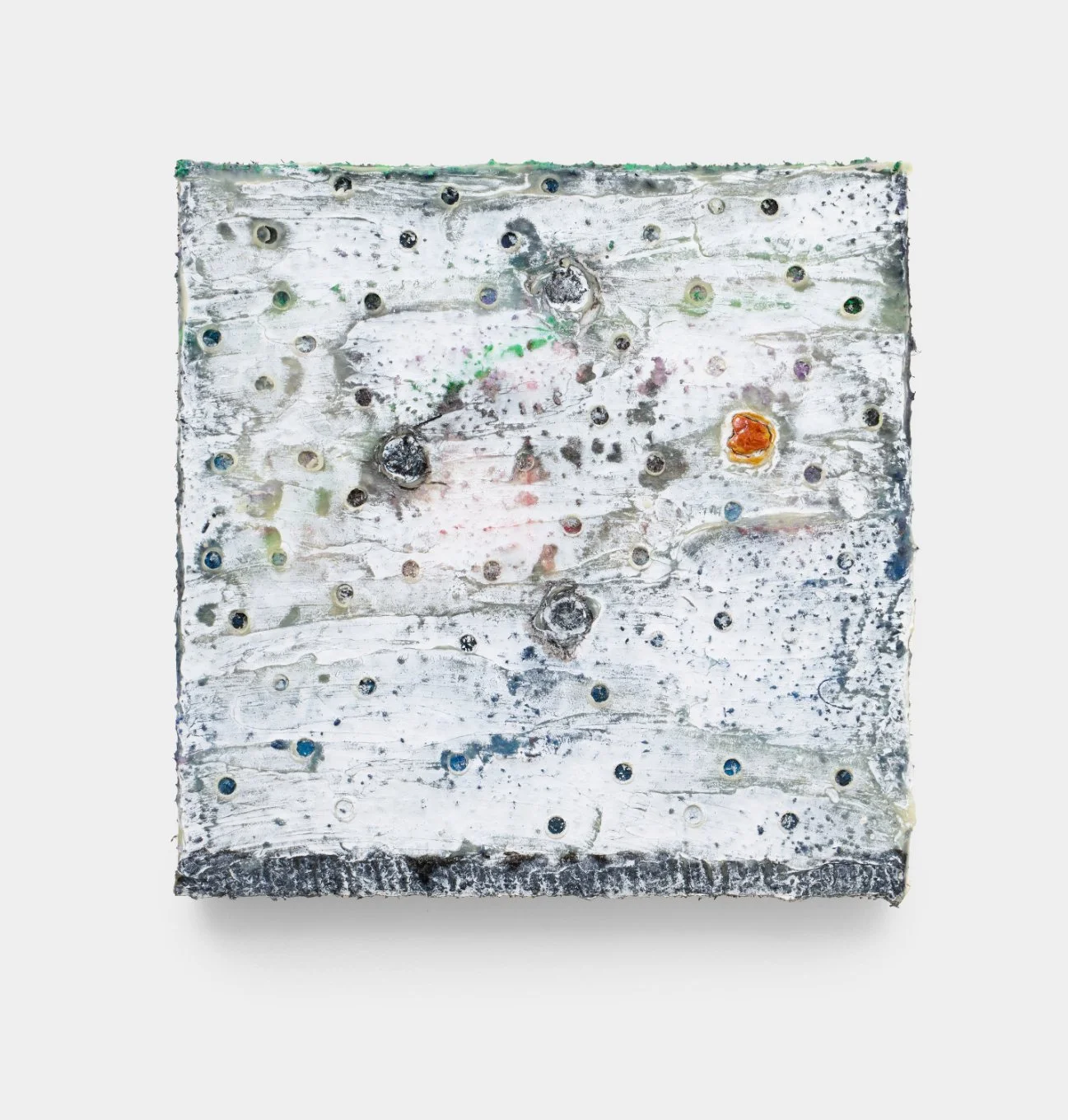
Salim Green, in another work, slathered above the usual felt and paint, oil and acrylic, bedding of beeswax. Although a degree of the shielded painting comes through the white wax, hole punctures shore up bits and pieces of what lies below. Three dark craters rupture the surface, and a volcanic glob of paint bubbles up into a hard crust. There is something unmistakably alive in this work’s absence. Layering organic material, stippled with holes and surface texture holding faint colors from whatever it is underneath, the painting has a tryptophobic effect. That, at any point, something, or somethings, might crawl out. But, in the same breath, it is also topographic. Small ripplings and cracks in the wax forge mountain ranges, colors produce a sense of scale differentiation. The painting oscillates between these two extreme perspectives, the organic and up-close and the aerial and cartographic.
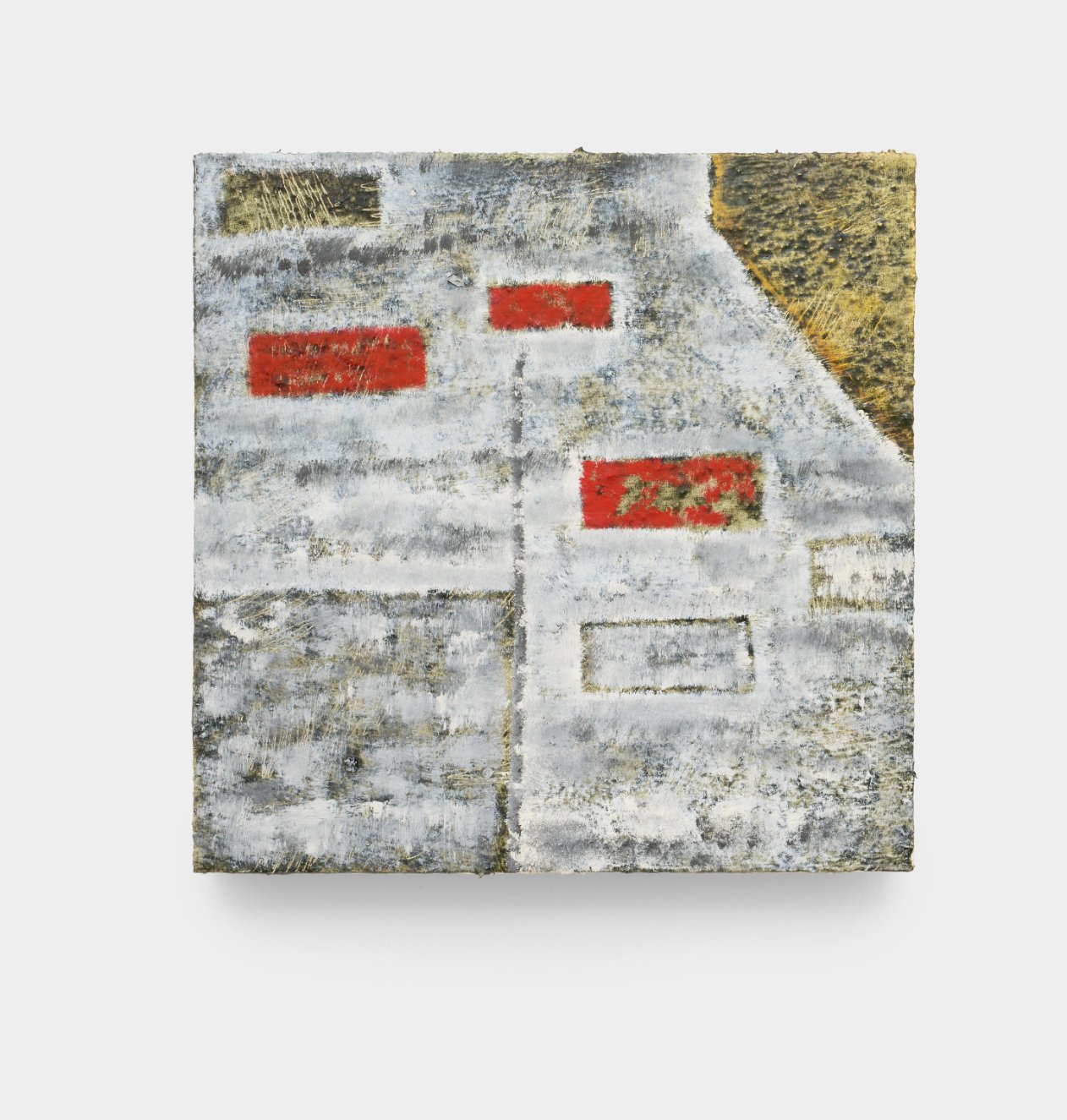
Something similar is accomplished with another untitled painting, where, white paint is used to cover up earlier surfaces rather than beeswax. Here, an aerial perspective is also felt, melting snow over farmland, although hardly affirmed. The felt texture protrudes in and out of fields of material, underscoring the layering process central to the making of this work. Obscurity is revealed as a core tenant of Green’s methodology.
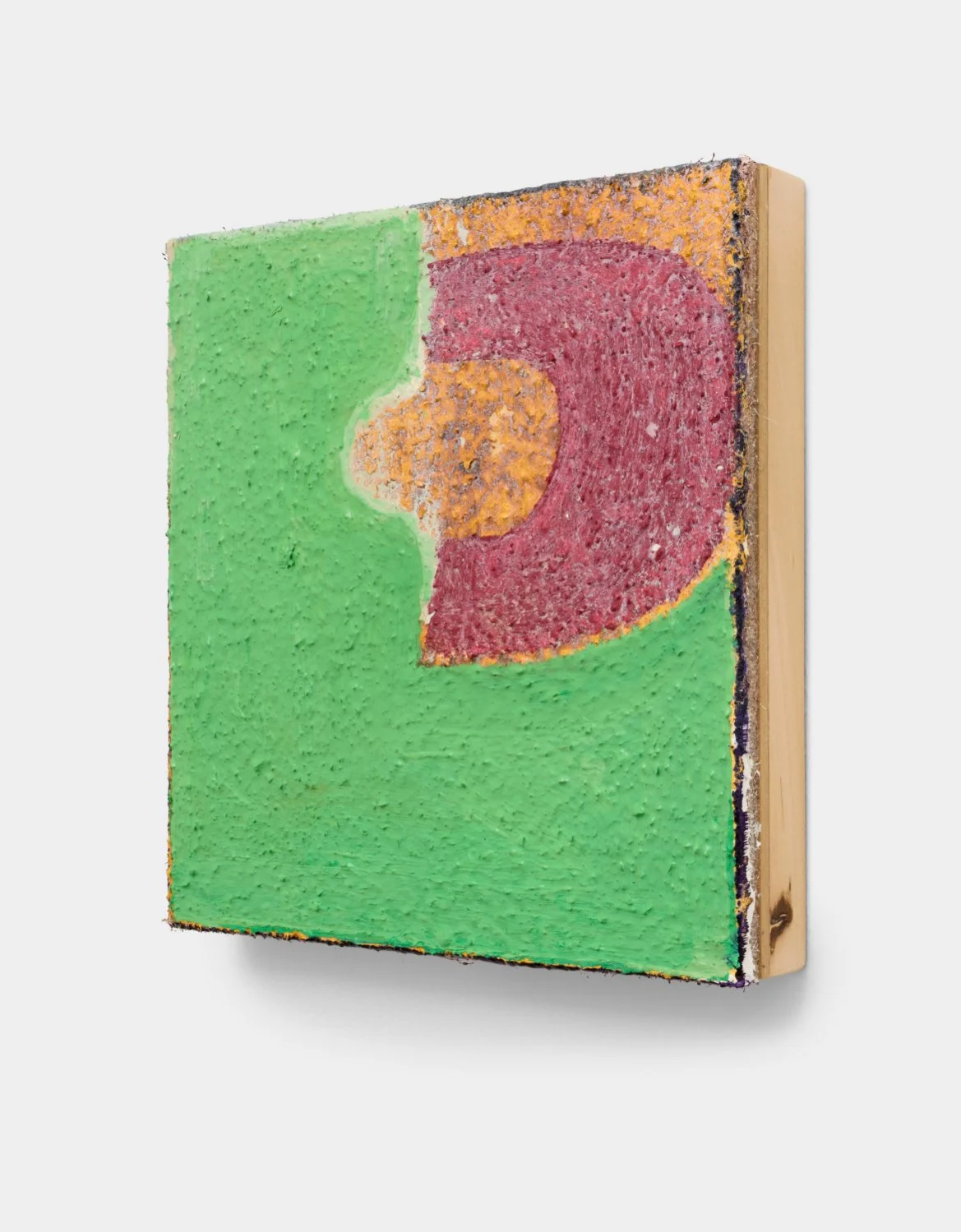
Salim Green
Untitled, 2025
Oil on wool felt on wood panel
9 x 9 inches (23 x 23 cm)
Courtesy of the artist and François Ghebaly, Los Angeles, New York
Both works feel as though they had been cut out of a larger composition, just a peephole into what was there before. A sense dramatized by the mystifying expanse of the gallery wall surrounding it. A fourth painting seems to literalize this feeling, where two color stories sit in contradiction. In a painting consisting of a grassy green field and some orange ground with a thick red curve, the edge of the work is a slick layer of purple and then white paint. It is difficult to ascertain whether a layer of wool felt is squeezed between the visible composition and the palimpsested one, but, regardless, the hidden paint comes to the viewer as a sickly icing mushed in between layers of days-old cake. Where is the rest of the cake? Who can say? But its absence makes it all the more present.
Salim Green’s Paintings is on view through June 20 @ François Ghebaly, 391 Grand Street, New York City.