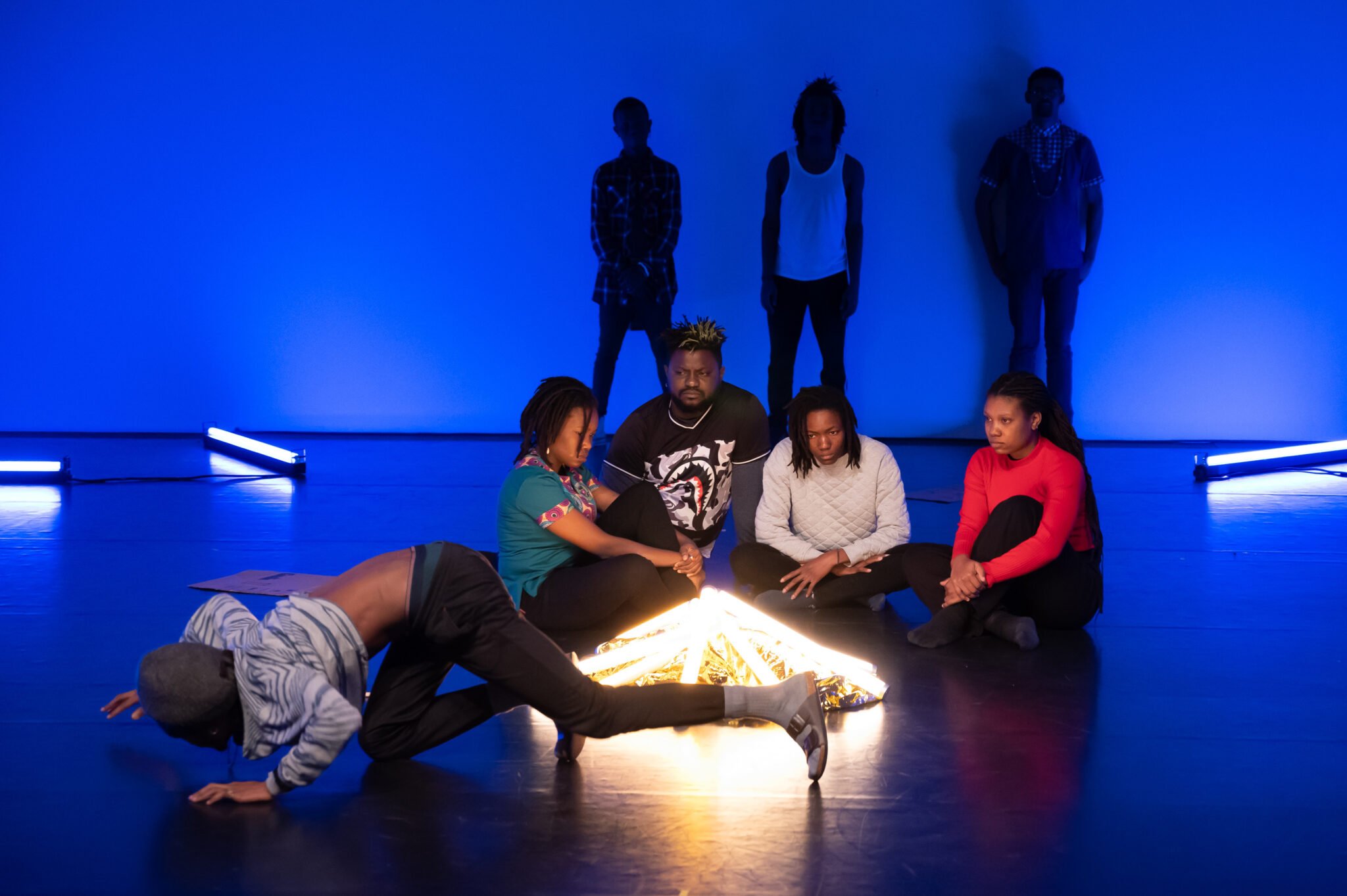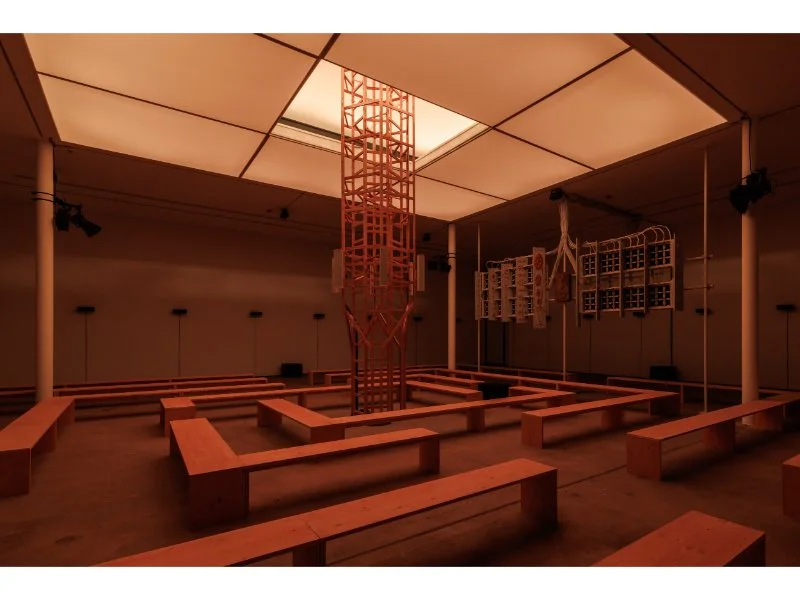
Installation view of the exhibition Holly Herndon & Mat Dryhurst–Starmirror at KW Institute for Contemporary Art, Berlin 2025
text by Arlo Kremen
Born in Johnson City, Tennessee, and Birmingham, England, respectively, artist duo Holly Herndon & Mat Dryhurst are two of the art world’s most outspoken figures for AI integration. Having attended Stanford while still being partly based in the Bay Area, Herndon’s continued application of AI models in her musical compositions and artwork remains unsurprising, as is her angle on this burgeoning technology. Partnering with Dryhurst, who has a history of advocating for internet decentralization and involvement in blockchain tech (think NFTs and social tokens), they have advanced discussions of AI through their music releases and installations since 2015. The KW Institute for Contemporary Art is the home for their current show, Starmirror.
Inspired by the much-admired Benedictine abbess and polymath from the Rhineland, Hildegard von Bingen, the show trains its attention on synchronicities between AI and the abbess’s own vision of divine order, all while considering the new role of authorship, whose precarity has undergone much turmoil in current AI-related discourse. Starmirror ultimately vies to reconceptualize human-AI collaboration and production, imagining beneficial and innovative relationships between two entities that many find existentially at odds.
Holly Herndon & Mat Dryhurst with sub
Arboretum, 2025
SLA resin, PETG filament, steel nuts, bolts, and pine wood
Commissioned and produced by KW Institute for ContemporaryArt, Berlin and the Kunstsammlung Nordrhein-Westfalen, Düsseldorf
The first room hosts Arboretum (2025), a sculptural work entirely concerned with Public Diffusion, an image model reared on publicly owned and Creative Commons Zero images, shaping a foundation model solely on ethically sourced images. Arboretum’s model uses no privately owned or sourced images in its training, a feature of nearly all AI image models. Its dataset is free to access, forming a democratized model without specific ownership.
The artists built PD40M, the largest public-domain dataset to date. Compiled from 40 million, it continues to grow through participation. The Starmirror app prompts viewers to add to the commonwealth of images already accessible to the public in an effort to resist the common perception that AI image models force viewers into a passive position. ‘Slop’ is the thrown-around term used to define the visual excrement of internet aesthetics that AI is famed for producing. Here, AI is posited as capable of producing something greater than lowest-common-denominator symbols. Instead of being the receiver of information, the human becomes the feeder, using AI to decode and visualize patterns within shared human activity. This model necessitates escaping the algorithm, going outside, and searching. If anyone remembers the screen zombies of the summer of 2016, the Starmirror app is a lot like Pokémon GO, except it is about seeing the world, not collecting clout in a digital landscape. It is AI between technology and the world.
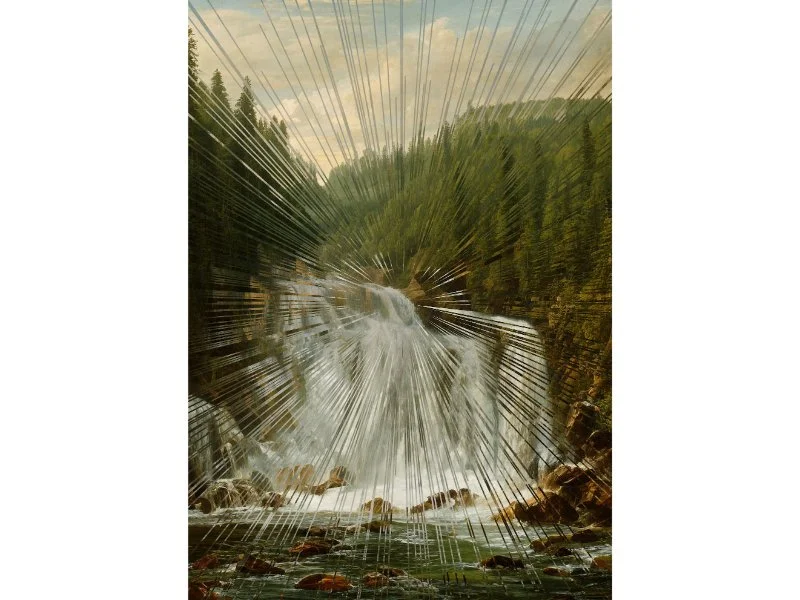
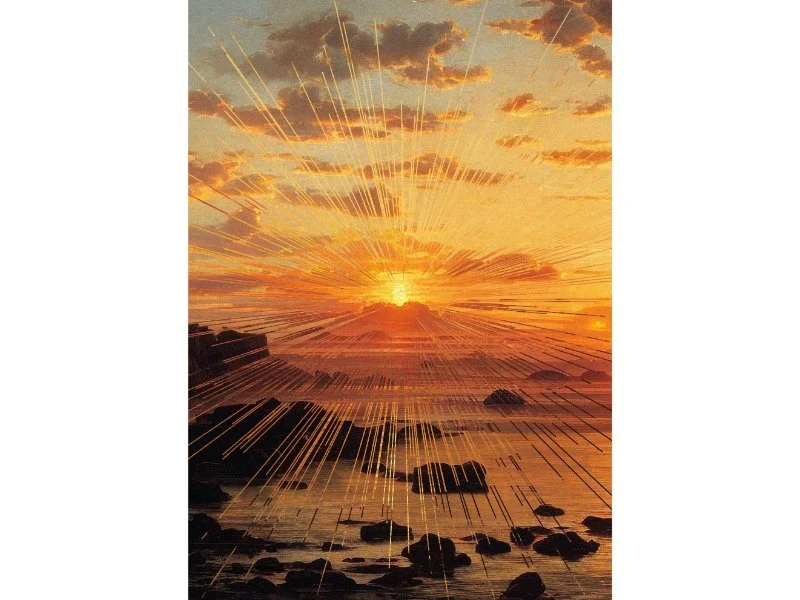
It’s a challenge to see the good in AI. Coming from a political background far outside the tech bubble, conversations around AI and pattern recognition are primarily centered on ICE’s collaboration with Palantir. That, regardless of intention and dedication to constructing a public-supporting commons, this technology will be appropriated and abused by government agencies and private businesses. Data will be bought, sold, and used to incriminate the most vulnerable. Perhaps this is naive, that all this is claimed without key information and the knowledge to differentiate models, and that fear-mongering over AI is possibly dangerous for other reasons. All of this might be true; none of it might be. But, regardless of how one might feel about such hesitations or the positive excitement provoked by the idea of such a work, the images produced by Starmirror, as one might expect, are layers upon layers of endless pastiche. So why is this at the KW institute? Starmirror is not about art. It is not about the capacity and ability of the image but about making sense of a database. This is where Hildegard von Bingen enters.
At the heart of Arboretum is a layered model inspired by Bingen’s 1151 play Ordo Virtutum. Using neumes (symbols from early Western musical notation) as a base layer, with an overlay of AI scrawlings generated by a model from Algomus, a team of researchers specializing in music modeling, analysis, and creation with AI. Here, the model composes a polyphony to create infinite variations of Ordo Virtutum that seek to pay her tribute by extending her legacy. Of course, the infinite iteration of her work neither pays her tribute nor extends her legacy. Such an approach to the authorship of a woman who died nearly 900 years ago is bizarre, to say the least. The product feels more like a mockery and bastardization than respect. For a play concerning the salvation of the human soul, protecting the soul from the devil who taunts it with worldly pleasures, the construction of a robot Hildegard von Bingen, in a removal of her holy dedication and soul, does nothing other than turn her work into a representation of those very earthly desires with which the devil taunts. The artists appear to care little about the actual work of Hildegard von Bingen, but about how AI can change it, add to it, and what AI can do when her highly interpretable and semi-illegible notation system enters a database.
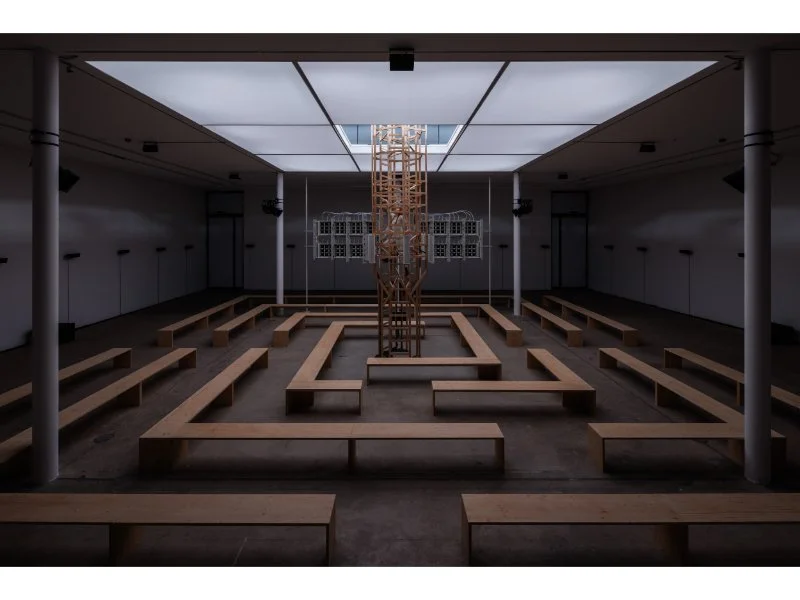
Installation view of the exhibition Holly Herndon & Mat Dryhurst–Starmirror at KW Institute for Contemporary Art, Berlin 2025
In the main hall, The Ladder (2025) continues the duo’s fascination with the German abbess, who envisioned ladders as hierarchies containing tiers with angels and virtues bridging Earth and the divine. In a convenient synchronicity, computer scientist and psychologist Geoffrey Hinton described machine learning systems’ latent space diagrams, which are based on the stacking of neural networks, from a more foundational bottom to an increasingly complex top, as “ladders of abstraction,” affirming the ladder as a dual referent. In the space around The Ladder, different sounds encroach, charging the hall with the divine. Some works are from The Call (2024–25), a research and development project and exhibition by Herndon, Dryhurst, and Serpentine Arts Technologies; others are from surviving medieval works, some by Hildegard von Bingen herself, but intermixed are AI interpretations of Hildegard’s work. In conjunction with the show, the artists invite the Starmirror ensemble, volunteers, and choirs to visit and contribute their voices in call-and-response sessions to train an AI choir that is scheduled to debut in the summer of 2026 at the Kunstsammlung Nordrhein-Westfalen in Düsseldorf.
Starmirror, perhaps more than an art exhibition, is a continuation of their experiment. The “art” of the shows is often secondary to figuring out how to coexist with, if not utilize, AI to serve people, not corporations—a highly respectable mission. But to take away a future in which AI might aid human creativity and art-making, at this moment, feels foolish. The show does not demonstrate the same level of care for the image or score as it does for the systems that produce them. So often, the show stressed the collaborative nature of their AI use. All of these folks come and share time, space, and their very bodies with each other and the AI choir they are building. The question that looms over the show: how is training an AI choir any more communal than the traditional choir? What is the difference in the aggregation of voices and beings other than the displacement and invisibility of the body?
Starmirror is on view through January 18, 2026 @ KW Institute for Contemporary Art, Berlin.