A Play of Balance and Form, Arthur Simms's Caged Bottle Triggers Engines of Memory @ KARMA New York


text by Arlo Kremen

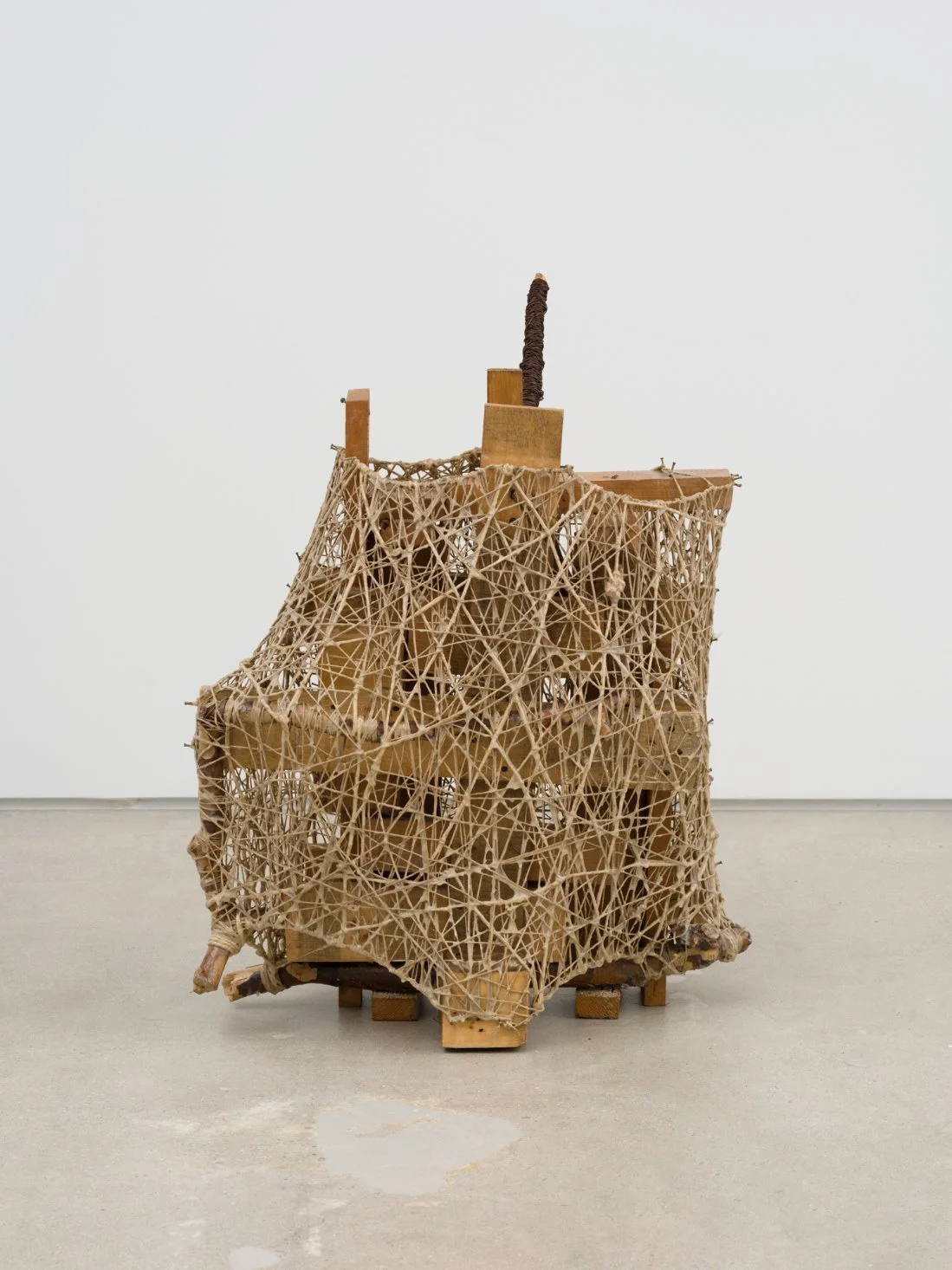
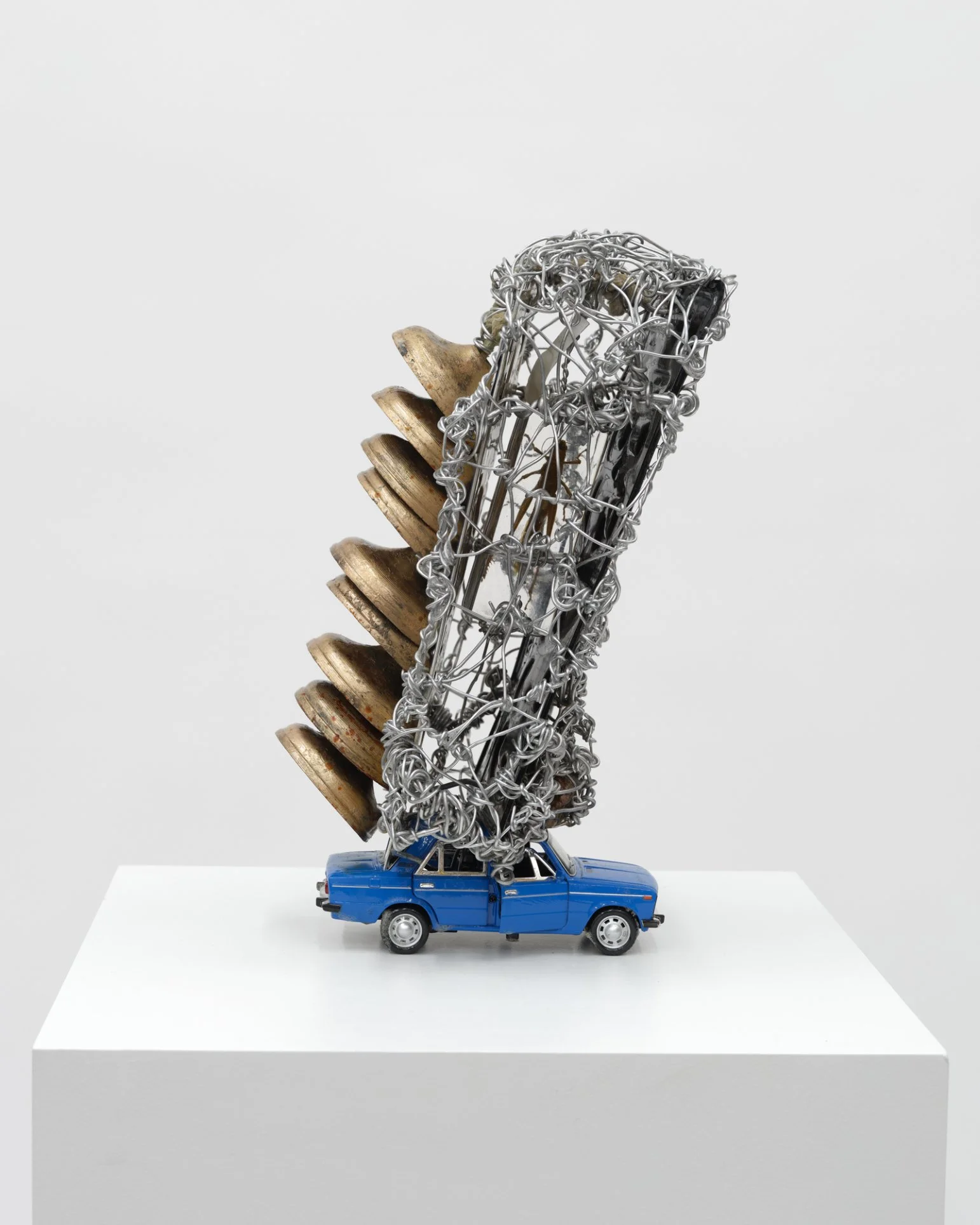
Arriving in New York City in 1968 at the age of seven, Saint Andrew, Jamaica-born Arthur Simms’ assemblages draw on the legacies of Duchamp and Rauschenberg. His new solo exhibition, Caged Bottle, at Karma New York shows works spanning nearly four decades from his studio on Staten Island. His sculptural works are made from found objects, often bound together by rope or wire. Rocks, bottles, toys, furniture, street signs, feathers, bones, and so many other discarded objects are manipulated by Simms into new forms. The binding of disparate objects together unifies them—a transformation of the many into a singular, fused work. Bug in the Cars (2024) is made from three toy cars, a roller skate, wire, and a bug, all stacked one atop another. The wire, wrapped around the glass encasing a bug carcass, cascades down to entwine two toy cars and the roller skate. A pink yarn webs the exterior of the sculptures into a fixed state, wrapped around the wheels of the roller skate, preventing movement. The third toy car, however, is quite literally disconnected. Free from the binding of wire and yarn, this car remains caged, likely able to move in the small space its cell affords, yet still a part of the overall sculptural figure—bound and unbound, unified and disunified, fixed and unfixed.
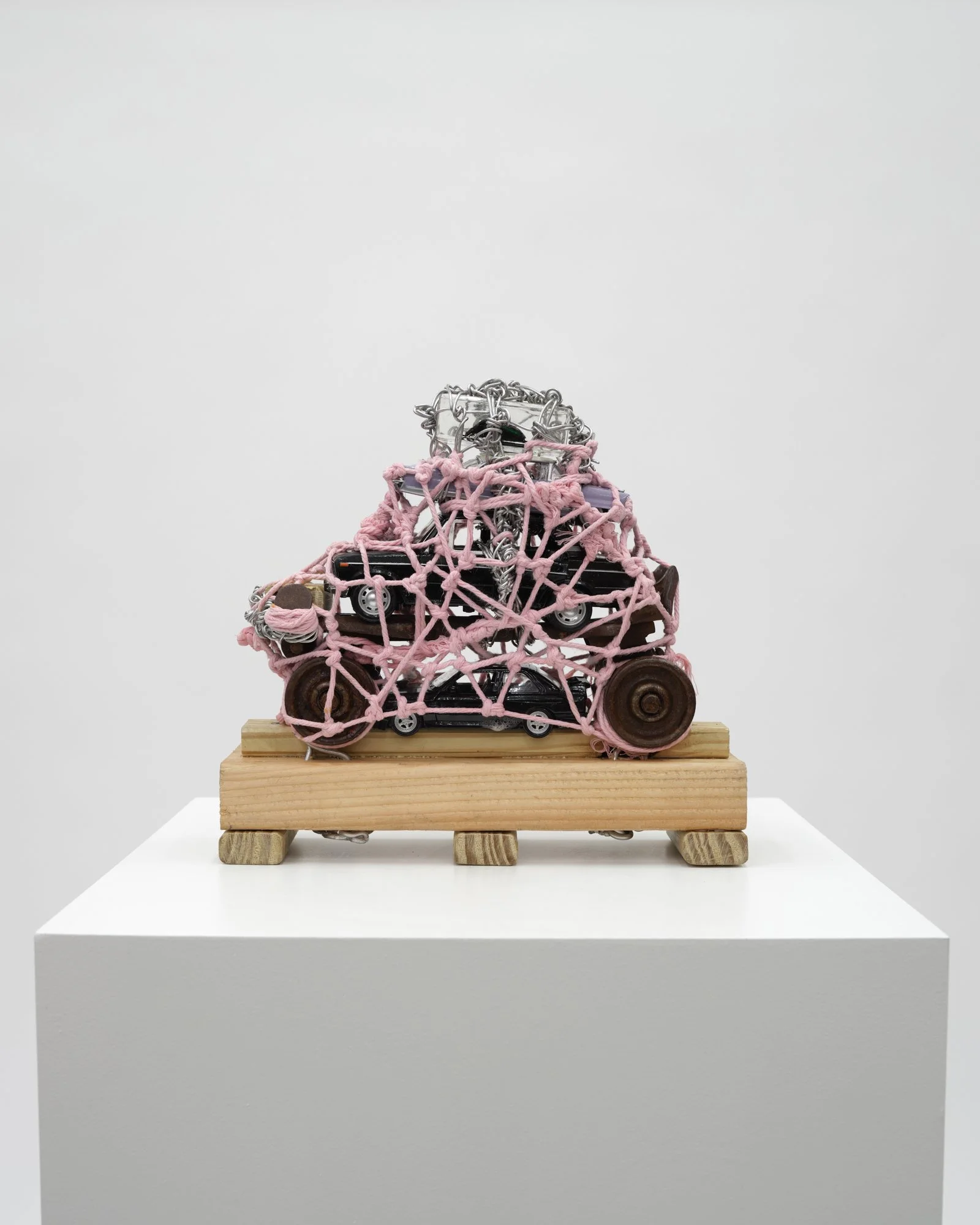
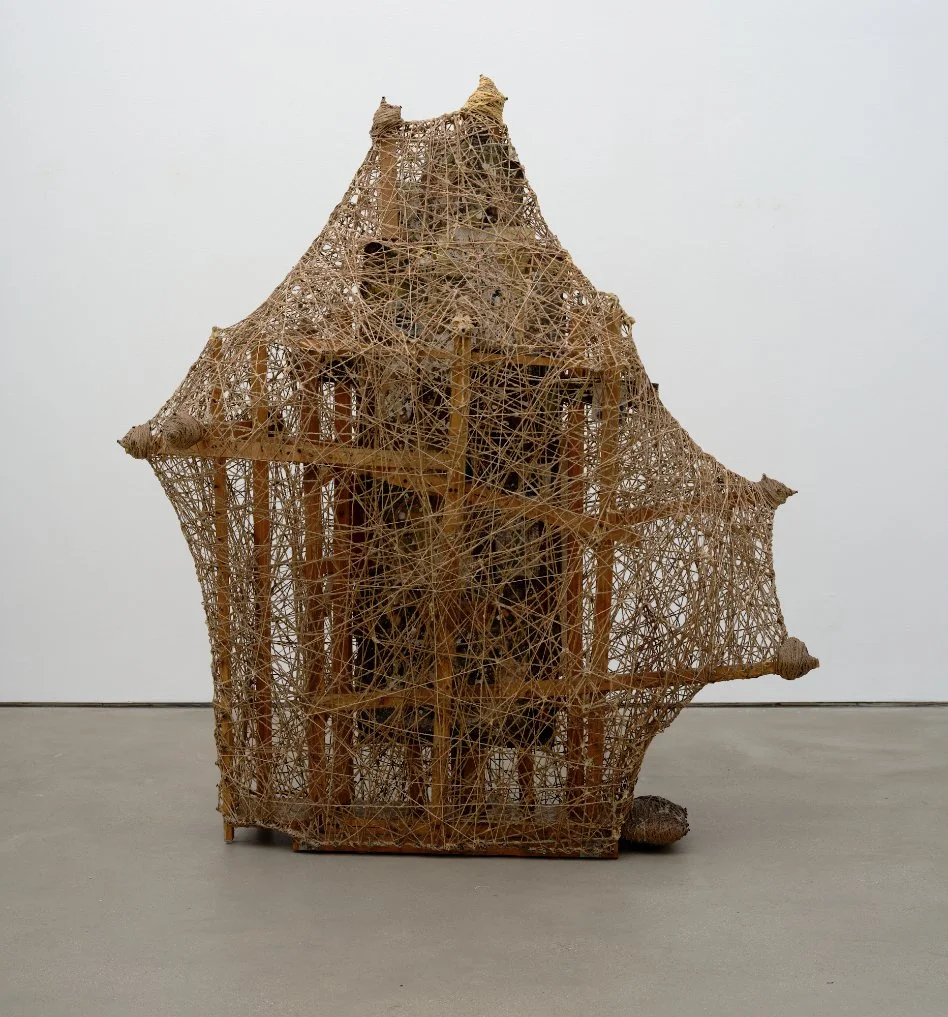


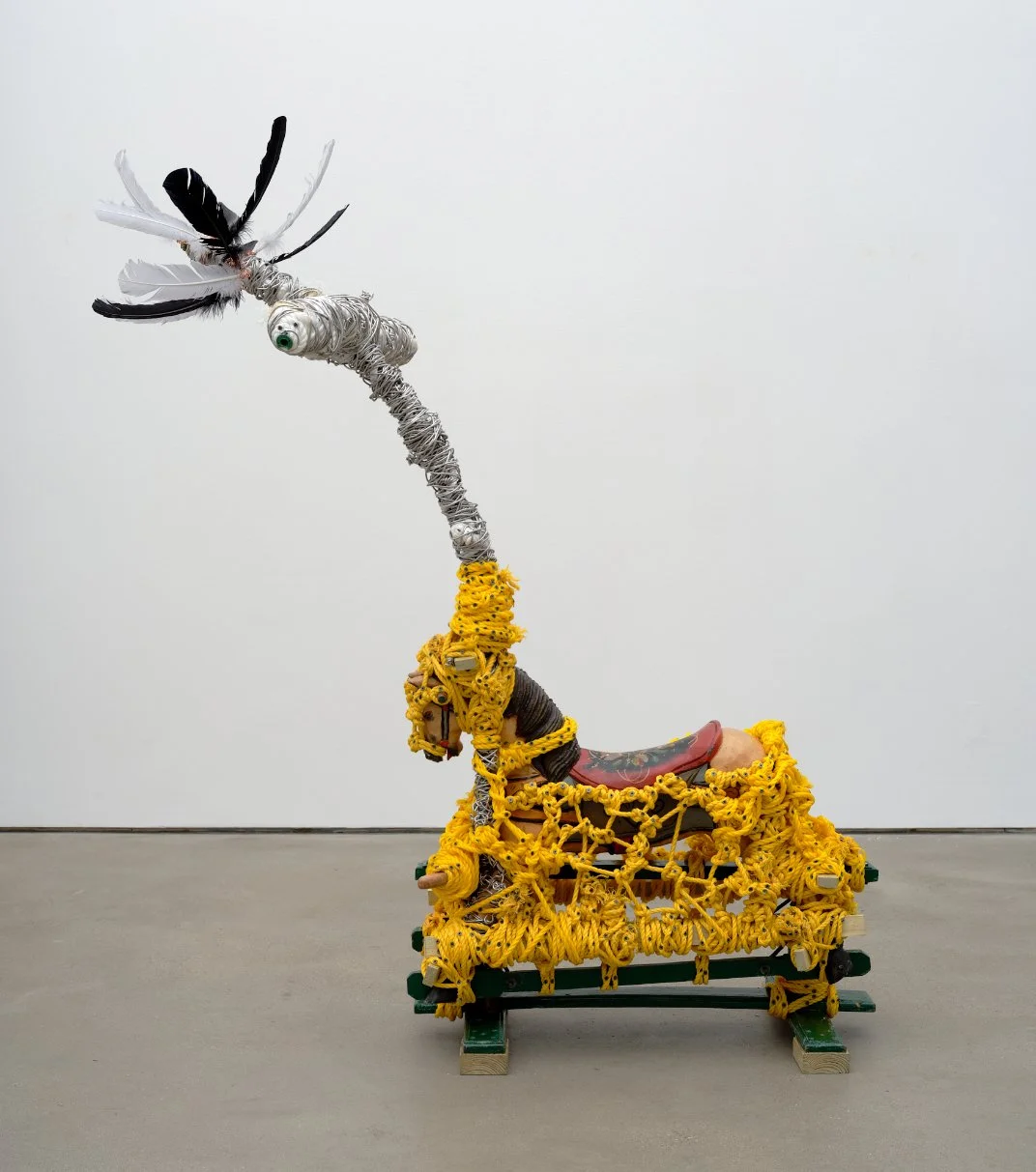
Simms’ use of yarn in Bugs in the Cars is relatively spare compared to his wrapping of rope in Sexual Tension (1992) and Spanish Town (2003). Both works are so densely bound with rope that their internal content becomes unclear from even a moderate distance. Whether it be the exact forms of wooden blocks in Spanish Town or whatever dark matter sits in the heart of Sexual Tension, a distinct separation occurs at the level of exteriority and interiority. The rope acts as a skin, concealing the beating organs it encases. Nearly spiritual, Sexual Tension, the earliest work in the show, although not relative to any human form, feels, in some sense, ghostly. A bodied quality sits hidden within an interior, inaccessible to onlookers, and can be directly encountered only through its shroud of hemp, while only the presence of an interior object is intimated.

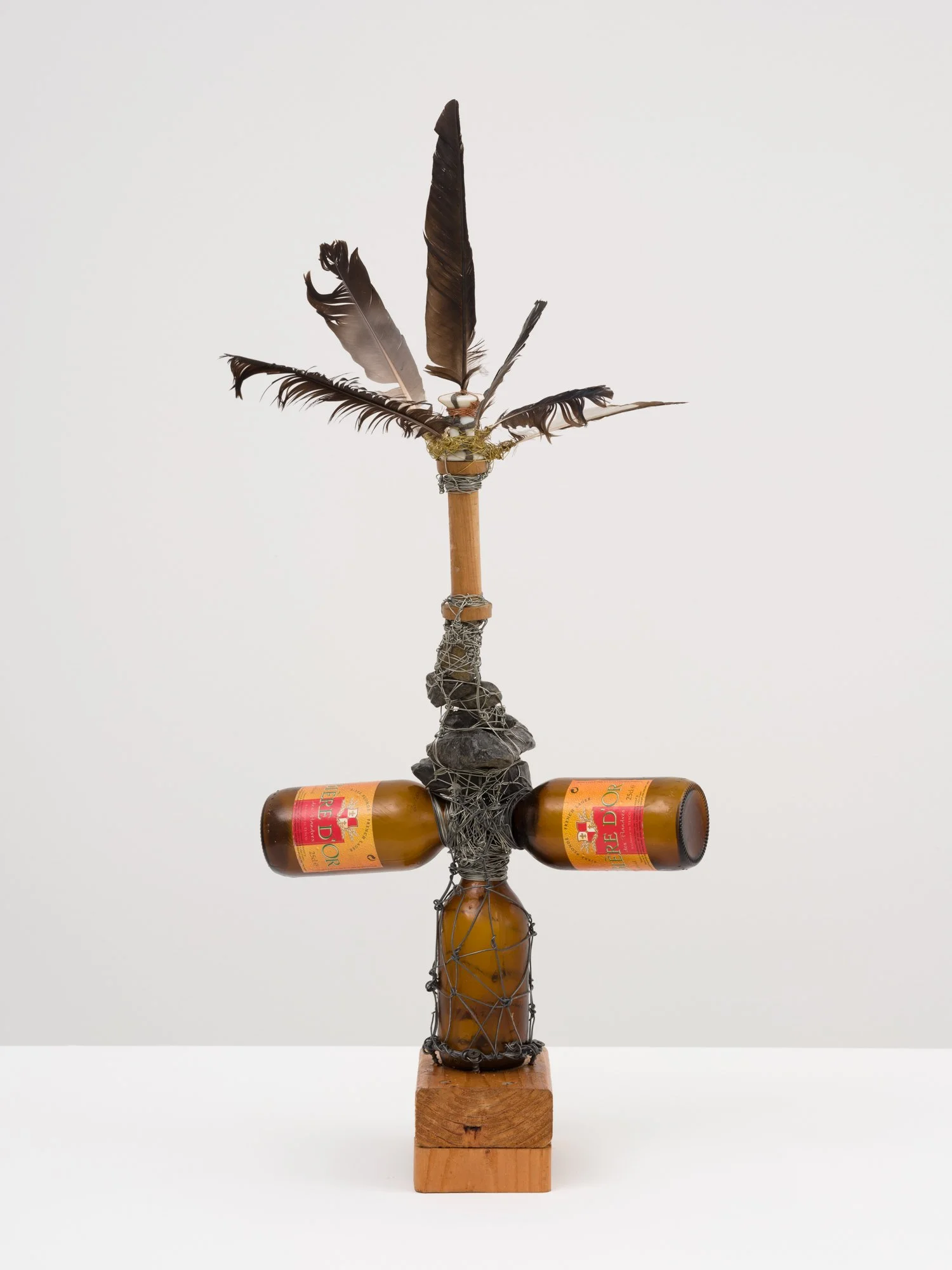
Simms continues his interest in the spiritual in his works inspired by Congolese Nkisi (vessels for spirits or medicinal substances to resolve disputes, enforce justice, heal, or harm enemies). It is possible to argue that perhaps when creating Sexual Tension, Simms was already thinking of Nkisi, sculptures that are at times seen wrapped in rope, but his inspiration becomes more clearly articulated in The Knife and the Hammer, Fear of Aggression (1994). Mimicking the Nkisi in his puncturing the work with nails and knives, he activates the spirit within this totemic figure. The work is exhibited here for the first time but was assembled while working at the Brooklyn Museum as an art handler in the early 1990s, when Simms became fascinated with Nkisi and Central African throwing knives. The work, in its vertical orientation, features a slab of wood perpendicular to the floor, appearing nearly cross-like. In his bridging together of Christianity and Congolese spirituality, he reckons with art history. Art objects are manifested in the show as being inseparable from cultural modes of metaphysical belief. 
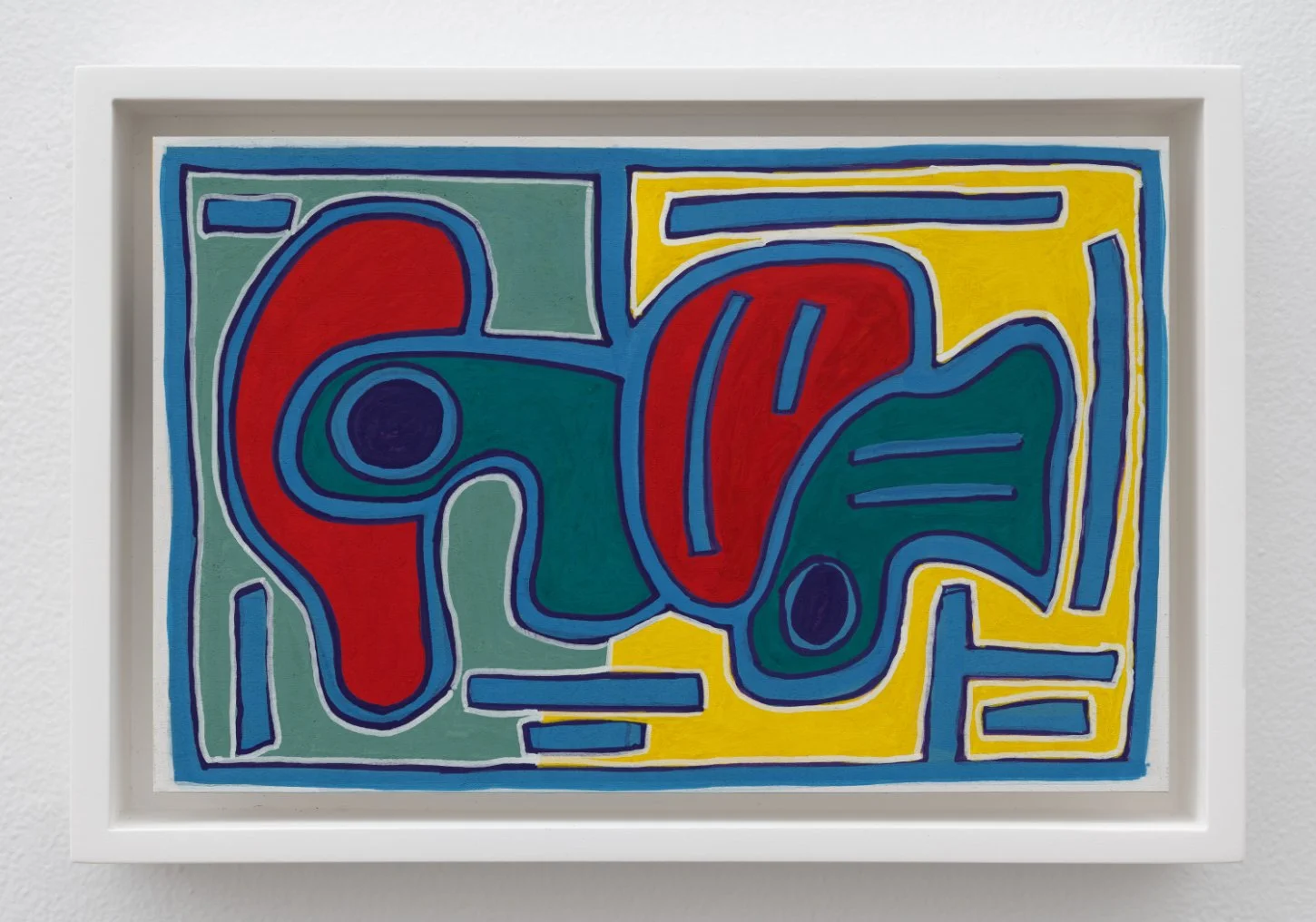
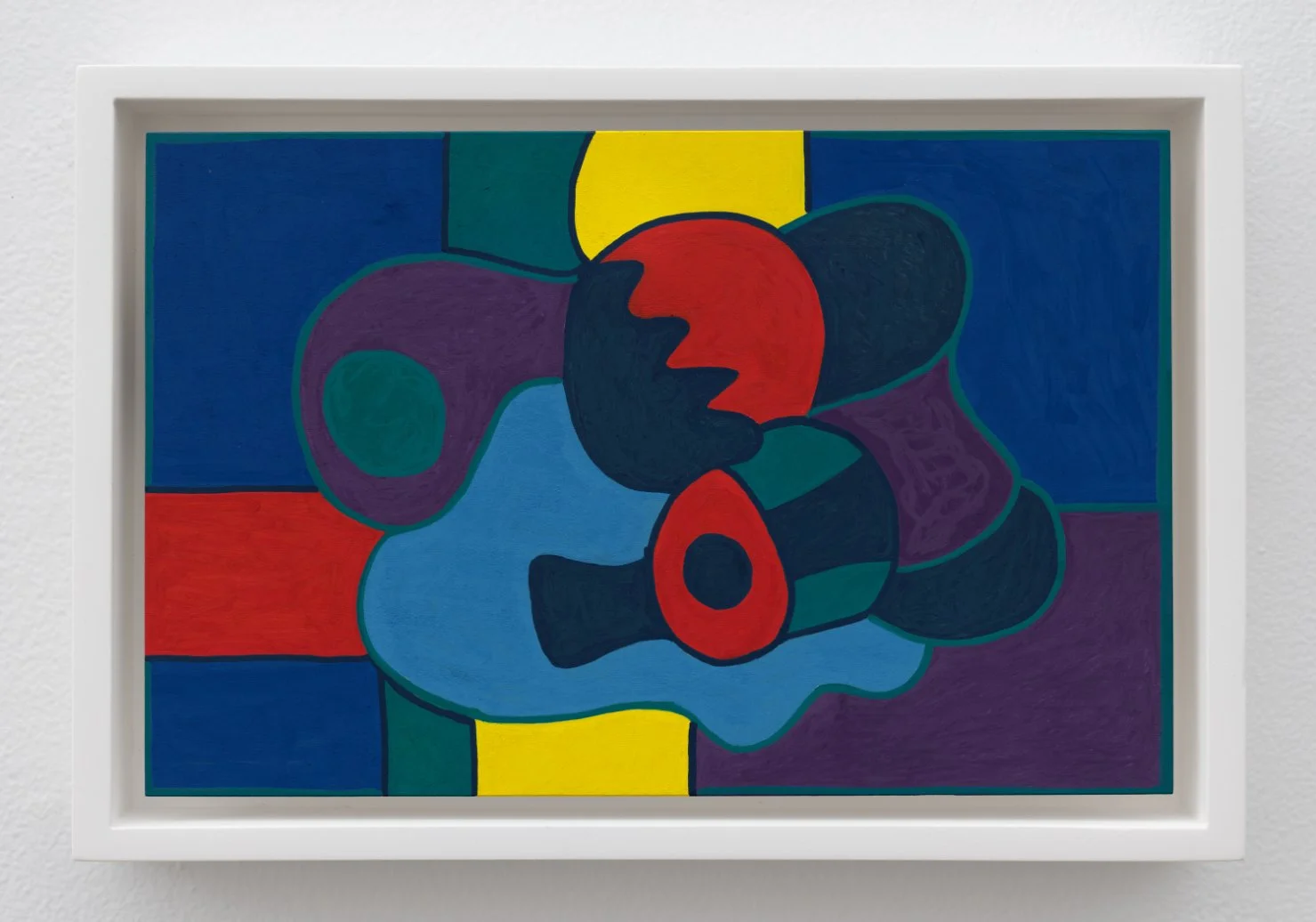
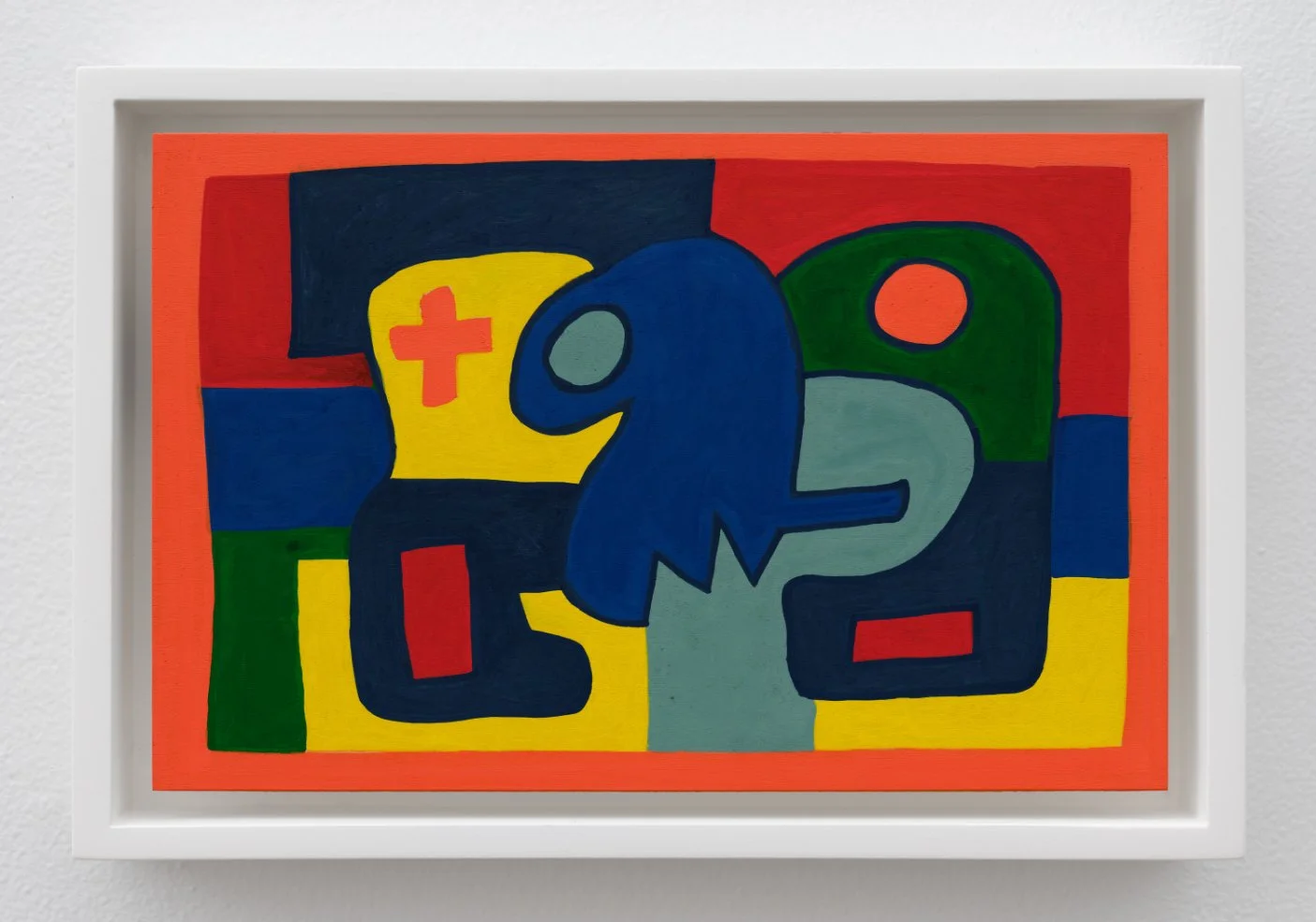
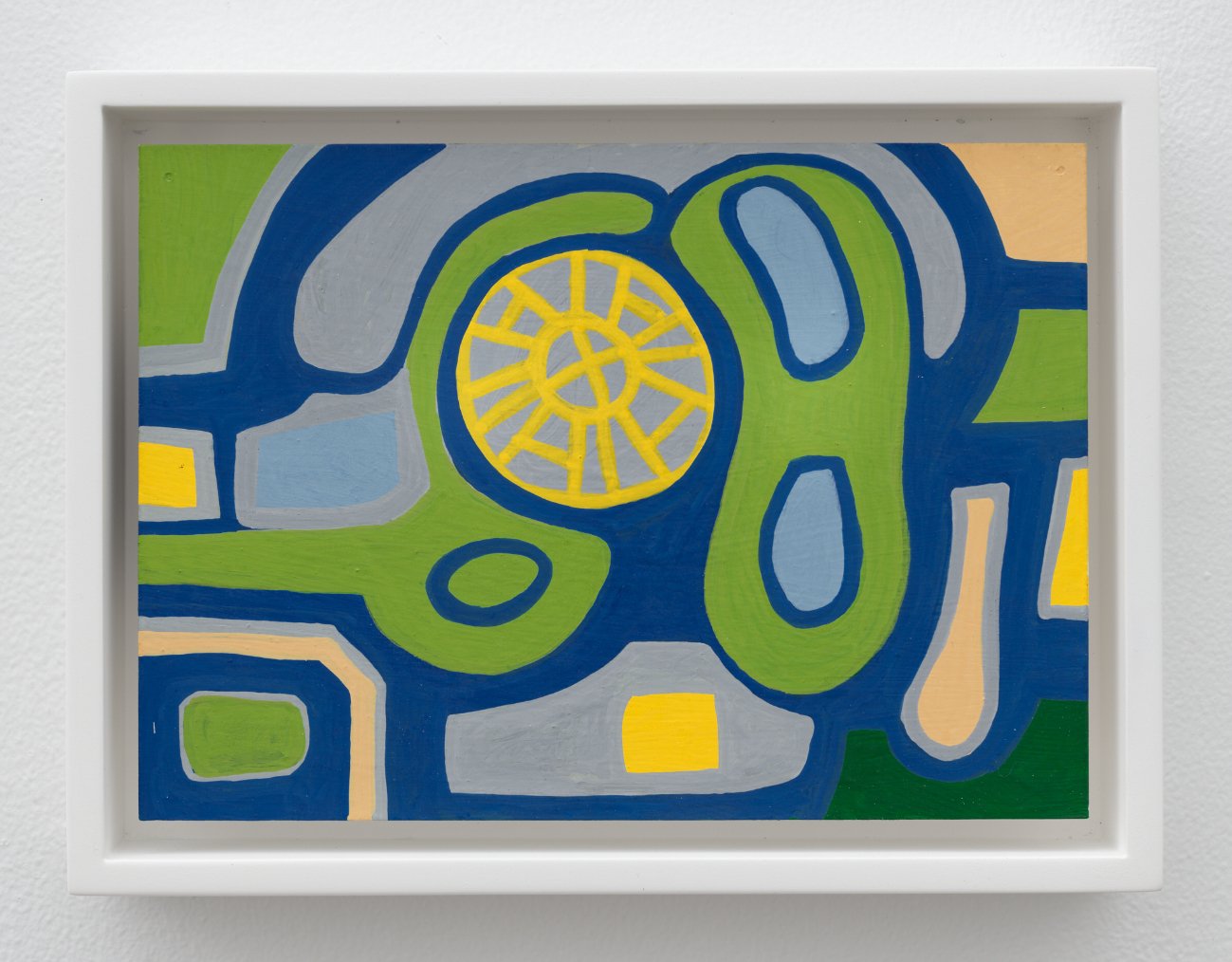
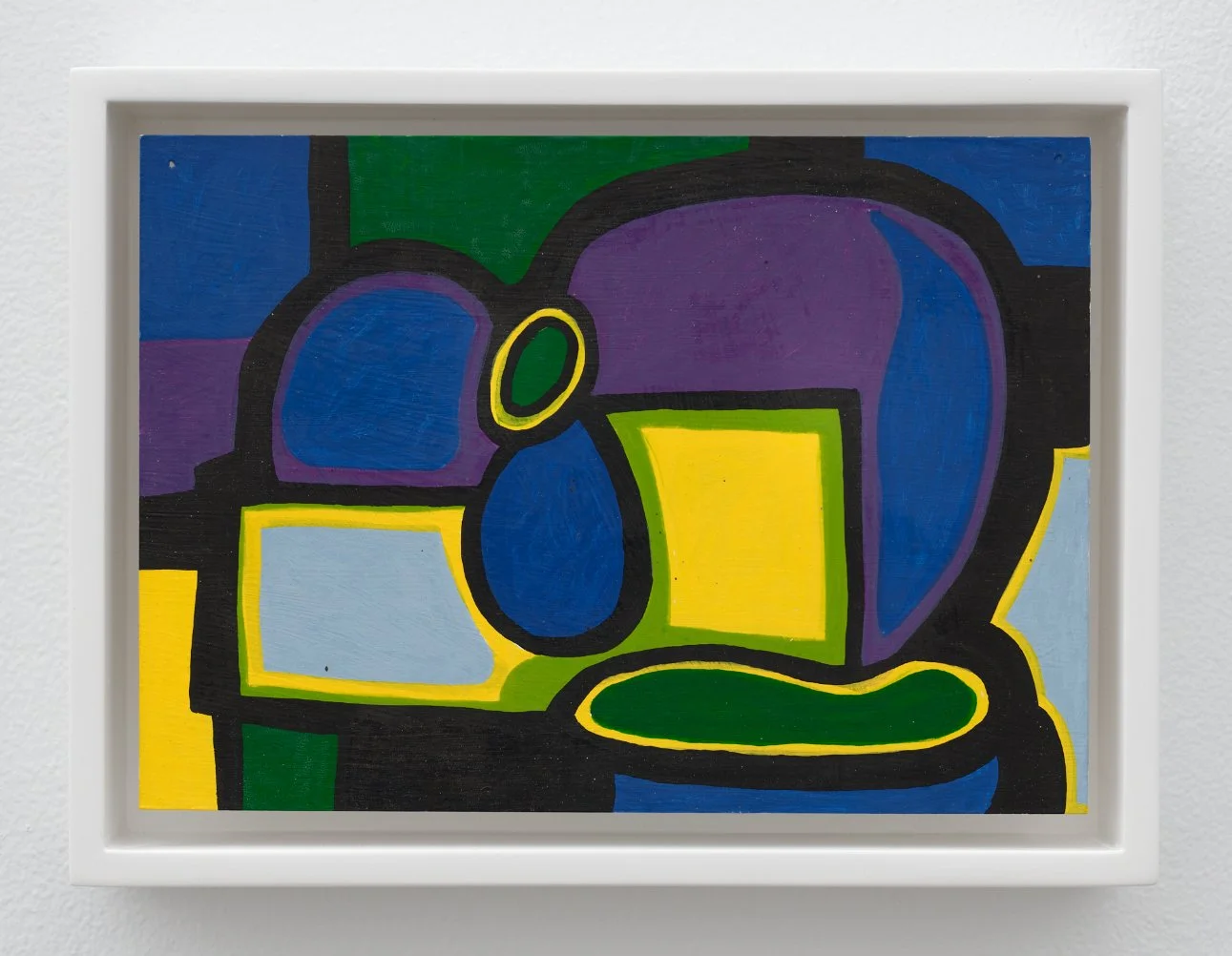
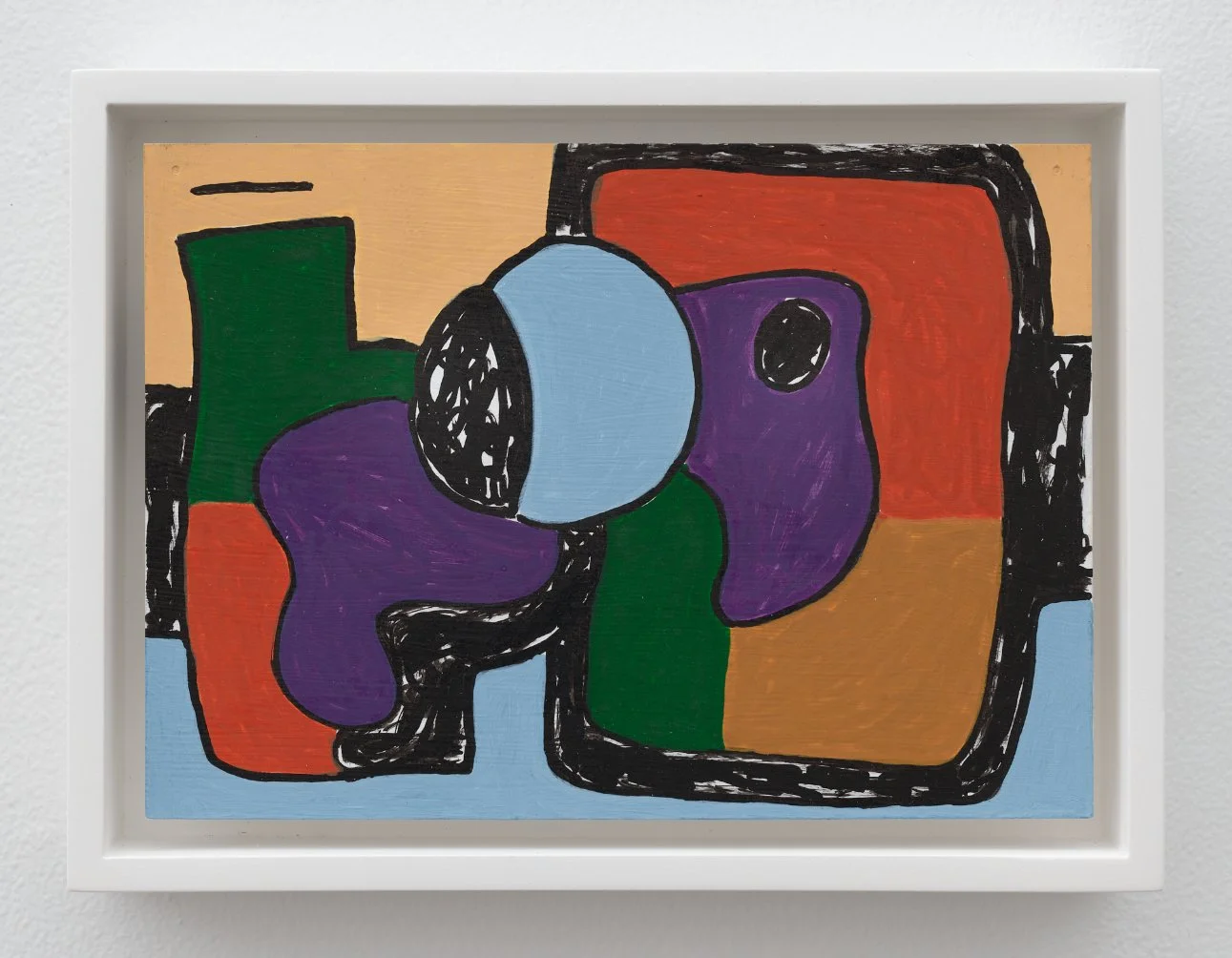
Just as much as his work might be about spirit, Simms pays quite a bit of attention to form. In his exhibited paintings, Simms propounds the strength of the line. With a collection of works from 2025 whose titles begin with “Search for form” followed by a number indicating their order, Simms demarcates exactly what is at stake in these works: the power of a line to define a form. He uses lines to create forms, to separate blocks of color, and to provide forms with loose details. These works apply lines identical to his Retablos from 2015 that continue his interest in spirituality. Two of the three retablos in the show, Retablo 5, Staten Island, and Retablo 1, Lois Dodd, are, unlike his searches for form, representative of something (Staten Island and Lois Dodd, respectively). He used the same techniques of line as used in 2015 as he did a decade later, studying the distillation of forms to lines and color, in a manner quite similar to Arthur Dove, and in the case of Lois Dodd, Marius de Zayas’s absolute caricatures. A throughline could be drawn from his acrylic paintings on wood and aluminum to his sculptural practice in his continued interest in rope and wire, linear forms. Simms explores the potential of the line as a sculptural gesture, something that can, of course, be used to bind and attach, but also the line as something that can conceal, mystify, and define interiors and exteriors, as is the case with Sexual Tension. He thinks of the line’s bulk—when wrapped repeatedly over itself, the line becomes its own form rather than a tool to define a form. 

Simms’ lines, particularly his ropes, are also soaked in memory. Being made of hemp, the use of rope betrays its presence before laying eyes on the works, with its pungent scent. Simms has spoken in interviews about his childhood memories remaining in smell and sound; thus, the olfactory dimension of the material triggers engines of memory. Many of his memories are related to the music he heard as a child, describing music as a process of layering and the coalescence and accumulation of sounds into a single work. As such, the binding feature of his linear forms refers back to his childhood.


Arthur Simms
The Knife and the Hammer, Fear of Aggression, 1994
Rope, glue, hammers, wood, knives, blades, wire, metal, screws, stones, monetary note, nails, cobblestone, and pencil
107 1/4 x 35 x 15 in.
© Arthur Simms. Courtesy the artist and Karma


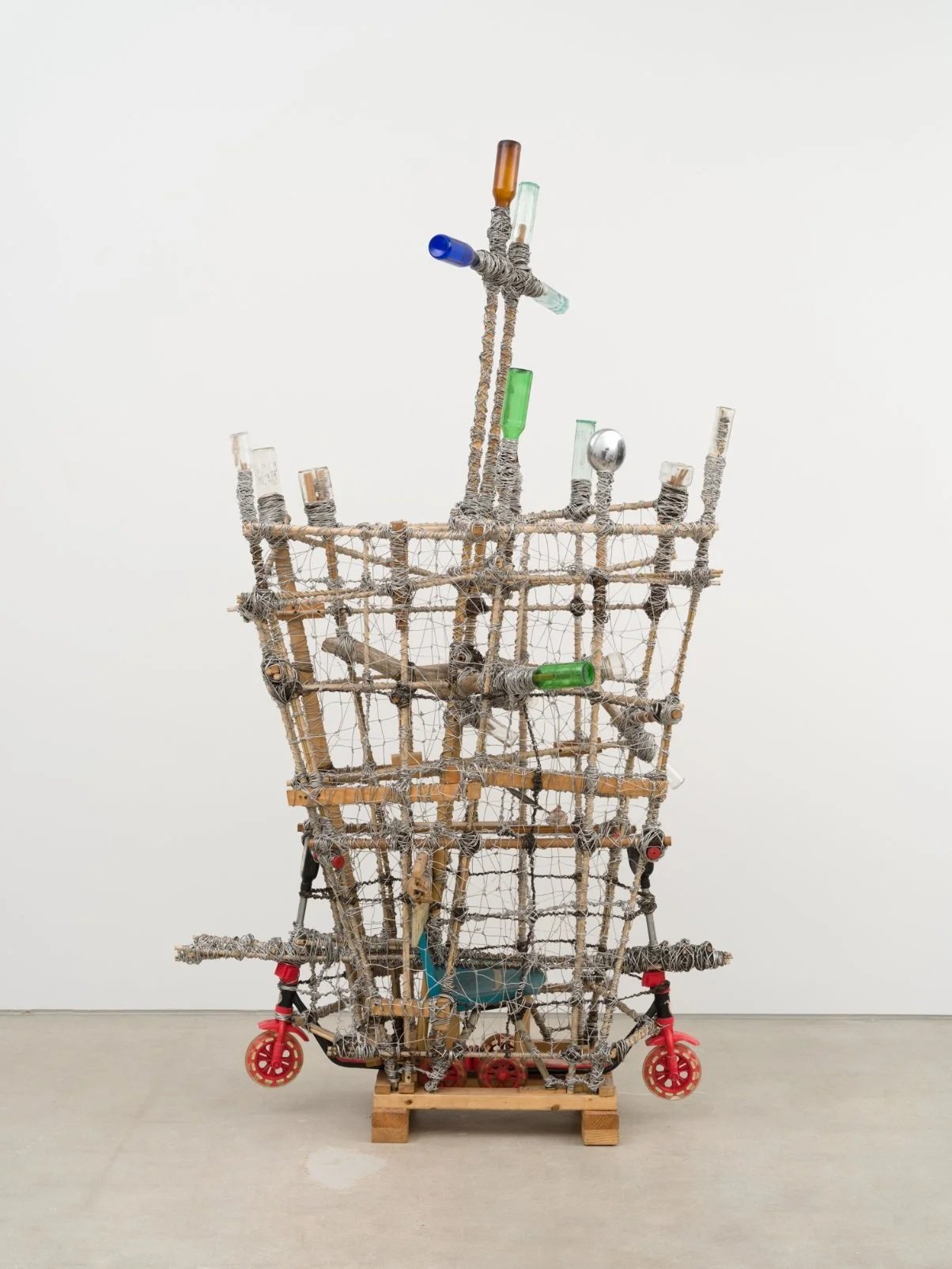
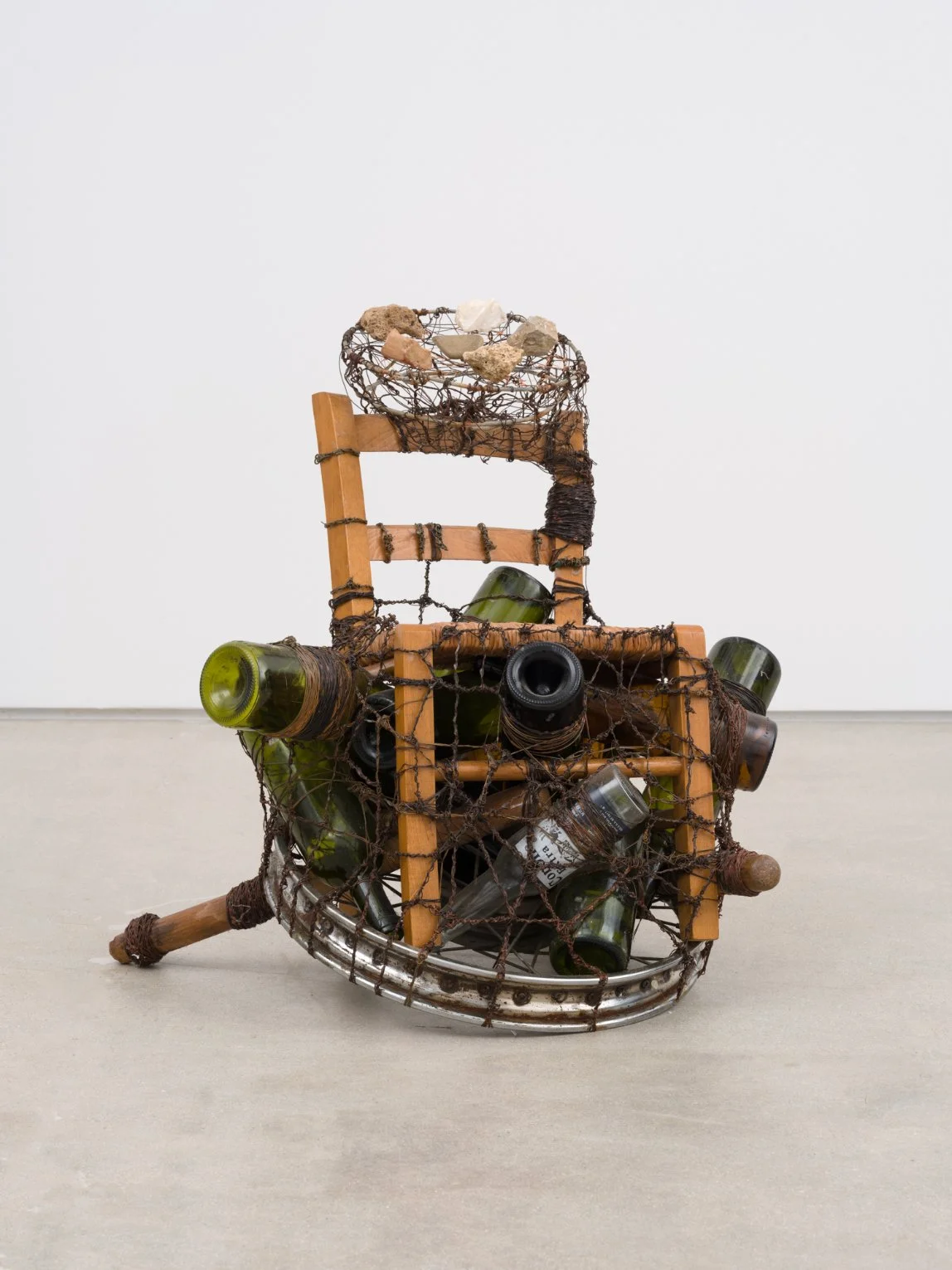
In the exhibition’s titular work, Caged Bottle (2006), Simms tests the strength of the line in the most literal sense imaginable. Using both rope and wire, Caged Bottle is a balancing act between a deconstructed toy bike wrapped in rope and a recycling bin-like structure made from wires and a bike wheel. Glass bottles and an assortment of other objects fill the interiors of the two sides, providing a distribution of weight that allows Caged Bottle to balance its wheels on a small platform without tipping and crashing, which would result in the unfixed glass bottle in a birdcage tumbling off and shattering. This work is all about precarity. But in using the linear forms of wire and rope to hold it all together, the halves can balance each other, preventing the destruction of the caged bottle. In this display of Simms’ work, presenting his paintings and sculptures together for the first time, alongside his interest in art history, the spiritual, the cultural, and memory, the artist’s formalist attitudes are made clear, positioning him as a unique artist undeniably worthy of this spike in recognition after so many years flying under the radar.

Arthur Simms’ Caged Bottle is on view through February 14 @ Karma, 22 E 2nd Street, New York City.

Arthur Simms
Caged Bottle, 2006
Rope, wood, glue, bicycles, metal, bottles, and wire
50 x 62 x 36 in.
© Arthur Simms. Courtesy the artist and Karma

Doug Aitken's "UNDER THE SUN" @ Nita Mukesh Ambani Cultural Centre

text by Arlo Kremen

In the third year since the birth of the Nita Mukesh Ambani Cultural Centre (NMACC), the embryonic institution offers its space to realize filmmaker and artist Doug Aitken’s Indian debut. Under the Sun occupies three gallery spaces, disseminating the tripartite show equally among each floor. Considering the historic temporal division of past, present, and future, Aitken applies design, craft, and technology as a means to consider the ways in which the human condition has shifted as a result of technological innovation.

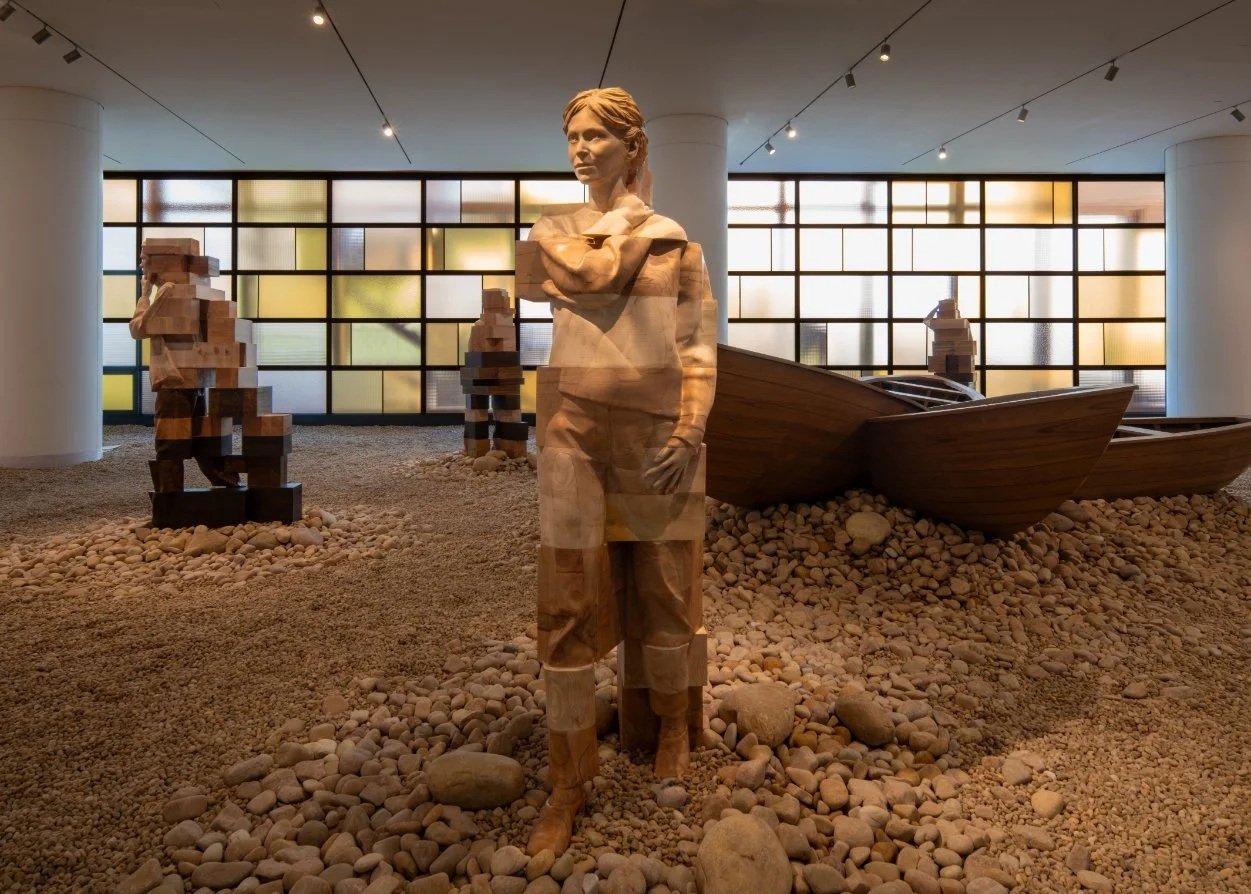
Past, the overarching title of the collection of works that make up this floor, is perhaps the most site-specific of any other floor. A collection of boats sit static aground, where instead of a frictive collision, they merge into one another into a Frankensteined structure. Rocks and pebbles flood the gallery’s floor, with the larger stones collected at the feet of those figures stretching their legs in a circular formation away from the derelict vessels. Sculpted out of reclaimed and raw Gujarat wood of variegated tones, human bodies emerge proportionally defined from pixel-like cubes of wood. Aitken’s use of machine milling and handiwork in the carving of these untitled and unidentifiable figures traces the development of ancient Indian wood carving into the modern age.

The walls hang textile works made by artisans across India who use embroidery and weaving techniques to imagine a selection of Indian rivers, as depicted in digital topographies, as being emblematic of meaning-suggestive hand signs. The works are dynamic, mixing blues with pinks and oranges in a bright clash. And by no mistake, the exhausting handcraft work required to make these works, each titled after the represented river, turns to the hand as the age-old mediator between idea and object, particular to the aforementioned rich history of Indian craft and design. To accomplish these works, Aitken’s studio collaborated with dozens of Indian artisans at Milaaya Embroidery House, bringing these generational techniques into the foray.

The second level, Present, turns to video work, projecting Aitken’s NEW ERA installation into a dark empty space of walls and mirrors. Centered on the history of the mobile phone and its inventor, Martin Cooper. By flitting between narratives of technological development and questions of humanity and personal identity, Aitken’s rightful juxtapositions of these two strains of thought define much of what it feels like to be alive in this current techne. The room is organized around three channels of video with mirrored panels. The mirrors open up the space with nearly endless halls of projections, leaving the viewer floating in an infinite space. Images of phones, roads, the ocean, telephone towers, and Martin Cooper's face and body move on and off the walls in a dance between past, present, and the yet-to-come future. Cooper’s voiceover stresses the existential importance of the cell phone, reminiscing on the site in which he made the very first public cell phone call on 6th Avenue in New York City, 1973. He reminisces, “I was lucky enough to make the very first public cell phone call in the world.” Bridging space from New York to Mumbai, Aitken stresses the global consequences of this act, bridging the two cities into the same technological globalist narrative.

Doug Aitken
NEW ERA
, 2018
Video installation with three channels of video
Three projections, freestanding room, PVC projection screens, mirrors

Future features LIGHTFALL / OTHER WORLDS, commissioned, like Past, for this show. Suspended above a wooden floor, hundreds of vertical LED tubes shape an orb of light. Pushing in and out, visitors are invited to lie down under the orb to focus on feeling the shifting swells of light from above while soaking in a drone composition working in conjunction with the convulsing sphere. This orb is universal, denying spatial and temporal restrictions. Atom, primordial specimen, pagan deity, AI creation, and planet—LIGHTFALL / OTHER WORLDS offers a hypnotic grounding into, ironically, the present, where the present can be felt as the site in which the future is imagined and sculpted.

Doug Aitken
LIGHTFALL / OTHER WORLDS, 2025
Installation view at NMACC
Courtesy of the artist
Photograph by Dhrupad Shukla/Floating Home

The light reacts to sound in real time, changing its form depending on its surrounding environment. As such, the immediate reactive quality of the work necessitates its location in the present. The work’s relation to the future is merely implied, or perhaps its visual allusions to past conceptions of what the future might look like. LIGHTFALL / OTHER WORLDS feels quite of the present, using current technologies and trends, appearing rather similar to those artworks that care less for ideas and more for experiences, so often observed on Instagram explore pages. Although Aitken's installations pre-date, and likely inspired, this trend of experience-based art works, the mass commercial proliferation of these works might warrant a pivot in the use of spectacle in this fashion. For a work so concerned with the mixing of life forms into a single pulsing entity, it would be unfortunate for its spectacle to distract from the deeply meditative ask of the work: what makes something alive and how might the encroachment of digital landscapes onto reality shift these perceptions?

Doug Aitken’s UNDER THE SUN on view through February 22nd @ Nita Mukesh Ambani Cultural Centre, Mumbai.

Herndon & Dryhurst's "Starmirror" @ KW Institute for Contemporary Art

Installation view of the exhibition Holly Herndon & Mat Dryhurst–Starmirror at KW Institute for Contemporary Art, Berlin 2025

text by Arlo Kremen

Born in Johnson City, Tennessee, and Birmingham, England, respectively, artist duo Holly Herndon & Mat Dryhurst are two of the art world’s most outspoken figures for AI integration. Having attended Stanford while still being partly based in the Bay Area, Herndon’s continued application of AI models in her musical compositions and artwork remains unsurprising, as is her angle on this burgeoning technology. Partnering with Dryhurst, who has a history of advocating for internet decentralization and involvement in blockchain tech (think NFTs and social tokens), they have advanced discussions of AI through their music releases and installations since 2015. The KW Institute for Contemporary Art is the home for their current show, Starmirror

Inspired by the much-admired Benedictine abbess and polymath from the Rhineland, Hildegard von Bingen, the show trains its attention on synchronicities between AI and the abbess’s own vision of divine order, all while considering the new role of authorship, whose precarity has undergone much turmoil in current AI-related discourse. Starmirror ultimately vies to reconceptualize human-AI collaboration and production, imagining beneficial and innovative relationships between two entities that many find existentially at odds. 

Holly Herndon & Mat Dryhurst with sub
Arboretum, 2025
SLA resin, PETG filament, steel nuts, bolts, and pine wood
Commissioned and produced by KW Institute for ContemporaryArt, Berlin and the Kunstsammlung Nordrhein-Westfalen, Düsseldorf

The first room hosts Arboretum (2025), a sculptural work  entirely concerned with Public Diffusion, an image model reared on publicly owned and Creative Commons Zero images, shaping a foundation model solely on ethically sourced images. Arboretum’s model uses no privately owned or sourced images in its training, a feature of nearly all AI image models. Its dataset is free to access, forming a democratized model without specific ownership.

The artists built PD40M, the largest public-domain dataset to date. Compiled from 40 million, it continues to grow through participation. The Starmirror app prompts viewers to add to the commonwealth of images already accessible to the public in an effort to resist the common perception that AI image models force viewers into a passive position. ‘Slop’ is the thrown-around term used to define the visual excrement of internet aesthetics that AI is famed for producing. Here, AI is posited as capable of producing something greater than lowest-common-denominator symbols. Instead of being the receiver of information, the human becomes the feeder, using AI to decode and visualize patterns within shared human activity. This model necessitates escaping the algorithm, going outside, and searching. If anyone remembers the screen zombies of the summer of 2016, the Starmirror app is a lot like Pokémon GO, except it is about seeing the world, not collecting clout in a digital landscape. It is AI between technology and the world.

It’s a challenge to see the good in AI. Coming from a political background far outside the tech bubble, conversations around AI and pattern recognition are primarily centered on ICE’s collaboration with Palantir. That, regardless of intention and dedication to constructing a public-supporting commons, this technology will be appropriated and abused by government agencies and private businesses. Data will be bought, sold, and used to incriminate the most vulnerable. Perhaps this is naive, that all this is claimed without key information and the knowledge to differentiate models, and that fear-mongering over AI is possibly dangerous for other reasons. All of this might be true; none of it might be. But, regardless of how one might feel about such hesitations or the positive excitement provoked by the idea of such a work, the images produced by Starmirror, as one might expect, are layers upon layers of endless pastiche. So why is this at the KW institute? Starmirror is not about art. It is not about the capacity and ability of the image but about making sense of a database. This is where Hildegard von Bingen enters.

At the heart of Arboretum is a layered model inspired by Bingen’s 1151 play Ordo Virtutum. Using neumes (symbols from early Western musical notation) as a base layer, with an overlay of AI scrawlings generated by a model from Algomus, a team of researchers specializing in music modeling, analysis, and creation with AI. Here, the model composes a polyphony to create infinite variations of Ordo Virtutum that seek to pay her tribute by extending her legacy. Of course, the infinite iteration of her work neither pays her tribute nor extends her legacy. Such an approach to the authorship of a woman who died nearly 900 years ago is bizarre, to say the least. The product feels more like a mockery and bastardization than respect. For a play concerning the salvation of the human soul, protecting the soul from the devil who taunts it with worldly pleasures, the construction of a robot Hildegard von Bingen, in a removal of her holy dedication and soul, does nothing other than turn her work into a representation of those very earthly desires with which the devil taunts. The artists appear to care little about the actual work of Hildegard von Bingen, but about how AI can change it, add to it, and what AI can do when her highly interpretable and semi-illegible notation system enters a database.

Installation view of the exhibition Holly Herndon & Mat Dryhurst–Starmirror at KW Institute for Contemporary Art, Berlin 2025

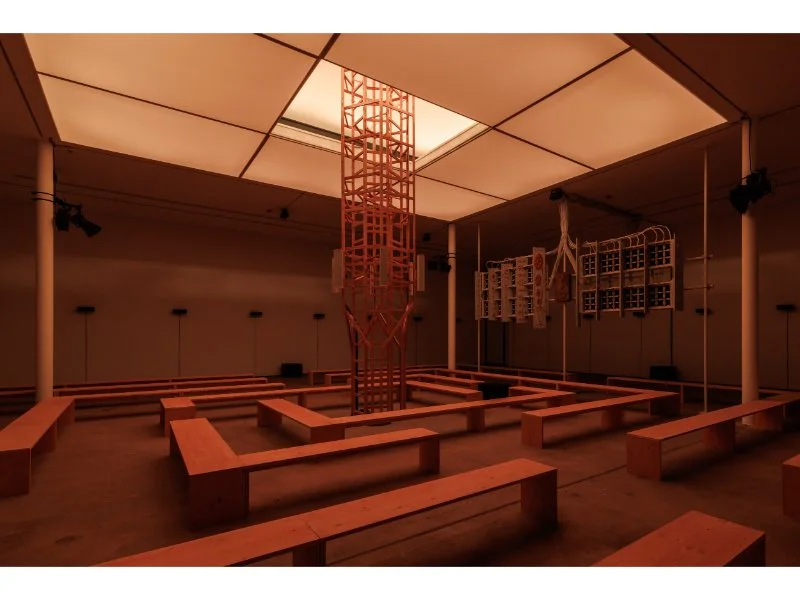
In the main hall, The Ladder (2025) continues the duo’s fascination with the German abbess, who envisioned ladders as hierarchies containing tiers with angels and virtues bridging Earth and the divine. In a convenient synchronicity, computer scientist and psychologist Geoffrey Hinton described machine learning systems’ latent space diagrams, which are based on the stacking of neural networks, from a more foundational bottom to an increasingly complex top, as “ladders of abstraction,” affirming the ladder as a dual referent. In the space around The Ladder, different sounds encroach, charging the hall with the divine. Some works are from The Call (2024–25), a research and development project and exhibition by Herndon, Dryhurst, and Serpentine Arts Technologies; others are from surviving medieval works, some by Hildegard von Bingen herself, but intermixed are AI interpretations of Hildegard’s work. In conjunction with the show, the artists invite the Starmirror ensemble, volunteers, and choirs to visit and  contribute their voices in call-and-response sessions to train an AI choir that is scheduled to debut in the summer of 2026 at the Kunstsammlung Nordrhein-Westfalen in Düsseldorf.

Starmirror, perhaps more than an art exhibition, is a continuation of their experiment. The “art” of the shows is often secondary to figuring out how to coexist with, if not utilize, AI to serve people, not corporations—a highly respectable mission. But to take away a future in which AI might aid human creativity and art-making, at this moment, feels foolish. The show does not demonstrate the same level of care for the image or score as it does for the systems that produce them. So often, the show stressed the collaborative nature of their AI use. All of these folks come and share time, space, and their very bodies with each other and the AI choir they are building. The question that looms over the show: how is training an AI choir any more communal than the traditional choir? What is the difference in the aggregation of voices and beings other than the displacement and invisibility of the body?


Starmirror is on view through January 18, 2026 @ KW Institute for Contemporary Art, Berlin.

Beverly Buchanan in Berlin: "Beverly Buchanan. Weathering" @ Haus am Waldsee

text by Arlo Kremen


Standing a block away from the last stop of the U3 at Krumme Lanke, Haus am Waldsee, a beautiful residence turned art museum, sits by the Zehlendorf quarter’s local lake, or Waldsee. Haus am Waldsee is the only property on the lake where all visitors are free to access the water, a facet of the institution deeply in line with the ethos of the late Beverly Buchanan’s work. For her “shack” works, Buchanan regularly trespassed onto the grounds of these structures of Southern American vernacular architecture for photos and inspiration, coming face to face with many upset, disgruntled, and irritated homeowners, but also new friends. In this regular practice, she met Ms. Mary Lou Fulcron, a woman who had built her house and lived alone. In an excerpt of the artist’s writing, Buchanan shares how she helped carry logs for Ms. Fulcron, and her challenge of ingratiating herself with an isolated black woman in Georgia, a challenge that had become a regular exercise for the artist. From her brief diary entry pinned up in the show, Ms. Fulcron meant a lot to Buchanan. A woman of endurance, who, when hospitalized, escaped back to her house on foot, ten miles away, scared something would happen to her home.

These are the stories Buchanan saw in every shack she came across, with many of these structures being somewhat-restyled slave cabins. She saw power, endurance, and survival in each and every one. When speaking to curators, Beatrice Hilke and Pia-Marie Remmers told another story of Buchanan entering a home at night without a roof. All she wrote about was how clear the stars were. She never came to a home with judgment, critique, or patronizing worry; she came to these homes as if they were art objects—monuments to those who live and have lived in them.

Beverly Buchanan
Three Families (A Memorial Piece with Scars) [with legend], 1989
Print on paper
10 x 23 cm
Courtesy of the Estate of Beverly Buchanan and Andrew Edlin Gallery

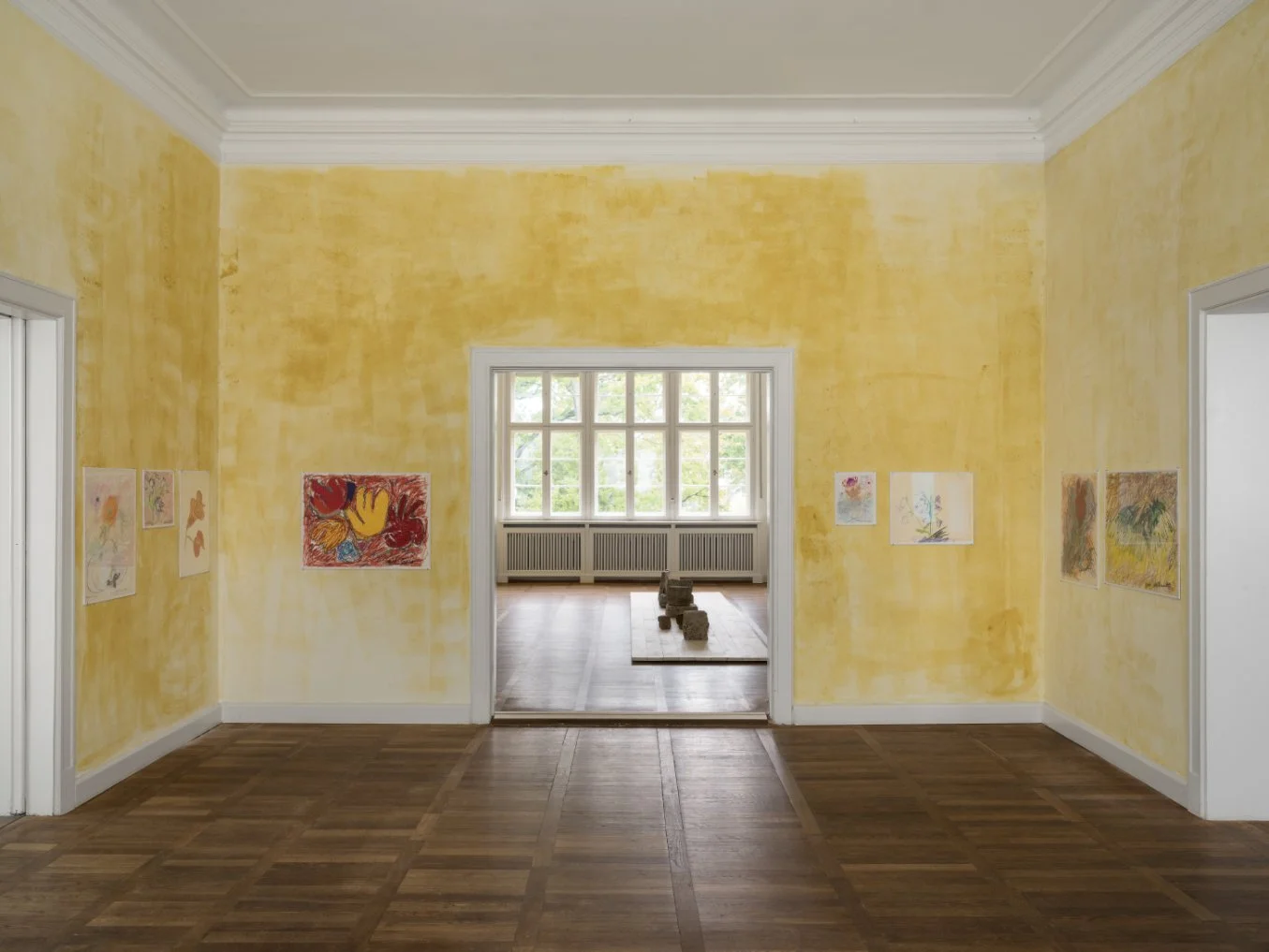
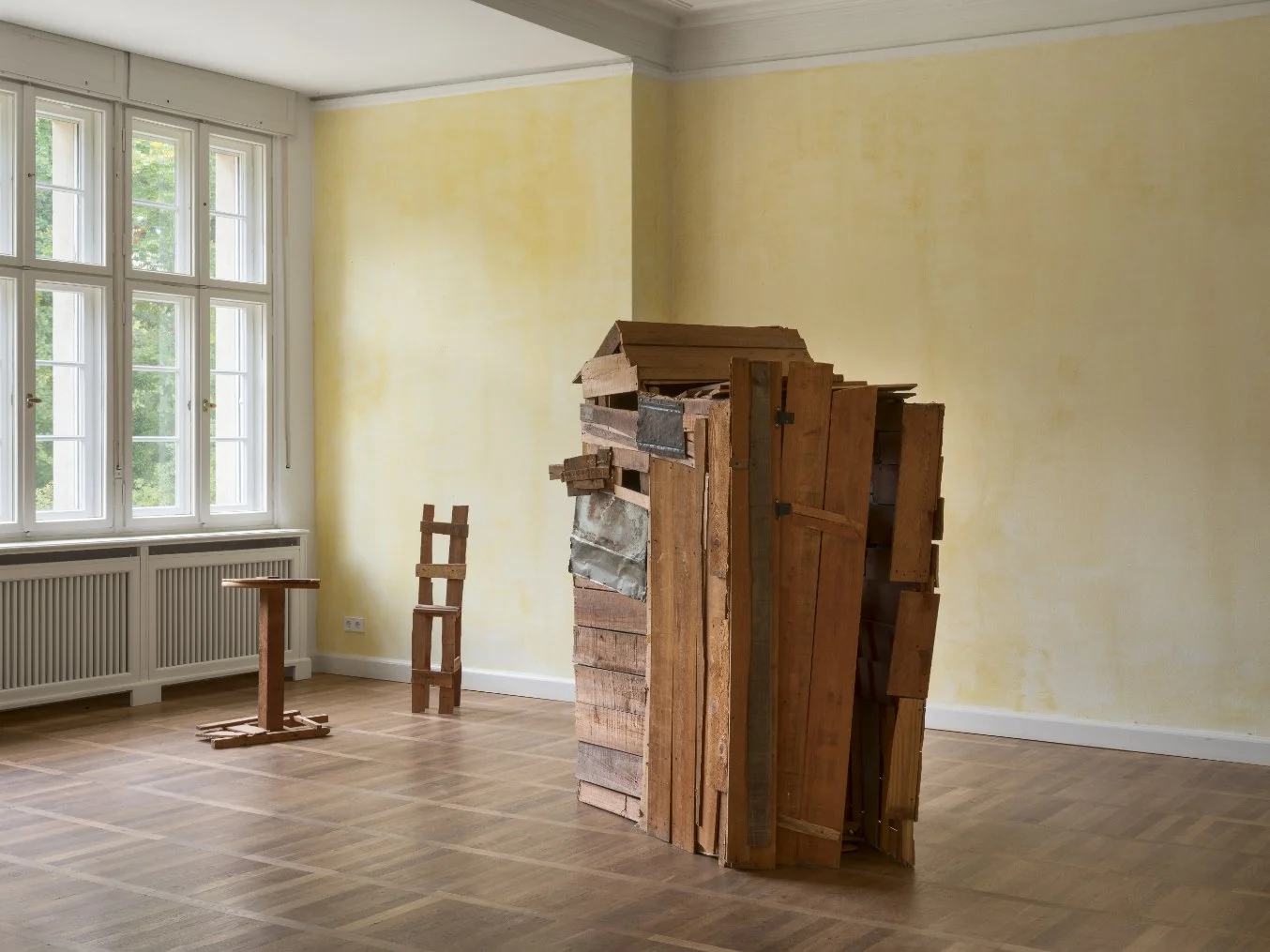
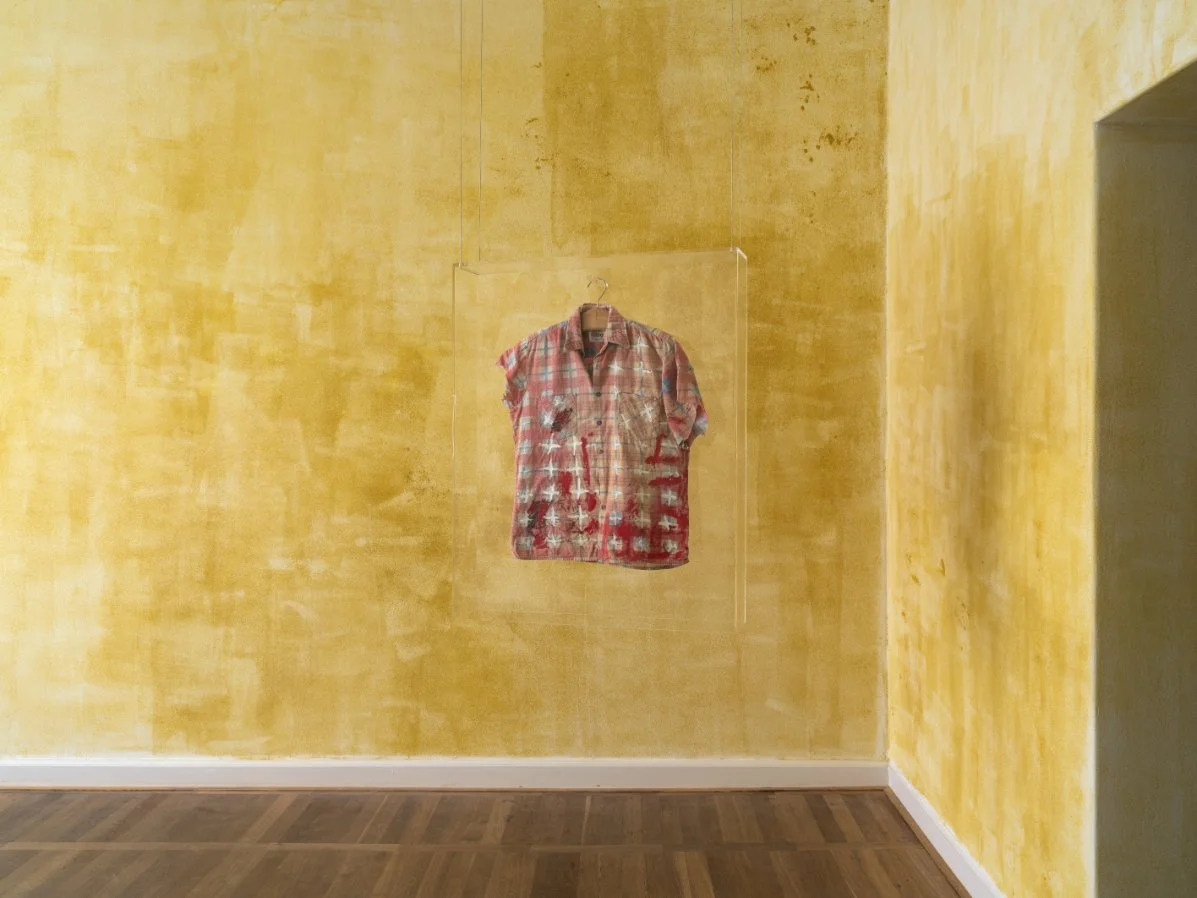
Ima-Abasi Okon made two accompanying works to the show. The first involved lockboxes outside the premises that take visitors to the lake and onto the private property around the museum. In these lockboxes are lube and organic materials. Lube is a substance to bring an object into a space where it does not belong. With its sexual connotations, the interaction between foreign object and intruded upon space can be procreative and pleasurable, referring to Buchanan’s trespassings and their paramount role in her practice. The other works Okon made were wall paintings covering every inch of wall with pollen. Titled Sex (2025), the walls are streaked yellow, bringing the materiality and smell of the outside inside. Here, Okon submits the walls to environmental degradation, a frequent technique of her more labor-intensive sculptural works. With a title like Sex, Okon also propounds this feature of her work as similarly pleasurable and procreative. 

A common misconception of Buchanan’s oeuvre is that she is an outsider artist. However, the artist had been exhibited at A.I.R. gallery alongside contemporary and friend Ana Mendieta and started out as an abstract expressionist under the tutelage of Norman Lewis. Buchanan was trained as an insider. Her works are of the trends of her time, land art, conceptual art, and post-minimalism, but her works have a D.I.Y. inflection to them. Her shacks, alongside her other wooden construction pieces, are undeniably in conversation with the folk art of the South. According to Buchanan, she always “made things,” never really understanding her creations as art objects until later. She began her professional life in medicine, studying parasitology at Columbia University, which brought her to New York, where she eventually connected with the Art Students’ League. 

Beverly Buchanan,
Lamar County, GA, 2003
Oil pastel on paper
56 x 76 cm
courtesy of the Estate of Beverly Buchanan and Andrew Edlin Gallery

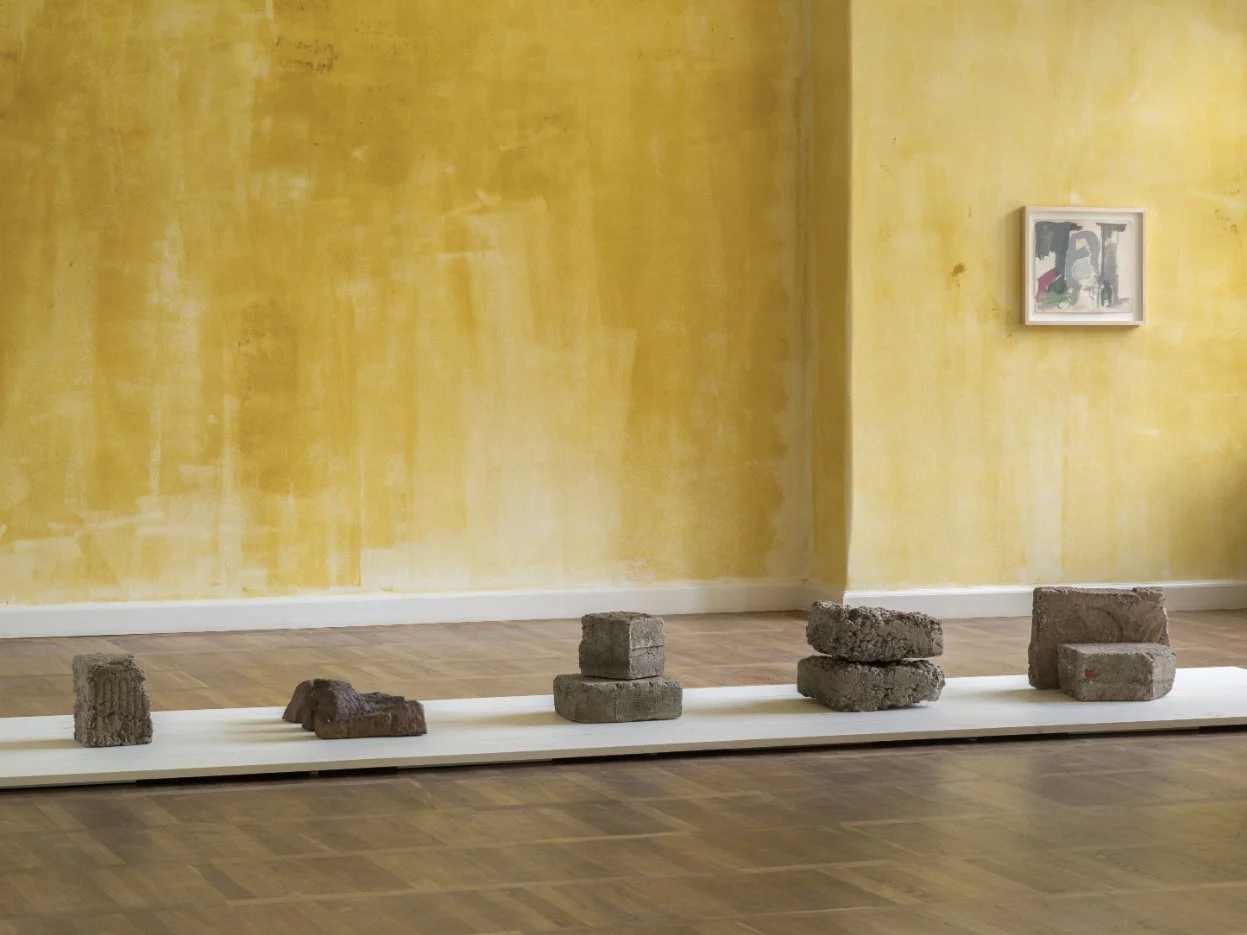
The artist suffered from several chronic illnesses, having stacks of medical bills to pay at any given time. To pay these bills, Buchanan sold many of her works for the exact prices of different bills, spreading her work across a plethora of private owners in and outside of Macon and Athens, Georgia. Hilke and Remmers, doing research in the state to prepare for this show, ventured into many homes only to find different Buchanan works on unassuming walls and tables. All of her flower works exhibited in the show came from these homes. The flowers were put together by Okon, offering a contrasting side to the artist, who, in adjoining rooms, has her still sculptural works. One such room includes her monumental frustula, cement sculptures whose molds she made from bricks and found materials like milk cartons. The frustula works, while many being of different cement mixtures, all have a timeless, enduring quality—shaped by time. The flowers, on the other hand, are electric. Quick, loose-colored scrawlings across paper build up a shape that could be called anything but still lives. Her shack pastels have an identical effect. Often exhibited with the shack sculptures, the curators made the decision to show the pastels on the second floor, overlooking the sculpture garden. By separating pastels from sculptures, both mediums could stand autonomously, the curators prevent the unfortunate hierarchy that tends to favor the shack sculptures as the more prominent representations.

Beverly Buchanan
Untitled, 1978—1980
Print on glossy paper
20 x 25 cm
Courtesy of the Estate of Beverly Buchanan and Andrew Edlin Gallery


Beverly Buchanan. Weathering took a very gentle, nuanced approach to the wide-ranging work of Beverly Buchanan, permitting her work to breathe and soak up the space as individual works and as series, while simultaneously forwarding the artist’s massive archive. Buchanan had a rigorous documentation process—photos, writings, poems, and drawings—spread by the stairwell on the second floor, situating her ephemera as a prime feature of her practice. Her archiving instinct became of sizable importance to her Marsh Ruins (1981). For this land piece on the coast of Georgia, Buchanan built a memorial to the enslaved people who, once landed on American soil, raced to the water and drowned as an act of return to their homes. Funded by the Guggenheim grant, Buchanan worked with a few other laborers to make tabby stones that blend into the swamp landscape, becoming nearly unrecognizable as human-made objects. Shown as a slideshow, the recording covers the correspondence between the artist and the Guggenheim, the work proceeds through the day-by-day photographic coverage with supplementary captions taken by the artist to prove the project was completed. Although not necessarily Marsh Ruins, the work shown is an artwork in its own right, turning bureaucratic processes into a creative act. Beverly Buchanan. Weathering showcases a nuanced approach to Buchanan’s work, all while giving visitors a glimpse into her mind to reveal a singular person who stretched her art into every corner of her life.


Beverly Buchanan. Weathering is on view through February 1st @ Haus am Waldsee, Berlin.

Surrealism's Provenance: "Networks of Surrealism" @ Neue Nationalgalerie

André Masson
Massaker “Massacre,” 1931
Oil on canvas
120 x 160 cm
Courtesy of Ulla and Heiner Pietzsch

text by Arlo Kremen


Tucked behind the cafe and gift shop of the Neue Nationalgalerie sits a modest L-shaped gallery space. Enough room to fit a medium-sized show, one would not expect it to be used to host the Surrealists’ international cohort, who could very well fill the entire museum with their verbose oeuvre. As such, Max Ernst to Dorothea Tanning: Networks of Surrealism has a specific aim, a narrowing agent succinct enough as to make the gallery space feel appropriately expansive to cover the community of artists with twenty-six works. The show homes in on provenance, tracking each displayed painting sourced from the Ulla and Heiner Pietzsch Collection.

In 2023, around 100 artworks from the Pietzsch Collection received careful attention from researchers seeking to uncover each work’s origin and the succession of owners. The goal was to ascertain whether Nazi persecution played a factor in the shifting of ownership. During the Nazi occupation in France, the Surrealists and their interlocutors had to make a decision: flee into exile, remain as a part of the resistance, or go into hiding. This collection began in the 1970s and ended in the 2000s, acquiring works from galleries, dealers, and auction houses globally. The couple’s 2010 donation to the State of Berlin made this show and its research possible.


The show maps the provenance timeline of each displayed work, bringing historical narratives into the foreground. Biographical exhibitions can be a challenge. In a slightly different educational gesture than the anti-intellectualism plaguing museum plaques, where artists’ personal details take priority over the work itself, the work of art here still takes a secondary position to information. Art represents a story and thus loses its autonomy. The work is no longer important because it is art; the work is important for the history it represents. This approach attempts to give the gallery-goer a painless point of entry into art and meaning-making at large, but it never fails to come across as patronizing and distrustful of the audience’s intellect, assigning identity and history as prime tools for interpretation rather than the age-old skill of looking.

Many works benefited from the exhibition’s pursuit of historical narrative, unveiling colorful details of the Circle’s interpersonal affairs. The first painting of the show, Miró’s “The Arrow Piercing Smoke,” had originally been owned by the man it was dedicated to, Serge Lifar. The Ukrainian-French dancer and choreographer was a member of the notorious “Ballets Russes” and had worked closely with Max Ernst in costume and stage design. Appointed a year before and holding on to his directorship of the Ballet wing of the Paris Opera during Nazi Occupation, he was removed briefly for Nazi collaboration once the German occupying force retreated from France. “The Arrow Piercing Smoke” was held by Lifar for about thirty-six years before the painting’s acquisition by Paul Pétridès, where, at some point in the mid-1960s, it made the same leap across the Atlantic that Miró made to New York City nearly twenty years prior, eventually settling into the home of Alexander and Louisa Calder. While not necessarily about the art, the information supplementing the work poses it more as an object used to better understand the inner workings, members, associates, and the political landscape of the Surrealist diaspora.

Joan Miró
The Arrow Piercing Smoke, 1926
Oil on canvas
40 x 56 cm
Courtesy of Ulla and Heiner Pietzsch

The show has quite a few Ernst paintings given its relatively small size. And this is by no means a critique—he was not only one of the most central figures of the movement but also was interned at Les Milles, the concentration camp that would inspire his escape to the US with Peggy Guggenheim during his second arrest. His life is tinged with the effects of Nazi occupation, the driving narratological force of the show, but this fact led to a reliance on indirect ties to Nazism on the part of his displayed work. Kurt Siegelmann had many works alongside Ernst at the Exposition internationale du Surréalisme. He also held on to Ernst’s Garden Airplane Trap. Due to Siegelmann’s Judaism, he brought the painting with him to the US to avoid Nazi persecution. Another exhibited Ernst painting belonged to a different Jewish artist, Tristan Tzara, to whom Ernst gifted his painting Two Nude Girls, which remained in Tzara’s possession until his death in 1963, following his move to Marseille and his involvement in the French Resistance. Another displayed Ernst painting, Gala, Max and Paul, is a far cry from Garden Airplane Trap and Two Nude Girls, whose provenance is inseparable from Nazi persecution. Gala, Max, and Paul tells the story of Ernst’s ménage à trois with Paul and Gala Éluard. Despite being wonderfully scandalous biographical details, its inclusion in this show feels askew. A dramatic tone shift towards the playful fits poorly among so many artistic artifacts whose histories speak to evading Nazi destruction. Such an inclusion possibly hints, if read ungenerously, as wall filler or, more likely, an incomplete concept. 

To exhibit a show where wall texts are more important than the paintings themselves is undoubtedly bizarre, a strangeness that permeated the gallery. Walking through the show, it felt out of place in an art museum like the Neue Nationalgalerie—possibly resonating more with a public archive or history museum than with an art institution. To study color and form felt antithetical to the curators’ mission, and yet, the format of an art show prevents combing through extensive texts, as the form necessitates the primacy of artworks. Networks of Surrealism was between an art exhibition and a historical exhibition, and in an attempt to straddle both, was left with two feet in the air.


Max Ernst to Dorothea Tanning: Networks of Surrealism is on view through March 1 @ Neue Nationalgalerie, Potsdamer Straße 50, Berlin

"Embrace" by Klára Hosnedlová @ Hamburger Bahnhof


text by Arlo Kremen

Embrace is the largest installation of the Czech-born artist Klára Hosnedlová. The installation was produced as the culmination of the annual CHANEL Commission at Hamburger Bahnhof—the old train hall turned art institution. Her resulting work has a remarkable all-at-once effect, where disparate facets of existence overlap: tactile, industrial, sound, history, architecture, scale, the land, and heritage are all interwoven in her piece, compelling visitors to sit patiently in Hosnedlová’s singular world.

The artist transforms the exhibition hall’s original floors with grey stone tiles. The plane of grey is interrupted by gashes of sand, dirt, and water—natural material invades the clinical space of art reception. Industrial speakers sourced from Berlin clubs, some of which no longer exist, pile onto some of the intruding earth beds. While some speakers amplify the audio cycle for the show, others lie entirely inert as empty vessels.

The show’s soundtrack was developed by Berlin- and Brussels-based composer and artist Billy Bultheel. The track cycles through a women’s choir, Lada, who sing in Moravian micro-dialects, instrumental sections, church bells, and the voice of Czech rapper Yzomandias. Much of the work originates in memories and histories of where Hosnedlová grew up, the Moravian town of Uherské Hradiště, where the inorganic structures of central-east European communist industrial architecture and the region’s rich cultural landscape came into contact. The eight steel walls bordering the show hold sand-covered reliefs that similarly evoke memories. Both referring to Moravia’s history, they also call on the socialist wall friezes common in public buildings. With the fossils embodying both prehistoric and communist histories, they turn to Hosnedlová’s childhood in the immediate aftermath of Czechoslovakia’s Velvet Revolution, her birth taking place just a year after and three years before the formation of the modern Czech Republic in 1993. But they simultaneously represent her childhood hobby of collecting fossils, believing them to be remnants of another world.

Embrace, 2025
Klára Hosnedlová
Installation view
Courtesy Artist, Kraupa-Tuskany Zeidler, White Cube / Nationalgalerie – Staatliche Museen zu Berlin, Zdeněk Porcal – Studio Flusser

These reliefs also bear the work of glass-making artisans whose practice has been informed by generations of glass-makers, joining the separate referents of the reliefs through their regionality and as a historic artisan medium. Like claws, the hand-cast glass protrudes from the reliefs, mimicking, too, the carbonization of a prehistoric relic. Nine pieces of colored glass in total, whose material contrasts with the rigid structure of the reliefs, balancing fragility and durability.

The embroideries embedded in the reliefs act as portals to the past, depicting scenes from unseen staged performances that were photographed at brutalist structures in Berlin. These slow, intimate moments transport the viewer into a still past. Some depicted scenes emphasize physical touch. One embroidery shows a man with a lighter flaming right by his ambomen; his skin, brightened by the fire, evokes the sensation of a flame near the skin—its primal warmth. Another shows someone fiddling with a lit match, meditating on the feeling of an enclosing fire, a moment before movement. These gentle images are blown up within the immensity of the reliefs, both in size and in their references to ancient life and architecture, considering these ephemeral interactions with the body and natural phenomena like fire as contained within the vastness of history, politics, and culture.


Embrace, 2025
Klára Hosnedlová
Installation view
Courtesy Artist, Kraupa-Tuskany Zeidler, White Cube / Nationalgalerie – Staatliche Museen zu Berlin, Zdeněk Porcal – Studio Flusser


Some reliefs, displaced from the steel walls, are fixed to the hemp and flax tapestries hanging in the middle of the hall. Six in total, they hang from the ceiling and culminate in clumped tendrils, which cover the floor around the tapestry. Each is made from spun flax and hemp and dyed in an earthy tone from plant-based dyes. Such works also return to Bohemia, for the region has a long, pre-industrial tradition of flax and hemp cultivation that largely ended after the Second World War, when global industrialization and the legacies of colonial trade displaced regional textile production across Europe. For these works, Hosnedlová worked with the last flax and hemp processors in that region of modern-day Czech Republic. These fixtures, both blocking the viewer out and trapping the viewer in, disassemble traditional notions of inside and outside, inculcating the viewer into a landscape.

The show accomplishes an evocation. Through Embrace, a feeling of loss and slippage permeates, but its subject is not turning to pure nothingness. What is decaying—whether it be the cultural traditions and history of Moravia due to colonial capitalism or the regional sonic topography of language and music felt passing through the dusty, beaten, and partially defective speakers—it is going somewhere. Whether in memory-soaked imaginative environments like the one Hosnedlová crafts, or as a relic for new generations to uncover, the artist demonstrates her trust that the Moravia of her childhood will not disappear—it will carbonize under the earth for someone else to uncover and cherish as a key to another world.

Embrace is on view through April 1, 2026 @ Hamburger Bahnhof, Invalidenstraße 50, Berlin.

A Disappearing Act: "Global Fascisms" @ Haus der Kulturen der Welt

View of ‘Global Fascisms.’ Image by Matthias Völzke


text by Arlo Kremen


At Haus der Kulturen der Welt, Global Fascisms is a mudslide. A terrific force leaking from a small alcove on the main floor downstairs, littering its debris across two gallery spaces and the hall that adjoins them. Quite literally too expansive to cleanly contain, artworks fill any available nook and cranny with just enough room and privacy to distinguish one series or individual work from another. With all wall text relegated to an optional booklet, the exhibition leans into this eclecticism—nameless, authorless, materialless works sharing spaces with no beginning or end, as though they are merely artifacts of the fascistic social conditions to which each work refers.

In this regard, Mithu Sen’s piece Unlynching: You never one piece (2017–) acts as a microcosm of the show’s sense of anonymity. Sen displays a variety of objects on a white wall behind glass with years penciled in next to broken mirror shards, bronze tools, and other ephemera. The piece refers to the violent uproars that have continued each year since the British partition of India in 1947, instilling ethnonationalism into the borders of an ethnically diverse people to enforce concepts of a pure national ethnicity. Sen’s objects were found in sites of ethnic conflicts, each speaking to the ever-present ripples of violent terror British colonialism left in its wake.

Mithu Sen
Unlynching: You never one piece, 2017—

Found objects and pencil
Courtesy of the artist

It is crucial to mention, if not already assumed, that the show’s definition of fascism is quite loose and does not fix the ideology to governmental institutions alone. HKW displays works concerning many facets of fascism and artist responses to fascism across time, from literal governmental suppression to symptoms of fascism on the internet, as well as in religious and subcultural contexts. Underscoring its breadth, the show traverses space and time with an aim: to locate the look and sound of fascism.

Walking through the show, a sense of desperation palpates. And rightly so. It feels as though there is no end to the pockets of fascism deserving of a rigorous aesthetic investigation, and yet, the show has a deadly, bleeding gash. A lapse so severe, it has impregnated every inch of the exhibition. An unfortunate predictability of a German institution, the Gazan genocide lingers as a specter. Palestine has one representative in the show from the Jerusalem-based painter Sliman Mansour, but the occupied Palestinian people are also mentioned in one work by Israeli artist Roee Rosen titled The Gaza War Tattoos (2024–2025).

Roee Rosen
Night Skies with Full Moon, 2024
Photograph
Courtesy of the artist

Rosen’s series shows a set of tattoos in reference to the ongoing “war” in Gaza. It features different tattoos recalling the deaths of Gazans and their means, such as the “mosquito” military procedure that uses human shields, and another tattoo, The Dreadful Dreidel, detailing the different titles the IDF uses to describe its military violence against Palestinians. Without question, Rosen is concerned with Israeli violence against Palestinians and is in active protest against its historic military campaign, and yet, why choose an Israeli artist over a Palestinian? The Gaza War Tattoos is one of the first works in the largest display space of the show, while Mansour’s prints are tucked away in a far less populated section, by both people and artworks. A bizarre decision for sure to prioritize an Israeli artist’s discussion of Israeli militarism over Palestinians, and yet, this has been a familiar rhetoric among not-quite-anti-zionist liberals and zionist progressives, if such a thing can even exist, who, over the voices of Palestinians and their political accomplices, use the image of anti-war protests in Israel as evidence that a morally sound Israel of the future is possible. What should be the prioritized subjectivity vanishes in an institutional disappearing act.

Sliman Mansour
Camel of Hardship, 1973
Print on paper
58 cm x 37.5 cm
Courtesy of Zawyeh Gallery

Mansour’s prints all predate the ongoing genocide, with the latest being from 2021, Olive Picking. Mansour’s work engages in the history of Palestinian resilience in the face of displacement, representing the lives of Palestinians, not under war or direct abuse, but in their perseverance to live their daily lives. Whether it be a woman picking olives, as in Olive Picking, or the variegated activities of a village scene overlaid in The Village Awakens (1987), he demonstrates life under occupation. This is particularly notable in Camel of Hardship (1973), where a Palestinian man schleps Jerusalem on his back, but in each careful portrait, his treatment of line and color radiates with hopeful futurity. Mansour’s work is wonderful and a worthy contour to a show concerning fascism; however, his placement in the show feels like a quota fulfillment—or a solution to institutional censorship.


Daniel Hernández-Salazar
The Traveler, 2013
Photograph on wallpaper
440 cm x 660 cm
Courtesy of the artist

Blown up to the size of the wall, the photo The Traveler (2013) by Daniel Hernández-Salazar captures a recurring motif of an angel whose wings are digitally edited, unearthed shoulder blades of unidentified victims of the Guatemalan civil war. The angel sets his hands around the shape of his open mouth with the words “SI HUBO GENOCIDIO” (IF THERE WAS GENOCIDE) in large typeface at the top of the image. In 2013, former president of Guatemala Efraín Ríos Montt was sentenced to eighty years in prison for genocide and crimes against humanity. During the trial, Hernández-Salazar imprinted this motif on the back of public buses in Guatemala City as pro-Montt revisionists attempted to silence archivists and activists dedicated to his sentencing.

The placement of The Traveler is perpendicular to Mansour’s prints. The relationship between the works cannot be a coincidence—a work concerning the censorship of activists and the need to acknowledge and provide justice for the victims of genocide sits beside paintings about a people and land undergoing genocide and censorship. Assuming that HKW stipulated the absence of Palestinian art about the concurrent genocide and Israeli occupation because of Germany’s broad definition of antisemitism, this move by the curators is an ingenious maneuver—managing both to amplify Palestine through subtext, all while embedding HKW into the systems of fascism that the show aims to illustrate.

The absence of a Palestinian artist’s perspective on the genocide feels even more pointed given that the recurring medium of the show is video—the very medium by which this genocide has been broadcast on social media. The journalistic work of Korean filmmaker Yoonsuk Jung, commissioned by HKW for this show, is showcased in STEAL (2025). Created after the attempted imposition of martial law in South Korea, Yoonsuk Jung covers the eternal relationship between democracy, authoritarianism, and spectacle using footage from parliament assemblies, news outlets, and his own original shots. The artist works with the very media the Gazan genocide has been displayed to the West—and yet, Gaza appears only in the form of a tattoo.


Global Fascisms is on view through December 17th, 2025 @ Haus der Kulturen der Welt in Berlin, John-Foster-Dulles-Allee 10 10557, Berlin

Inhuman Failures: Kennedy + Swan's "The Red Queen Effect" @ Schering Stiftung

Kennedy + Swan
The Red Queen Effect, 2025
Photograph


text by Arlo Kremen
images by Kennedy + Swan

The Schering Stiftung is both non-profit and gallery. Its mission: to bring artists in to make work that engages the cross-section of art, technology, and education. This is particularly true for its residency program at BIFOLD, the Berlin Institute for the Foundations of Learning and Data, titled Art of Entanglement, where selected artists become entrenched in the discourses of data management and machine learning. The residency culminates with a show at UNI_VERSUM at TU Berlin, which went up for collaborating artists Kennedy + Swan this past May. This show, THE NEVERENDING CURE, was adapted for its new display at the Schering Stiftung Project Space, now titled The Red Queen Effect.

The Red Queen Effect has two parts: Lung Portraits, lightboxes shining through chemical-treated ink on glass, and the titular work, a four-channel video installation. In the first, twelve lightboxes hang from a wall, forming a circle that climbs nearly to the top of its fixed support. Each work mimics bacterial landscapes of different lungs, albeit in a highly colorized fashion, from the perspective of a health professional’s microscope slide. Laser cuts in the glass identify potential health risks, such as cysts or melanoma, even identifying a rare subtype of breast cancer in one painting.

Kennedy + Swan
Lung Portraits, 2025
Ink on glass in a lightbox
60 x 60 cm

The artist duo merely painted these works, leaving the diagnoses to an AI model built on the study of lung tissue scans to recognize regional cancers and other cellular defects. In response to the AI model’s given diagnoses, the artists cut into the glass to write the identified issues and marked areas in the colorscape that the model had defined as problematic. This work proves rather didactic, for it poses an experiment to prove that current medical AI models have a crucial failing. They are quicker to misdiagnose than admit confusion or uncertainty, a remarkable tool for the kind of risk assessment required to treat anything from cysts in the lungs to micropapillary breast carcinoma.

The four-part video installation bears an architectural exoskeleton, holding each screen in white-tile structures, emblematic of the lab in which ALICE works. ALICE is the name of a new AI-based medical practice boasting an ambitious promise similar to that of Elizabeth Holmes’s Theranos, that with suitable samples, ALICE can identify all current and potential health risks. The installation stages a pilot run, inviting volunteers to apply for the first clinical trials. Through a series of rotating videos and images, twenty-two volunteers speak. Animated through red watercolor, each represents the variegated facets of the public debate around AI’s role in medicine. Activists, technocrats, transhumanists, skeptics, rebels, a twelve-year-old girl, and many more positionalities make up the volunteer base.

Kennedy + Swan
The Red Queen Effect
, 2025
Video stills in a grid

The most common reason for applying among the participants is the general distrust of doctors, reflecting the frequent sentiment of distrust among people, positing AI as a non-human, transcendent entity. However, through the visualization of the laboratory, ALICE’s code, and the AI’s visualization as a doll-like baby, the human gesture is present. There is nothing transcendent or neutral about AI—it is of the human imagination, learning from human data and human language. Kennedy + Swan refuse to dislodge AI models from the pre-existing social systems that begot them, which are the very same systems from which many of the volunteers are trying to escape.

The Red Queen Effect is presented by Schering Stiftung and is on view through December 12 @ Schering Stiftung, Unter den Linden 32-34, 10117 Berlin.

From Giza to Memphis: Christelle Oyiri's "Dead God Flow" @ CANK Berlin

Christelle Oyiri
Hauntology of an OG, 2025
Video still
Courtesy of the artist, the LAS Art Foundation, Amant, and the Pinault Collection

text by Arlo Kremen
photography by Jacopo La Forgia
images by Christelle Oyiri and Neva Wireko

For Berlin Art Week, artist Christelle Oyiri teamed up with CEL, a freshly formed Black, female art collective, and Las Foundations to bring Berlin her first installation in the city at CANK in Neukölln, a retired 1950s mall turned event space. The exhibition shows alongside an event series by CEL called “Foundations.” One such event transformed the space into a nightclub of sorts, bringing several DJs to perform with Oyiri, who performs under the stage name Crystalmess, to headline. Unfortunately, Oyiri could not make it due to flight issues beyond her control, but its impact on the installation site remained palpable.

The installation sees CANK’s spacious second floor emptied. On one side, CEL projects a short film of their own; the other hosts two films of Oyiri’s, Hyperfate (2022) and Hauntology of an OG (2025). Between the two ends, darkness fills in the gap, with green and blue overhead fluorescents bleeding in and out to choral-like, electronic waves. Obscure darkness swells, not just with light, but also with something else, a numinous effect common to nightlife—a world in which, ideally, freedom is sovereign and individuals can collect into a symbiotic ecosystem, where, as Oyiri put it in an interview, music produces “unspoken connections.”

Christelle Oyiri
Dead God Flow, 2025
Courtesy of the artist, the LAS Art Foundation, Amant, and the Pinault Collection

Born and raised in the Paris region to Ivorian and Guadeloupean parents, Christelle Oyiri brings much of herself to her art practice. As an artist who occupies the nightlife world, she demonstrates great care for the poetics and politics of music and musicians, especially those of rap and rappers, the subject of her two films in Dead God Flow, where music brings her to look upon herself and her history in relation to these figures in Hyperfate and to adventure to Memphis, Tennessee, to look up close at one of southern rap’s capitals in Hauntology of an OG.

Hyperfate studies systems of power and surveillance within rap culture. Oyiri traces the culture’s relationship with death, noting how a rapper’s trajectory can significantly affect the probability of their death. The figure of the rapper, a sign of wealth and success, often becomes a target of envy and ridicule, particularly for rappers who come from gang-affiliated backgrounds. Such a dynamic only becomes exacerbated by constant self-surveillance online. It is through her reflection that Oyiri posits that the rap industry became so bloodied, thinking of rappers like Tupac, XXXTENTACION, Pop Smoke, and Takeoff as figures drawn to their premature deaths as prophecy, which is horrifically par for the course of their trade, dying by the same hand that gave them glory.

Oyiri ties in her own biography into the narrative, discussing her older brother’s path to winning the European championship inThai boxing and sharing footage of her childhood apartment building. Her filmed documentary footage, whether in Paris or driving around Pop Smoke’s neighborhood, Canarsie, Brooklyn, cuts between rappers’ IG lives and stories, images and videos of her and her family, and a supernova, grouping personal narrative with the historical to sublimate it. The question of prophetic deaths and material realities of racial capitalism becomes enlarged, cosmic questions with existentially urgent consequences.

Developed alongside photographer Veva Wireko in Memphis, Tennessee, and narrated by poet-rapper Darius Phatmak Clayton, Hauntology of an OG positions Memphis as a reference to ancient Egypt, with one pyramid serving as a parallel to the other. Oyiri understands the pyramid as a symbol of “death, continuity, and hierarchy,” looping the pyramid on the Mississippi River into a symbolic lineage that speaks directly to the contexts in which Memphis rap emerged—namely, the end of the futurity expressed by Martin Luther King Jr. after his death in 1968. Giving his last speech in Memphis, Oyiri sees the city’s rap culture as somewhat of an elegy to this snuffed-out dream. A since-past desire for an alternative future tormented by the vitriolic racism Black Americans endure, particularly in the poor, Bible Belt city of Memphis, where this past April, Clayborn Temple, a Black church community center and the historic organizing point for King Jr., was intentionally burned down. 

Christelle Oyiri
Hauntology of an OG, 2025
Courtesy of the artist, the LAS Art Foundation, Amant, and the Pinault Collection

The pyramid’s construction was completed in 1991 and was intended to serve as an entertainment venue for concerts and sports. However, today, the structure is a shopping center, housing the Bass Pro Shop megastore, among other commercial enterprises. Rather than a theological monument to a deceased pharaoh, Memphis’s pyramid memorializes and upholds the economic episteme that produced it, liberal capitalism; thus, Memphis rap produces a different monument, a sonic architecture dedicated to histories of struggle. The show’s title, Dead God Flow, refers to Nietzsche’s “God is Dead” concept, where Oyiri witnesses Nietzsche’s epistemic utterance in Memphis’s rappers, hearing in their flows a call for a new future.

Dead God Flow is presented by LAS Art Foundation and is on view through October 19 @ CANK, Karl-Marx-Straße 95, Berlin-Neukölln