Vaginal Davis’s Magnificent Product Chronicles Five Decades of Her Playful Defiance @ MoMA PS1

Magnificent Production by Vaginal Davis, MoMA PS1, 2025. Photo: Isabella Bernabeo.

text and photographs by Isabella Bernabeo

Magnificent Product marks Vaginal Davis’s first major US institutional show, presenting art from her early Los Angeles projects to her more recent Berlin-based creations. Organized thematically instead of chronologically, the works take viewers on a journey filled with vivid colors, humor, and emotion.

Magnificent Production by Vaginal Davis, MoMA PS1, 2025. Photo: Isabella Bernabeo.

The exhibition begins in a light mint-green room titled Naked on my Ozgod: Fausthaus – Anal Deep Throat. This square room features green sheer curtains along every wall, with hundreds of photos from Davis’s early Los Angeles years covering the walls behind the fabric. Visitors are invited to slowly peel away the fabric from the wall to get an intimate view into Davis’s personal life before seducing them into the next room. This section is inspired by one of her first art exhibitions, originally held at the Pio Pico Library in Los Angeles. 

In the next space, HAG, Davis reconstructs her old Sunset Boulevard apartment in Los Angeles, the site where she produced many iconic zines, such as Shrimp, Yes, Ms. Davis, and Sucker. The dimly lit room glows pink and includes a walk-in box in the center. Inside, its walls display drawings and figurines of a woman’s head, possibly self-portraits. The slanted floor creates a warped, unbalanced environment that meshes reality with fantasy, just like the work it supports. 

Magnificent Production by Vaginal Davis, MoMA PS1, 2025. Photo: Isabella Bernabeo.

Another engaging room in Davis’s collection is HOFPFISTEREI, where visitors are encouraged to interact with her artwork. A table and four chairs occupy the room’s center, surrounded by piles of Davis’s zines, writings, and creations. A photocopier stands nearby for visitors to print out copies to take home. 

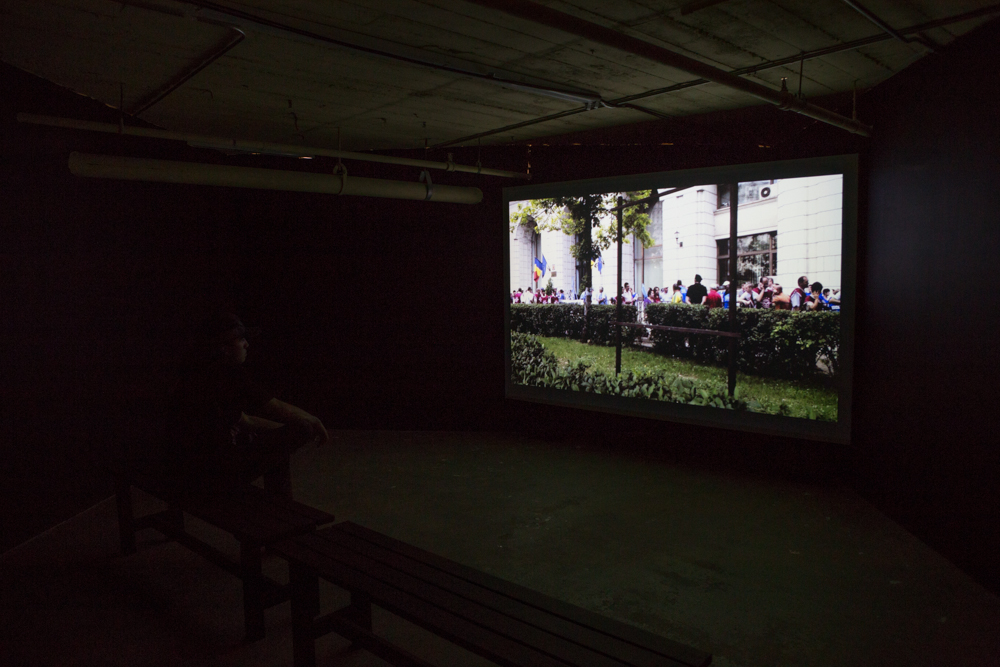
Davis also utilizes a screening room, which resembles the Cinerama Dome movie theater that operated on Sunset Boulevard from 1963 until 2021. Here you can watch low-fi videos she created during the 1980s, showcasing her range of personas as an artist, queer activist, self-proclaimed “Blacktress,” and more. These recordings, much like the earlier photos, give visitors a detailed and in-depth view into Davis’s life; they’re a testament to how interconnected her art is with her identity. 

Magnificent Production by Vaginal Davis, MoMA PS1, 2025. Photo: Isabella Bernabeo.

Another striking installment is from her Wicked Pavilion collection, displaying a reimagined version of Davis’s teenage bedroom. However, instead of her in the rotating bed, a large phallic sculpture sits in the space. The room is completely pink, from the walls to the rug to the curtains. A miniature desk sits in the right corner, topped with two lamps, a pile of jewelry, and an array of colored nail polish, hinting that Davis’s has relished dressing up as the showstopper she is since her youth. 

Along the ceiling, dozens of images are hung from a clothesline. These photos are of Davis’s muses, such as actor Michael Pitt or actress Isabella Rossellini. While visitors take a look around the bedroom, they listen to a mix of the song, “A Love Like Ours,” from the 1944 film Two Girls and a Sailor, interviews that Davis herself conducted for LA Weekly in 1996, and a voice message from Davis’s own secret admirer, creating a fully-immersive experience.   

Magnificent Production by Vaginal Davis, MoMA PS1, 2025. Photo: Isabella Bernabeo.

Across all of these works, Davis’s playfulness and defiance shine through. Magnificent Product is a living experience that can be overwhelming at times, yet each room offers a sense of freedom. Davis commands her viewers’ attention—and she intends it that way. 

Magnificent Product is on view through  March 2 @ MoMA PS1 22-25 Jackson Avenue, Long Island City, Queens

Judith Godwins’ First European Solo Exhibition Expressions of Life @ Pippy Houldsworth Gallery

Pippy Houldsworth Gallery presents American painter Judith Godwin's first European solo exhibition, Expressions of Life. The exhibition comprises an overview of the artist's work from the early 1950s - the period in which she was associated with the Abstract Expressionist movement - to the end of the century. The opening exhibition truly illustrates the artist’s lasting influence over the landscape of American art, despite the challenges she faced as a result of both her sex and sexuality.

Long underappreciated, Godwin’s contribution to the New York avant-garde has undergone recent revision following her inclusion in landmark exhibitions at the Denver Art Museum, Whitechapel Gallery and Fondation Vincent van Gogh Arles, that offered a reappraisal of women abstractionists of the 20thcentury. Her thesis was – and remained – one of liberation from the conventions of a movement anchored in a language of masculinity and heteronormativity. Starkly aware of the limitations imposed on her by the milieu in which she practiced, Godwin sought to redefine such ‘masculine’ values by way of gestural abstractions that brought a loose geometry into dialogue with nature, dance and Zen philosophy. Her innovative reorientation of the language of modernism remains a radical statement today.


Godwin’s interactions with the New York art world began early in her career. As a student at the Mary Baldwin College in her native Virginia, she sought the acquaintance of the modern dancer and choreographer Martha Graham. Godwin’s invitation to Graham to perform at her college laid the foundations for a lifelong friendship between the two, and Graham’s trailblazing path in a world dominated by men became a touchstone for Godwin. The diaphanous washes of colour, colliding forms and sensuous arcs which characterise Godwin’s works from the early 1950s are indebted to Graham, whose performances she frequented on arrival in New York, often watching from the wings.


By 1953 Godwin had settled in New York and was continuing her artistic education under Hans Hofmann, whose influence can be seen in her dynamic approach to composition and colour. Provincetown Summer, 1953, exemplifies Godwin’s facility for translating depth and volume into two dimensions. Introduced to Zen Buddhism by Abstract Expressionist painter Kenzo Okada, such philosophies began to play a larger role in her painting, encapsulated by calligraphic brushwork, redolent too of Franz Kline, another close friend of Godwin’s. As the 1950s continued, the artist’s work took on larger proportions and a darker palette, all the while maintaining an organicism and proclivity for light and space in her evocation of the spiritual in nature. Her vigorous abstractions caught the attention of influential art dealer Betty Parsons, who included Godwin as the youngest artist in the inaugural exhibition at Section Eleven Gallery in 1958 alongside artists including Agnes Martin, and went on to present solo exhibitions of her work in 1959 and 1960.


During the 1960s, as Pop Art and Minimalism began their ascent, Godwin distanced herself from the New York art world, retreating instead to Connecticut where she worked restoring 18th-century homes and trained in masonry, carpentry and landscape design. Her return to New York in 1974 saw a change in her paintings, which demonstrated a robust communion with the outdoors and a physicality that invoked the power of nature. With its assertive cardamom red palette and esoteric iconography, Elegy to a Slain Deer, 1975, captures Godwin’s investigation of the relationship between the physical and metaphysical. As in her paintings of the 1950s, her keen appreciation of the corporeal form is palpable in the material presence of her body on the canvas, in body-length arcs of the brush that express her movements with agency. The liberation of the body and its inherent sensuality continued to play a central role in Godwin’s works of the 1980s and 1990s, as articulated by the flesh-inflected palette of The Nest, 1994. Godwin died in 2021 at the age of 91, just as her work began to reach new audiences worldwide. Her lasting legacy is in the transformative nature of her practice, which successfully recalibrated the masculine language of gestural abstraction, shifting representations of womanhood and sexual identity on the canvas.

Expressions of Life is on view through March 9 @ Pippy Houldsworth Gallery 6 Heddon St, London W1B 4BT, UK