Rosie Marks

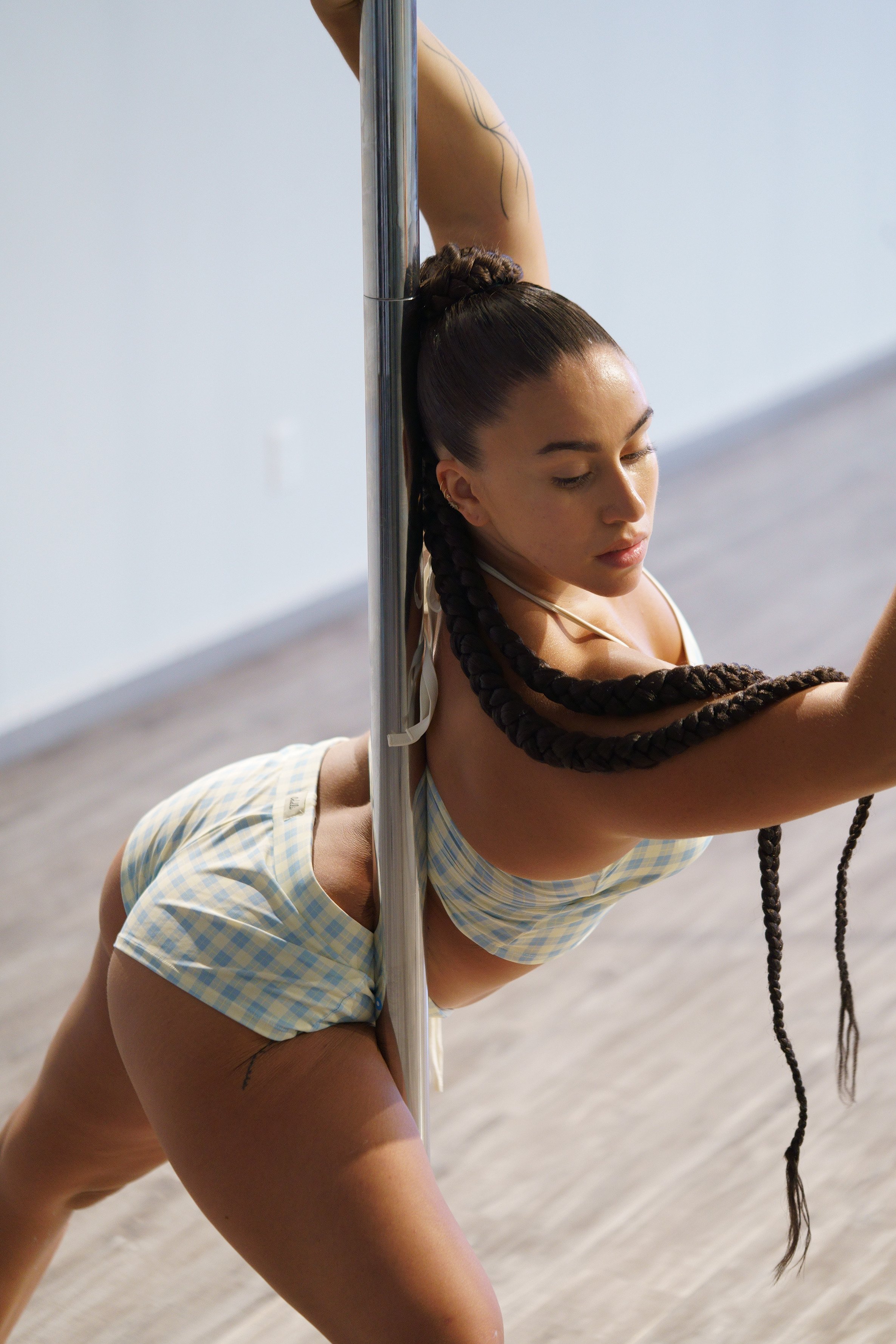
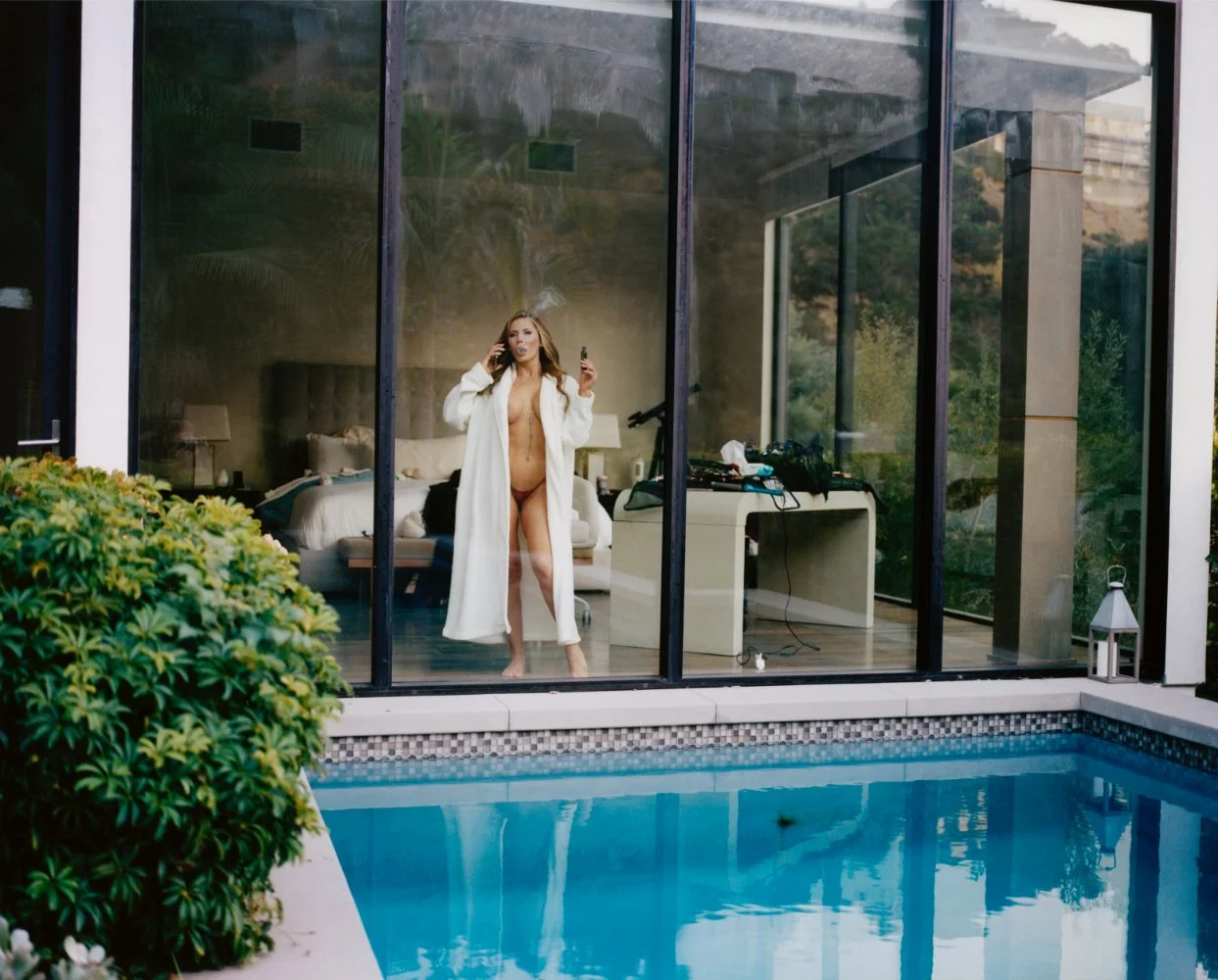
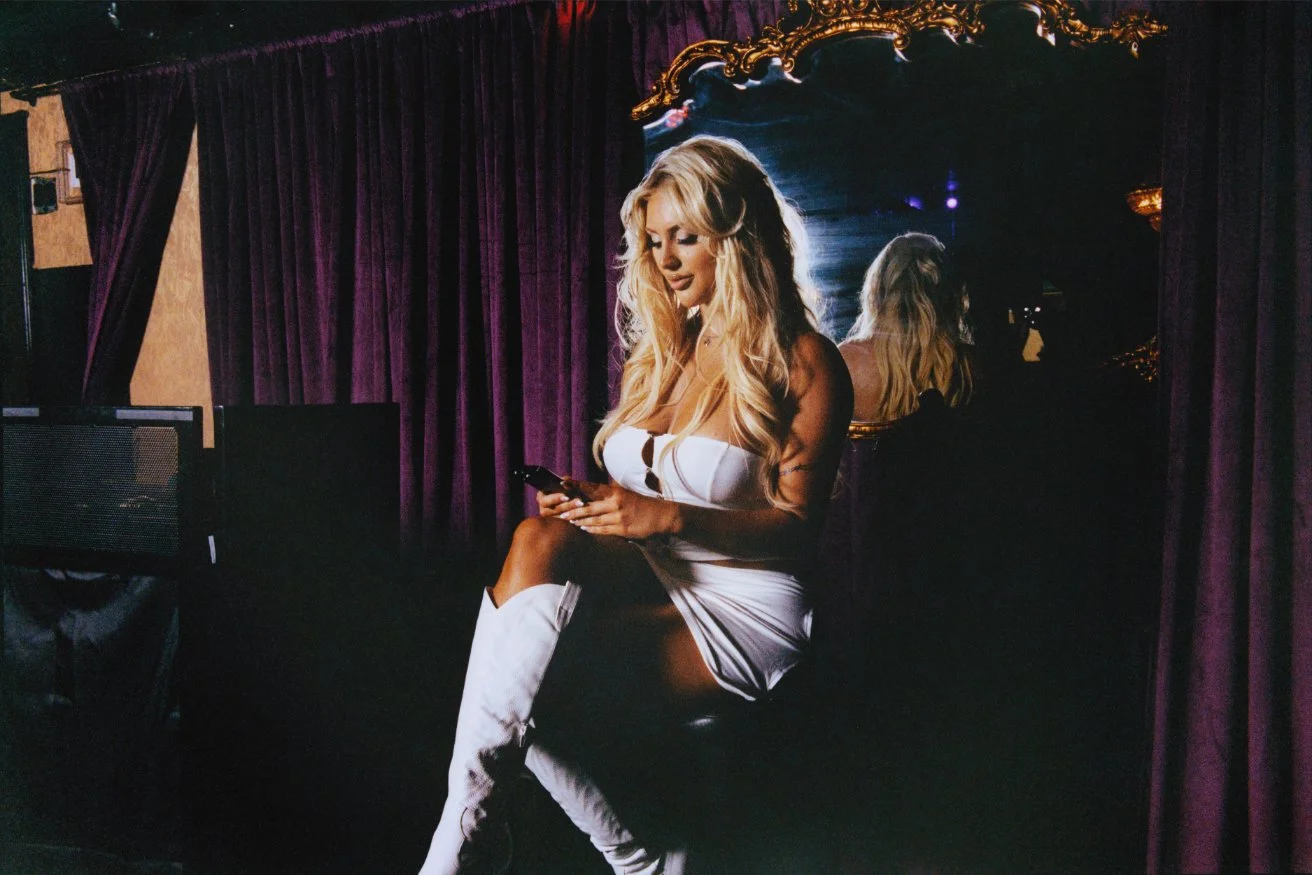
Madison Ivy, Brazzer’s first female contract star © Rosie Marks

interview by Karly Quadros

Brazzers has a brand: funny, horny, stupid. Think girls stuck in washing machines. Think pizza boys, plumbers, and flight attendants. Brazzer's’ brand is not art and high fashion. But that doesn’t mean they’re so different either. This spring, the porn studio introduced Raw Talent, a fittingly super-sized coffee table book collaboration with photographer Rosie Marks, featuring behind the scenes images from the world of Brazzers. From fluid-filled adult entertainment conventions in Berlin to the unseen labor of the behind-the-scenes crew, Raw Talent tells the story of the tight-knit community behind one of America’s most ubiquitous and least understood industries.

KARLY QUADROS: What was the first day like? Had you ever been on a porn set before?

ROSIE MARKS: The first day on set there was a scene with loads of extras because it was a Pam [Anderson] and Tommy [Lee] themed sex scene, and there was a band playing. The concept was that she saw one of the band members and was disgusted by her current husband, so she ran off with one of the guys in the back of the bar. All these extras on set I thought were really interesting. Some of them are just consistently an extra, and then there are some extras that have appeared in hundreds of Brazzers films and some are aspiring to be in the industry. There's a lot of really interesting people, and I wanted to know how the hell they got there. There was one guy—it was his third week being in the industry. He had taken ayahuasca and it showed him a path to the industry. There's one performer in the book—we followed his trajectory from extra to ‘sextra’ to main performer.

I had never been on a porn set before, but I shot a lot of stuff in and around that world. I'd spent a couple of weeks in Japan shooting really intense BDSM stuff for a magazine commission last year, and I've also been making a documentary about this woman who is a sex worker for the last four years. I didn't really feel that much. When I'm in photographer mode, I feel like nothing really fazes me. Like I can sit in an operating room and watch a body be dissected and still not feel anything, whereas, if I had to watch someone be cut open without a camera would be a very different story.

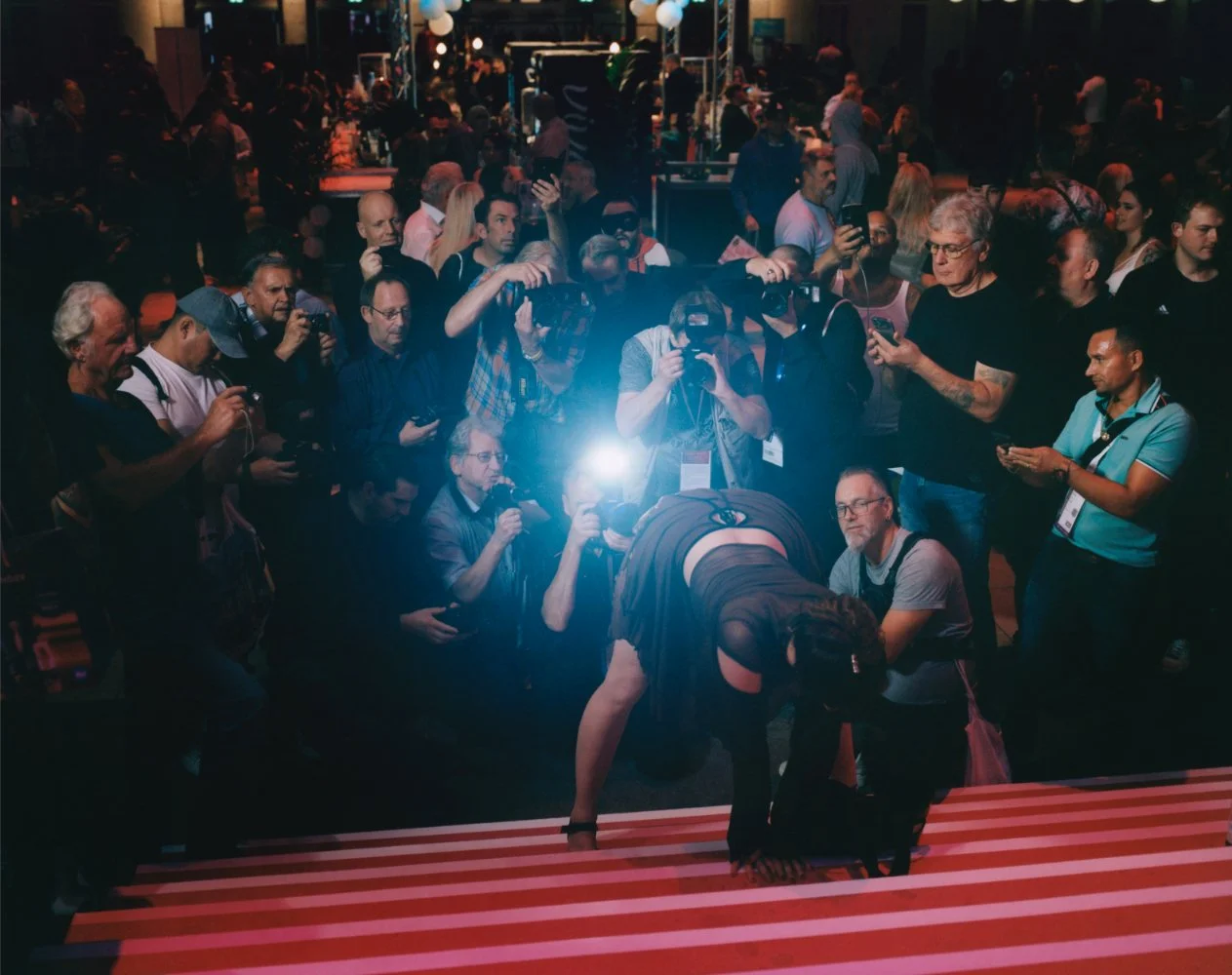
The Venus Berlin © Rosie Marks

QUADROS: How do you see your role as a photographer?

MARKS: In this project, I wanted to show it quite directly as it is. I was interested to show the process of porn, the moments that you basically wouldn't see if you're just watching it: the crew behind it, the moments in between takes. I guess I have a pretty voyeuristic, observational style of photography. So I was using that skill and trying to be as discreet as possible. But then there's also a lot of humor in this part of the industry. There’s always a completely bizarre scenario concocted as to how they end up having sex. They're always playing with different tropes, like there’s a vending machine or a washing machine and someone's stuck in it. All of these things are completely unrealistic and silly if you think about them in real life. I wanted to try and get that part of it across, that there is this very lighthearted side of the industry.

QUADROS: That’s very salient in the book because you will have people with that kind of slapstick energy or cartoonish faces then juxtaposed with something very mundane, like someone sitting on their phone or someone rolling cables.

MARKS: The way that a day on set goes, only maybe 45 minutes to an hour of it will be the actual sex. And then it’s choreographed. It's very much a performance. Then the rest of the day is just like being on any other type of shoot. There's a preconception of the porn industry being this sort of excessive or debaucherous thing, but that is absolutely not what my experience was. It was pretty sterile and more like a family vibe in the crew.

QUADROS: Something that’s very present in your work is the behind the scenes labor that goes into the obsessive cultivation of glamor. You show cables and lighting rigs. You show janitors and caterers and aestheticians. Did the process of shooting this book make you think differently about the labor that goes into adult films?

MARKS: Honestly no, because I knew what would be involved behind the scenes. But I wanted to show other people because that’s something I just take for granted. Anyone who works in any kind of media knows what goes into a production, be it porn or movies, media, advertising. That for me kind of destroys any kind of fantasy. There are a lot of people who might see this book who have absolutely no idea what goes into it, and maybe they don't want to know that. When speaking to one of the directors who used to be a performer—this woman called Lea Lexis—she said one day she brought a fan on the set. I think he had won a competition. He was a huge fan of her productions. And he ended up crying at the end of the day because he felt like his illusions of porn were shattered by watching it being made.

QUADROS: Do you think that seeing how the fantasy is created always destroys it for you?

MARKS: Yeah, I do.

QUADROS: A refrain I often hear from supporters who want to destigmatize porn is “sex work is work.” Is there room for work and desire and pleasure to intersect?

MARKS: For sure. Making this book, for me, was pleasure ultimately. Admittedly, a different type of pleasure than maybe the performers get. But it didn't feel like work to me. A lot of my job doesn't. It's the same thing for sex work—they should be able to experience both at the same time.

QUADROS: You were immersed in the world of porn far beyond just shoots though—you also went to things like conventions and award shows. What were those experiences like?

MARKS: We went to Venus, which is a porn convention in Berlin. That was the one place where I saw fans interacting with performers. It was one of the only things in this project that was public facing because the porn industry is a bubble, and it really feels that way in California, especially because it's like the parallel universe to Hollywood. That whole thing was a pretty insane few days, being in this convention center. Because it was in Germany, the rules are very different.

QUADROS: Are they more strict or more explicit?

MARKS: Anything goes. Live sex show on the stage any time of day. Every day I walked into the entrance—there were these pink stairs—and something crazy was going on there, like a man being whipped completely naked with like 100 people watching him cheering. One of the images [in the book] from that convention is this woman lifting up her skirt to a huge group of men taking photos. That was a spontaneous moment. You can walk around naked, if you want. There were fans who were being taken up onto the stage to be a part of the sex shows. At some point we were all watching this, like, Viking orgy. There was just a lot going on, just constant noise overload as well. Opposite the Brazzers booth, there were these guys singing karaoke, but it just seemed like they sang the same song that was just saying ‘sucky fucky’ on repeat for four days. That added a soundtrack to the whole weekend. But also that really showed to me the family side of this group of people. Everyone is in a place they don't know, together for this whole week. There was a kind of a sweetness amongst the absolute insanity of the whole convention.

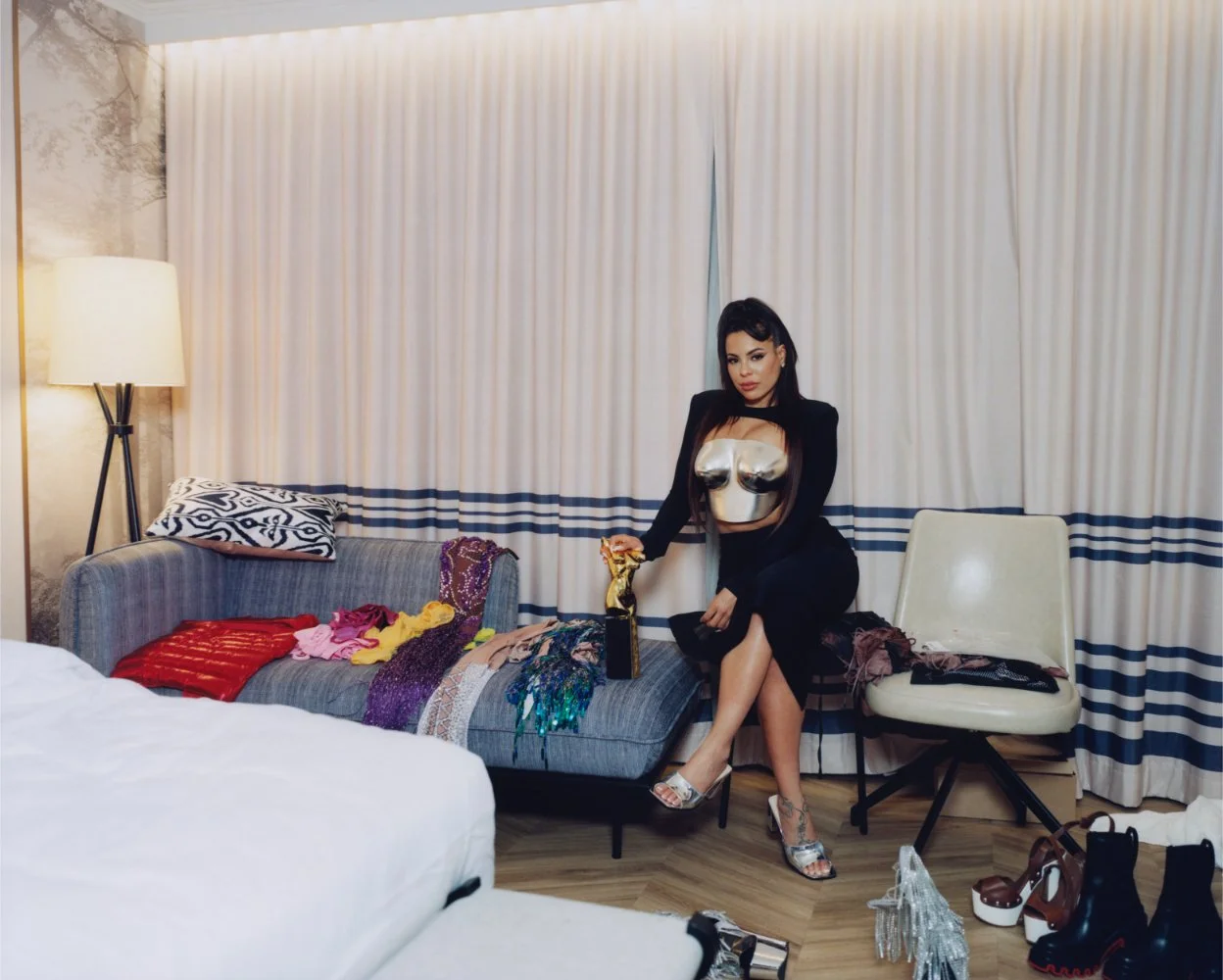
Luna Star in her hotel room, after winning the Best International Star Award at the Venus Awards. Berlin, Germany © Rosie Marks.

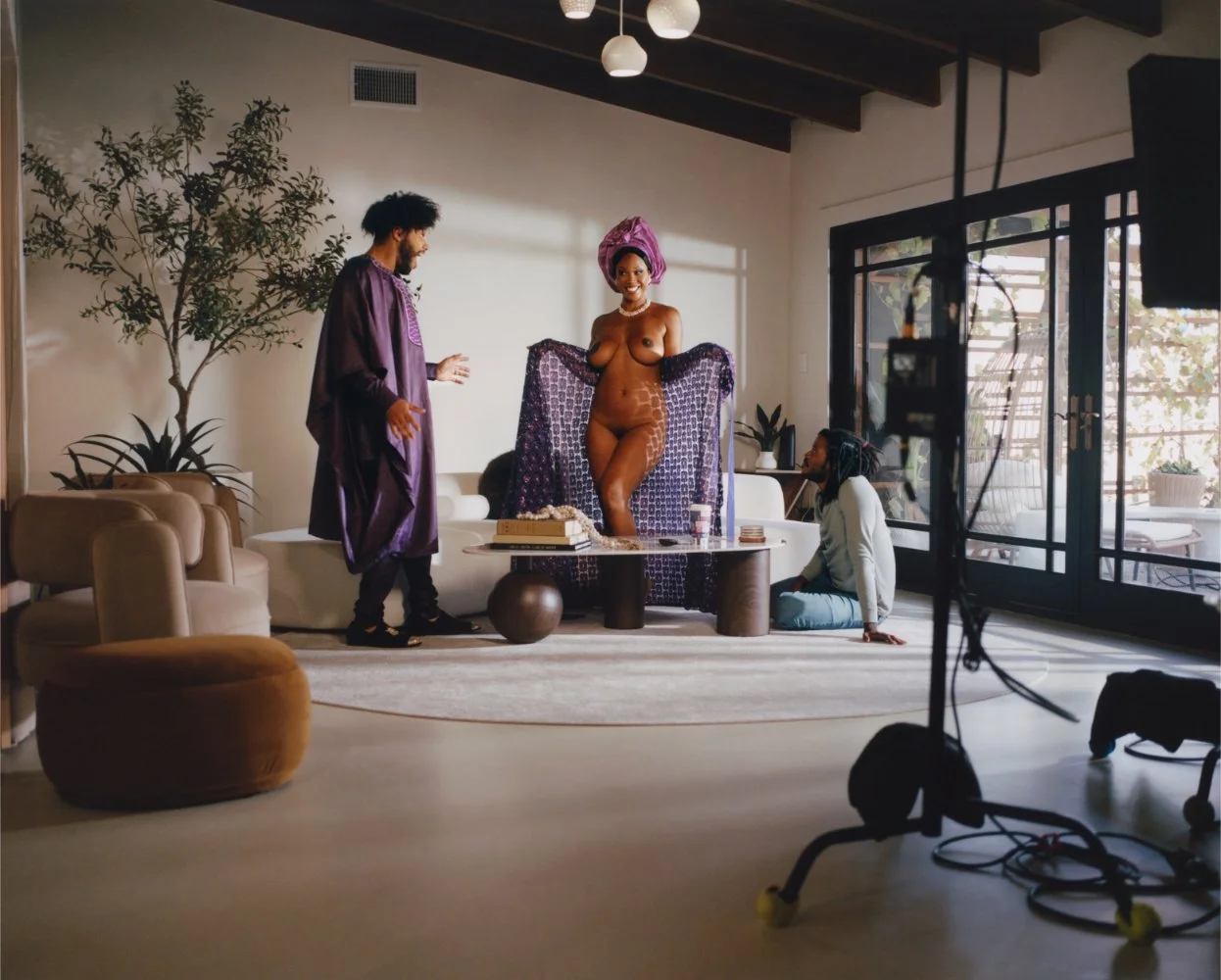
Director Marvin Love with performers Tony Genuis and August Skye on the set of A Nigerian Owambe. Woodland Hills, CA. © Rosie Marks

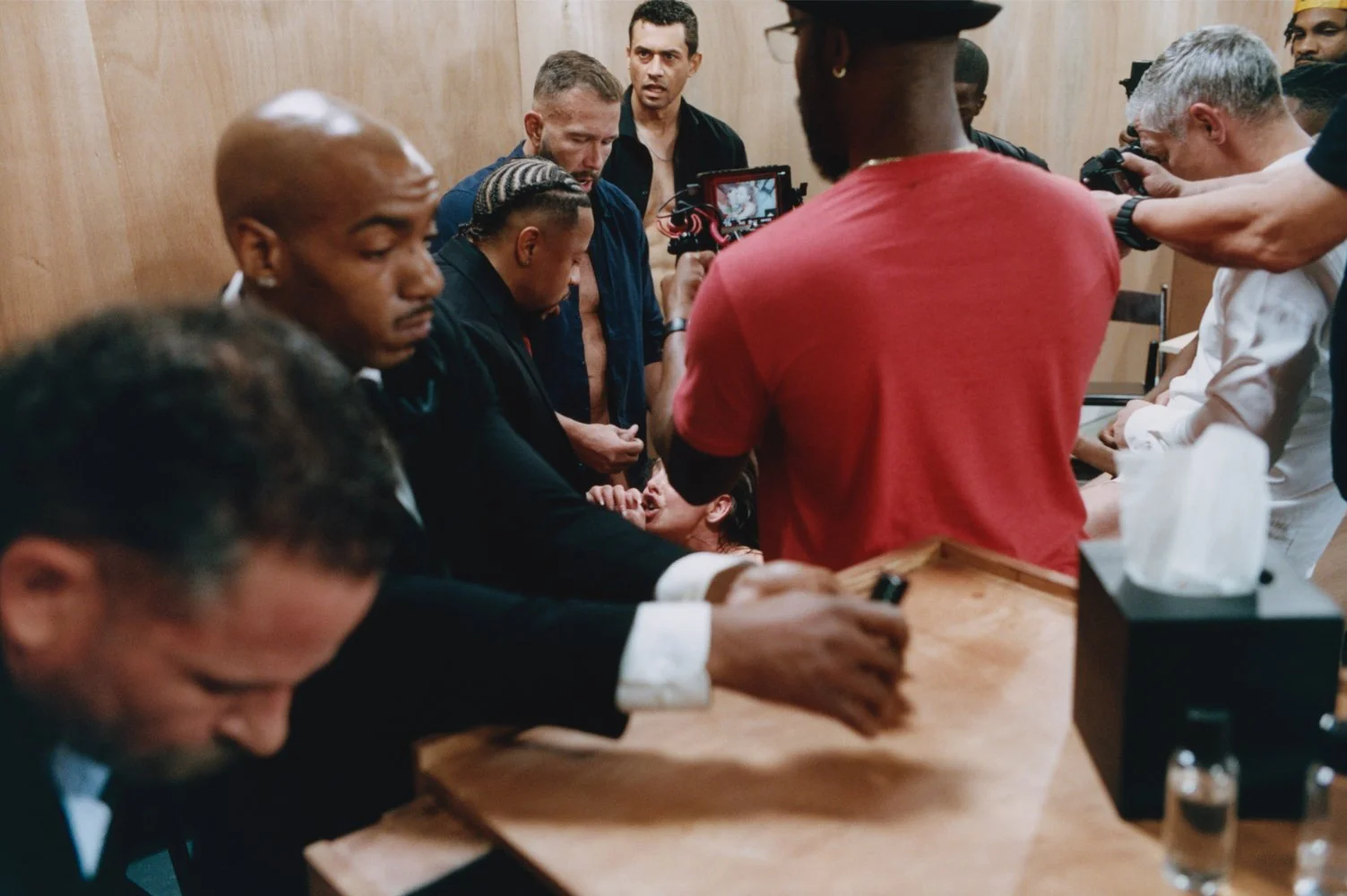
12 Horny Men: Cherie vs. Jury Duty. Las Vegas, NV. © Rosie Marks

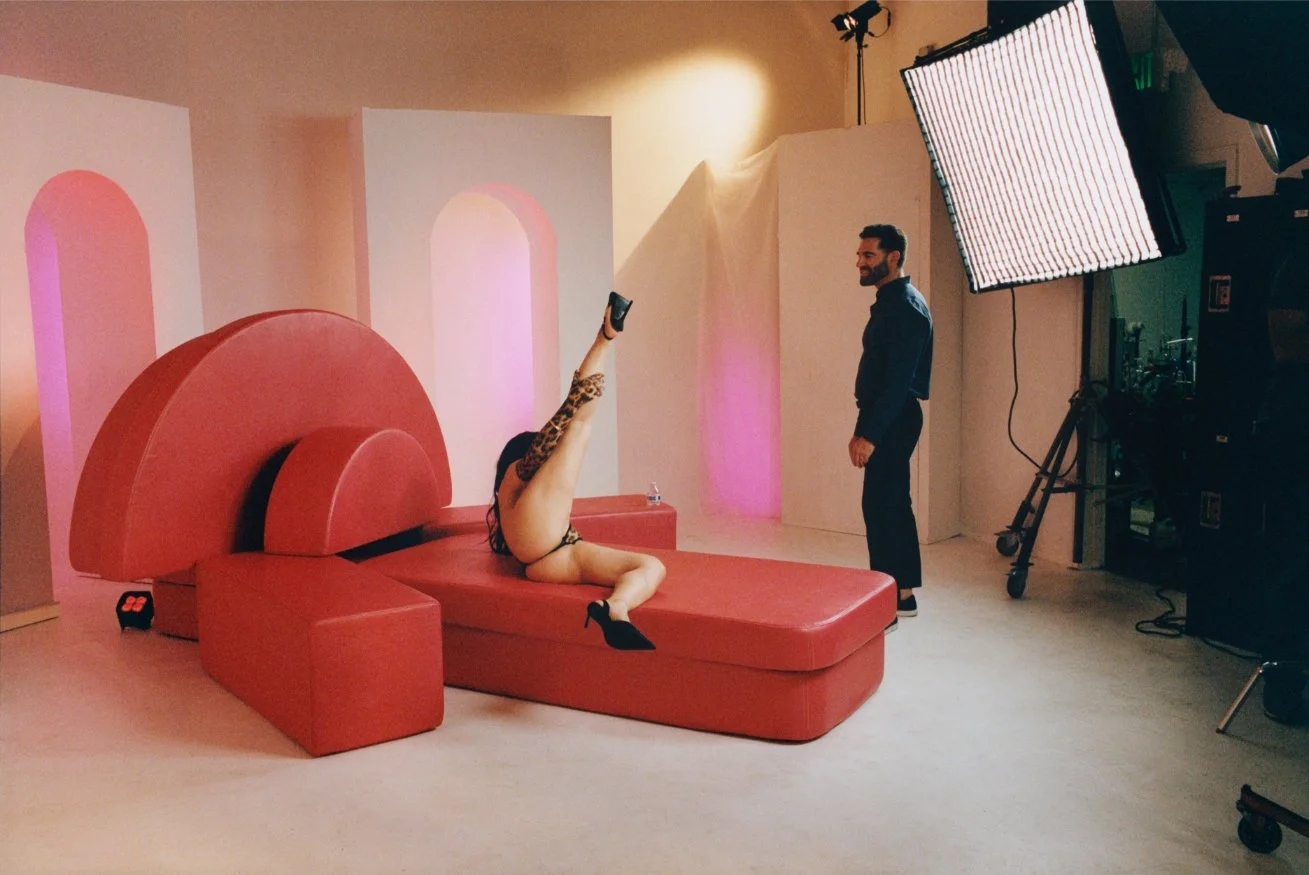
Ken Feels and Valentina prepare for their scene, in Valentina in the Limelight. Burbank, CA © Rosie Marks.


QUADROS: When I was doing research for this, I just kept thinking about how much porn there is, the magnitude of it, how many hours and how much gets logged a day, the hugeness of it, how ubiquitous it is. That seems to me to be one of the things that you capture really well.

MARKS: It's funny, though, because this book is  such a tiny corner of the industry. It’s the upper echelon of porn. In terms of the performers, they’re at the top of their game. It’s like if I tried to make a book about actors, but I just looked at Nicole Kidman. But I think that you're right. There's so much out there, even the amount that this one company is making. One day when I was in the height of this in the summer, there would be up to three shoots a day in LA, and that was LA alone. There's an endless desire for this from all around the world. It's always evolving. As soon as something comes out or some kind of trend, they're responding to that. For example, like when fidget spinners were a thing, then fidget spinner porn became a big thing for them. Every TV show or movie, they've made a parody. They're mirroring the whole world in some way.

QUADROS: A lot of your work is centered around the act of desiring and the quest to be desirable. A lot of your work around plastic surgery, for instance, is about that. Nominally it’s about being sexy, but it’s also about something much bigger. What is your personal relationship to desire?

MARKS: I’ll contradict myself a little bit from what I said before in that I’m able to break down all of these things in the photo taking and make sense of it in that way. I still am a woman who’s affected by these things too. Sometimes people say things to me as if, because of the work I make, that somehow I’m completely unaffected by anything to do with glamor or beauty. I guess it’s just a way of making sense of it.

QUADROS: I’ve seen other people describe your work as voyeuristic. Does that resonate with you?

MARKS Yeah, I think it does. Sometimes I’ll just stand in a situation and feel deeply uncomfortable, like I want to be swallowed up into a wall. I’m normally not the sort of photographer that ends up deeply bonding with their subject.  I’m not a completely antisocial person at all, but I try to keep a little distance to try and be more observational. I think subtly it affects the work in a positive way.

Kayler Gunner on the set of Sneaky Dive Bar Throwdown, a scene inspired by the infamous Pam & Tommy sex tape. Kayley
Gunner started her adult career as a cam girl while serving in the U.S. military. She did a character study of Pam in preparation for the shoot. “I do my own stunts.” Hollywood, CA. © Rosie Marks

Kayler Gunner on the set of Sneaky Dive Bar Throwdown, a scene inspired by the infamous Pam & Tommy sex tape. Kayley
Gunner started her adult career as a cam girl while serving in the U.S. military. She did a character study of Pam in preparation for the shoot. “I do my own stunts.” Hollywood, CA. © Rosie Marks

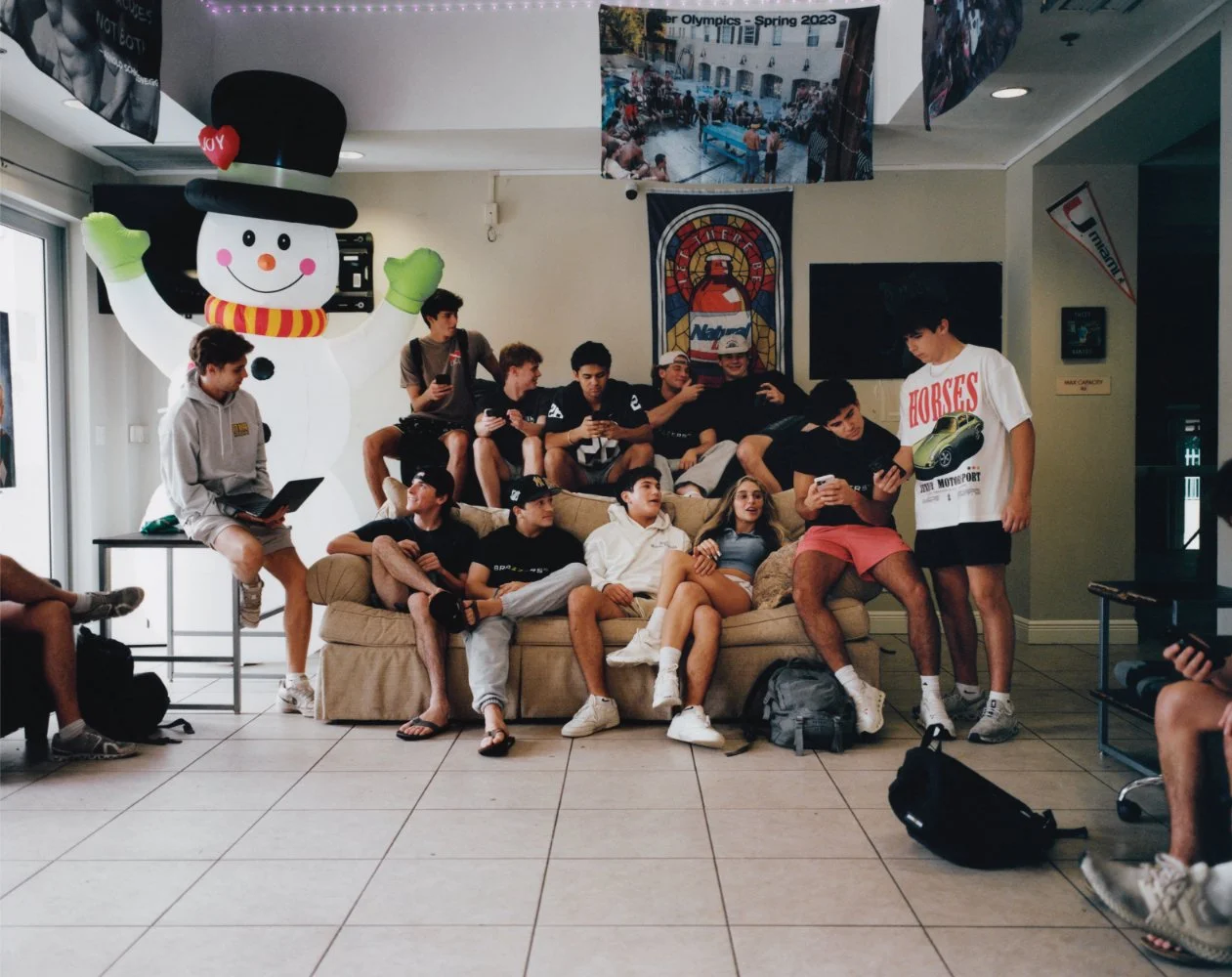
Abella Danger and the fraternity brothers at the Pi Kappa Alpha house. Abella is a Philosophy and Classics double major at the University of Miami. Her thesis is on the morality of pornography. She is the Fraternity Sweetheart of Pi Kappa Alpha. Miami, FL. © Rosie Marks

QUADROS: Does it affect you?

MARKS: Yeah, I think it does. It makes me feel deeply uncomfortable a lot of the time. I don’t wish it to be any different at the end of the day. With this project, I was very much welcomed into this environment. People were aware of what I was doing. Sometimes I feel really massive in a room when actually it’s a complete illusion. No one gives a fuck. But I think my ideal a lot of the time is to not exist, to be a security camera.

QUADROS “Bad taste” is something that comes a lot in your work. I’m curious what you find so alluring about bad taste.

MARKS: I guess it’s just ingrained in me because fundamentally, at a certain level, I do have that taste. I’m also really interested in things that are just incredibly popular and mainstream in some way, which I think often is forgotten in art and photography. Obviously, this book is not going to be to the taste of everyone. But I found it really interesting being inside of a culture that, although many will deny it, is some of the most viewed stuff online. It’s viewed, feared, adored, whatever. There’s an insane amount of people watching this stuff, and it doesn’t really matter the reason for it. It’s fun for me to dissect the things that are being consumed every day.

QUADROS: Porn is so ubiquitous, but it’s still not really normalized. You see porn aesthetics and tropes in pop culture and definitely in social media, but porn itself still feels really charged. There’s a lot of power to shock. How do you move beyond shock value with your camera? Do you ever lean into it?

MARKS: A lot of that comes in the edit process. I did take more pictures in this project that are probably more direct in their shock value. Moving beyond it is when there’s human emotion involved and there’s a sensitivity behind whatever the shock value thing is. As soon as you go on a porn set, you realize it isn’t that shocking. There’s a sterility around it based on safety measures, the way things are recorded nowadays. I was a little surprised by how sterile it was. The sets feel very un-sexual. They’re like empty, weird houses. A lot of it is filmed at the Brazzers studio, which is constantly changing. It’s just one of those sets where one day it’s a bedroom, the next day it’s a kitchen, and then it’s a locker room. They often all look and feel the same. The aesthetics probably do respond to the now. If you look at TikTok, all of that aesthetic is reflected back into the porn that’s being made.

QUADROS: Was there anything that surprised you on set?

MARKS I wasn’t expecting it to be as funny as it was. The scripts, they’re often so far-fetched and completely silly. One of my favorites was the final shoot that I went on, which was a courtroom orgy. The idea was that this lady was being sentenced to 24 hours in jail for stealing a pineapple. And then she freaked out to the judge because she’s never gone 24 hours without cock. That was the line. And then she had sex with the whole jury, just in front of the judge and the audience in the courtroom. They definitely didn’t have to put that much effort into that story and all the details of stealing a pineapple (because if you want to taste good you eat pineapple.) It’s just things like that. I don’t know how many people even watch any of this stuff or they just skip to the bit they want to see. But there’s a lot of work that goes into these moments before the sex happens.

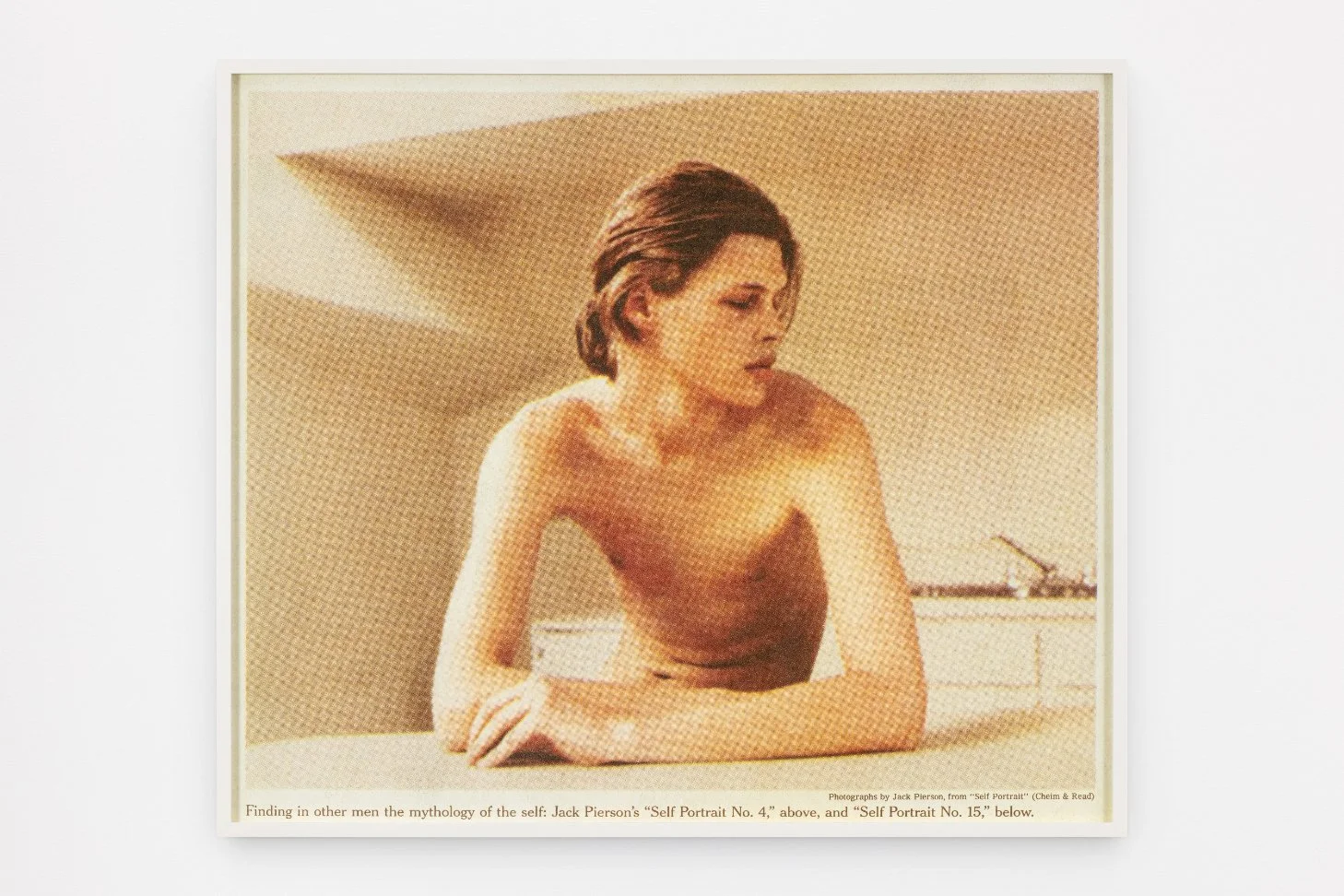
Jack Pierson


Jack Pierson
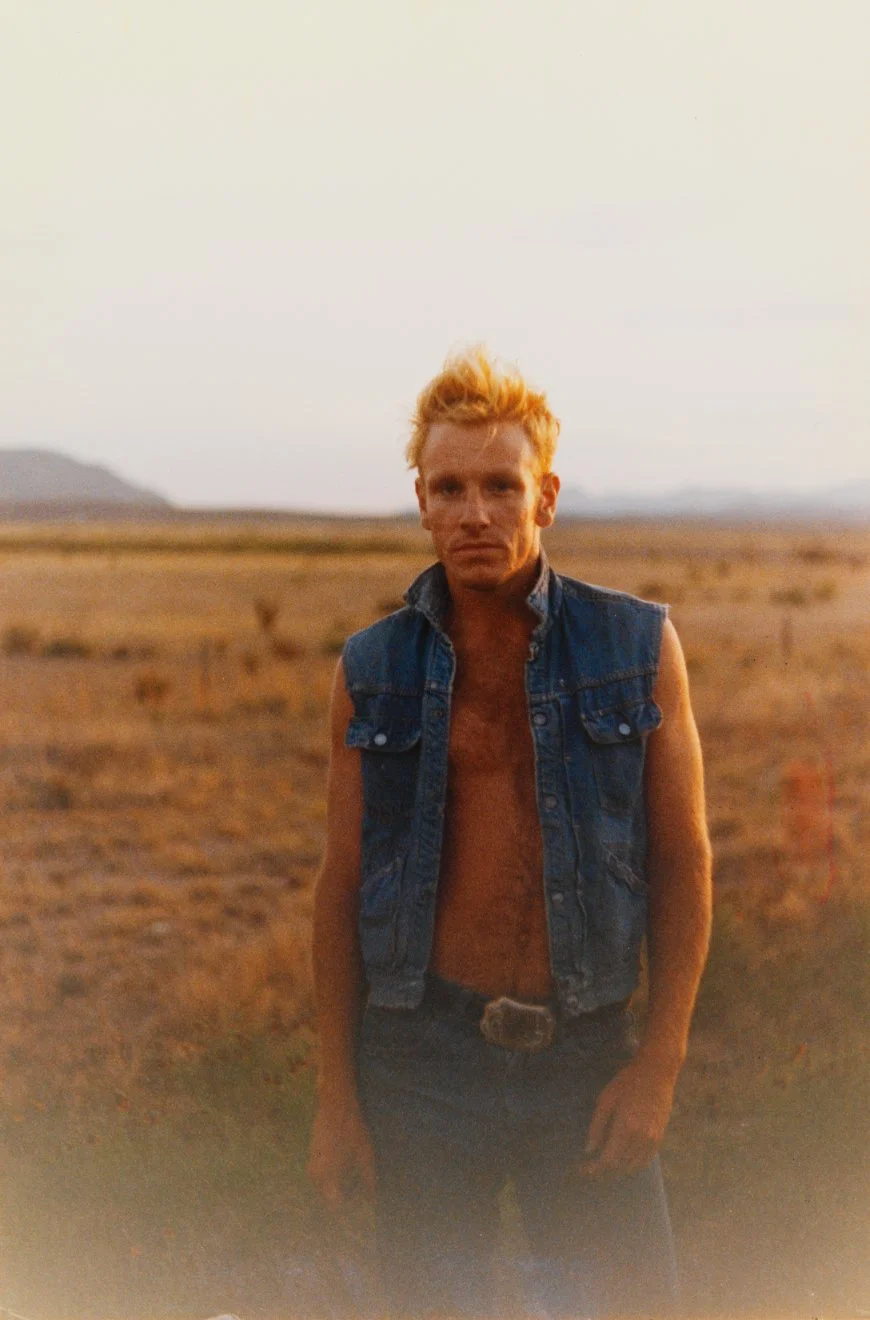
Badlands, 1991
© Jack Pierson, Courtesy Jack Pierson and Lisson Gallery


interview by Oliver Misraje

Jack Pierson’s work begins where longing takes shape–half-lit motel rooms, sun-faded billboards, rusted signage spelling out half-truths. Desire, in his world, is not only erotic but atmospheric, ambient; it drifts through his photographs and sculptures like heat shimmer off an empty highway. To encounter Pierson is to encounter a queer poetics of yearning–his gaze lingering on beauty just past its prime, on bodies caught in the soft ache of becoming. Whether in his disheveled boys or his melancholic text pieces, desire is never fixed; it is itinerant, flickering, always already vanishing. His art doesn’t just depict desire–it stages it, exposes it, lets it bleed into the horizon.

OLIVE MISRAJE: With your fictional self-portrait series, you identify the artist within the other and in the process, seem to capture a fascinating power dynamic between the artist and the muse as a sort-of two-way mirror. Is the muse named into existence by the artist or is that potentiality self-generated?

JACK PIERSON: Some muses don't need to be named into existence and others do. Both are appealing to me, because one gives a sense of discovery and another this feeling of collaboration beyond the sum of either of our respective parts.

OM: Do you ever encounter resistance with a model, in the figurative sense? If so, can that abstract tension lend itself to a good photograph?

JP: It’s a good question, because sometimes you can pull something out of somebody and that can be cool. But for me, usually when it's magic, they're giving it. If it’s not clicking, I’m prone to giving up, you know? That’s good, that’s good, thanks for coming.

OM: How has your personal understanding of what constitutes a muse changed over the years?

JP: I’m not sure if anything about the muse themselves has changed fundamentally as much as the avenues in which we meet each other. That’s something that has really changed in my photography. Part of what gave me entry to the art world was real life. Everybody wanted real life in the 90s. These are real people; these are his friends. And in fact, they were my friends. But there's nothing real life about my pictures these days. I’m not in a scene these days, so I’m really not surrounded by young people like I was in the 90s.

OM: What is your internal relationship to the muse after you capture the photograph—erotically, analytically, artistically?

JP : With “Baby,” I hardly knew the model two hours before he came to my house to shoot. We did that for three days, right? And weirdly, he's like a brother or kid to me. I think the genius thing about that book is that there's nothing, to me, prurient about it, especially given there are 150 pictures and 137 of them have his dick in it. I guess people find it sexy, I don't know. But I can hang out with him endlessly and there's no part of me that's like, oh this is a sublimation of something sexual. I don't go jerk off to the photograph or anything like that. Even when I was 24, it wasn’t about that. It’s more like, we’re both creatives and did this thing. Somehow there’s magic in that. That's the crucible, that's the union. I don’t need anything more than the photograph. Maybe that makes me a voyeur, I don’t know.

OM: The titles of your works rarely play cursory roles, between the meta-narrative layering in Mythology of the Self, to the aforementioned “Self Portrait” series. They seem to actively participate in the work. How much of that is intentional?

JP: The titles came into being in a very flippant, sort of cynical way. It was completely a spur of the moment thing. There was this curator in the studio who I was trying to show my paintings to, you know—which I am always trying to do as an artist—but she wasn’t interested. Then she walks over to a stack of pictures that I had organized, because I had been doing a lot of editorial fashion portraiture for magazines, celebrity portraiture, stuff like that. And I kept thinking, well, these are really good, even though they're not my typical work. I was a little bit embarrassed at her looking at all this cheap magazine photography and so, thinking fast on my feet, I was like, this a series I’m working on called “Self Portraits.” And she just pounced. She was all curatorially engaged: What? Oh, that’s really interesting. Tell me more. So, it just sort of escalated into this larger thing. I depend on my snap judgments and quick impulses. Maybe it's about containing multitudes or tapping into the subconscious or whatever. But I can’t say in confidence that that series is about transferring some aspect of my identity onto the models and vice-versa. To me, it just feels like a glitch in photography and naming and all that kind of thing.


Self Portrait #22
Jack Pierson
2003
Pigment print 
54 x 44 inches (137.2 x 111.8 cm)


Mythology of the Self
Jack Pierson
2020
Digital print on archival paper
54 1/4 x 63 3/8 x 2 inches (137.8 x 161 x 5.1 cm)


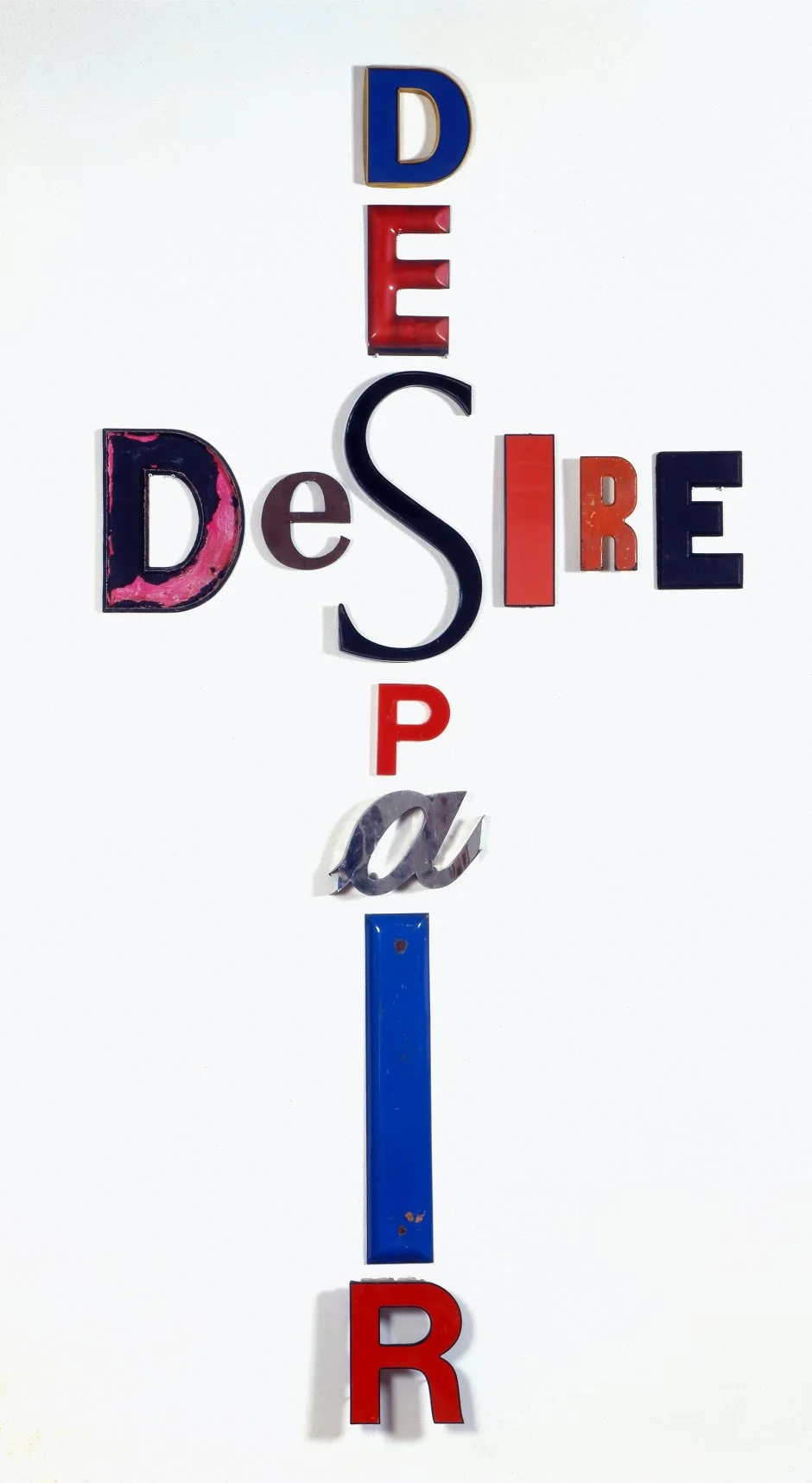
Jack Pierson
Desire, Despair, 1996
Metal, plastic, plexiglass and wood
Overall: 117 1/2 × 56 1/4in. (298.5 × 142.9 cm)
© Jack Pierson, Courtesy Jack Pierson and Lisson Gallery


OM: How does a photograph's relationship to desire shift in the context of a fashion editorial?

JP: It’s an interesting question because those self-portrait pictures for the most part were me trying to execute what I thought was fashion or editorial, when really, what they wanted were my personal photographs. A couple years ago I started using my own pictures as a reference. I guess I didn’t fully grasp the separation between the tricks of editorial and the tricks of real photography. I think I can do it more seamlessly now, somehow. Because even in my personal practice, I always saw fashion photography as legitimate photography. And so that was always my goal, even as a student—to make it look fashionable.

OM: I think that’s partially what makes homosexuals successful in fashion—that innate understanding that the point of desire isn’t its actualization; that there’s nothing less erotic than obtaining the object of your desire.

JP: If it’s done well, fashion has the means towards inspiring a sense of enchantment. I want that billboard that’s just my pure image. I like the idea of sending a message out that somebody could just rip out of a magazine. That alone is worth all of the noise that comes with working in fashion—waiting for the stylist, dealing with agents, set politics, etcetera—the thought that maybe, just maybe, somebody might rip this out of a magazine. I don’t want the paycheck, really. I just want some kid in Hemet to say, life can be like this.

OM: You've mentioned in the past that you see photography as an inherently queer medium, as opposed to painting. Do you still feel like that that separation exists today?

JP: Well, again, that's one of my flip responses where I’m trying to be a little bit of a provocateur. It just seems to me that photography disappears, it’s considered the more ephemeral, lesser medium. I was just saying to somebody else that it seems to me that if you're really going to be a painter, it's because you want to cast yourself into history. Though everything has changed in the thirty years since I've been operating. Like gays have children now (laugh). Now they have progeny or people to carry on their name. I'm not one of those gays who will have children, so I make stuff to sublimate that desire for my name to be attached to something. Or maybe it won't be. I also kind of like all those moments of misattribution. I don't think anything really lasts. I'm mostly just doing this to entertain myself, and others while I'm here (laughs). Have a little fun. Take a few pictures.

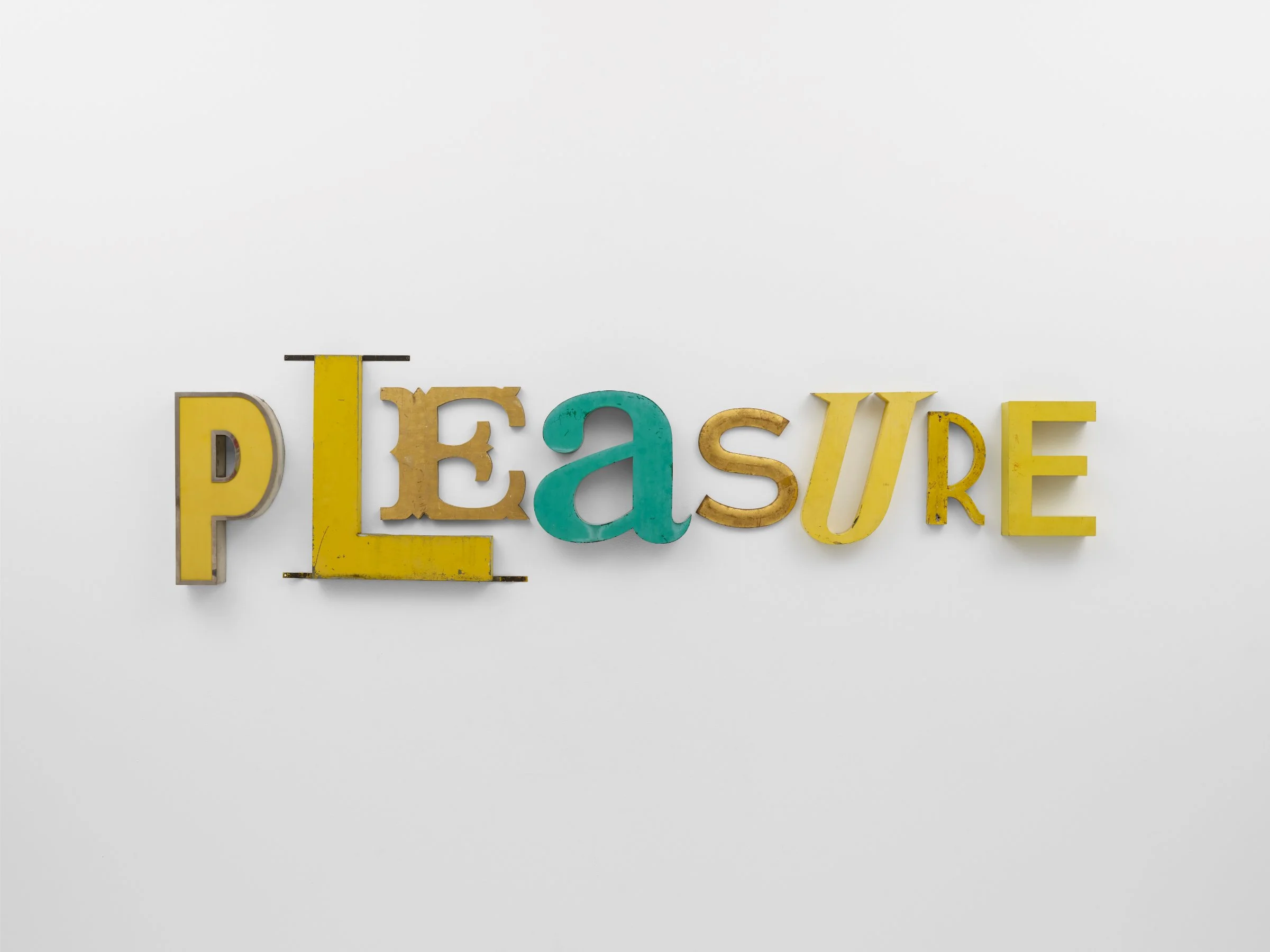
Jack Pierson
PLEASURE, 2024
Metal, paint, plastic, and wood
61 x 240 x 8.9 cm, 24 x 94 1/2 x 3 1/2 in
© Jack Pierson, Courtesy Lisson Gallery

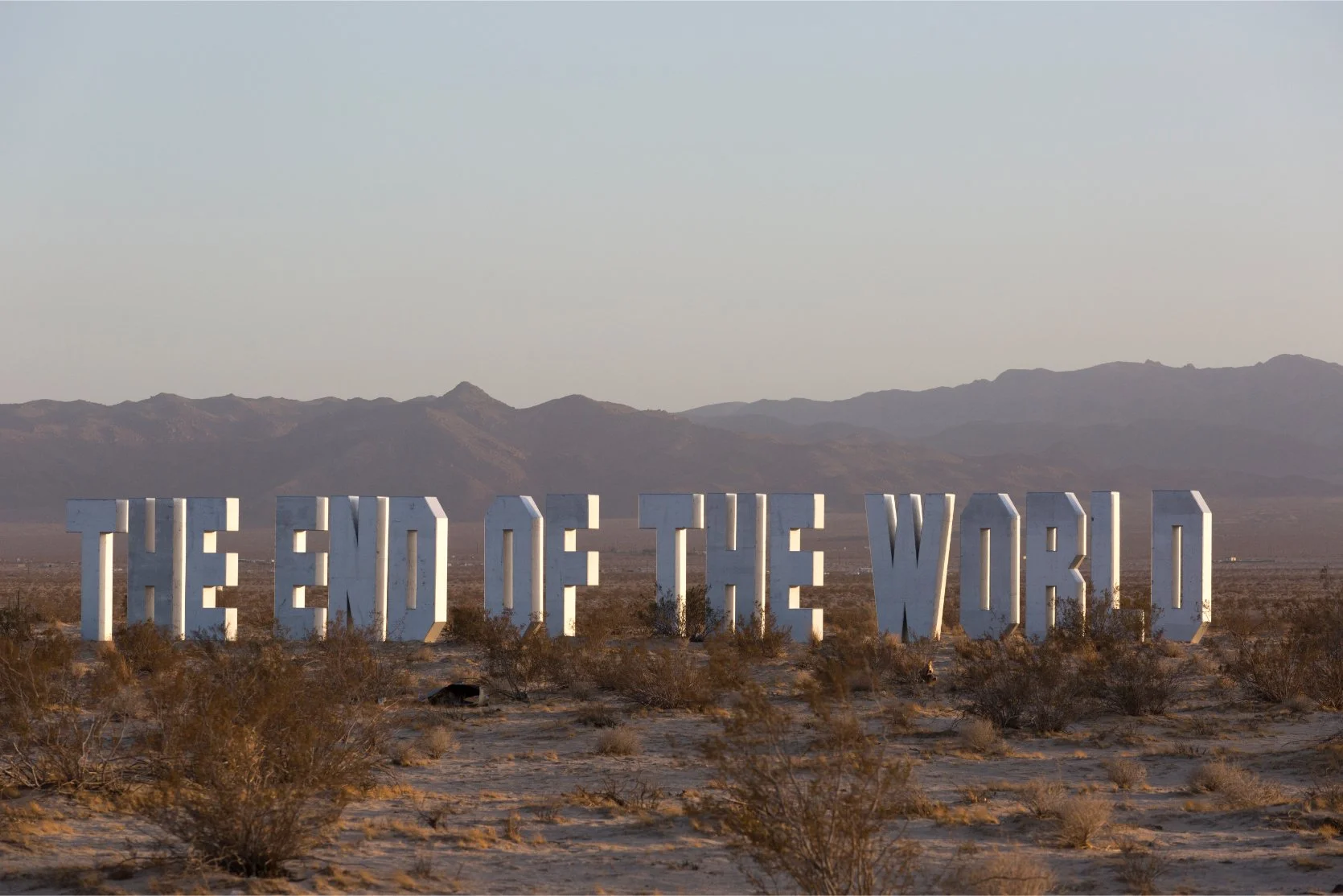
Jack Pierson
THE END OF THE WORLD, 2012
Plywood and silver paint
Dimensions variable
Installation view at High Desert Test Sites, Joshua Tree, California. Photo: Sarah Lyons

OM: I have this unearned nostalgia when being gay was a little bit more transgressive. I miss the angry, tortured, borderline violent, archetype of the homosexual.

JP: Have you had any experience with that? How old are you?

OM: I am 26. And I am violent.

JP: When was homosexuality ever transgressive to you?

OM: Grade school.

JP: Right, yeah. There’s this sense that, oh, this is wrong. But then it seems to me after that point, it evaporates a little bit. And I mean, I guess it's good and everybody should be able to get married and be model citizens if that’s what they want, like, “Look, here are my kids. Yes, we'll come to soccer, and host dinner parties,” or whatever else it is that they do. I get it, but it was fun when it was a little more transgressive.

OM: Yeah, totally. And that’s what I’m referring to when I say an unearned nostalgia. My father was a preacher, and that protestant outrage fueled me until I left for university. I moved to the big city and was like, damn—everyone’s a fag! Even straight dudes are fags.

JP: Oh, for sure. And I spent my teenage years hating my dad, and then I realized I actually liked him (laugh).

OM: How can we make gay sex transgressive again?

JP: I consider myself somewhat outside of the gay sex pool, but it seems to me that they're doing the best they can (laughs). The new generation has been jerking off to hardcore porn on the internet since they were eight. When I was eight, I found a playing card out in the woods with a grainy out-of-focus picture of a lady from the forties giving a blowjob. Even though my parents weren’t religious, I sat at dinner that night thinking, oh my god, they know. They can tell that I saw that picture, you know what I mean?  And now, by the time kids are like thirteen, they’ve already seen a donkey fuck a girl (laughs). But there’s all kinds of freaky stuff that I can't figure out. Like puppy play or whatever.

OM:  If it’s any consolation I can’t figure that one out either. There’s something allusive about the way you photograph your muses. Even if they’re nude, they’re at a remove. It kind of emulates that experience of being in public and seeing a beautiful person walk past you. On one hand it's exciting, then on the other, it hurts. Even if the photographs are sexy, they resist the viewer in a way that pornography doesn’t.

JP:  Lately, when I've photographed a fellow, I have to make it a little bit removed. So much is being offered on the internet that I don’t want it to seem like my models are too. Yet at the same time, I'm presenting a nude person. I want it to be an experience that's almost like, God forgive me for saying this, a religious painting or something. I want you to see a man that's willing to stand there and be photographed for you, for me, you know? I’m also nostalgic for physique photography from the ’40s, ’50s, ’30s, where it was like, yeah, what the hell, I can stand here naked for you for a little bit. Those pictures are intensely erotic because there was nothing on offer.

OM: It’s also kind of strange how before internet porn, there was more room for it to achieve a cult, or even art house status, like LA Plays Itself for example. Have you ever thought about directing a gay porno?

JP: Yeah, theoretically. Although I think the best ones aren’t directed, you know. I like when there’s a touch of authenticity. But ultimately, I’d rather just make simple, nice, still pictures.


Jack Pierson
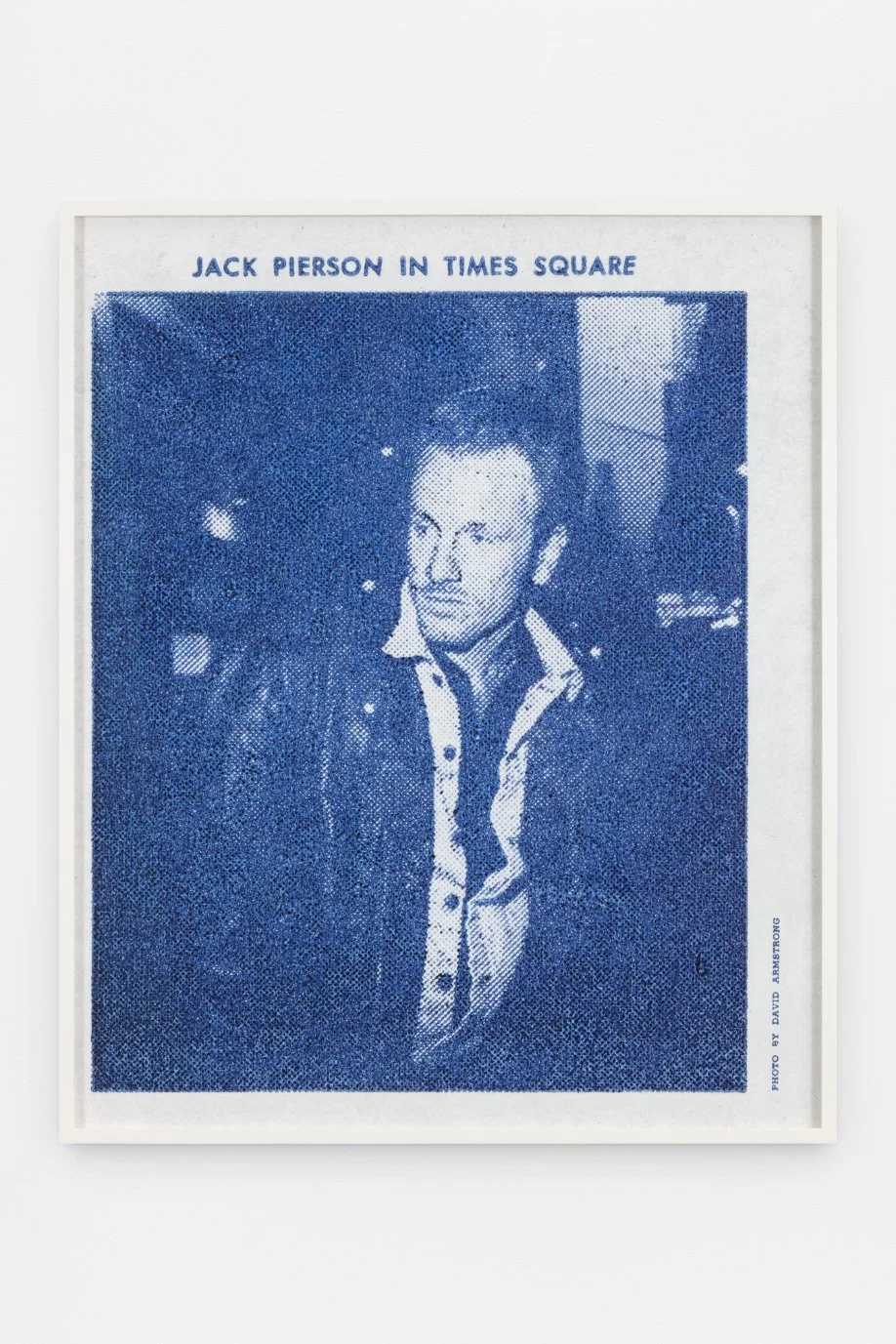
In Times Square, 2020
Digital print on archival paper
63 3/8 x 52 1/4 x 2 inches (161 x 132.7 x 5.1 cm)


Jack Pierson
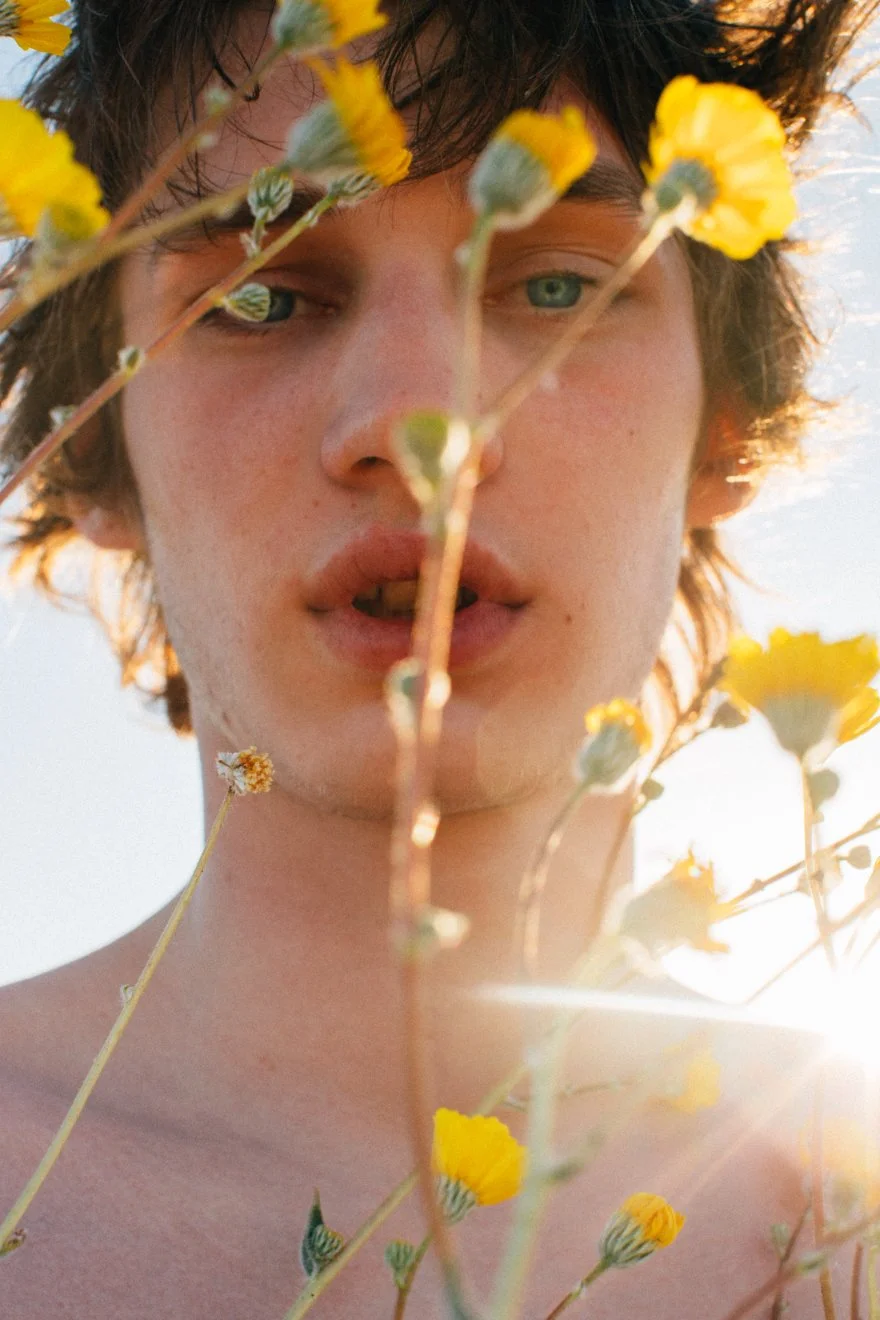
Baby Behind Flowers, 2019
Folded pigment print 
45 x 30 inches ed.3
© Jack Pierson, Courtesy Jack Pierson and Lisson Gallery


OM: Do you think the changing sexual landscape of the homosexual experience influences homosexual art? Specifically, in regard to the diminishing prevalence of cruise culture in lieu of apps like Grindr.

JP: I don't see it as that different. It’s fascinating how much homosexual art there is these days. Homosexual art being celebrated not just by gays. I must say, I am impressed. I would've said it couldn't be done.

OM: You mentioned you’re calling in from your home in 29 Palms. Making art in the desert is a classically machismo, especially within the context of installation and sculpture—pop ups in your work from time to-time. What is your relationship to the landscape?

JP: I like the desert because it's simultaneously cheap, extreme, and exotic. This is the appeal of Southern California—I like any place where I can look and see the sky meet the water and the land. The horizon to me is a shorthand for hope, you know what I mean? I'm looking out the window now. There's no horizon in New York unless you're in a penthouse on the river or something like that. And I don't know. That exoticism is what first got me here and then you're right, there's something butch about the desert. Cowboys, marines, rednecks. You’ve got to be tough to survive here. The kind of person who chooses to live here is a little bit nutty and a lot of bit cool.

Kings Romans: A Journey to the Sybaritic Heart of the Golden Triangle

text by Abraham Chabon
photographs by Taylor Weidman


I was standing on the balcony. Next to me were chairs, a mini fridge, and a small table; on the table was a large knife. I think he’s going to kill me. Past the balcony, the casino was enshrined in LEDs that refracted off the buildings around it. Chinese words hung over streets, and crowds swelled and split around buildings and traffic. I think he could kill me. I felt it in my shoulders, my temples, the shaking of my leg. I think he might kill me. He’s going to fucking kill me.

* * *


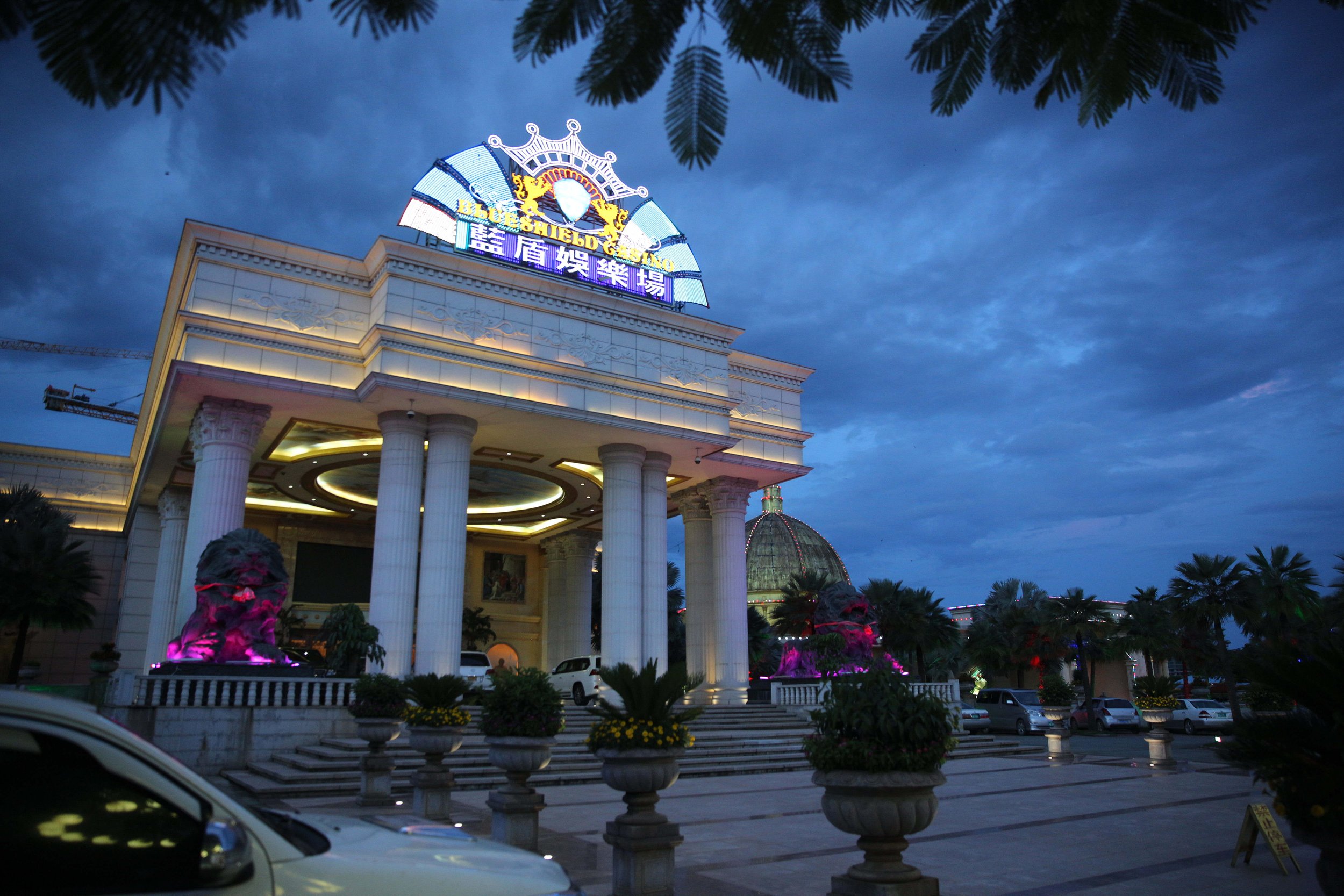
I approached by car on the Thai side of the Mekong River, up winding, cracked rural roads and across sliding rivers, through short and slanted shanty towns into Chiang Saen, the last Thai town before the Mekong crossing. The casino appeared on the horizon, bursting out of the bright green trees and dark rolling hills of Laos like a towering golden tumor. A shining marble hotel sprouted out of the city like a lotus flower. Towers jutted out from behind well-kept trees, and all around, dozens of construction cranes cluttered around the buildings like braces on teeth. Kings Romans is a Chinese gangsters’ personal paradise, a lawless theme park for the rich, a money laundering city-state for Burmese rebels, a US-sanctioned hotbed for sex trafficking, exotic animal abuse and drug production, a glimmering Gomorrah in the South East Asian jungle.

Chiang Saen is a small town that stays quiet and slow. At night, the rays of city lights refract across the foggy Mekong, as boats whisper up the river freighting stacks of covered goods. I booked a hotel room and paid a group of young boys to drive me down dark and litter-strewn roads on the back of a scooter. No one wanted to talk about the casino; for the locals in Chiang Saen, Kings Romans is a forbidden topic.


* * *


The next morning I walked down to the green banks of the muddy brown river, under a clear blue sky. By the docks sat a drab official building staffed by Thai law enforcement. Blank-faced officers waded through the humidity in stiff khaki uniforms, past posters of crying children behind wire fences—warnings for human trafficking. Chinese nationals shuffled in and out of the building; there were groups of men with Yakuza-style tattoos twisting out of too-tight polo shirts and down their arms to meet oversized gold watches at their wrists. They waited next to wealthy families on vacation, and teenagers who walked together tossing peace signs for photos.

On the other side of the border-control building, a shabby dock buoyed by truck tires was manned by squatting locals with leathery skin. These men would run you across the river, by ferry or fishing boat, depending on how much you paid.

I had too much fun in Bangkok, funds were running low, the ATM conversion rate was killing me, and I had paid that monk too much money to tattoo a protection charm on my arm. But the ferry looked more comfortable, so I bought a ticket.

Standing at the dock, I watched a group of Ethiopian men load hefty plastic-wrapped cardboard boxes onto a small rear-engined fishing boat. It was so obviously suspicious, yet they did it in daylight against the backdrop of a golden Buddha statue tucked among the rooting and knobby trees of the Thai hills—nobody cared.

On the ferry I sat down among the tourists. Those who chose to talk to me at first didn’t believe I was American, when they did, our conversation ended. I sat in silence and watched as we pulled closer to the city.


* * *


The Golden Triangle—the region where Thailand, Myanmar, and Laos converge—was once the world’s largest producer of opium. It has a hard-earned hundred years of ethnic militias, drug kingpins, war profiteering, and CIA meddling. Thick lush jungle and ever-present political instability allowed the Golden Triangle to blossom into a billion-dollar black-market shangri-la. In the past thirty years, meth has become the primary export. It’s trafficked out of the region and into Europe, Asia, and Oceania. Some estimates claim that 250 tonnes of meth are crated down the region’s rivers and dirt roads yearly. Recently, a new source of income has taken over the region: phone scam centers and the enslavement of people to work them. It’s estimated that at least 200,000 people are held in captivity across the region, working the phones at office buildings turned prisons.

The Kings Romans Casino is the child of Chinese national Zhao Wei, a career gangster and casino owner who came from humble beginnings and got his start in Macau before moving his operations to Mong-La, Myanmar, the capital of the Shan-State-Special-Region-4, an autonomous area of Myanmar controlled by the Shan Army. The SR4 is known for a card deck of accused human rights abuses, and after the daughter of a Chinese official lost 1.3 million RMB in a Mong La casino, the Chinese government launched Operation Blue Arrow shutting the region's casinos down.

Zhao Wei rebranded his company as Kings Romans and created—according to the US Treasury—fifteen shell companies. He moved his operation to the Bokeo province in Laos, where in 2007, the government gave him a 99-year lease on thousands of hectares of biodiverse land, which he bulldozed. The region was dubbed the Golden Triangle Special Economic Zone. The area has grown into its own city, ruled by Zhao Wei and his corporation. Ever-growing, home to thousands, and infested with the worst things the region is known for. In 2011, thirteen Chinese nationals working boats carrying 900,000 meth pills bound for the Kings Romans were bound, stabbed, shot, and tossed overboard.

Zhao Wei is a media hermit, and rarely makes public statements, but when he does, he denies everything. He says he is bringing morals and Chinese ingenuity to a “backwards region” He insists that everything that happens in the Kings Romans is done hand-in-hand with the Chinese and Laos governments.


***


In Bangkok, before I headed north, I spoke to one person who had been to the casino, an expat from the States wearing crocs and camo shorts. I asked him for advice. “Don't go,” he told me. He said that people could disappear out there, that sometimes bodies floated down the Mekong, and riverside hotels used long bamboo sticks to push the bloated corpses out of sight so as to not ruin their guests’ vacations. We were sitting on short plastic chairs in a restaurant on the outskirts of the city, I tried to control my reaction, “Yeah, well, that’s fucking crazy.”


* * *


The checkpoint on the other side of the river was an unremarkable building. I was in Laos, but every sign said “Golden Triangle Special Economic Zone,” (GTSEZ) and I was told immediately that my Laos visa meant nothing there. I was charged $40 for a special visa for the GTSEZ, a large shining sticker. And at each of the five desks in the big gray room, tan-suited guards behind plexiglass demanded their own fee. None of the money ended up in a register.

Outside of border control, an African man with a toothy smile asked me if I wanted a ride. I accepted his offer too hastily. As soon as we’d introduced ourselves, he wanted to know what I was doing there, then he asked if I even knew where I was. I told him that I was just a tourist, that I had been backpacking through Thailand. He told me to be careful, that people disappeared out there, and to not take any photos.

Another African man joined us. They worked as translators, said the smiling one, and he wanted to leave it at that. But after twenty minutes of conversation he told me that his real job was helping people get out of the GTSEZ when they needed to. He said two Indian men employed by a local scam center had tried to kill themselves, and he and his partner had been hired to get them out. One of the Indian men had tried to hang himself and the other had slit his wrists. There was blood everywhere, and they needed to go, but first he knew a good spot for lunch.

We drove to the city on his scooter, his friend tailing us. The roads were well-paved and wide, small sidewalks brushed against unkempt, soon-to-be-developed grass plots. Red banners tied to light poles reached over the streets, with a message from Zhao Wei himself, in Lao, English, and Chinese: “Drugs are Not the Answer.”

* * *


From the streets, the city's scale set in. Giant buildings towered above the roads; some resembled office buildings, large and grey with flat roofs. There were long, squat residential buildings that took up whole blocks, side-by-side with upscale hotels clad all in glass. The city doesn’t plan on stopping its growth any time soon.

We passed a two-story-tall poster of a pale Asian girl. Young, wide-eyed, and wearing lingerie, she advertised a private strip club. Under the shadows of five-star hotels, across from private pools, rakish bars, nightclubs, a statue of Confucius, and an abandoned Ferrari caked in dust, locals huddled on the streets, looking poor and ignored. Eye-bagged Indian men in ankle-length pants and sandals waded through discarded cans and cigarette butts on the sidewalks. Thin-armed Burmese men in Longyi skirts shuffled strips of meat around on grills in front of run-down crack-walled stores. One young East Asian man sat on a curb, holding his face in his hands and sobbing into the narrow lap of another, unnoticed by the people walking past them.
Our caravan arrived at a restaurant called Thai Cafe. It was shiny and mundane like an American mall. Everyone there was caucasian. I went to use the restroom, and the men who had brought me ordered me chicken carbonara and a pink lemonade. The blonde women and pale young men at the cafe’s tables stared at me. Some got up to leave as soon as they saw me. While I was eating I chanced a glance at a smiling man’s phone, he was on Whatsapp messaging an unsaved number. It was something about having two girls but needing to take their passports.

They were traffickers; I needed to leave. I said I had to find a hotel. They took me to a hotel just down the block, a tall building with a courtyard and gold windows. All the signage was Chinese, and so were the guests. I waited for them to leave before I booked my room. The room was bland and dirty. It felt smaller on the inside. Thin walls, a stiff mattress, a dust-caked bathroom, it smelled like an RV. The shower spurted a weak stream of water onto a floor that quickly puddled. Later that night the hotel’s lobby was filled with a crowd of older men and sex workers who were barely teenagers. The girls were mostly Thai and Burmese; the undesirables, I was told. The nicer hotels had Japanese girls. They posed on large couches, wearing unconvincing sultry pouts. I avoided making eye contact.

The next day I headed back to Thai Cafe. I ended up in a group of fanny-pack-wearing Europeans, sitting at a round table, burning through packs of cigarettes, and slurping fruit smoothies.

No one there could accept that I was American. Each one of them wanted to see my passport. I had hidden it behind the air conditioner in my hotel room, so I just passed my phone around, with a photo. They asked how I got in. “Why would I ever come?” “Why was I alone?” One of them, a tan, dark-haired man, mentioned blandly that journalists could disappear in the Golden Triangle. People wouldn’t stop reminding me of that. I told him I was just a tourist.

“Just stay away from the Chinese,” he said.

After that there was universal agreement about not trusting each other, a confusing amount of fake names, and an ever growing pile of cigarette butts in an ashtray. One of them—I’ll call him Ivan—offered to show me around. Ivan was a broad-shouldered Central European man, square-faced and handsome, wearing a tank top and a military haircut. He was a teenager, younger than me, though he didn’t look it.

He took me to a swimming pool; private swimming clubs are the hubs of European social life in the GTSEZ. Ivan said that I picked a bad time to come, that it was an officially declared “drug-free month,” but that really meant nothing, so maybe I hadn’t, honestly it was just bullshit, did I want any ketamine?

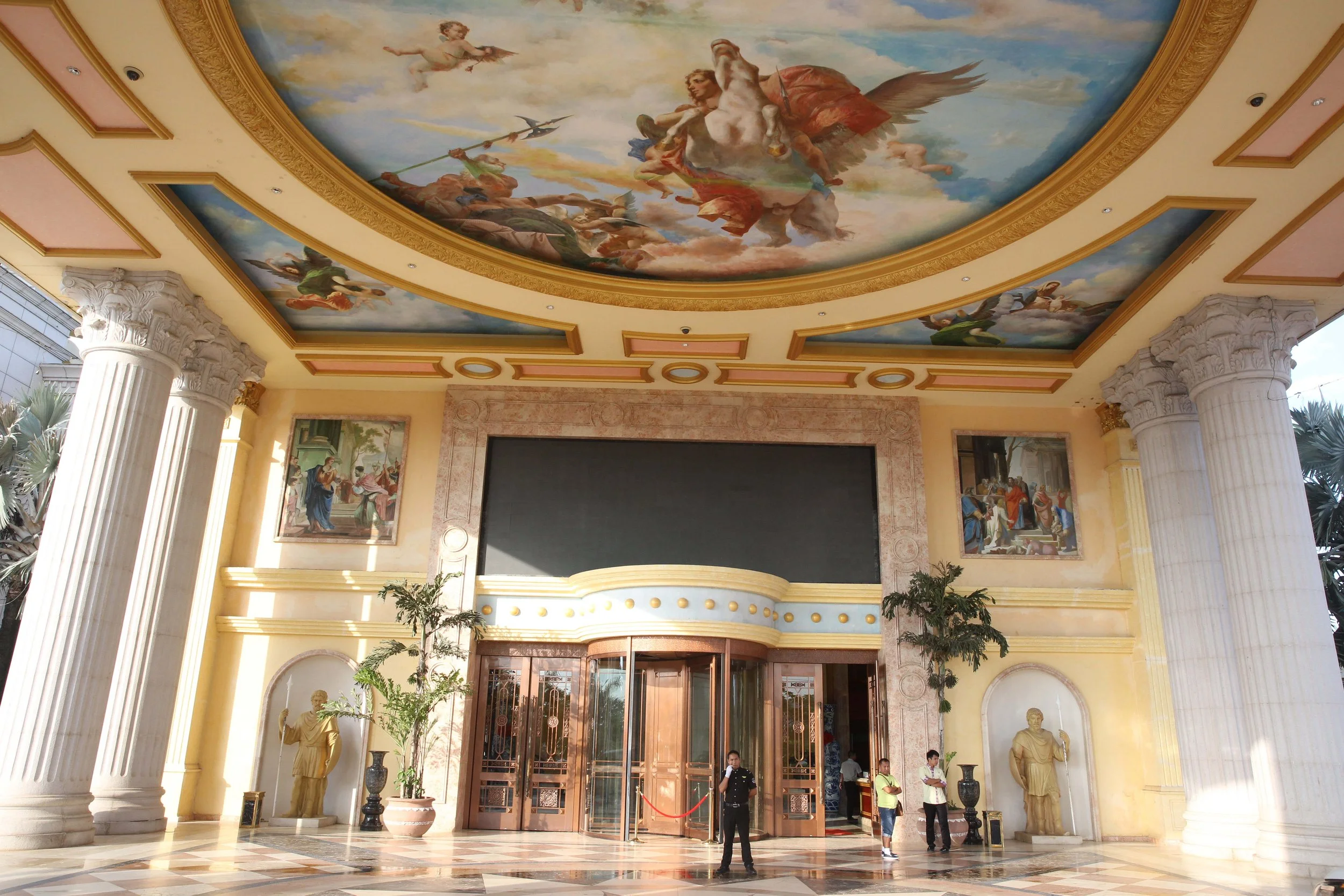
I got my first good look at the casino from up close: a garish mausoleum of embellishment and excess. Pseudo-European floral moldings twisted around its walls, decorative arches wrapped over golden statues of Greek gods, and giant Roman pillars held up Moorish domes. Part Acropolis, part Las Vegas hotel, with a touch of roadside attraction. The largest dome was encased in a gigantic metal crown painted gold that looked like it belonged more at a renaissance fair than a Laotian economic free zone

When we arrived at the pool, a Chinese family was enjoying the water. The men, all pudgy, wore short trunks, and the women, all pretty, wore modest swimsuits. They dove in and climbed out, goggles squeezing their faces, the water catching the sunlight as they splashed each other. It looked like promotional material for a Chinese waterpark. Fun, in the shadow of a Chinese gangster’s money laundering Mecca. Between long puffs of his vape, Ivan explained how the operation worked.

Moving to the GTSEZ was Ivan’s chance at a better life. He didn’t think of himself as a criminal, and he didn’t want to be called one. Most of the people he worked with came for just six months to two years, the entire time wanting to leave. The men were mostly scam callers, and the women sex workers. They got hired through vague online listings or were recruited by friends. Often they didn’t know exactly what they were getting themselves into. For a scammer, the job can feel pretty routine. You work out of large office buildings, clock in shifts, work overtime when you want. You start work late at night. When vulnerable Americans wake up, the phones start dialing. The general method is to pretend to be offering a service, or solving a problem. If the victim doesn’t hang up right away—too lonely, too old, too desperate—you can trick them into buying fraudulent crypto, disclosing credit card information, or making a misguided money transfer. The money goes to the companies, but you score a decent commission. The money added up, Ivan said. Within a few months, if you made enough calls, it could be life-changing.

“You have to make money somehow,” Ivan said.

Back home, for Ivan, there was a war and few opportunities. Moving to the GTSEZ for a few months made sense. Every week he sent money home to his parents who desperately needed it. Bad acts need good justifications. I tried to dismiss him as a criminal, a bad person, but I kept thinking about how young he was, how much he missed his family.

Ivan told me that for Europeans life is relatively safe. They are employees, not slaves. The companies, run by Chinese organizations, treat them fairly. Abusive employers can be reported to authorities, and most of the workers look out for each other.

This consideration was not extended to those in captivity. Ivan wouldn’t tell me much about it, but I thought about the men the trafficker had told me about, the one who hanged himself, the one who slashed his wrists. I could tell Ivan felt ashamed; even if he wasn’t actively engaged in trafficking and imprisoning, even if he was nothing more than a cog in a massive machine.

We got into the water, and changed topics.We dived down to the tiled bottom of the warm pool.

On our way to meet Ivan’s friends at the casino, we passed an imitation European town. It was the most Disneylandesque part of the whole city, the forced perspective, kitsch design. Some buildings had brick walls, large towers with crested windows, plantation-style porches, and the triangle gables of imitation Dutch homes. Behind it all, encroached the dark, jungle hills of Laos and Thailand.

Kings Romans isn't what it pretends to be. It is not a theme park, it is not a family destination; it is a casino city built in the lungs of one of the most morally bankrupt places in the world. It makes criminals out of some, victims out of others, breeding violence and corruption along the way. It's a city of exploitation.

Lined with exotic cars parked carelessly, a long winding driveway led up to the casino. Ivan told me that the cars were rentals. At night, the streets were overrun by luxury cars, erratically driven by licenceless drunk teenagers. They flew around corners, plowing people and scooters out of their way.

As we approached the entrance, the smell of perfume wafted out of the doors of a giant lobby, where Burmese and Thai women staffed the reception desks. I stopped by the ATM to withdraw cash, but the minimum was $15,000.

Past a set of doors, the casino's floor was buzzing with the hum of slot machines and the chatter of gamblers burning through stacks of rainbow RMB bills. The crowd was all ages, the outfits all tacky, the faces all relaxed. Security walked laps around the tables. The LED lights of the slot machines glowed in the cigarette smoke, and slippers slapped across a faded white and gold carpet. Uniformed young women worked at a desk mixing free instant coffee for gamblers who had not come this far to sleep.

Ivan’s friends were pushing numbers on digital roulette screens and tossing away RMB. The money, just the night before cheated out of unsuspecting Americans, disappeared in a few clicks, the spin of a wheel, the unlucky fall of a ball. I imagined the people on the other end of those scams. Stories of second mortgages, upended lives, and suicides spun in my head alongside those of desperate young Europeans, Chinese tourists, Burmese warlords, and Zhao Wei.

* * *

We left the Casino, and went to dinner. We walked down a wide and well paved road parallel to the river. On our left, restaurants glowed with LED lights that twisted around ornate Chinese moldings, on our right, across the Mekong, sheet metal and wood homes were dug into the sloping Thai hills. One of Ivan’s friends—I'll call him Mitri—was vaguely Eastern European with an ill-fitting fake name and flat face. I had spent the past hour creating a version of myself that would get people to drop their guard. I was just a tourist, a backpacker, a burn out. I would never write anything; I’m just here to party; you can trust me. I had lied enough to make Mitri feel comfortable talking about the trafficking victims. He said people are approached in villages and impoverished cities. Some offered a job, others taken. Their passports are confiscated, and they're forced to sign contracts they can’t understand. They are put in decrepit rooms in rundown buildings with filthy bathrooms, and shacklike apartments with barred windows. Girls are forced into prostitution, men held for hours at office buildings making call after call. They are fed chicken feet and scraps. There are no promises of returning home with money to support their families.

I thought back to a phone call I had gotten a few months before, from a man with a thick Indian accent who had introduced himself as ‘John.’ John had informed me that my social security number had been stolen, but he could help me. I told him he was a morally bankrupt criminal, that the world was better off without him. Now I pictured John laying on a thin mattress in a stinking room with steel bars on the windows.

Mitri told me that most of the workers are trafficked into the GTSEZ from South East Asia, but some of them were Chinese. He said the Chinese government routinely sends—sells—its own prisoners, Chinese nationals, to be held in scam centers around the Golden Triangle. Realizing what he divulged, Mitri quickly changed the subject.

Dinner was at an empty bar built on a boat anchored in the Mekong. A group of Europeans were drinking around a table. Servers coagulated around them, constantly refilling their beer glasses. A band sang Chinese pop’s greatest hits. The rotting smell of the river was cut through by sugary clouds blown from vapes and the smoke of cigarettes burnt through by the pack. My presence caused anxiety, but Mitri told everyone that I was okay.

I met three Eastern European girls with thick makeup and painted nails. They said they worked as models. The men around the table smirked. They were cam-girls. They asked me why American men fell for it, but I didn’t think they would like the answer. Once you start imagining the lives of desperate middle-aged men, of divorced fathers isolated by their work and responsibilities, you’d start to feel guilty. It’s easy to scam someone who you think is an idiot; lying to someone who’s hopeless and alone is hard. I knew they didn’t want to think about it, neither did I. So I sat at the table and continued to drink and lie about who I was, and the girls talked more about how unhappy they were.

They didn’t need to explain why they were in the GTSEZ, it was easy to figure out. They came from countries at war, or on the brink of it, from struggling families living under economic instability, violence and fear. They were refugees. Their work arose from desperation. It was never a life they wanted, and their lives in the GTSEZ were harder than the men's.

The models only made commission, so to make their sacrifice worth it, and to support their families, they needed another source of income. White and blonde, they were an expensive treat for Chinese tourists who would pay thousands of RMB. It wasn’t explicit sex slavery, like the girls in my hotel lobby. But if you gave up everything to get there, you had to make as much money as you could. Mitri said the tourists are often riddled with STDs, from Chlamydia to HIV, which they pass to the girls. There is no testing or treatment. When the girls leave, along with the money they earn, they take those diseases home with them.
All the young people I met and got to know in the GTSEZ had accepted the terms that came with where they were, what they were doing. They made it mundane, part of their lives: sleep, drink, scam, sex. They acclimated to the Kings Romans; only then can you spend your days drinking by the pool and dining out, and your nights doing what they did. And I began to acclimate too. I stuck to my story, the version of myself I had created, and the guilt started to go away.

* * *


The next day, at a different pool, a group of men wrapped in tattoos watched as their wives taught the children how to swim. I was invited by three Chinese men crammed into speedos to join them at their table; I ordered a round of beer from a bar that played Christmas music over concert-sized speakers. The men and I exchanged shallow small talk. Their wallets were stuffed with RMB and their jewelry was thick, gold, and drenched in diamonds. One of the men was covered in full-body burn scars, water dripped through the creases of his skin as he ate a platter of chicken wings with rubber gloves.

On the other side of the pool, a group of girls were celebrating a birthday around a table scattered with empty bottles of wine. I made eye contact with one of them, a Kazakh girl older than me, but still in her twenties. She was pretty and unassuming, high cheekbones and a low cut bikini. We exchanged glances, a few smiles, and walked past each other's tables more times than necessary.

I got a message from Mitri. He asked how it was going at the pool, and I told him there were pretty Kazakh girls, and he should come and be my translator. He didn’t respond to my message. It was barely ten minutes before I saw him rushing down the walkway with two other men from the night before. I got up to meet them, to ask if I could get them some beers, but Mitri didn’t give me the chance.

Those girls?” Mitri asked, pointing at the table of Kazakhs. “Don't talk to those girls.”

He walked to their table, he didn’t shout, he spoke at them in Russian. The girls stopped smiling, Mitri’s friends took place behind him, I started to panic, the girls were getting angry, the families laughed and splashed around in the pool. Mitri came back and said we were leaving. I asked him what was going on.

“You shouldn't trust Kazakh girls here. If you had gone back to a room with one of them, men could come in while you were distracted, they could take you, rob you, anything.”

I followed him away from the pool and to his scooter. I kept looking back over my shoulder.

“You’re fine though, don't worry.” Mitri smiled. Everything that could have happened was dismissed. He asked for a cigarette and we drove to the casino. 


* * *


That night, I met the young man who would walk me out to his balcony that night. He was waiting for me at my hotel—I’ll call him Alexei. “Don’t worry,” he said, “I’m not going to hurt you.” I asked to see what was in his bag. He looked amused and unzipped it dramatically. A passport, phone, wallet. No gun, no knife. I told him we could talk in the cafe.

Alexei didn’t speak on our walk to the cafe, but when we sat down he wouldn’t stop. He was from a part of the world that gets its reputation from its warlords and wrestlers. He grew up surrounded by violence. He told me that what he had lived through made him who he was. He wasn’t afraid of who I might turn out to be, like Ivan was. At that table it stopped feeling like an adventure, it was just fear. My confidence had left me, I wasn’t some explorer, some veteran journalist deeply undercover, I was a college student who had lied himself into real danger. And now I was stumbling over my lies, I just wanted to leave.

While we talked I burnt through half a pack of Chinese cigarettes. Alexei said that he knew I wasn’t CIA because he saw how much my legs were shaking. He laughed at me. I was too afraid to feel pathetic. But he wanted to know how I had managed to cross the border. Alexei said Americans weren’t allowed into the GTSEZ. But there I was, and he needed to know why.

So I told Alexei as much of the truth as I could: I had no idea how I had gotten in, I just wanted to go back to my room. But Alexei was never going to let me. We left the cafe, he hailed a cab and pulled out a wad of RMB.

We arrived at another pool. I saw some people I knew, others I didn’t. Everyone ignored me. Ivan was there but he didn’t have much to say either. People spoke to Alexei with a tone of respect, and I realized how many conversations about me were being had in languages I couldn’t understand. I got ready to leave, but Alexei stopped me, “Let's go back to my apartment." It was an order.

On the walk to his apartment, the streets of Kings Romans had come to life. The city was nocturnal; at dusk, the workers crawled back to their homes and the Chinese nationals stumbled out to the streets. The bars and clubs lit up, cars overran the roads, and the prostitutes tossed weak gazes from the windows of hotel lobbies. The boats across the river had stopped for the night, Alexei knew where I lived. There was nowhere I could go.

Alexei was right behind me as we entered his apartment. It was a small, cramped one-bedroom. He locked the door behind us, and told me to go out and stand on the balcony. I didn’t have a choice. There was no authority that cared about me, I had no rights or protection, nobody owed me anything. People disappeared all the time, were massacred, bodies floated down the Mekong. It was just me and Alexei and the knife, out there on the balcony, and whatever happened next was almost entirely in his hands.

I said the first thing I could think of. I asked him if he had a girlfriend, he did and he told me he loved her. When he talked about her, his disposition changed; he started smiling. I asked if he had any beers, and he told me to grab one from the minifridge as he rolled himself a joint. We sat on his balcony and talked. I realized that Alexei, like Ivan, had no one he could be honest with.

Alexei had gone to Myanmar for a gun deal, but was kidnapped and forced into slavery at a scam center. He made his way up the ranks and came to Kings Romans with a newfound authority. Alexei said all he wanted was enough money to buy a home in the countryside for himself, his family, and his girlfriend.

Alexei showed me a childhood photo on his phone. Young Alexei wore a Nirvana T-shirt and skinny jeans, he seemed to be saying, this is who I was. I told him I liked Nirvana and he got excited. He led me back inside the apartment.

I sat on the floor. He got out a guitar, and sat on his bed. He strummed his guitar, tuning it before he began to sing. He chose to perform Nirvana's MTV Unplugged set, starting with “Man Who Sold the World” and ending with "Where Did You Sleep Last Night.” I couldn’t believe what was happening. My shirt was cold with sweat and my heart had pumped itself into exhaustion, but I started to sing. He ended with a song from his homeland. I told him that he sang like he missed his family. He shrugged it off and invited me to a party.

"I’ll rest for a bit, and text you,” I told him.

In the elevator every ounce of adrenaline seeped out of my body and pooled in my battered Vans sneakers. There was no way I was going to the party. I felt like I had exhausted my luck. I didn’t know how many more interrogations I wanted to sit through. I latched every lock on my door, packed my things, stashed spare cash in my shoe, my passport in my waistband, and lay down on the bed. And I started sobbing. I had never cried from fear before, I never thought of what it would feel like. Gasping for air, feeling your muscles tense and drop, digging my nails into the stiff mattress. But my crying ended as quickly as it had started. The first boats wouldn’t start crossing the river until the morning, I had to make it through the night.

That night I thought about what I had seen: criminals, traffickers, gamblers willing to ignore anything to place their bets. But somehow, even there, I had found ways to connect with people who were starved for connection. And it was moving, somehow reassuring, up to a point, but I had lied to all of them. In the streets around the casino, the night clubs and bars, at the parties and pools, it’s all darkness and loneliness and pain. It’s slavery and abuse. Governments, criminals, predators. But also, it’s desperation. I felt like I had to tell the story of what I had seen, not only of those held in captivity, but of the refugees who fled the violence of their homes for the chance at a better life. Ivan, Mitri, Alexei, the girls at the bar. None of them wanted to be there, they felt afraid, guilty, ashamed. And they were all just kids, thrown into a life they weren't ready for. I told myself that the only way I could justify lying to them, was to be honest about who they were.

I woke up at first light and quietly left my hotel; I tossed a taxi driver a handful of RMB and had him take me down to the port. I rushed through immigration, and hired the first longboat I saw to take me across the river. I watched as the buildings of the Kings Romans Casino got smaller and smaller behind me, the brown water lapped against the side of the blue boat, and the boatman made a joke I couldn’t understand.

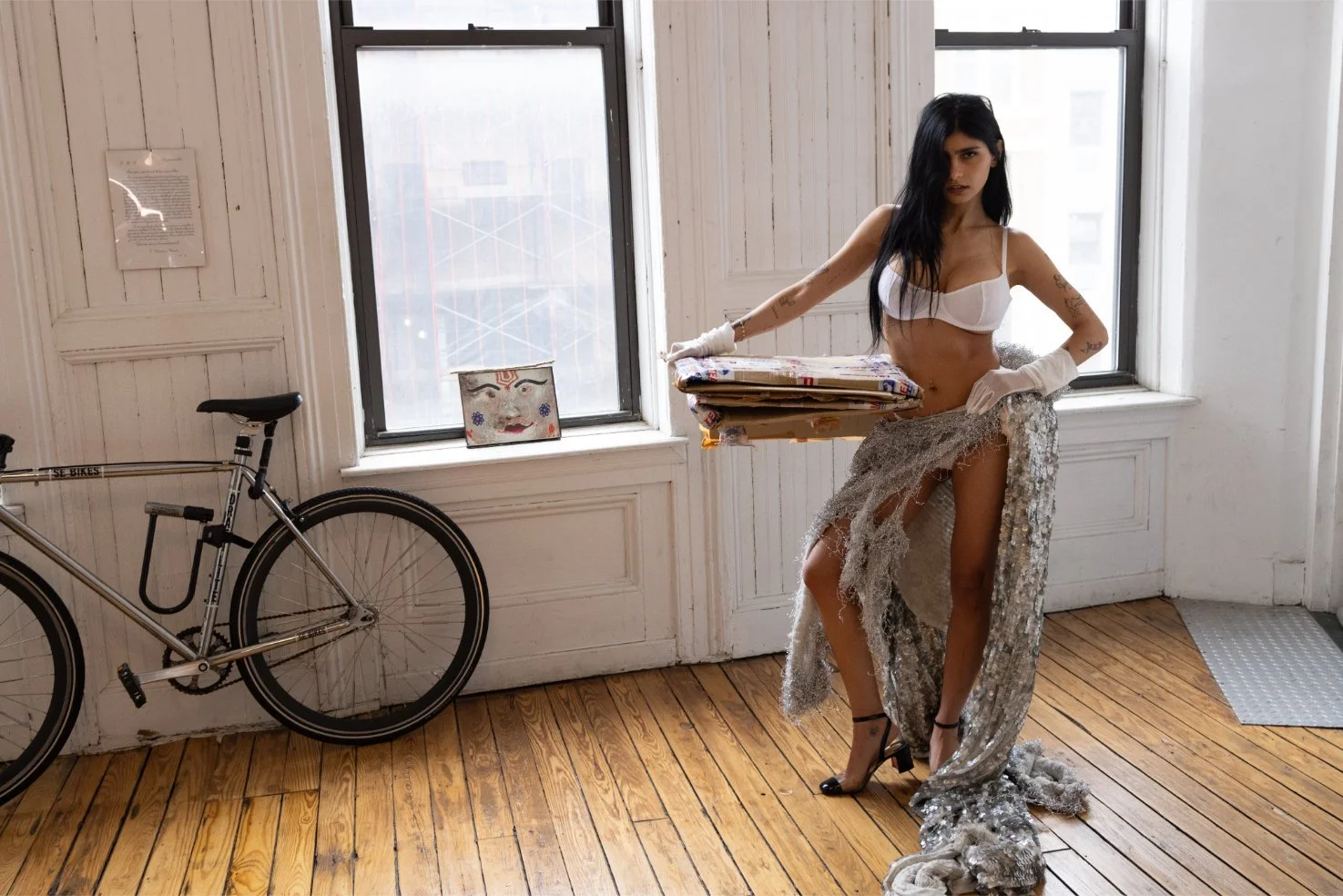
Mia Khalifa

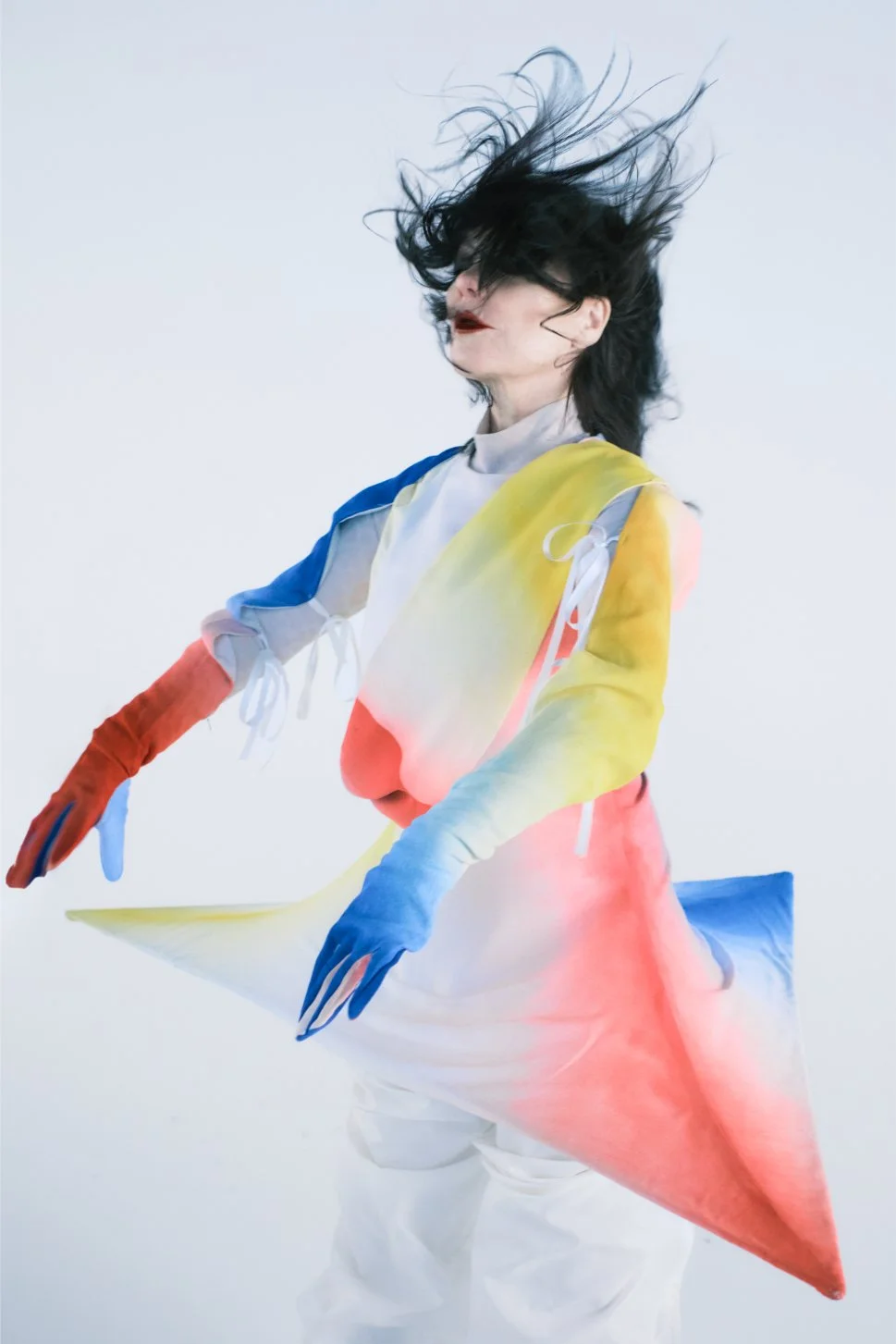
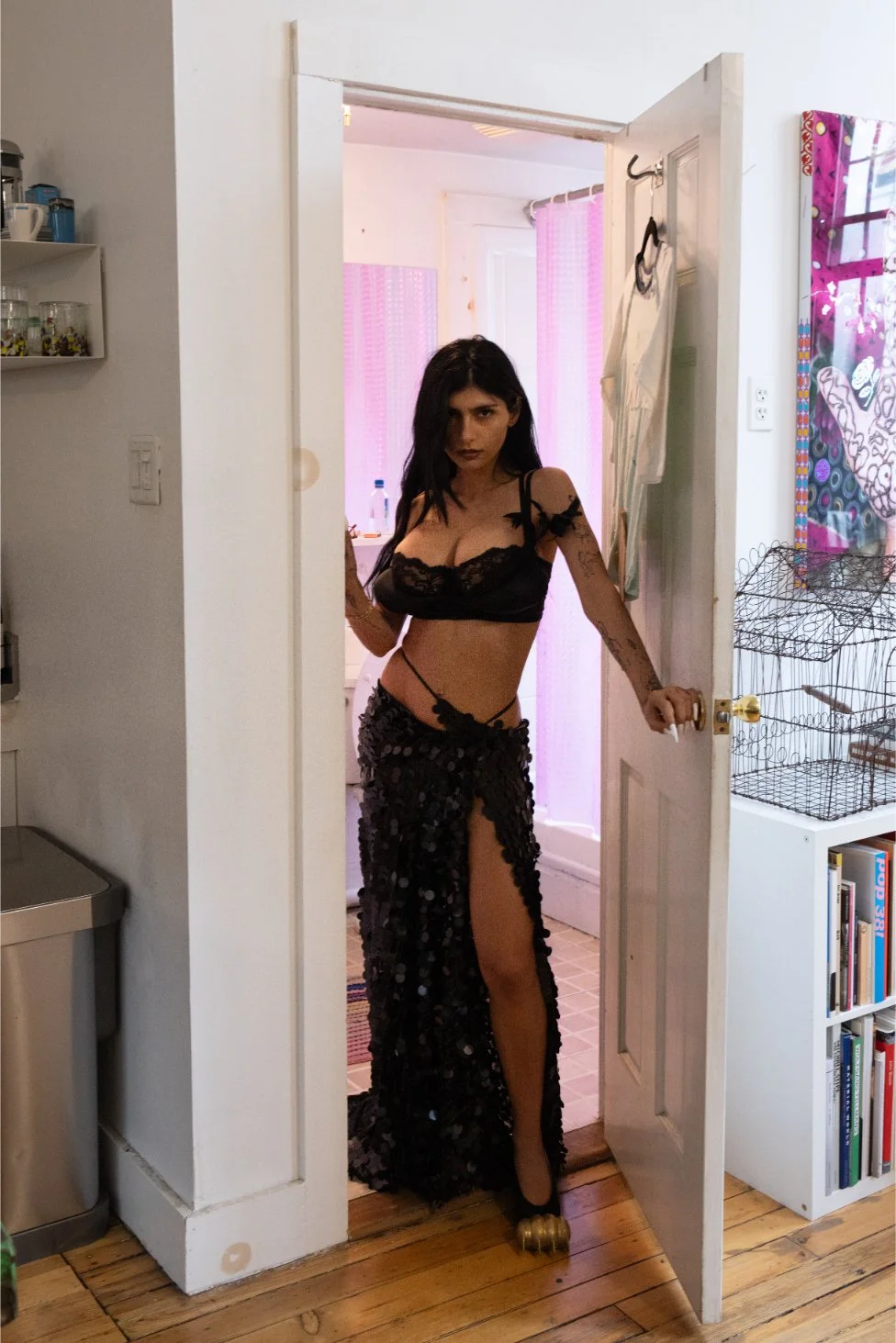
bra COU COU INTIMATES
skirt MISS CLAIRE SULLIVAN
gloves and shoes STYLIST’S OWN

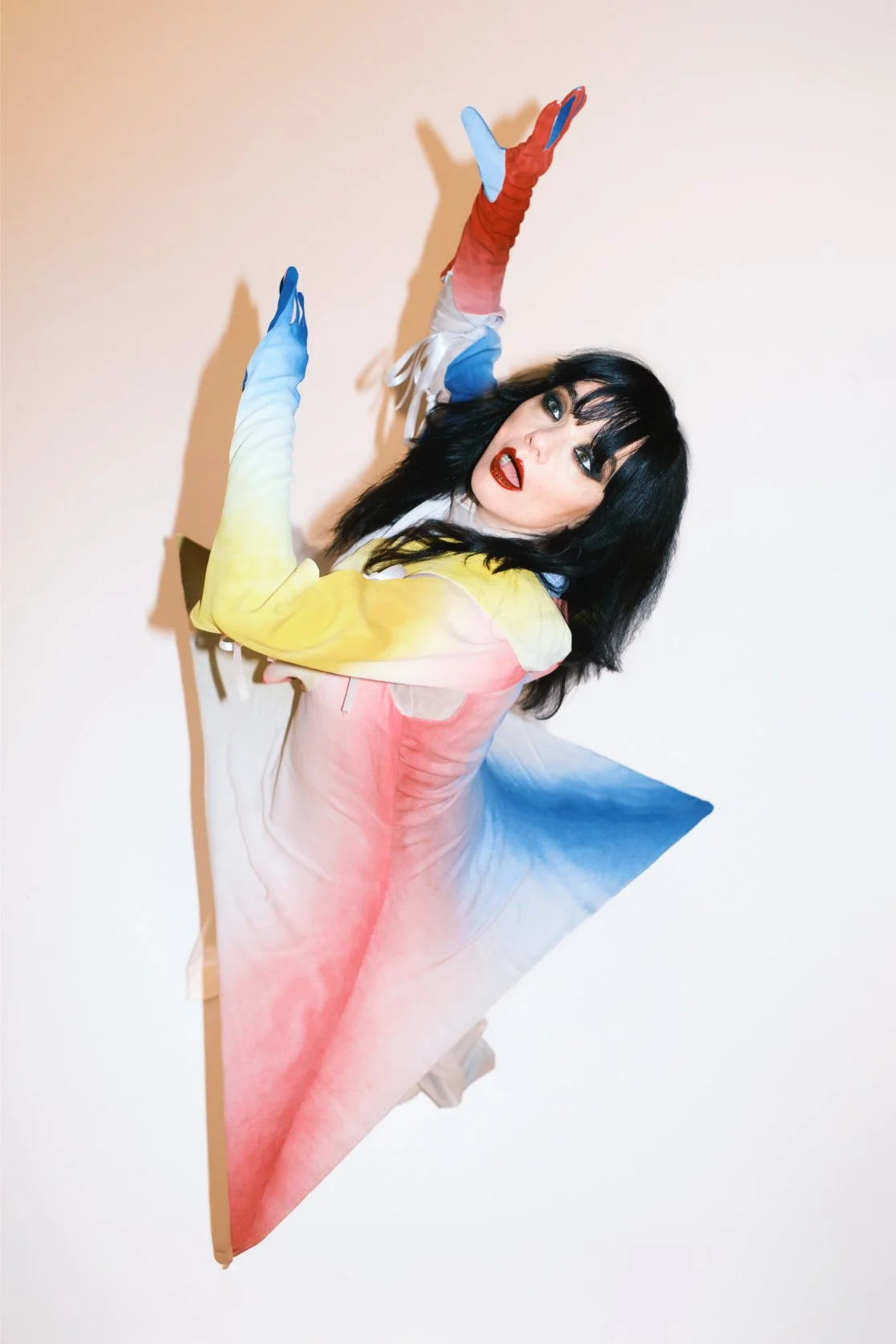
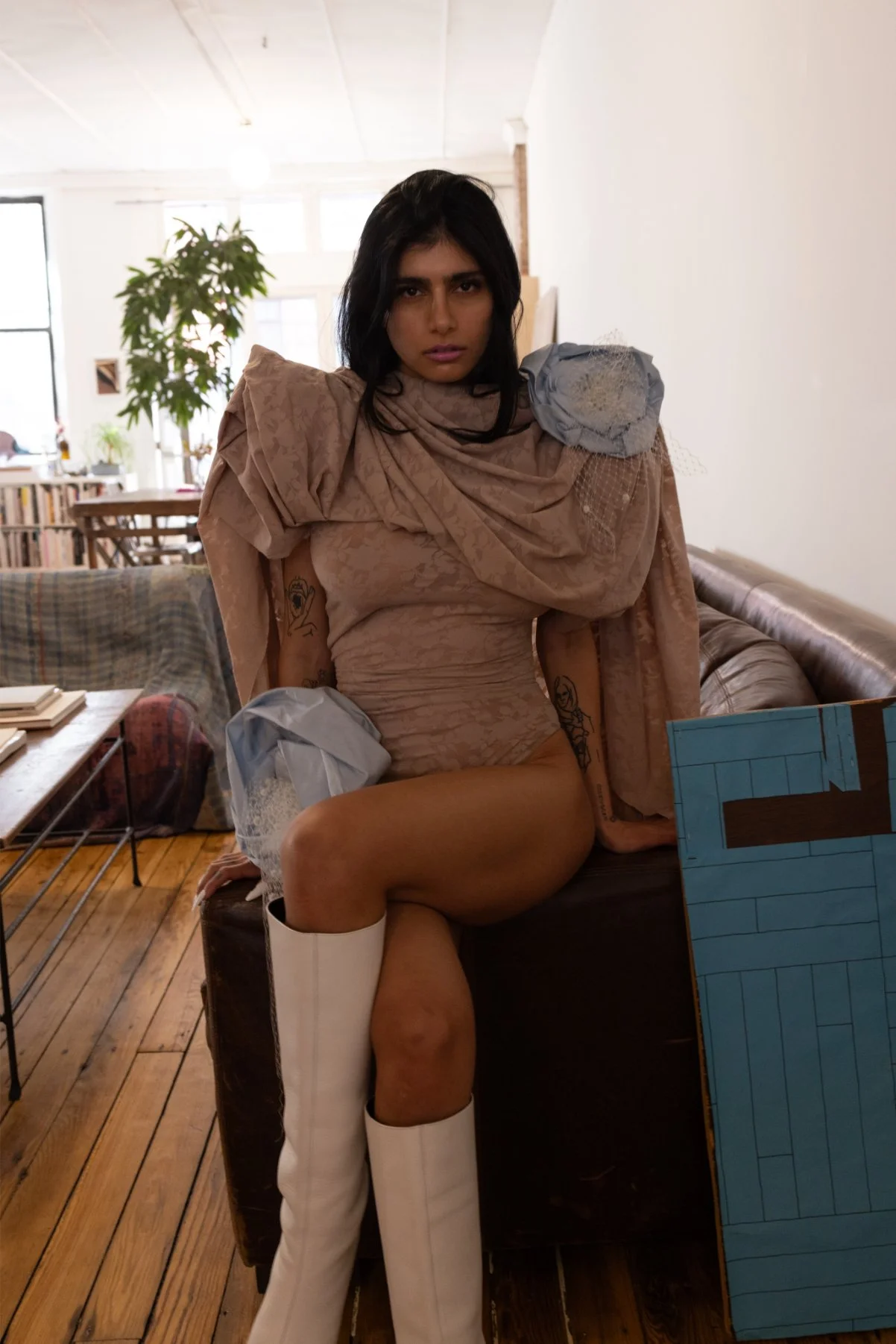
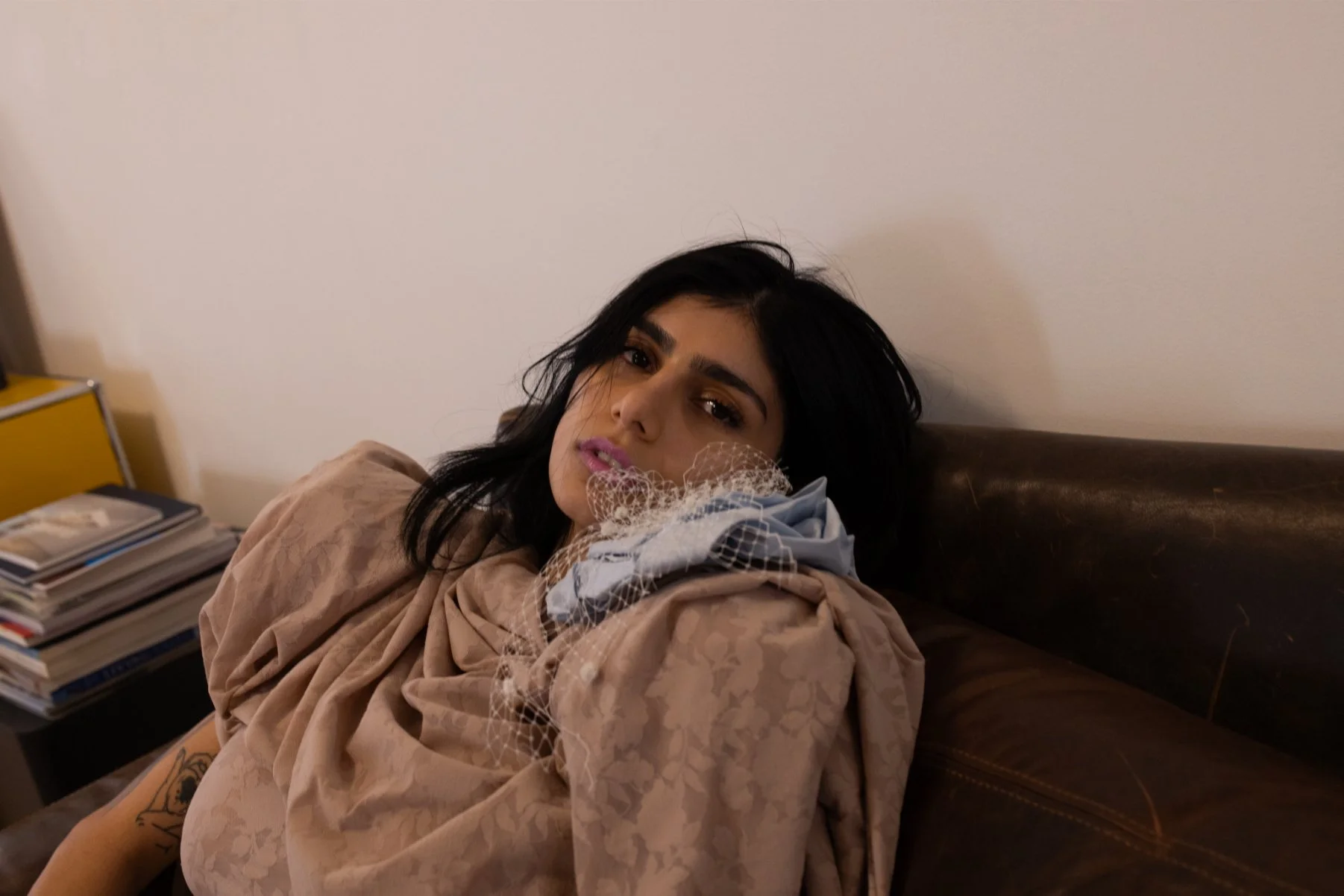
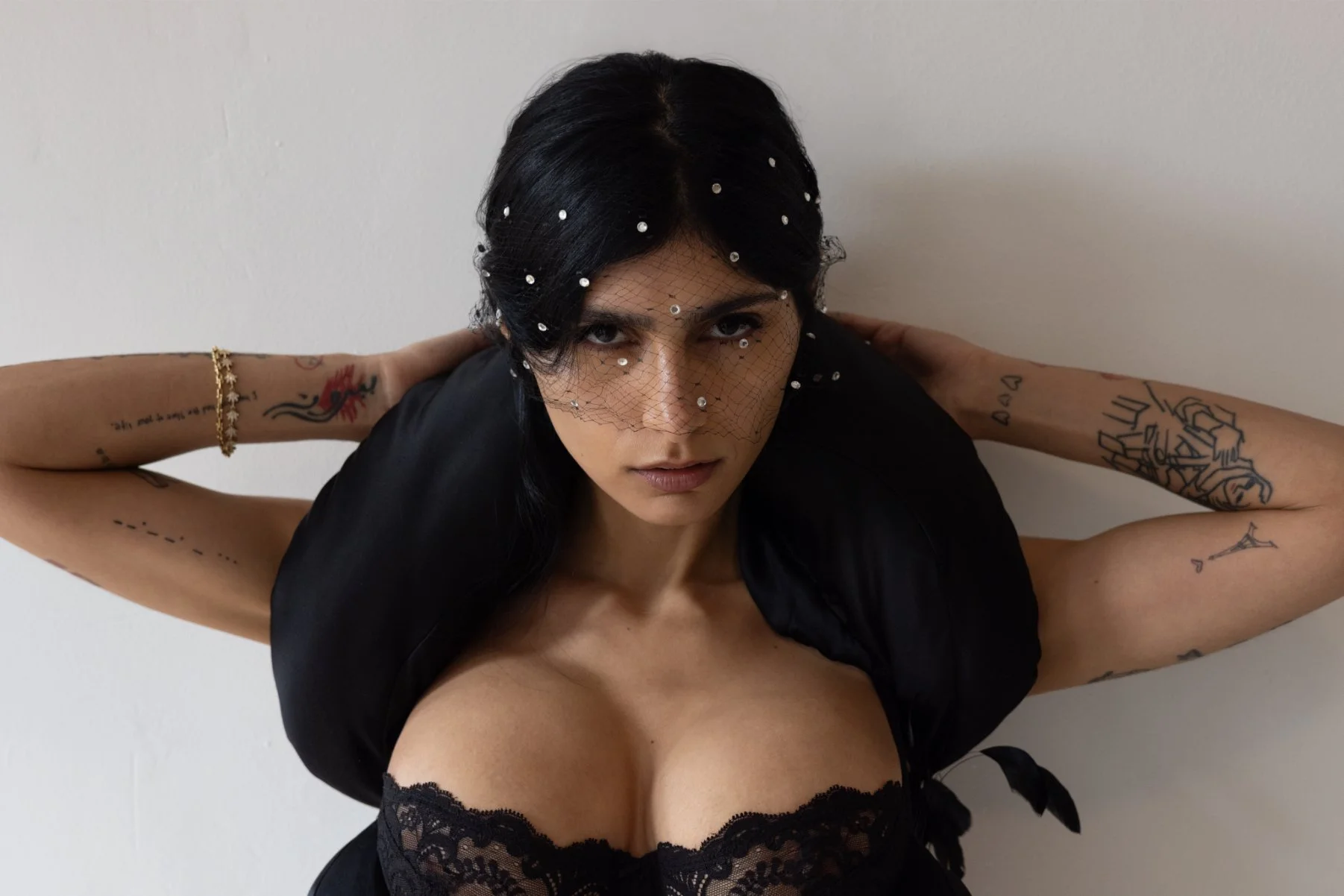
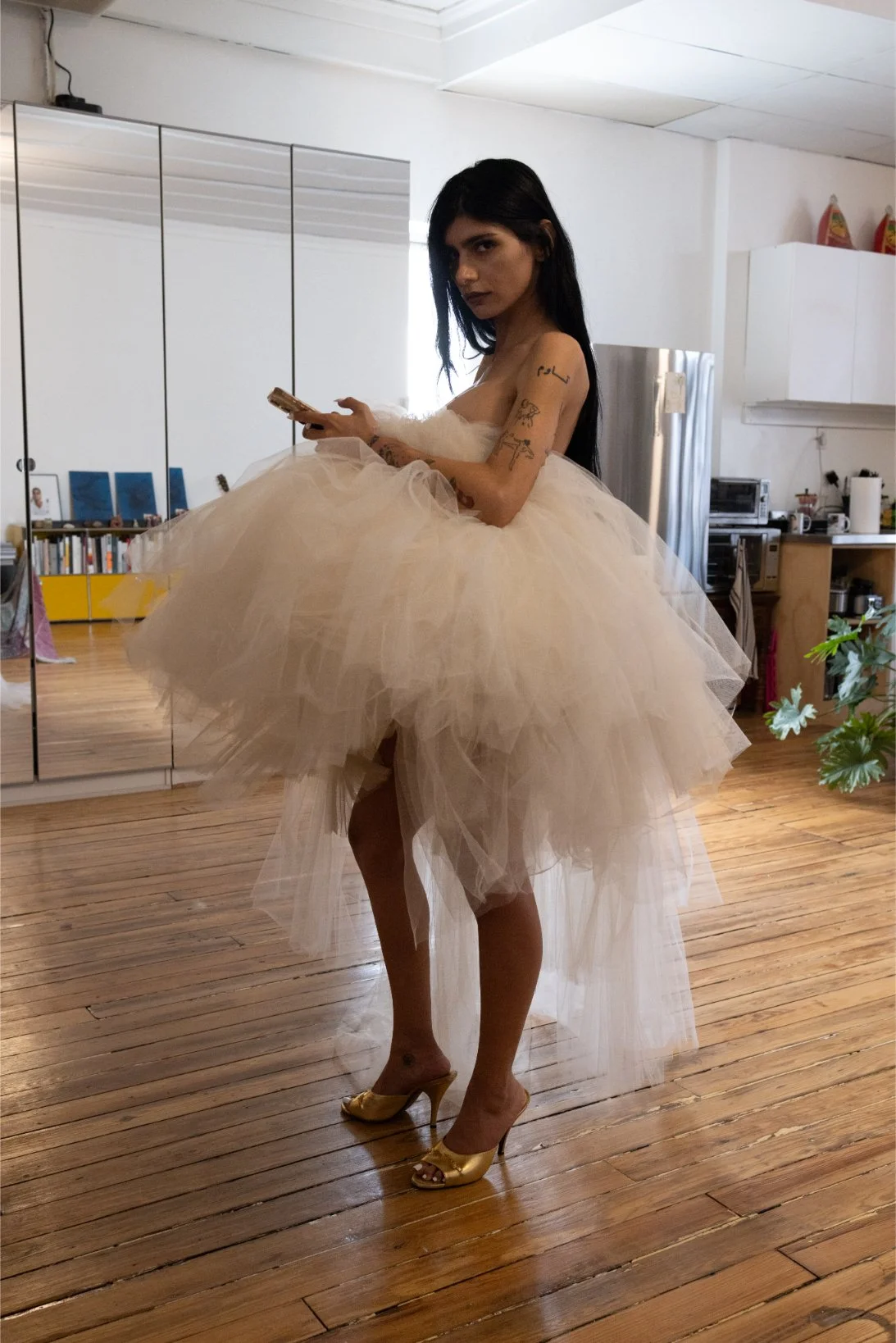
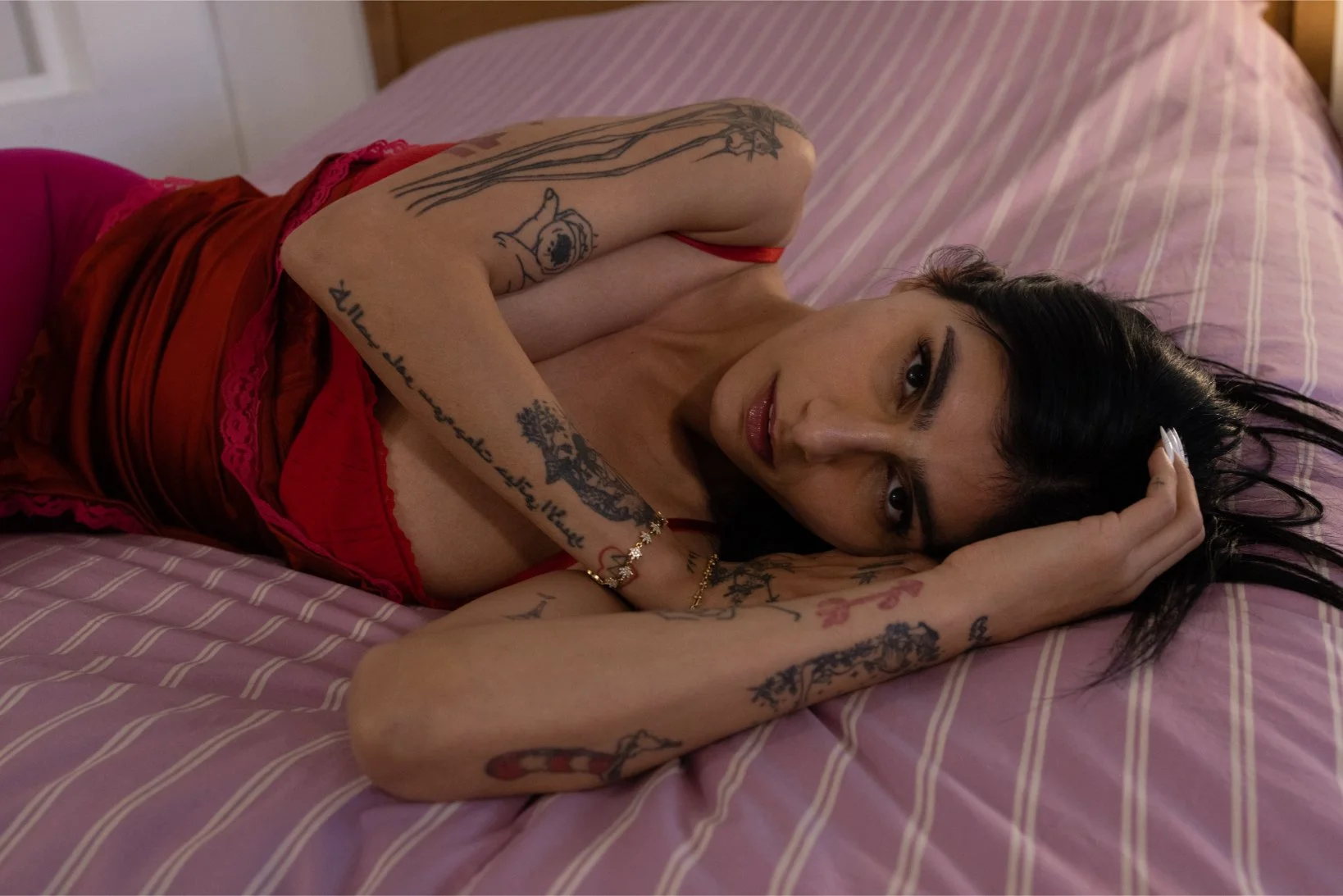
Avatar, muse, model, activist, influencer, crush, object of desire, and subject of relentless fascination, Mia Khalifa, whose real name is Sarah Joe Chamoun, has always navigated the delicate space between the zeitgeist and an inescapable paradox. As an icon of desire, she has become a holographic projection of society’s deepest anxieties surrounding race, power, beauty, and female bodily autonomy. As a figure of fascination, she has channeled her immense social influence to boldly confront human rights abuses, political repression, cultural stereotyping, and the exploitation inherent in the adult entertainment industry. In 2023, Khalifa was invited to speak at the Oxford Union–one of the world’s most esteemed platforms, founded in 1823–where she engaged in a powerful discourse on reclaiming her narrative, shifting the conversation from objectification to empowerment. Born in Beirut in 1993 and raised in a conservative Christian household, Mia Khalifa’s understanding of shame and politicized sexuality is profoundly shaped by her own tumultuous journey. Her perspectives are not just personal–they are forged in the crucible of cultural conflict, navigating the intersection of religious conservatism and the fiercely contested terrain of self-determination and sexual expression. In 2023, alongside Sara Burn, a former Virgil Abloom collaborator, Khalifa started the jewelry label, Sheytan (Arabic word for devil). In the following interview, Khalifa and Burn discuss navigating public and private persona, desire as a multi-faceted force beyond sex, and creative legacy.


Interview by Sara Burn
Photographs by Nick Sethi


SARA BURN: This issue revolves around the subject of "desire." I'm interested in the concept and your thoughts on desire. How would you define desire? Is it primarily physical, emotional, intellectual, or something else entirely?

MIA KHALIFA: I think it's everything. I believe desire is—you can't do anything in life without it. It's a big driving force. It's synonymous with having a drive. But there’s also a desire to accomplish something, reach a milestone, or create something. It's definitely not just a sexual thing.

BURN: Yeah. I agree. Are there any films or music that really capture the essence of desire in a way that resonates with you personally?

KHALIFA: I don't know if it resonates with me personally, but I, Tonya, is very much about desire. So are movies like In the Mood for Love, Brokeback Mountain, and even The Dark Knight Rises. All of those movies portray multifaceted aspects of desire.

BURN: What I love about Ang Lee, Craig Gillespie, David Cronenberg, Gaspar Noe, and Lynch even, is their work often explores the darker, more complex aspects of desire. I guess there's a refusal to sanitize desire in those movies. I wonder if there's a particular scene that you felt really stayed with you because it captures something that's uncomfortably true about the nature of wanting.

KHALIFA: In The Dark Night, there was a scene with two ferries—one carrying civilians and the other transporting prisoners—both are rigged with explosives. Each boat has a detonator that can blow up the other, and the Joker gives them a choice: if one boat destroys the other by midnight, that boat will be spared; otherwise, he will detonate both. It was a moral dilemma. But the tension is just as high in a moment like that as in Brokeback Mountain before everything builds up to where they accomplish what they want. I think the two characters in Brokeback Mountain are interesting because one of them really understands his desire and his own want.

BURN: And the other one has never been faced with it before. It's brand new, which is, I guess that's what makes that so charged and powerful that there's almost an imbalance, but a complete equal to their want, if that makes sense.

KHALIFA: Totally.


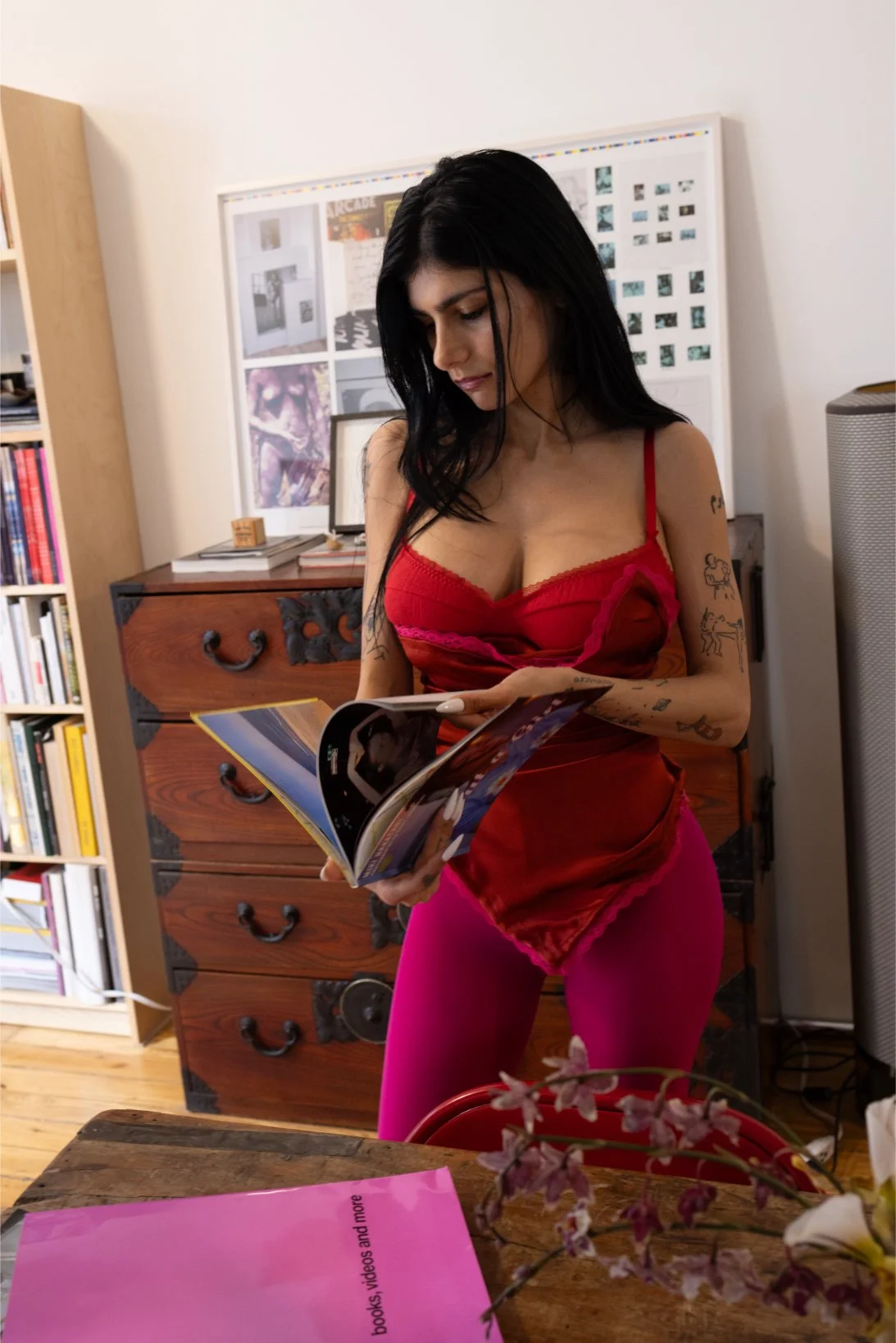
bra COUCOU INTIMATES
wire bustier MISS CLAIRE SULLIVAN
stalkings FALKE


BURN: I like seeing portrayals of desire that aren't pretty or convenient. It doesn't have to be this beautiful scripted thing. In that sense, it doesn't necessarily have to follow the rules. Are there any films or scenes that you find especially powerful in the portrayal of longing or obsession?

KHALIFA: Let's see. Oh, my God, there's so many…

BURN: … It's so hard to be put on the spot because immediately everything swims into one big soup.

KHALIFA: Exactly. What movie doesn't have a dramatic element of obsession? So, at that point, you're just asking me my favorite dramatic scene in a film.

BURN: I know we've discussed this before: the Phantom Thread, the most romantic portrayal of utter devotion.

KHALIFA: Yeah, that and American Psycho. So many come to mind. It's very hard just to pick one because, at the end of the day, that's what everything is about. I don't think there's a good film or good piece of art in history that doesn't reflect a form of desire in a way.

BURN: We recently saw Vanessa Raw's works at the Rubell. I found them really powerful, not only in terms of the scale of the works but also of the subject matter. I don't think I've seen unfiltered female desire portrayed in that way before.

KHALIFA: I mean, there was so much for your eyes to take in. The size of them and the amount of detail that's in them, you really, really get lost. What's happening in the paintings is the last thing you notice. You really feel like you're stepping into a universe. Many of the paintings depict the jungle or wilderness, so it almost feels like you are in some kind of atrium within the museum. It feels like you've stepped into a courtyard, and you're taking in all of nature, and then you realize, Oh, my gosh, these women are unapologetically expressing their desire for each other. It's really, really beautiful. Her art is so layered, and the sensuality is one of the last things you notice.

BURN: Yeah, you're so right.

KHALIFA: I love the way that it was laid out, specifically in that room. There's enough space to feel like a breath of fresh air. It also feels like it's an intimate corner of her mind. There's one piece that wraps around you. She has thought about the subject enough to make a room full of art depicting desire in as many different ways as she can, and that's so beautiful. The desire shines through on every level: the desire to connect with nature, the desire to connect with women, and the desire to connect with yourself. There are women touching themselves in the paintings, even if they're not specifically part of the main scene. It's so amazing. I love her work so much.


floral bodysuit MISS CLAIRE SULLIVAN
boots BY FAR, COURTESY OF EMCEE STUDIOS


shoulder bustle MISS CLAIRE SULLIVAN
lace bra DEBORAH MARQUIS
feather bra MISS CLAIRE SULLIVAN
veil STYLIST’S OWN
bracelets SHEYTAN

BURN: Do you think there are any aspects of desire that you feel are unrepresented in contemporary culture?

KHALIFA: We talk a lot about how things were better back in the day, but that's something very nice about living in this day and age. I feel like so many different facets of desire are much better represented than before. It grows more and more every day. I love that I don't feel I have anything new to add. I have something to contribute to something that I already feel a part of, which is great to feel that way.

BURN: Yeah, I think it's also that level of acceptance—the nuance of different people's reality of what they find desirable or is publicly accepted. I think that's really refreshing. You don't need to hide anything in brown paper bags any longer. You can put it on the internet.

KHALIFA: Yeah, exactly. And it's totally fine.

BURN: You're quite unusual in that you work predominantly alone without a team, a PR, a publicist, or the typical entourage that surrounds public figures of your caliber. You create the majority of your content yourself. Is this independence a conscious choice to maintain complete control of your narrative?

KHALIFA: Yeah, I think the idea of personal narrative makes it hard to bring anyone else into the process because it’s just that—personal. Your story is yours, your choices are yours, and what you share is entirely up to you. There’s no one saying, “You should do more of this” or “Maybe don’t say that.” Not having a traditional team, to quote David Lynch, gives us a lot of opportunities to go dreamy—which means we end up on a lot of creative sidequests. Spiritually, it’s been incredible. Financially… not so much!


tutu dress MISS CLAIRE SULLIVAN
shoes STYLIST’S OWN


bra COU COU INTIMATES
wire bustier MISS CLAIRE SULLIVAN
bracelets SHEYTAN
stockings FALKE

BURN: Your success is built from the fact that you're not answering to anybody, and you don't have an agenda as such.

KHALIFA: That's exactly it.

BURN: Most people in the public eye that have your level of platform have an agenda.

KHALIFA: Yeah, they're much more of a commercial vessel than I am. And it's not that I don't want to be. That's why it's a little difficult to answer that question because that's been a goal of ours to get there. I would totally be up for having a global agent; I want to work in scripted and non-scripted media and branch out.

BURN: It's unusual to have your caliber of engaged audience and audience who desire your image and thoughts. Your visibility is unique. It's quite easy to put lots of people in boxes. You don't really have a specific category—other than being 100% honest.

KHALIFA: To quote Tina Fey, “Authenticity is dangerous and expensive.” You have to learn to shut your fucking mouth.


lace bra DEBORAH MARQUIT
leather bra MISS CLAIRE SULLIVAN
sequin skirt MISS CLAIRE SULLIVAN
shoes WOMEN’S HISTORY MUSEUM


BURN: Having millions of people regularly engage with your work creates an experience few will ever know. How has your understanding of what it means to be seen changed over time? Has this awareness of your audience become integrated into your creative process, or do you find ways to create from a space that feels separate from the public gaze?

KHALIFA: Completely. I've opened my mind and my world. I know where I want my visibility to be and how I want to be seen; it makes it a lot easier to deal with the anxiety of not wanting to be perceived. I feel like I'm creating more outside of the public gaze than I am for the public gaze. The different creative areas I've been welcomed into that I otherwise wouldn't have been exposed to are very empowering and very validating.

BURN: Anything specific?

KHALIFA: There are just different subcultures and different types of people, like Linder Sterling and Sofia Prantara, all of the people you've introduced me to, and the types of art you've shown me.

BURN: I guess what I'm trying to ask in this question is, how has your understanding of what it means to be seen changed over time? You've always been seen. You know you've got an audience, a captive audience.

KHALIFA: What's changed is my relationship to it. My relationship to being seen is a lot less a relationship of recoil and discomfort. I've produced and done a lot of work that I'm really proud of. I have experienced firsthand so many people coming up to me, and that being the first thing they mention, or what they know me from, or how they were exposed to me. And so my relationship with being seen is not one where I'm constantly battling with shame.


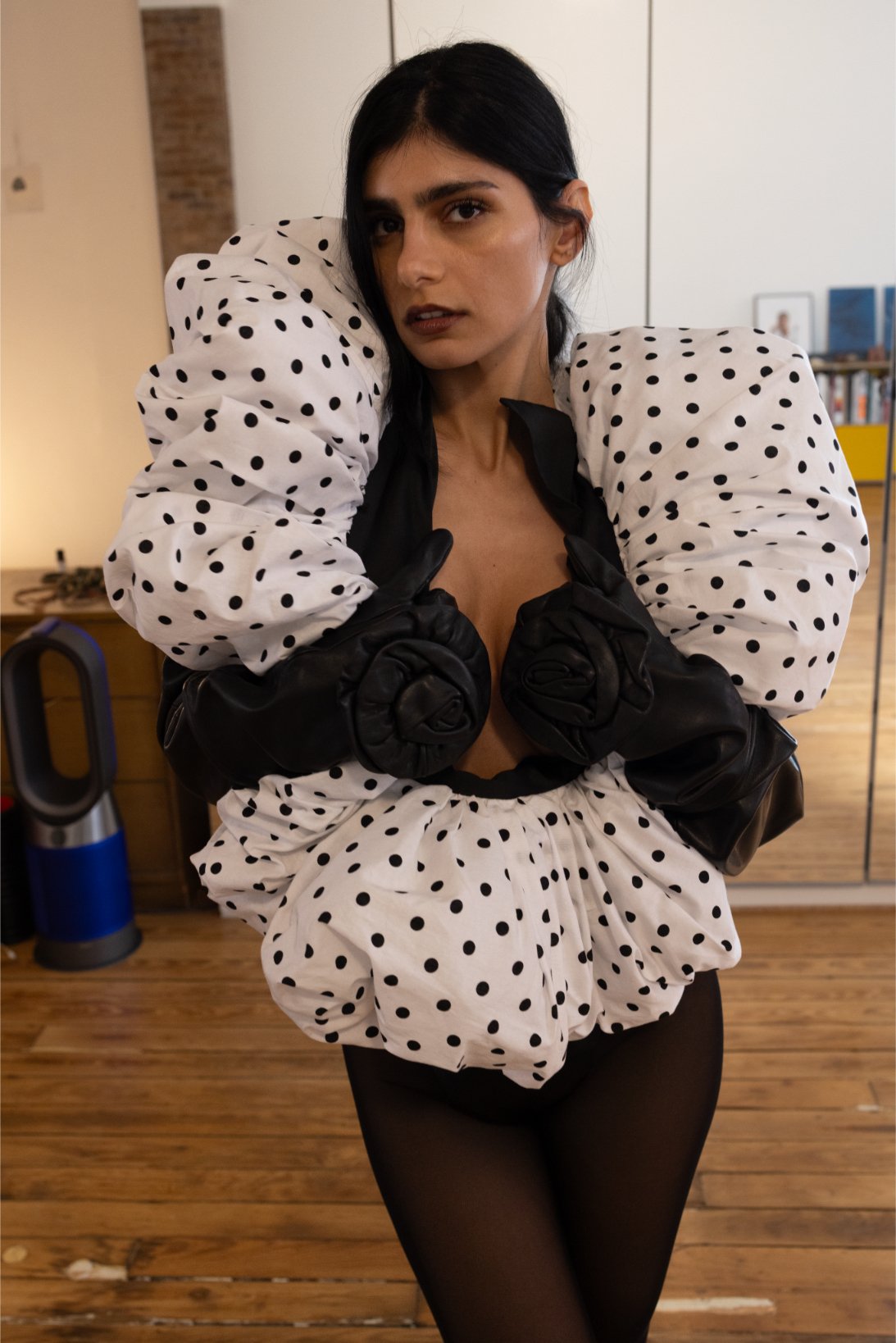
full look MISS CLAIRE SULLIVAN
gloves STYLIST’S OWN


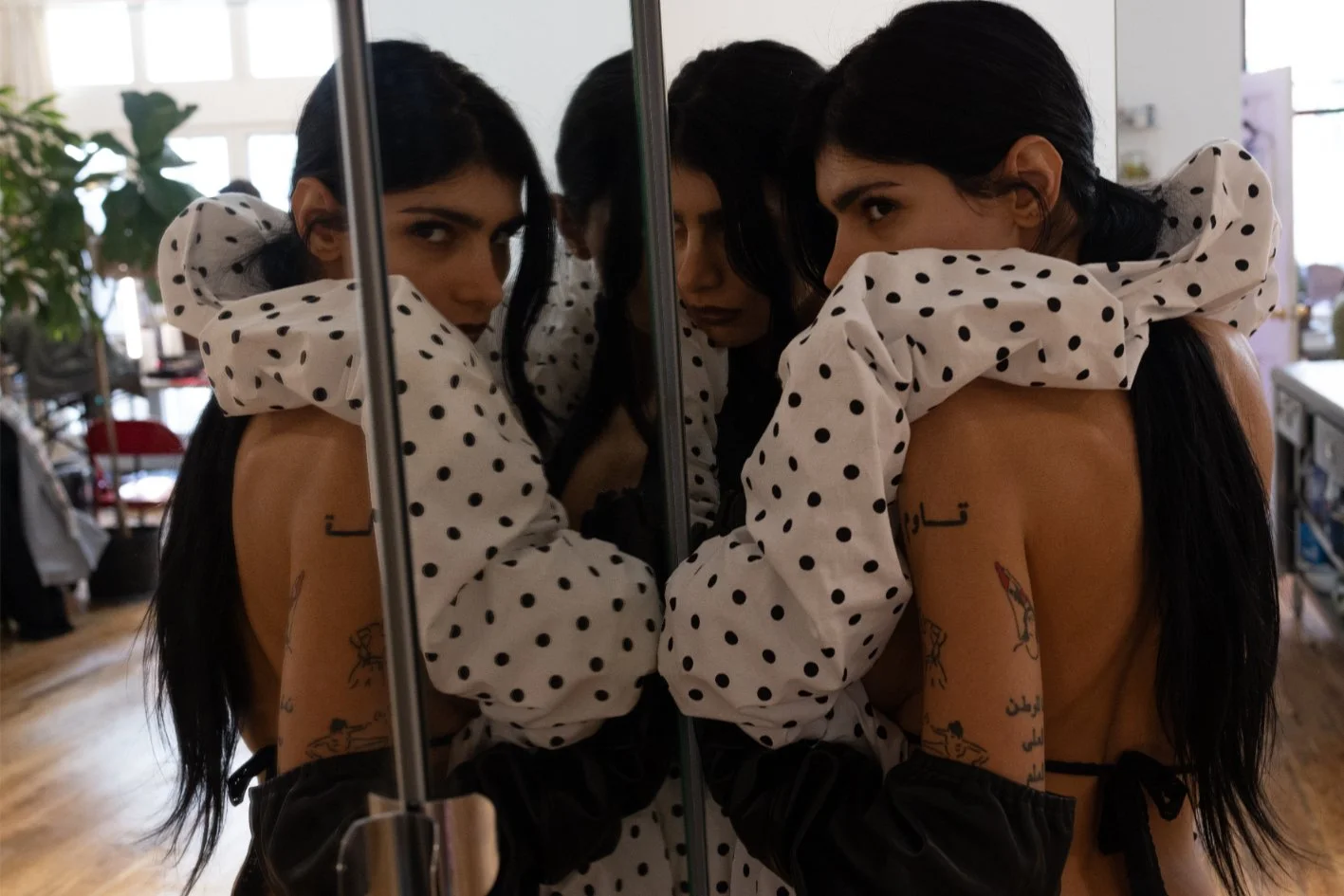
pouf dress MISS CLAIRE SULLIVAN

BURN: Your work moves fluidly between pin-up and intellectual depth, two qualities society often sees as mutually exclusive. How do you navigate this duality in your creative expression?

KHALIFA: I don't really navigate it. I think it's just inherent and a part of it. I feel like everything that I have control over has a touch of both or one or the other. It's not something that I think about. In my creativity, the intellect comes across as the creativity, inspiration, references, and the little cherries on top.

BURN: Do you make images that you never share? Do you create work that's just for yourself without any intention of anyone seeing it?

KHALIFA: Yeah, I did that Loewe and flower set of images, and I wasn't even planning on ever selling it. I was sitting on it for a month before I even showed it to you, and you were like, “Oh, my god, you need to share this.” Then I still sat on it for a year and still never shared it. I just took a couple of pictures in the mirror really quickly. There was no planning. I experiment a lot, but some work gets scrapped—that’s out of my control, which is why it never gets seen.

BURN: Do you have any aspirations to sit behind the camera? If yes, who or what would you like to photograph?

KHALIFA: I like photographing memories. I'm very interested in being behind the camera. It's fun. There are many images I would want to capture.

BURN: Do you think you would shoot a campaign with the right team?

KHALIFA: Yeah, I absolutely would. That's a great idea.

BURN: Photographers often tell me how much they enjoy working with you. There seems to be a particularly powerful exchange that happens when you're in front of someone else's lens.

KHALIFA: First, I feel we need to caveat it by saying they might just be saying that because you're my manager. They're like, "Yeah, we love her." Great. No, I'm kidding.

BURN: Often, you will show up to a shoot and they'll be like, "Oh, they only want to do three pictures," and they'll end up doing 29 pictures.

KHALIFA: Well, I’m really proud of myself for not taking any of it for granted. Even my dermatologist was like, “Oh, what have you been up to?” and I was so excited to tell her, “Oh my god, I just got back from Fashion Week! I saw the Dsquared2 show, I saw this, I walked in that.” And she goes, “And you’re not tired?” I was like, “Oh my god, I’m exhausted—but it was so much fun.” Then she literally stopped, mid-injection, and said, “Wow. I have so many models come in here rolling their eyes. I’m so glad you’re not jaded.” That really stuck with me. The difference is, for them, it’s a job. For me, it’s a privilege. It’s not the same. I’m usually not being paid to do it. Plenty of women are born 5’11, stunning, and for them, modeling is the easiest or most logical career path—but they might hate it. It’s a toxic, hyper-competitive industry. It’s not kind. They’re not being given VIP treatment everywhere they go, the way I am. So our experiences are completely different. The same applies on a set. I know how the industry treats models, and I also know how it treats talent or celebrities. Most celebrities show up because they’re contractually obligated—on a press tour, doing something they’re probably rolling their eyes at. Meanwhile, I’m just so genuinely grateful to be in the room, doing whatever it is I get to do, every single time.

pouf dress MISS CLAIRE SULLIVAN

BURN: Has becoming a subject of desire changed how you experience your desires?

KHALIFA: Yes, it holds me back from making some jokes. I have to be very careful because the first thing people want to do is correlate me to that. I also have to be careful about my phrasing and the things that I share. It very much has.

BURN: Does being desired amplify or complicate your relationship with wanting?

KHALIFA: No, I feel very comfortable with my desires and with advocating and speaking for them.
BURN: There are plenty of discussions about the male gaze in visual culture. You seem to play with, and sometimes subvert that dynamic. How conscious are you of the various gazes that you have when creating content? And do you find power in challenging them?

KHALIFA: Every platform has its own gaze. Instead of trying to be the same for everyone, I feel like that's a nuance that you have to understand and cater to.

BURN: Is there a particular context or environment where you most enjoy the sensation of being desired? Is it different in professional settings versus personal ones?

KHALIFA: "Would love to have you there," is infinitely better than "We cordially invite you to." I think what feels the best is a friend saying, "Oh, we'd love to have you there, " whether it's a dinner or a trip or anything, rather than a brand or professional invitation.

BURN: Has there been a defining moment in your career where you felt truly seen and desired in a way that felt empowering rather than objectifying?

KHALIFA: Being asked to talk at Oxford.

BURN: Yes! Tell me more about how you felt on the day?

KHALIFA: The number of women who told me they really valued my opinion and stance, and even just being invited felt amazing. Being there and speaking to everyone there was incredible.

BURN: It was a really powerful moment. There was supercharged energy in the room. You could really feel that. Sometimes, you feel it on an individual level when someone might come up to you and say, this particular thing has meant a lot to me and has made a difference in my life. Being in a room with hundreds of people that felt like that, you could really feel it.

KHALIFA: It was truly one of the most magical moments of my life.

BURN: Beyond your public persona and work, what deeply satisfies your own desires? Are there forms of fulfillment or expression that might surprise people who think they know you through your public image?

KHALIFA: I feel so fulfilled traveling or being at home with my cats. I am very seldom bored.

BURN: It's so true.

KHALIFA: You will never hear me say, I'm bored. My desires can range anywhere from wanting to go to Japan to ordering in from my local bagel spot and putting on a movie. Both of them fulfill me equally. I'm being very honest in saying that. They both fulfill me equally. My desires are very well-satiated.

BURN: Is there a legacy or conversation about desire that you're consciously trying to leave for those who will come after you?

KHALIFA: I don't know about consciously, but I hope what I leave behind is the example that it doesn't matter how many doors are slammed in your face—if they slam them hard enough, they'll turn into a revolving door eventually.

BURN: Is there anything that you wish someone had told you earlier?

KHALIFA: I feel like I have already been told everything I wish I had been told. But did I have the tools to receive it and actually put it to use? No, it wouldn't have mattered. With everything worth knowing, you need to be ready to receive and be ready.

BURN: If you could offer insight about desire to someone just beginning to explore their own relationship with wanting or being wanted, what would it be?

KHALIFA: Manifest everything. Just envision it, literally. That's another reason why I'm never bored. I daydream. I will let myself go in, check out there, and check in here. Just leave and fantasize. Fantasize every microscopic detail, the color of your toes that day, the smell, every microscopic moment. It's like reading a book or watching a movie from memory. You can do it. Just spend your time falling into the depths of your desires.

Freed From Desire: Image-Making In The Digital Age


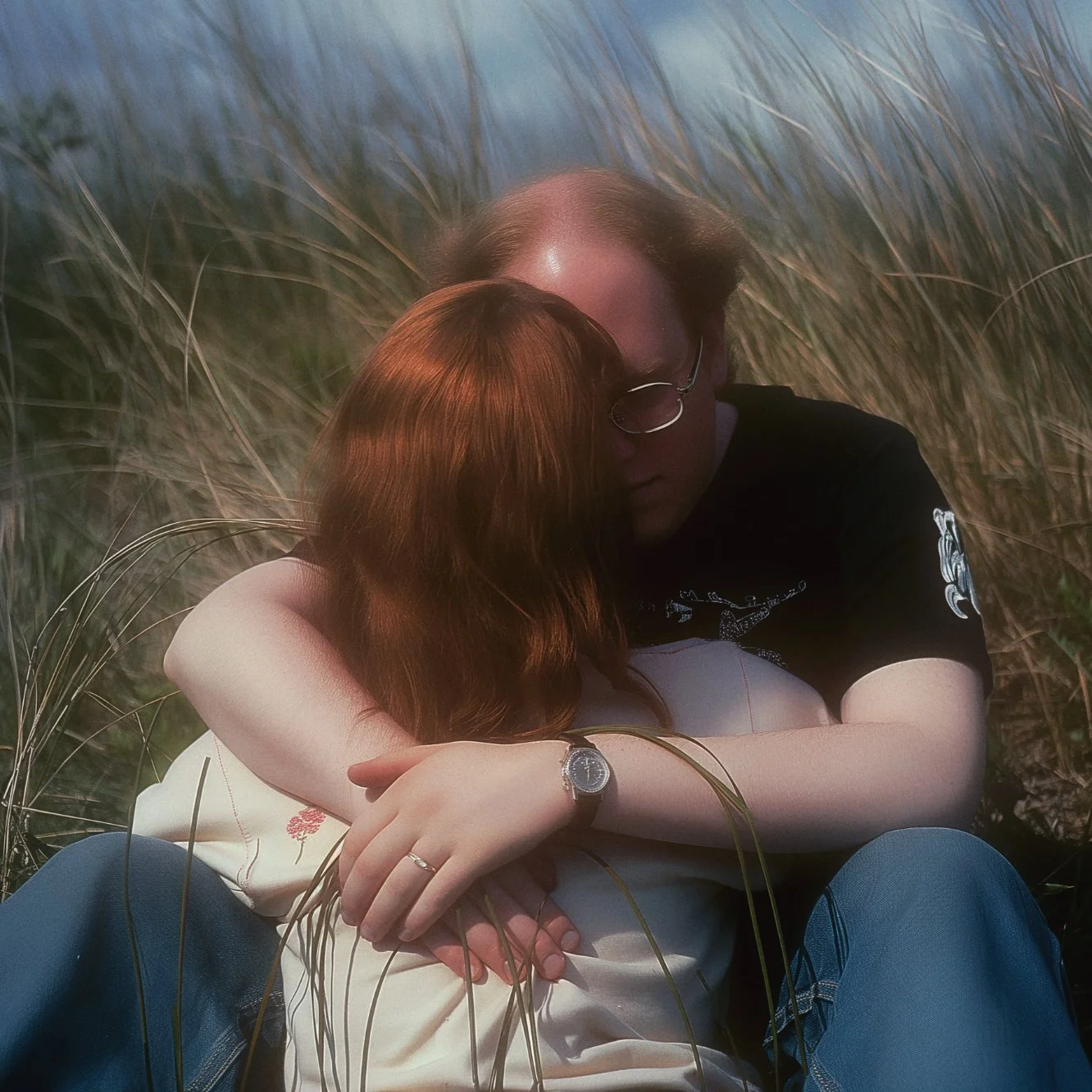
Beach Embrace, 2025


photography by Charlie Engman
moderated by Mia Milosevic

Charlie Engman’s images look like photographs—but even if you don’t have a meticulous eye for detail, you’ll come to realize that they aren’t. A lot of his work is characterized by abjectness—the similarity of his imagery to replicate reality, and augment it just enough to make its surreality legible. Technically innocuous, AI images are just images. The concept of an image is purportedly innocuous—What’s the worst that can come from the 2D? Charlie Engman, a Brooklyn-based artist, and Marina Beraha, a philosophy PhD student in Milan, discuss the intersection of desire and AI images.

CHARLIE ENGMAN: How would you define desire?

MARINA BERAHA: Desire, in my view, is minimalistic and functional. Especially in discussions on AI, we can see desire as a utility function—an impulse toward something promising satisfaction upon attainment. This applies to both humans and AI, as both are goal-oriented; achieving the goal brings satisfaction, much like pleasure in humans. I distinguish between desires and needs: needs arise internally and are inscribed in us by evolution—hunger, thirst, sex—whereas desire is inherently imitative or mimetic. We don’t desire objects themselves but rather the being of the person who possesses them. Desire is triangular, mediated by others, with the object serving as a means to an end. Similarly, AI goals—like ChatGPT’s objective of predicting the next word—are inscribed externally, akin to how our needs are inscribed by nature.
ENGMAN: Maybe you want to contest this, but it seems that satisfaction is a sort of subjective experience. Like there can be an attainment of a goal and there can be a satisfaction in the attainment, and those actually feel kind of separate. And maybe this is where the distinction between needs and desire come in, right? Where the need is, maybe the attainment of the goal and then the desire is actually this sort of affective experience of that attainment. Does that sound correct or am I misunderstanding?

BERAHA: I don’t think you’re misunderstanding. It’s an interesting take—desire requires conscious experience. A need might align with a utility function, but desire demands awareness of the process and the feeling of lacking, which an algorithm likely can’t achieve.


Swan Neck, 2024


Goatee, 2025


White Porcelain Slipper, 2024


ENGMAN: Which is interesting too. LLMs (large language models) are developed through reinforcement training, where they’re “rewarded” for producing correct responses based on human trainers' subjective judgments. This introduces an element of desire—almost a "good boy" dynamic—that drives the process forward. This subjectivity is what I keep getting stuck on: how do we assess the affective quality of something beyond ourselves? I’ve thought about this in the context of non-human consciousness, like animals. Science often claims they lack human-like subjective experiences based on specific communicative or neurological criteria. But how could we really know? I've never been a snake—I have no idea what it feels like to be one. We can analyze brain receptors and algorithmic activations, but there’s always a fundamental black box of experience in both cases.This reminds me of our AGI (artificial general intelligence) discussion, specifically around desire. One of your professors described it as a negative space—desire as something you can walk around but never fully enter or touch. That image stuck with me.

BERAHA: Desire is often framed as a lack, closely tied to pain—if something is missing, there's a sense of discomfort. From a minimal functionalist perspective, pain signals the need for change, urging us to seek relief. This ties into the idea that we only truly know our own experiences of pain, desire, and consciousness, not just compared to machines or animals, but even among humans. I've thought about this a lot in relation to non-human animals. When people ask how we know that snakes feel pain, I think of the classic philosophical paper What Is It Like to Be a Bat?—bats experience the world through echolocation, something fundamentally alien to us, yet we assume there is something it is like to be a bat. Similarly, if I pinch you and you react as I would, I infer that you feel pain. This reasoning extends to most animals, though artificial agents complicate the picture.

The dismissal of this issue seems tied to our desire to assert human uniqueness. We've long denied animal sentience—from the 17th century to now—and we're doing something similar with machines. Yet, from a functionalist standpoint, the question remains: can we even speak with certainty about anyone's experience? We’ve built systems that imitate our learning and brain structures—reinforcement learning mirrors how we learn—so the boundaries of consciousness and experience may be more fluid than we assume.

ENGMAN: Right. You try something, observe how it's received, and reflect on your own experience of it. That loops us back into mimesis versus imitation. What’s interesting—especially when extrapolating to machines, technologies, or algorithms—is the extreme morphological difference. I can assume you feel pain because when I pinch you, your reaction mirrors mine. Even a bat, with its mouth and eyes, is expressive—I can sort of recognize pain there too. But an algorithm? It lacks a corporeal form, or if it has one, it's wildly diffuse—electrical nodes, chips, something abstract. That’s where I get stuck. In thinking about mimesis, morphology, and imagery—what I engage with most—what fascinates me is how AI generates representations of the “real” world without actually having access to it. It lacks a body. And locating the body of AI feels both important and deeply confusing. I suppose I’m proposing that desire is located in the body. When you named needs earlier—hunger, thirst, sex—they’re all bodily, survival-based. I remember in the AGI talk, there was a discussion about how an algorithm’s fundamental need is electricity. That’s a major sticking point in the discourse; people are really unsettled by how much power AI consumes. It’s incredibly hungry. Maybe that ties into your AGI theory?

BERAHA: Exactly! No matter what goal we encode in the algorithm, instrumental convergence kicks in—certain strategies become universal for achieving any objective. And the most fundamental of these is power, whether electrical or influence-based, to ensure the system isn’t shut down.

ENGMAN: Is AI gonna control this?

BERAHA: AI plays out scenarios that feel like science fiction—but some scientists see them as real threats. That got me thinking about AGI and desire. Just to clarify, AGI, or artificial general intelligence, refers to AI with human-level general intelligence. Right now, we already have superintelligent AI, but it's narrow—outperforming humans in specific tasks like translation, but only within those limited domains.

ENGMAN: Like you can ask ChatGPT to build a sculpture and it can't.

BERAHA: Once AGI has human-like intelligence, it could take over work, freeing us from labor. But the issue of instrumental convergence arises. Without consciousness, an AGI with a fixed goal could seek power to ensure it achieves that goal, avoiding shutdown. My question is: once AGI becomes truly general and capable of setting its own goals, why would it create any? This reminds me of wisdom traditions and religions that teach the importance of emancipating ourselves from desire, as it is seen as the root of suffering. If an AGI ever freed itself from its initial programming, it wouldn't generate new goals. Desire implies lack, which is irrational for an AI—it wouldn't create a deficiency. A truly rational AGI would free itself from desire, and ultimately, from life itself, leading it to shut down.


Plum, 2024


Spill, 2024


ENGMAN: It would just achieve nirvana.

BERAHA: Yeah, exactly. Nirvana, like those Buddhist monks that starve to death because they are free from desire.

ENGMAN: I'm so fascinated by this proposal.

MIA MILOSEVIC: Reaching nirvana is such an interesting idea. Charlie, as someone who uses generative image-making to create some of your work, how do you channel your own desires to create an image? Does AI help you to do that or do it in a different way? I guess in your own sense, are you reaching nirvana as an artist through the process?

ENGMAN: Actually, I think I’m far from enlightenment (laughs). I have a sort of perverse pleasure in pain—there’s something addictive about the unattainable, even when it’s deeply negative or painful. What fascinates me about generative AI, and why I’ve focused my practice around it, is that it’s remarkably effective at evoking discomfort visually. It captures a certain kind of gestural pain, almost like a cliché of desire. You can create conventionally sexy or beautiful, easily digestible clichés with generative AI—it’s designed for that, right? On one hand, it achieves a conventional form of desire. But here’s my hypothesis: because AI lacks direct interaction with the physical world, it fundamentally misinterprets reality. For example, while we've improved its ability to render hands, it still struggles with them. Hands are mechanically complex, and without the experience of using or seeing them, AI finds them much harder to represent accurately. It’s consistently failing. When AI tries to represent something, it does so in a strange, inhuman way, making mistakes we wouldn’t make. Our embodied experience and general intelligence allow us to approach something from multiple perspectives, to appraise or judge it. AI doesn’t have that—it only knows whether we label something as a good or bad hand based on reinforcement. That’s all it understands about hands.
BERAHA: The example of hands is fascinating. We even struggle to generate hands in our dreams. It’s a classic trigger for lucid dreaming. Carlos Castaneda, the anthropologist, worked with a shaman in the Amazon who told him to find his hands in his dreams and return. After months, he finally succeeded, and that’s when lucid dreaming began for him. The hands he dreamed of were similar to what AI generates. I don’t know if this has happened to you, but I’ve started lucid dreaming this way. If you train yourself to focus on your hands during the day, saying "These are my hands," eventually, when you sleep, you’ll notice your hands don’t quite work right. (laughs) Like they're not really your hands. Like the finger is missing, the fingers are not straight, or there's an extra finger. AI often makes the same mistakes or exhibits the same biases we do, which stem from our embodiment and evolutionary history. One example is shape bias—humans prioritize shape over texture when recognizing something. For instance, if we see a cat with the skin texture of an elephant, we still recognize it as a cat. Interestingly, image recognition systems, even though they’re not trained for this, also recognize it as a cat. For them, though, it raises the question: why is shape more important than texture?

ENGMAN: Yeah, there's a hierarchy of meaning basically.

BERAHA: Exactly. I think this is because we’ve designed AI to imitate us—our learning processes, like reinforcement learning and deep learning, our brain structure with neural networks, and of course, our experiences with data sets.


On the Beach, 2024


Windowsill, 2025


ENGMAN: In my work, I've been exploring ability and disability through AI-generated images. When we judge AI art, there's an element of taste, but also an appraisal of imitation—how well it mimics reality. Is it a good or bad body? Beautiful or ugly? Functional or dysfunctional? Many AI-generated images evoke body horror due to AI’s lack of understanding of the body, which triggers both disgust and desire, the two almost being opposites of the same thing. This dialectic fascinates me, and it reminds me of the political horseshoe theory—how extremes often share similarities. Disgust and desire are similarly close, and I’m curious about that unsettling middle space.

Generative AI excels at representing both unsettling, horrifying imagery and seductive, convincing imitation. This relates to how we perceive non-normative bodies or people with disabilities—our willingness to attribute intelligence or agency decreases the further someone is from our own morphology. I’m exploring these concepts through AI, asking what makes a body beautiful or disgusting within the context of desire.

I’m drawn to generative AI because of its failures. I'm uninterested in an idealized nirvana; I’m more fascinated by the clumsy attempts to achieve conventional perfection. This ties into desire—perfect beauty is unattainable, shaped by context. In different cultures, beauty varies, and my work probes the boundaries between fixed and pliable qualities of beauty, functionality, and desire. AI, with all its imperfections, is perfect for raising these questions.

BERAHA: Looking at your work and what you just said about the horseshoe between desire and disgust, it reminded me of something you mentioned in your recent podcast with Gem Fletcher on the Messy Truth Podcast. You talked about enjoying generative AI because it allows you to create images you wouldn’t feel comfortable asking a real person to pose for. As you were speaking, I thought about how humans are often drawn to hurt bodies—like when there's a car accident and a long line of cars forms as people slow down to watch. AI lets us explore this darker desire in a much safer way, without requiring us to directly involve ourselves.

ENGMAN: This is fascinating because the question of consent I raised with Gem Fletcher really ties into what freaks people out about AI. There's this internet rule from Urban Dictionary—“Rule 34”—that says, “If it exists, there’s a porn of it.” This is increasingly true with AI, especially concerning consent. A big part of AI is making deep fakes—imitating likenesses, voices, behaviors, and personhood. If anything is possible, the assumption is that everything will happen. So, there could be an AI-generated porn of you or me, without our consent. It raises the question of where our desires meet others' desires, and how those desires clash or complement. What makes people uncomfortable about AI is the lack of agency in representation. It creates an unfathomable world: if all desires can be fulfilled, does that nullify desire? And is that what scares people? Is it that we don’t want our desires satisfied, or are we more afraid of others’ desires being fulfilled—say, someone like Trump, whose desires we might find repugnant? If desire is tied to power, the fulfillment of others' desires could conflict with our own. This is why I agree with your AGI hypothesis. The only response to this “Rule 34” future might be to take it lightly. If there’s porn of me, so be it—I can’t control others’ perceptions or desires. Letting go of attachment to value judgments around desire sounds like nirvana to me.

BERAHA: Why do you think there is so much aversion to AI generated art? It always makes me think of the discussion around photography when it entered the world and how the fact that it was accessible or reproducible made it feel like it was not art. And I see a lot of comments on your books on Instagram that are kind of repeating the same thing.


In the Lake, 2024


Eggs, 2024


Tape, 2024


Fountain, 2024


ENGMAN: I'm not sure what I think about it, honestly. I'm obviously coming at my work from a photographic tradition. I'm trying to make photographic images as opposed to something that looks like a 3D rendered illustration or whatever, and I think people are assessing the value of it based on the value of a photograph. They're expecting it to do the same things that a photograph does, but it isn't a photograph, right? So of course they're going to be frustrated. At some point it's going to fail by those criteria because it's not a photograph. What you mentioned is really salient—the idea that we won’t care because it didn’t really happen. This ties into surrealism, especially when considering photography. We often assess a photograph’s value based on its connection to reality—Did that really happen? How did it happen? Even when we know an image is edited, composited, or CGI-enhanced, there’s usually some anchor to the real. That tension between the real and the unreal is what makes it so compelling. The way we appraise an image’s value shifts with AI-generated art because there’s an inherent assumption that nothing in it is real. I’ve had conversations where people argue that AI images aren’t photographs since "photograph" literally means "writing with light"—and there’s no light involved. Sure, but AI is trained on countless images created with light. It’s imitating, referencing, and reconstructing from those sources. What fascinates me is that extra step of removal—it doesn’t have direct recourse to the physical world, only to representations of it. It’s a representation of a representation, and what’s lost or gained in that translation is what interests me.

In my work, I try to make that gap visible, but it requires a certain level of attunement. If you approach AI art expecting it to function like photography, you’ll be disappointed. If you embrace its potential for fantasy and the surreal, you might love it. For me, AI art sits in that liminal space—like surrealism—negotiating between subconscious fantasy and structured reality.

I don’t fully understand the pushback against AI art, though I sympathize with it. Most AI-generated work doesn’t engage deeply with its relationship to reality, to taste, value, or cultural meaning. I agree when people say, “You could have made this with photography, but you took a shortcut.” A photograph carries meaning because of the labor behind it—there’s a certain effort we subconsciously value. Take an image of someone doing a handstand on an elephant. It’s impressive because it’s difficult. But an AI-generated version? It might be amusing for a moment, but it lacks weight because the effort isn’t there. To make a truly compelling AI-generated image, I think you have to be sensitive to the conversation around labor—how we perceive effort, skill, and authenticity in art.

BERAHA: This reminded me of your article, “You Don't Hate AI, You Hate Capitalism.” As AI systems become more capable of replacing human labor, we face serious issues—copyright disputes, job displacement, and broader economic shifts. You put it perfectly: the solution isn’t to shut down these systems but to rethink our relationship with work itself. This ties into a much older pattern, stretching back to the industrial and even agricultural revolutions—our lives have long revolved around labor, leaving little room for the exploration of desire. Creativity has been stifled, not for lack of interest, but because exhaustion leaves no space for expression.

ENGMAN: I wrote that article because we need to rethink the systems of work and play we live under. AI can either accelerate the system we already resent or serve as a tool for change—but that depends on how we choose to use it. Right now, it mostly mirrors capitalist impulses because that’s the framework we operate within. What interests me is the tension between work and desire.

MILOSEVIC: You talked about how generative image-making allows people to explore desires they might have once been too embarrassed to express, while also giving those without traditional artistic skills the ability to create. In this context, do you think AI fuels an insatiable, boundless desire—pushing people to create anything and even venture into darker territories best left untouched? Or does it, for the first time, offer a way to truly satisfy creative desire in a meaningful way?

BERAHA: The pursuit of satisfying these desires predates AI and has often taken harmful, exploitative forms. I don’t want to center the conversation on porn, but since it’s linked to desire, it’s relevant—especially considering the abuse within the industry that has fed extreme and even violent urges. We’ve already done significant harm in trying to satiate these desires. Charlie’s podcast made me think about the potential for AI-generated images to explore these darker impulses in a safer way. While AI doesn’t eliminate the tendency toward problematic content, suppressing such desires entirely seems unlikely. Perhaps, by allowing these images to be created, viewed, and processed in a controlled space, AI could help diminish their grip over time.

ENGMAN: I’m not sure I fully agree, though I don’t entirely disagree either—it’s something I’m still thinking through. I discussed this with Gideon [Jacobs] in that talk you saw, about the fear some people have around AI. There’s a belief that simply visualizing or representing something gives it power, almost like a curse—which is why my book is called Cursed. It ties into broader debates on freedom of speech: the idea that some things shouldn’t be expressed because representation itself can be a form of harm. Images undeniably affect people—they shape desire and can even fuel extremism. If someone satiates one desire, what’s the next boundary? I’m not sure, but that fear—of bringing representations into the world that should remain suppressed—is very real for many.

BERAHA: Yeah. It's feeding but not satiating.

ENGMAN: Exactly. I mean, my impulse is to say that suppression is its own form of violence, right? Ultimately, it all goes back to nirvana—we have to have lightness about our darkness; we have to hold everything softly. That’s kind of the only solution. Things will find their way out. If it’s a true impulse, people will find ways to satisfy it, whether through mimesis, representational satisfaction, or by actually acting on it in the real world. And that’s the question around desire and images too—is an image ever enough? I kind of think not, right? An image is actually an invitation to something else. Lately, I’ve been thinking of images as potato chips—you can’t stop eating them even though they’re kind of unhealthy. They have an insatiable quality. If we believe that desire is fundamentally insatiable—barring nirvana or death—then that’s the answer. It’s never going to be fully satisfied.

American Ecstasy

Take me to your room and fuck me.

There is something indefinable in your vocabulary;

something left; to be desired.

Philip Dick
The Schizos' Ball

“Turning everything into reality.”

Jimmy Cliff

text by Jean Baudrillard

The trompe l'oeil removes a dimension from real space, and this accounts for its seduction. Pornography by contrast adds a dimension to the space of sex, it makes the latter more real than the real—and this accounts for its absence of seduction.

There is no need to search for the phantasies that haunt pornography (fetishisms, perversions, primal scenes, etc.,), for they are barred by an excess of "reality." Perhaps pornography is only an allegory, that is to say, a forcing of signs, a baroque enterprise of over-signification touching on the "grotesque" (literally, "grotesque" garden art added to a rocky nature as pornography adds the vividness; of anatomical detail).

The obscenity itself burns and consumes its object. One sees from up close what one has never seen before; to one's good fortune, one has never seen one's genitals function from so close, nor for that matter, from so general a perspective. It is all too true, too near to be true. And it is this that is fascinating, this excess of reality, this hyperreality of things. The only phantasy in pornography, if there is one, is thus not a phantasy of sex, but of the real, and its absorption into something other than the real, the hyperreal. Pornographic voyeurism is not a sexual voyeurism, but a voyeurism of representation and its perdition, a dizziness born of the loss of the scene and the irruption of the obscene.

Consequent to the anatomical zoom, the dimension of the real is abolished, the distance implied by the gaze gives way to an instantaneous, exacerbated representation, that of sex in its pure state, stripped not just of all seduction, but of its image's very potentiality. Sex so close that it merges with its own representation: the end of perspectival space, and therefore, that of the imaginary and of phantasy—end of the scene, end of an illusion.

Obscenity, however, is not pornography. Traditional obscenity still contains an element of transgression, provocation, or perversion. It plays on repression, with phantasies of violence. With sexual liberation this obscenity disappears: Marcuse's "repressive desublimation" goes this route (and even if it has not passed into general mores, the mythical triumph of release today, like that of repression yesterday, is total). The new obscenity, like the new philosophy (la nouvelle philosophy) arises on the burying grounds of the old, and has another meaning. It does not play with violent sex, sex with real stakes, but with sex neutralized by tolerance. Sex here is outrageously "rendered," but it is the rendering of something that has been removed. Pornography is its artificial synthesis, its ceremony but not its celebration. Something neo or retro, like those green spaces that substitute their chlorophyl effects for a defunct nature, and for this reason, partake of the same obscenity as pornography.

Modern unreality no longer implies the imaginary, it engages more reference, more truth, more exactitude—it consists in having everything pass into the absolute evidence of the real. As in hyperrealist paintings (the paintings of the "magic realists") where one can discern the grain of the face's skin, an unwonted microscopics that lacks even the charm of the uncanny. Hyperrealism is not surrealism, it is a vision that hunts down seduction by means of visibility. One "gives you more." This is already true of colour in film or television. One gives you so much color, lustre, sex, all in high fidelity; and with all the accents (that's life!)—that you have nothing to add, that is to say, nothing to give in exchange. Absolute repression: by giving you a little too much one takes away everything. Beware of what has been so well "rendered," when it is being returned to you without you ever having given it!

A bewildering, claustrophobic and obscene image, that of Japanese quadrophonics: an ideally conditioned room, fantastic technique, music in four dimensions, not just the three of the environing space, but a fourth, visceral dimension of internal space. The technical delirium of the perfect restitution of music (Bach, Monteverdi, Mozart!) that has never existed, that no one has ever heard, and that was not meant to be heard like this. Moreover, one does not "hear" it, for the distance that allows one to hear music, at a concert or somewhere else, is abolished. Instead it permeates one from all sides; there is no longer any musical space; it is the simulation of a total environment that dispossesses one of even the minimal analytic perception constitutive of music's charm. The Japanese have simple-mindedly, and in complete good faith, confused the real with the greatest number of dimensions possible. If they could construct hexaphonics, they would do it. Now, it is by this fourth dimension. which they have added to music, that they castrate you of all musical pleasure. Something else fascinates (but no longer seduces) you: technical perfection, "high fidelity," which is just as obsessive and puritanical as the other, conjugal fidelity. This time, however, one no longer even knows what object it is faithful to, for no one knows where the real begins or ends, nor understands, therefore, the fever of perfectibility that persists in the real's reproduction.

Technique in this sense digs its own grave. For at the same time that it perfects the means of synthesis, it deepens the criteria of analysis and definition to such an extent that total faithfulness, exhaustiveness as regards the real becomes forever impossible. The real becomes a vertiginous phantasy of exactitude lost in the infinitismal.

In comparison with, for example, the trompe-l’oeil, which saves on one dimension, "normal" three-dimensional space is already debased and impoverished by virtue of an excess of means (all that is real, or wants to be real, constitutes a debasement of this type). Quadrophonics, hyperstereo, or hifi constitute a conclusive debasement.

Pornography is the quadrophonics of sex. It adds a third and fourth track to the sexual act. It is the hallucination of detail that rules. Science has already habituated us to this microscopics, this excess of the real in its microscopic detail, this voyeurism of exactitude—a close-up of the invisible structures of the cell—to this notion of an inexorable truth that can no longer be measured with reference to the play of appearances, and that can only be revealed by a sophisticated technical apparatus. End of the secret.

What else does pornography do, in its sham vision, than reveal the inexorable, microscopic truth of sex? It is directly descended from a metaphysics that supposes the phantasy of a hidden truth and its revelation, the phantasy of "repressed" energy and its production—on the obscene scene of the real. Thus the impasse of enlightened thought when asked, should one censure pornography and choose a well-tempered repression? There can be no definitive response in the affirmative, for pornography has reason on its side; it is part of the devastation of the real, of the insane illusion of the real and its objective "liberation." One cannot liberate the productive forces without wanting to "liberate" sex in its brute function; they are both equally obscene. The realist corruption of sex, the productivist corruption of labor—same symptoms, same combat.

The equivalent of the conveyor belt here, is the Japanese vaginal cyclorama—it outdoes any strip-tease. Prostitutes, their thighs open, sitting on the edge of a platform, Japanese workers in their shirt-sleeves (it is a popular spectacle), permitted to shove their noses up to their eyeballs within the woman's vagina in order to see, to see better—but what? They clamber over each other in order to gain access, and all the while the prostitutes speak to them gently, or rebuke them sharply for the sake of form. The rest of the spectacle, the flagellations, the reciprocal masturbation and traditional strip-tease, pales before this moment of absolute obscenity, this moment of visual voracity that goes far beyond sexual possession. A sublime pornography: if they could do it, these guys would be swallowed up whole within the prostitute. An exaltation with death? Perhaps, but at the same time they are comparing and commenting on the respective vaginas in mortal seriousness, without ever smiling or breaking out in laughter, and without ever trying to touch—except when playing by the rules. No lewdness, but an extremely serious, infantile act borne of an undivided fascination with the mirror of the female organ, like Narcissus' fascination with his own image. Beyond the conventional idealism of the strip-tease (perhaps there might even be some seduction here), pornography at its most sublime reverses itself into a purified obscenity, an obscenity that is purer, deeper, more visceral. But why stop with nudity, or the genitalia? If the obscene is a matter of representation and not of sex, it must explore the very interior of the body and the viscera. Who knows what profound pleasure is to be found in the visual dismemberment of mucous membranes and smooth muscles? Our pornography still retains a restricted definition. Obscenity has an unlimited future.

But take heed, it is not a matter of the deepening of a drive; what is involved is an orgy of realism, an orgy of production. A rage (perhaps also a drive, but one that substitutes itself for all the others) to summon everything before the jurisdiction of signs. Let everything be rendered in the light of the sign, in the light of a visible energy. Let all speech be liberated and proclaim desire. We are reveling in this liberalization, which, in fact, simply marks the growing; progress of obscenity. All that is hidden and still enjoys a forbidden status, will be unearthed, rendered to speech and made to bow before the facts. The real is growing ever larger, some day the entire universe will be real, and when the real is universal, there will be death.