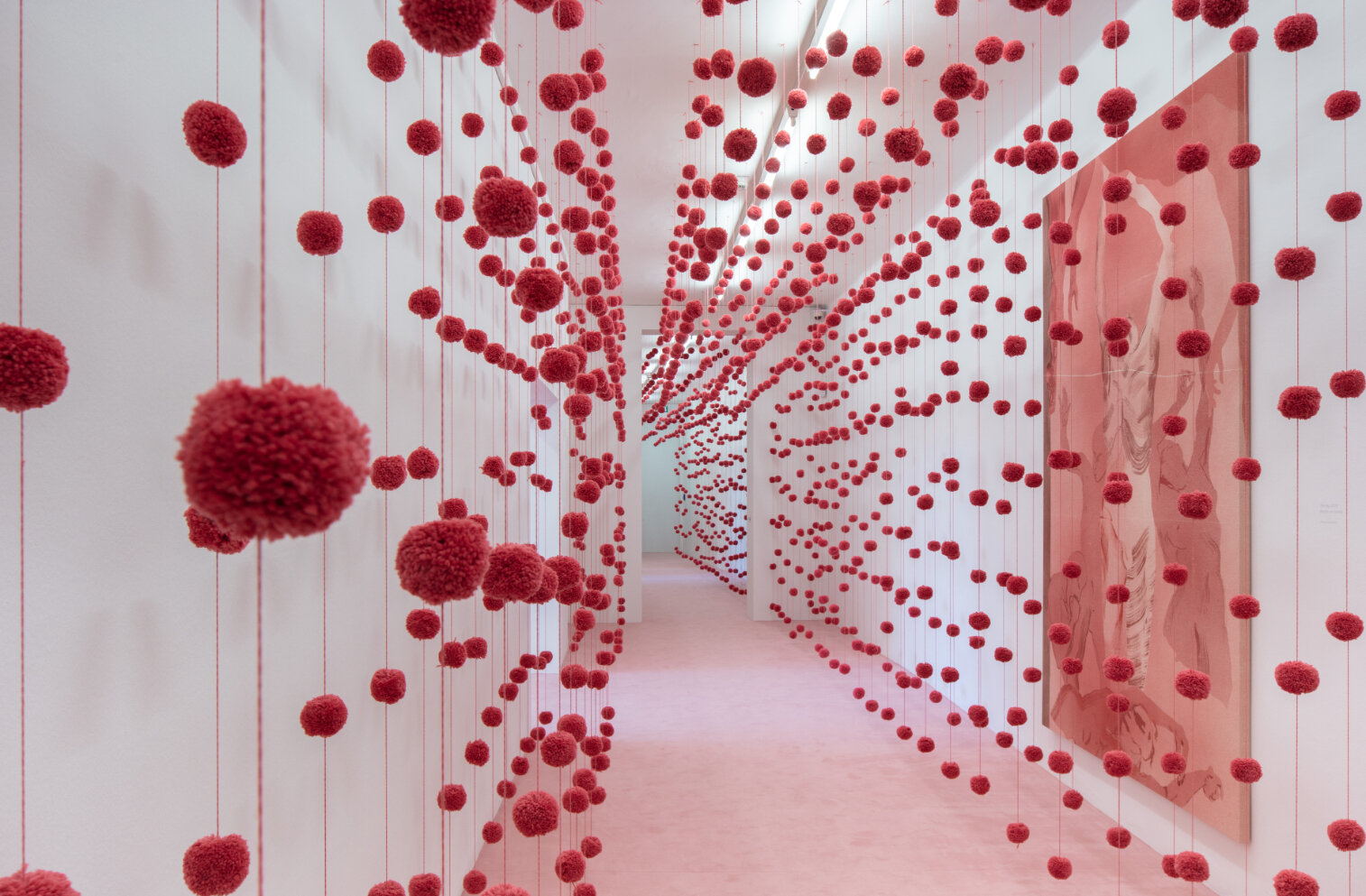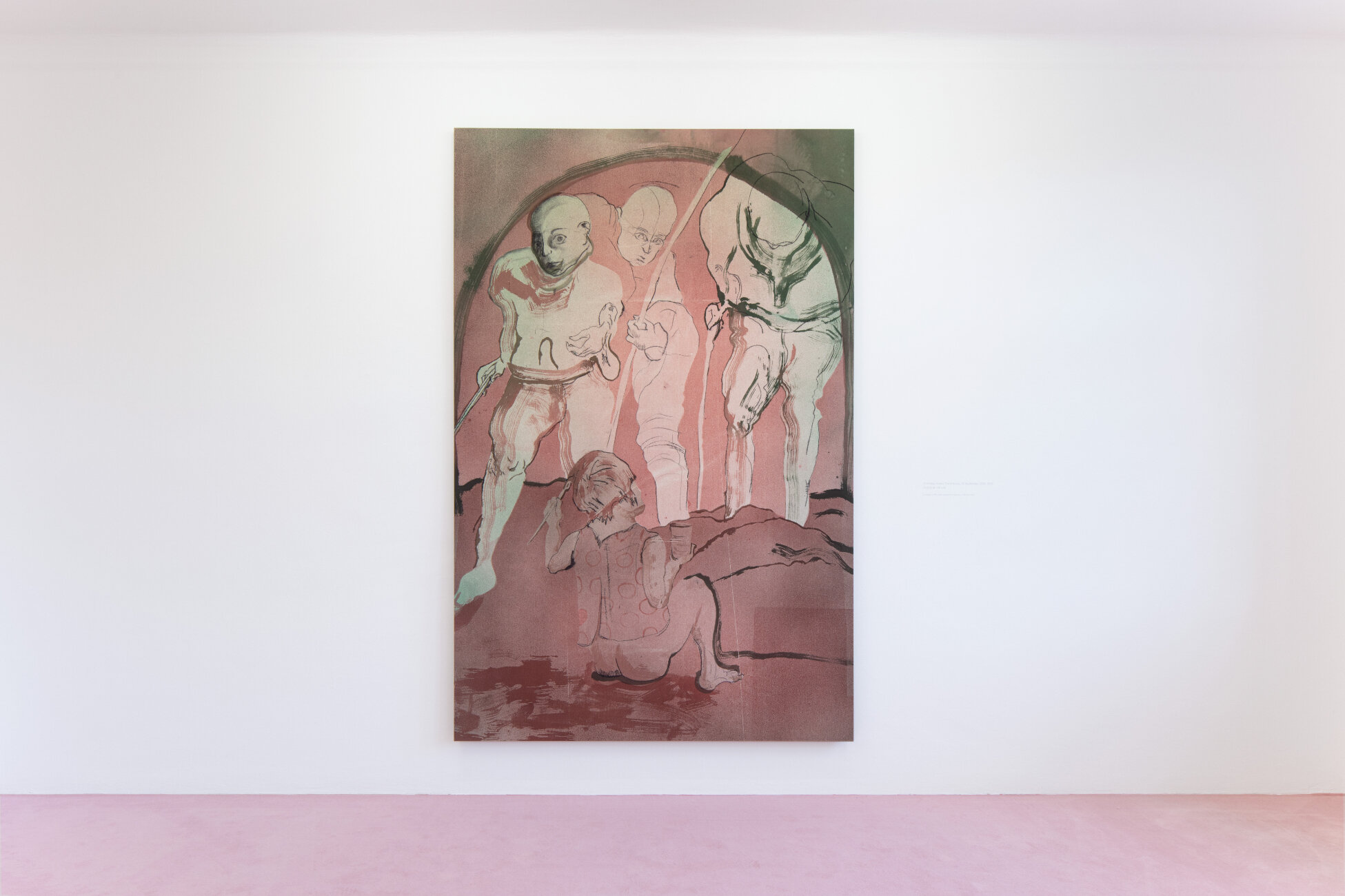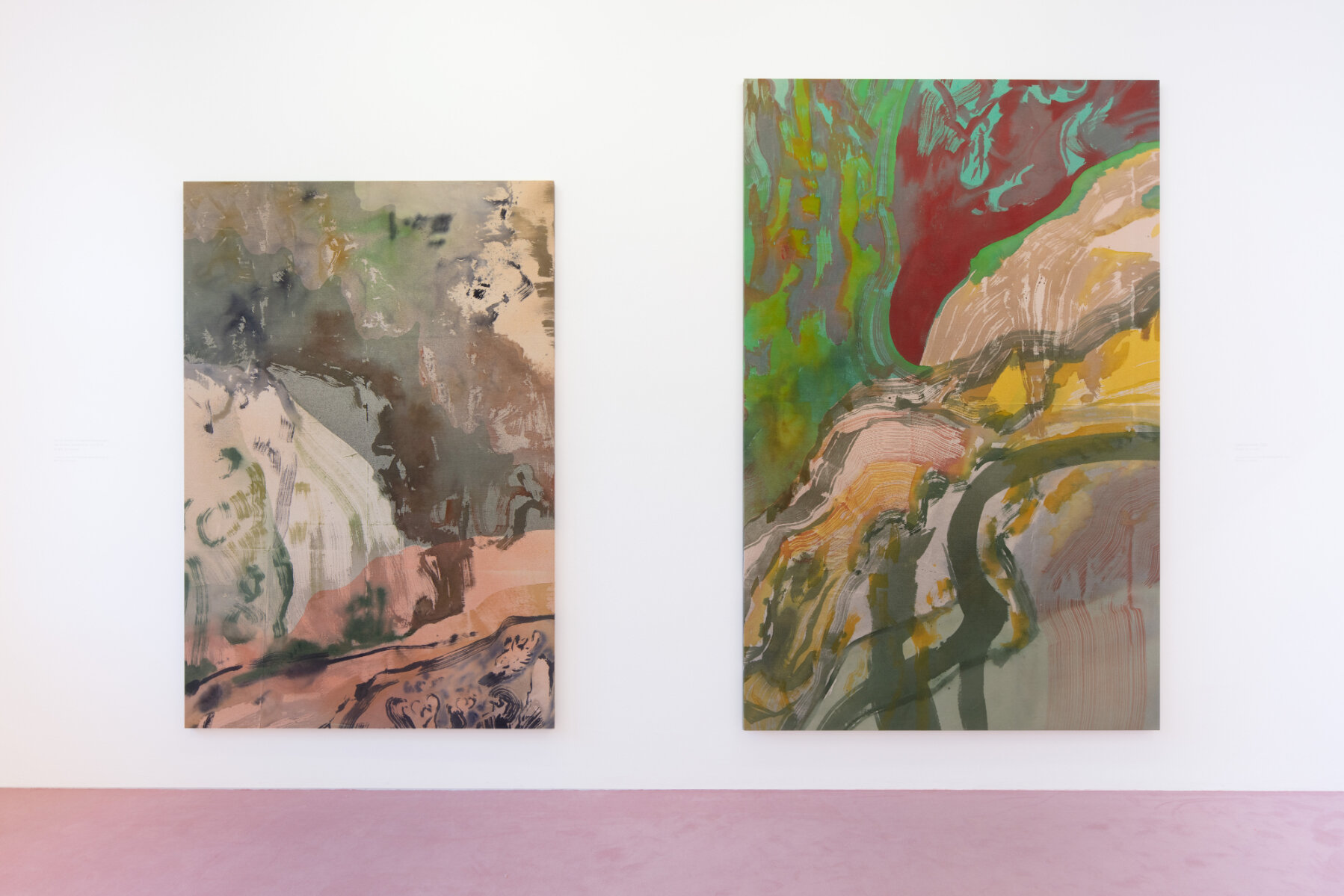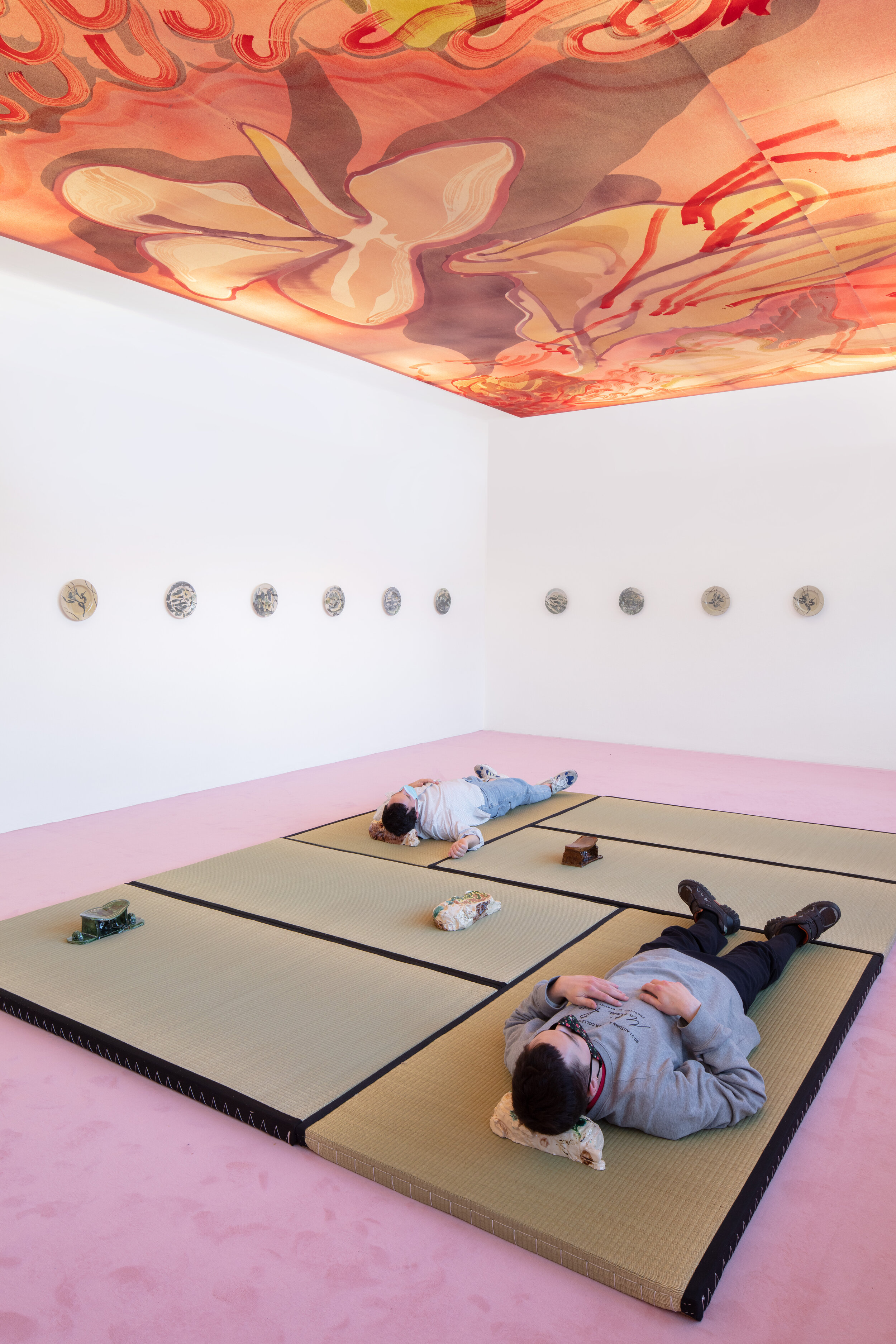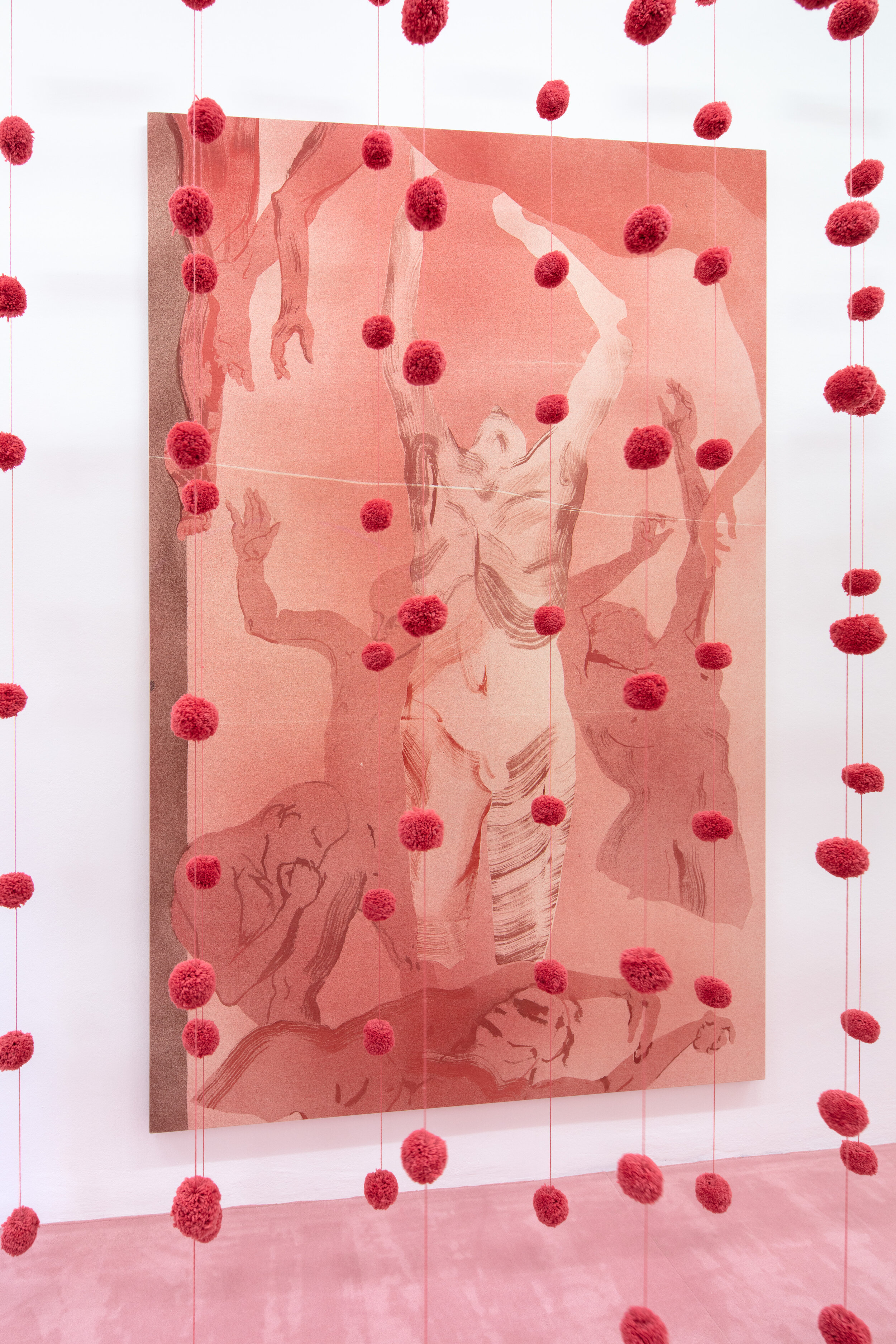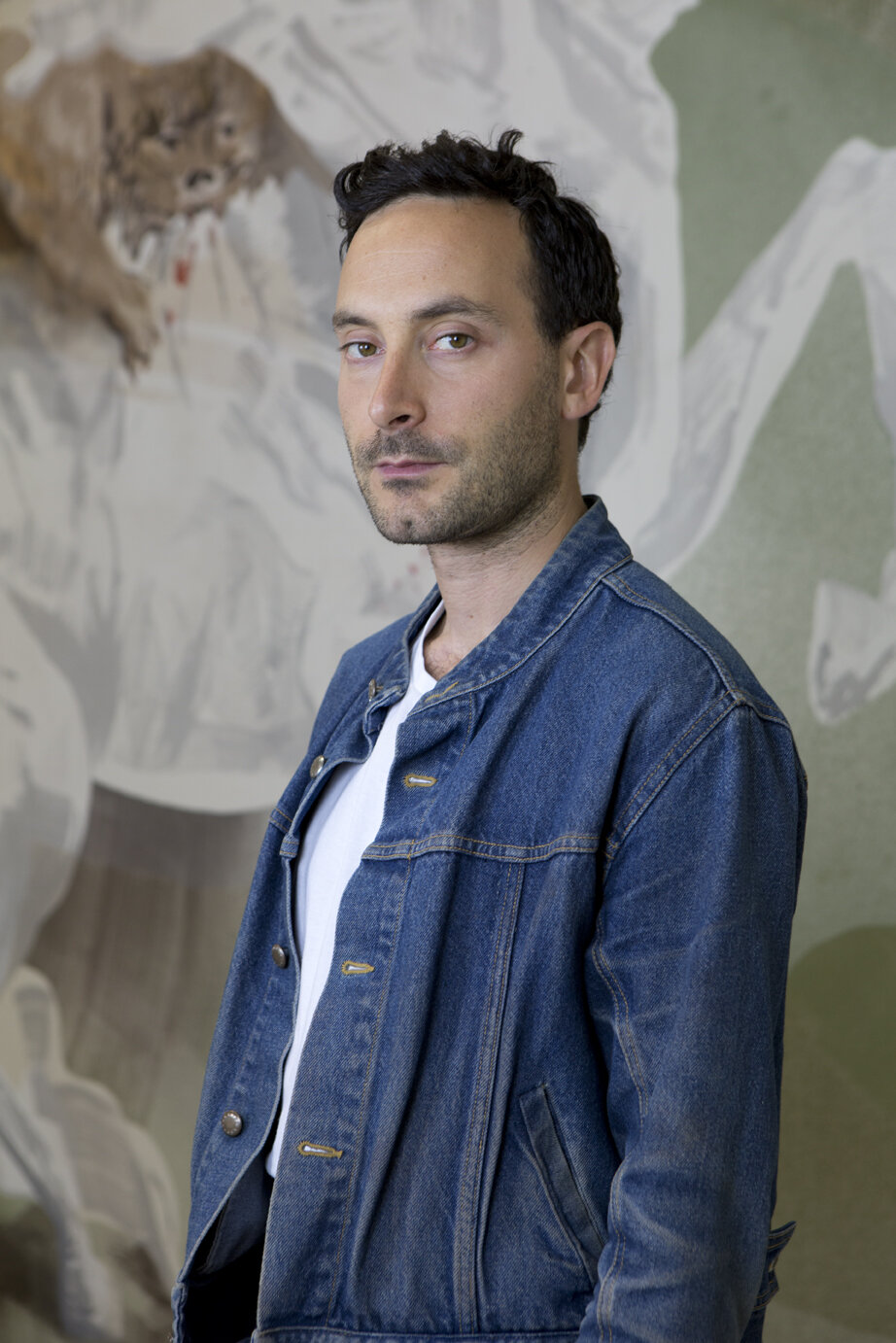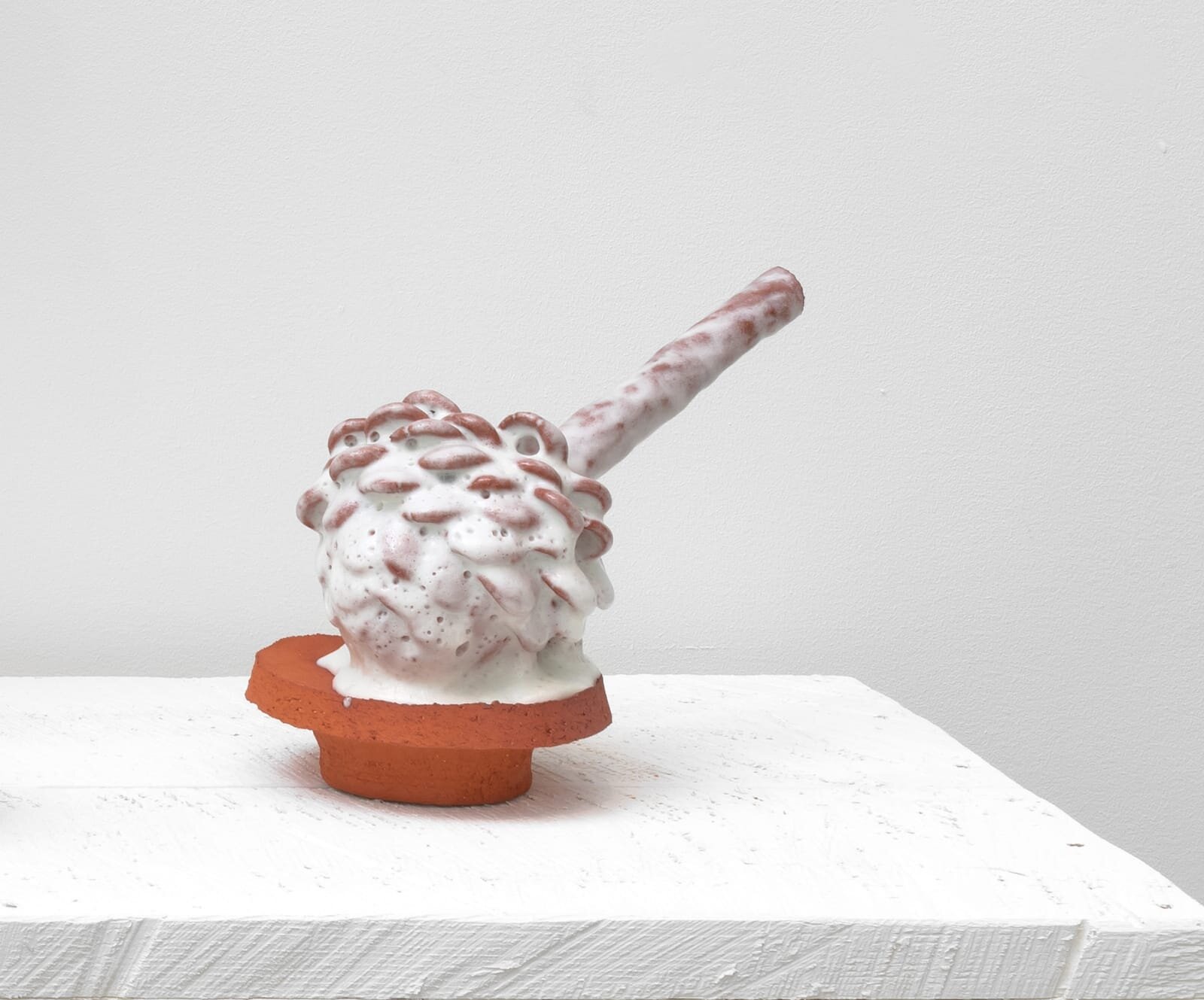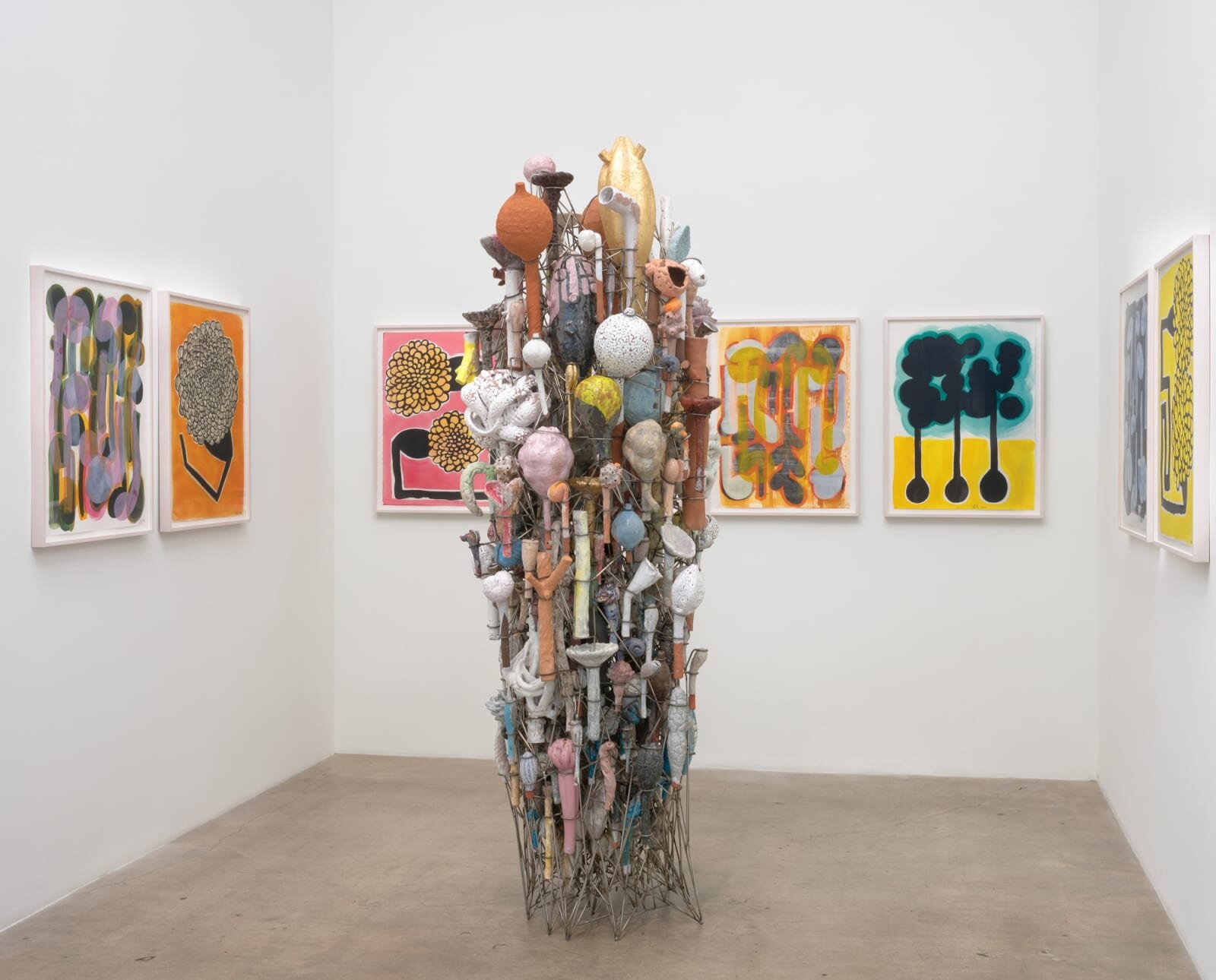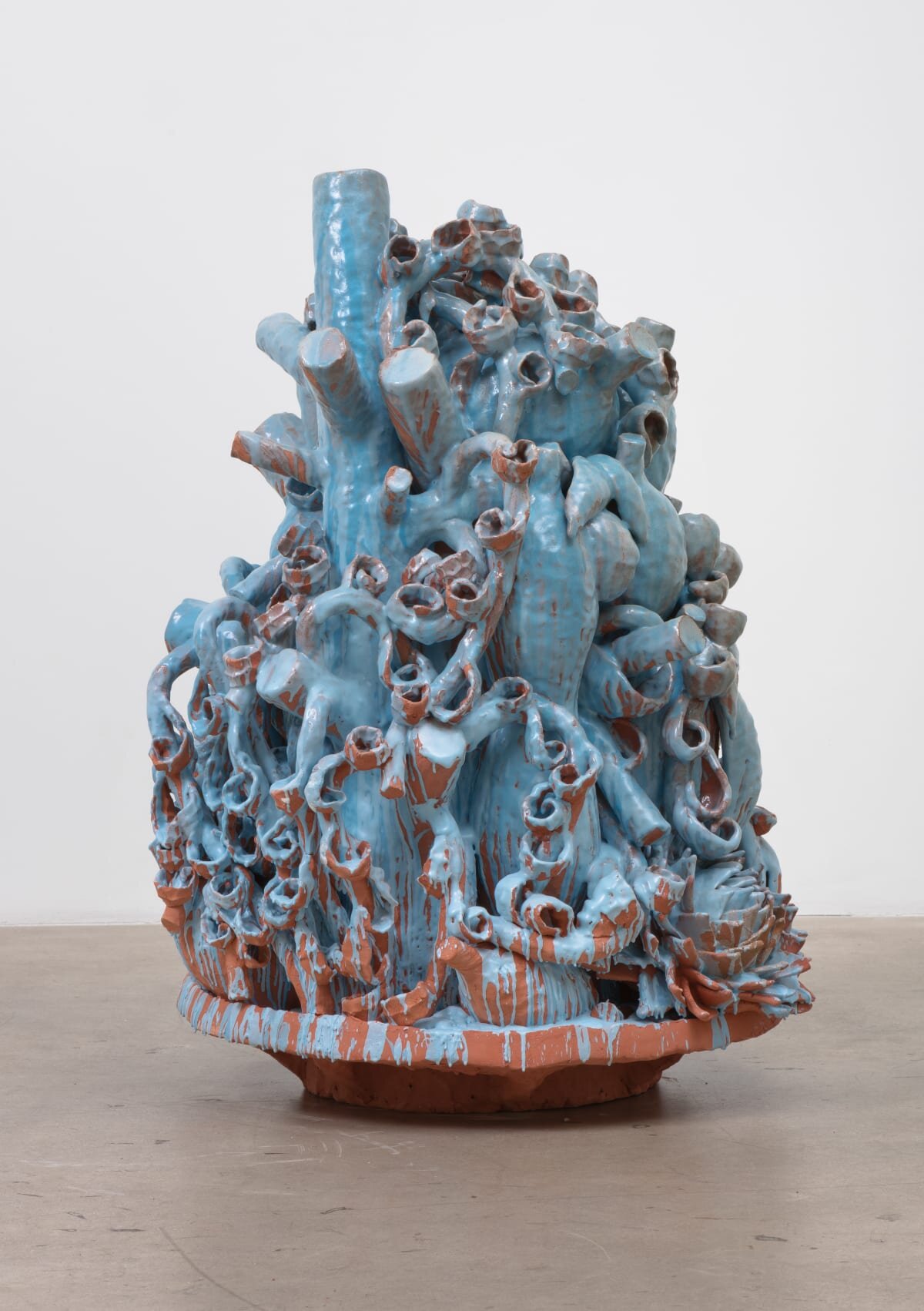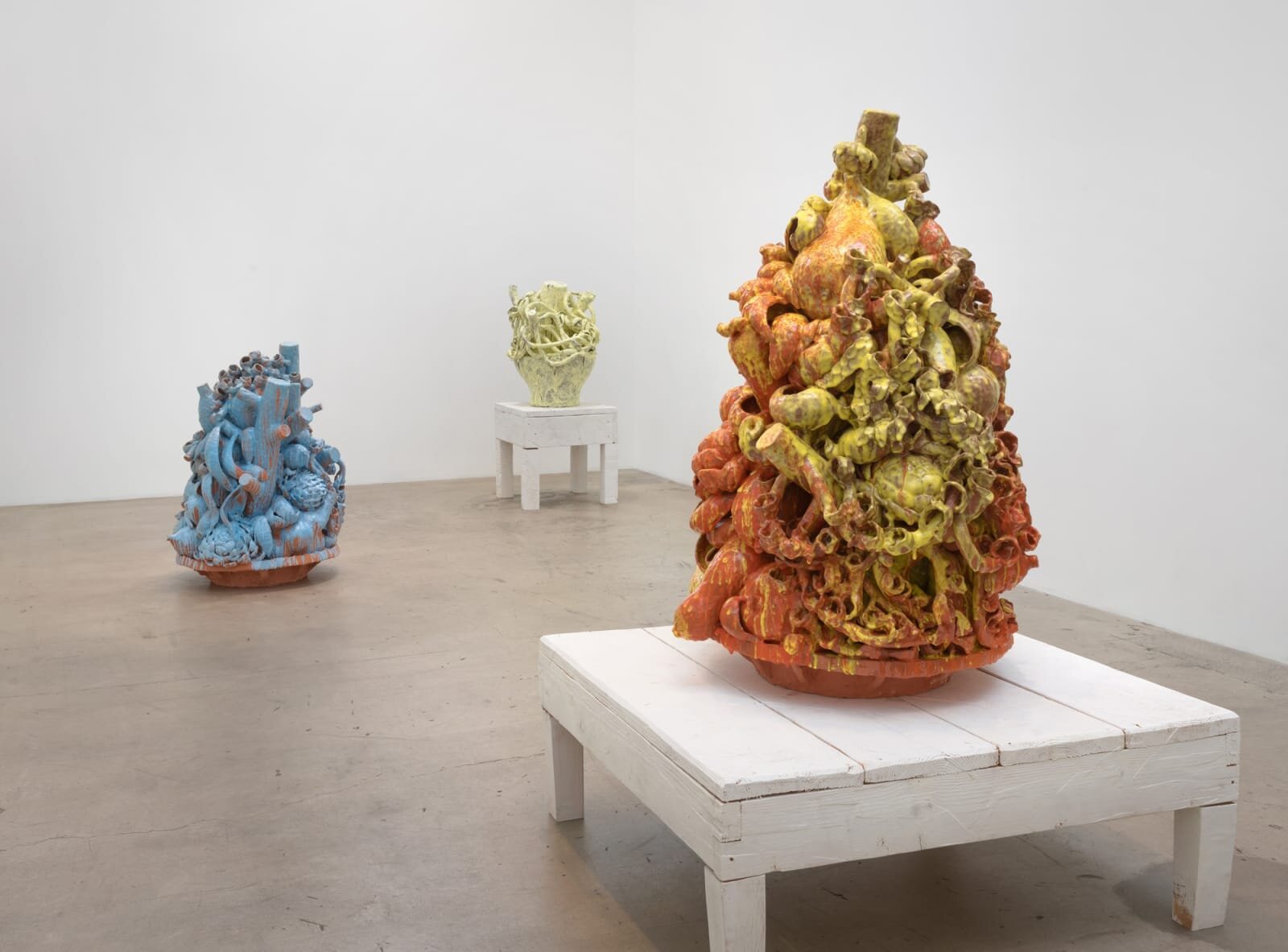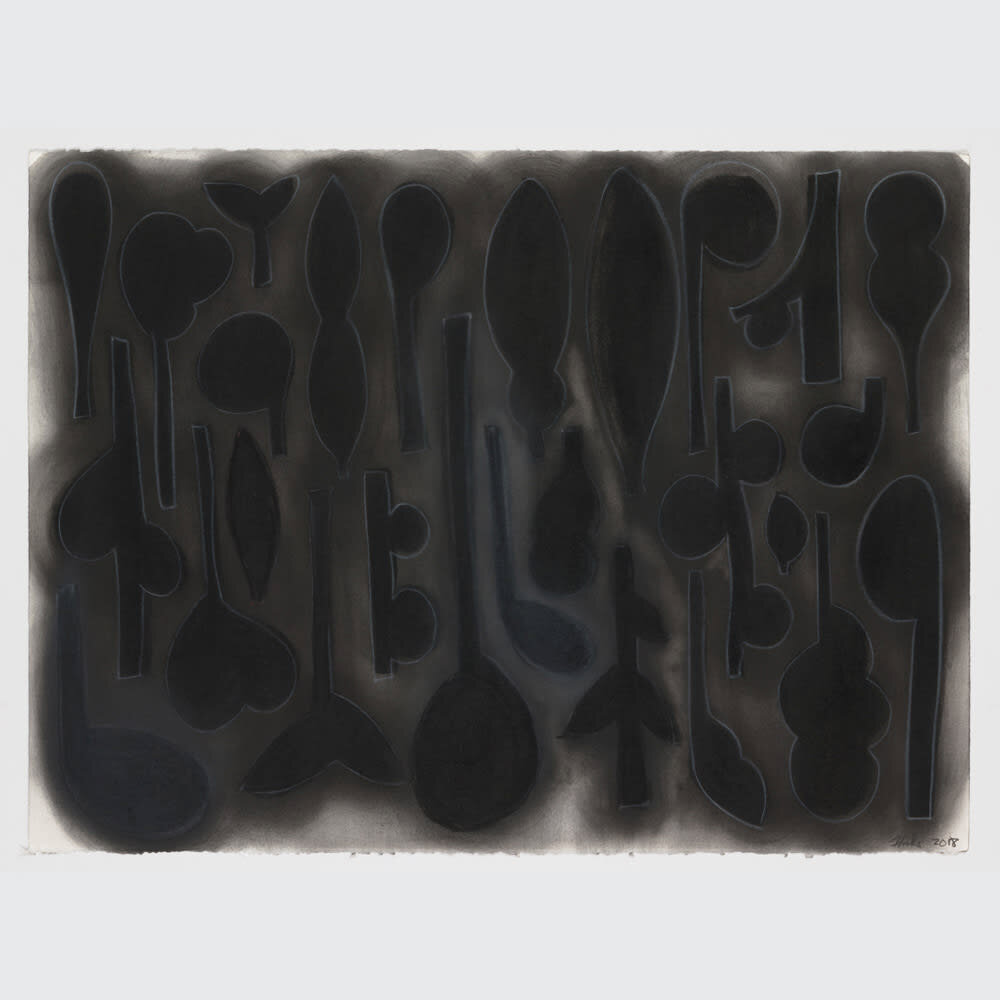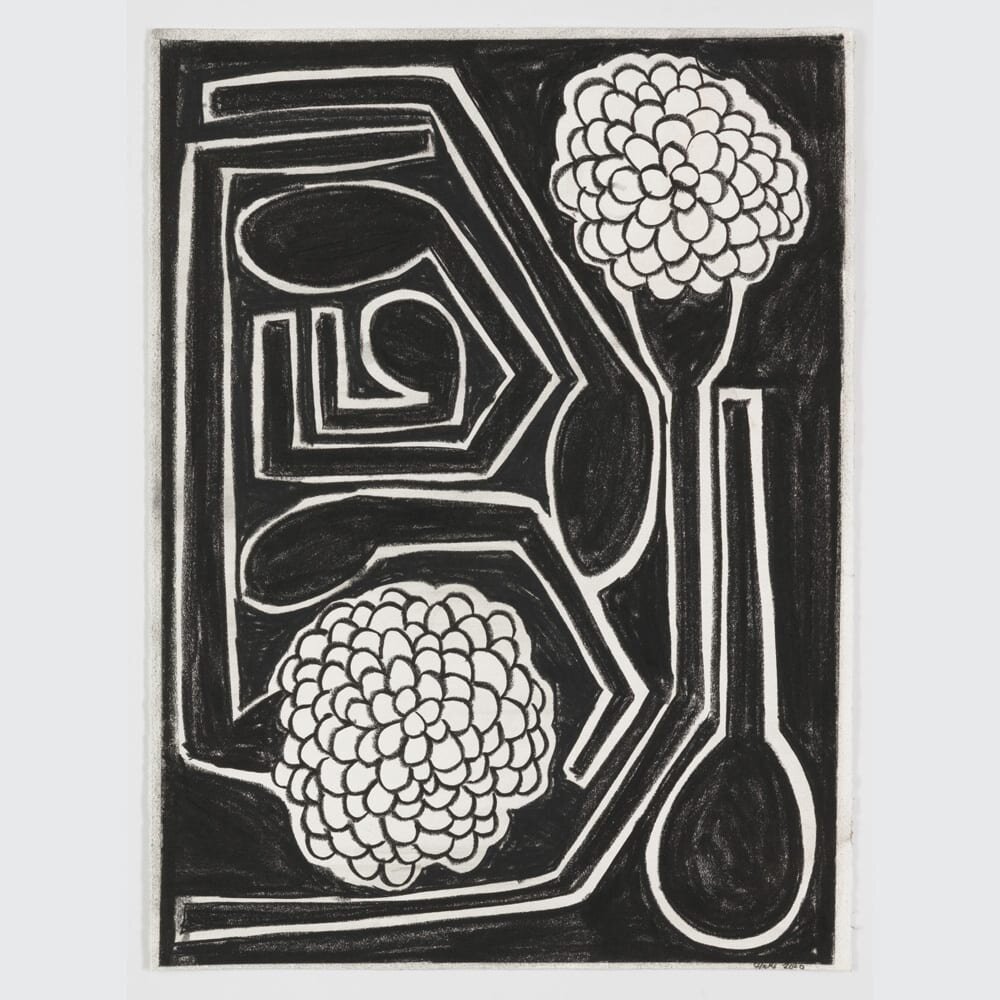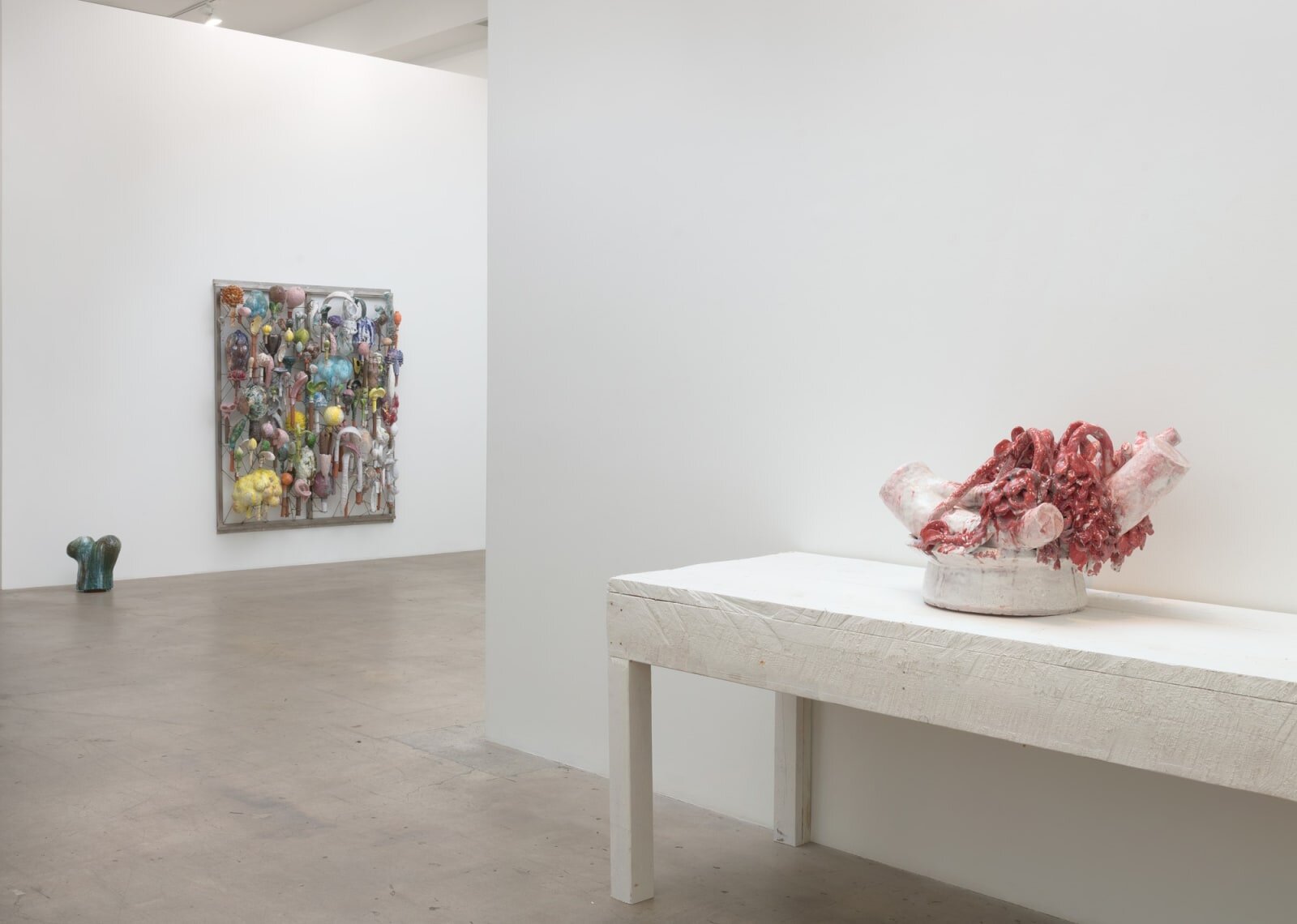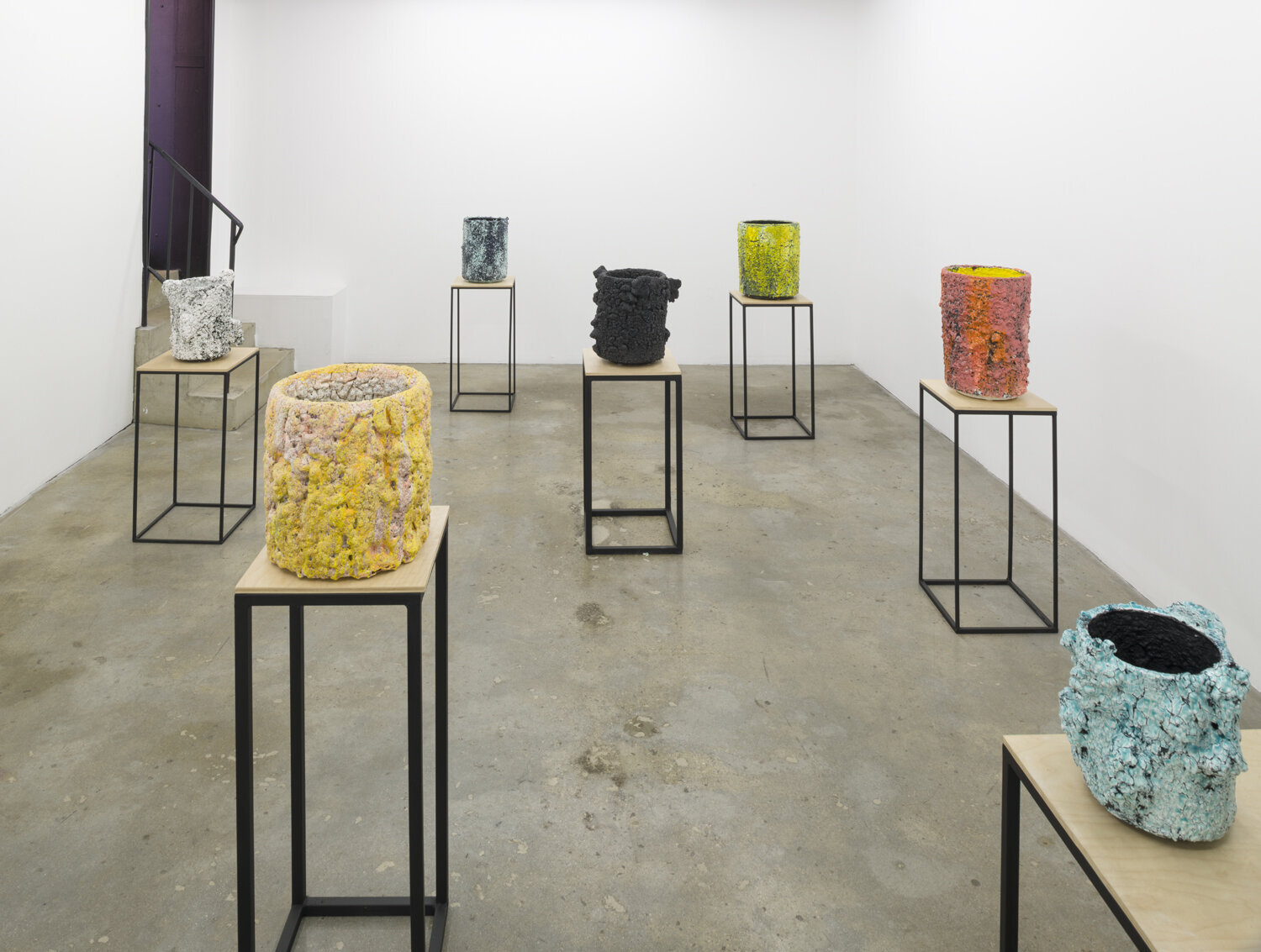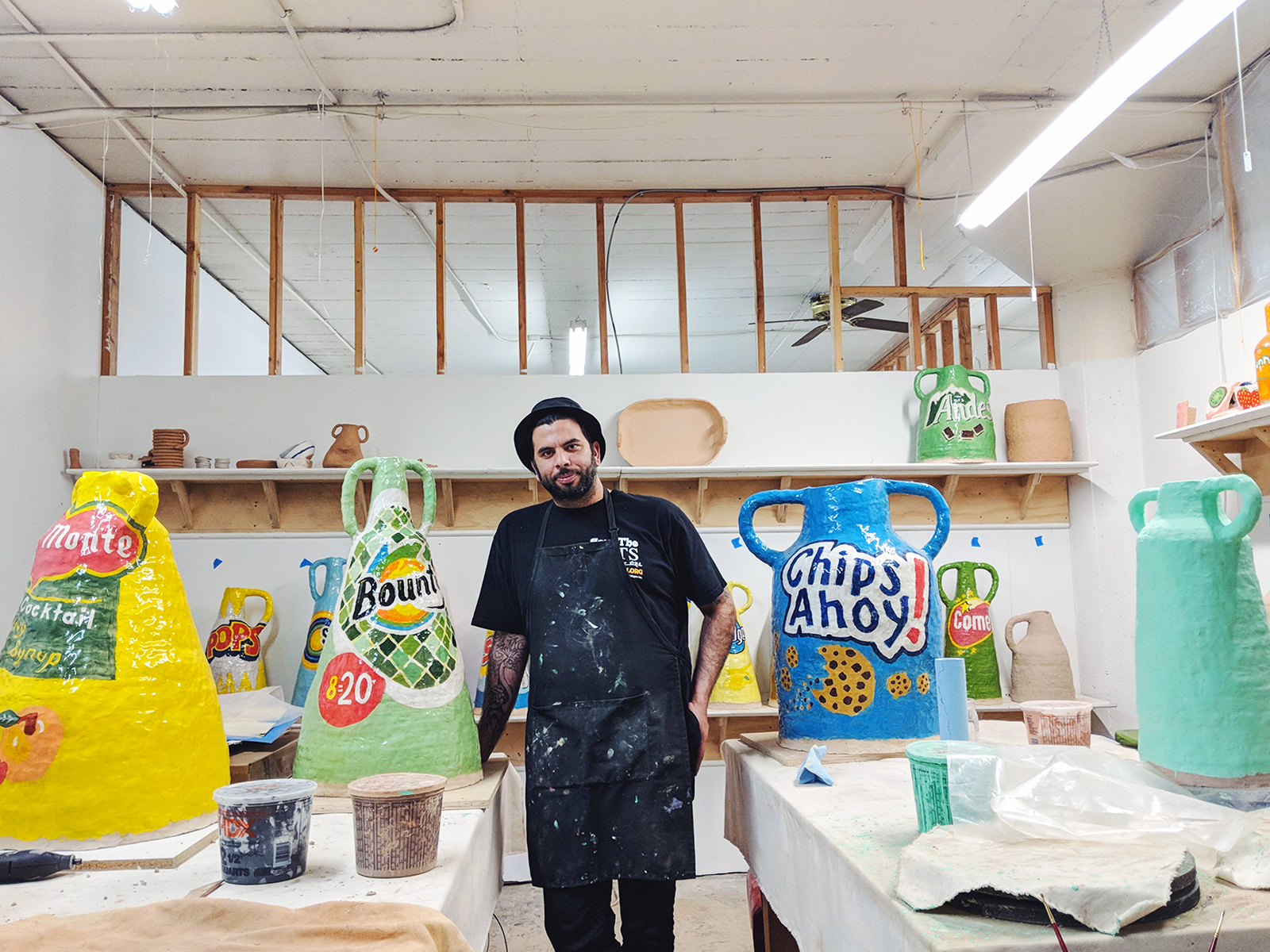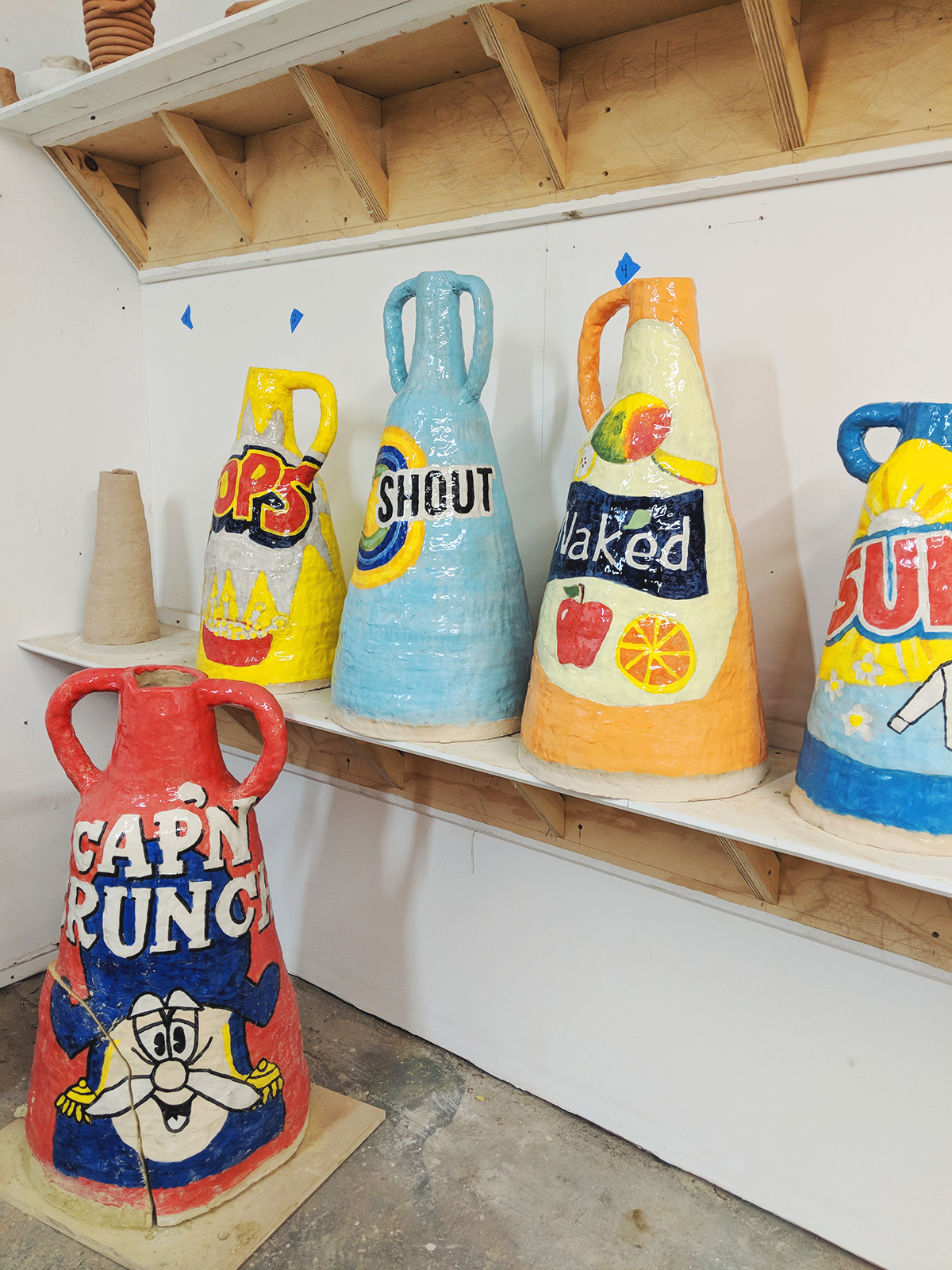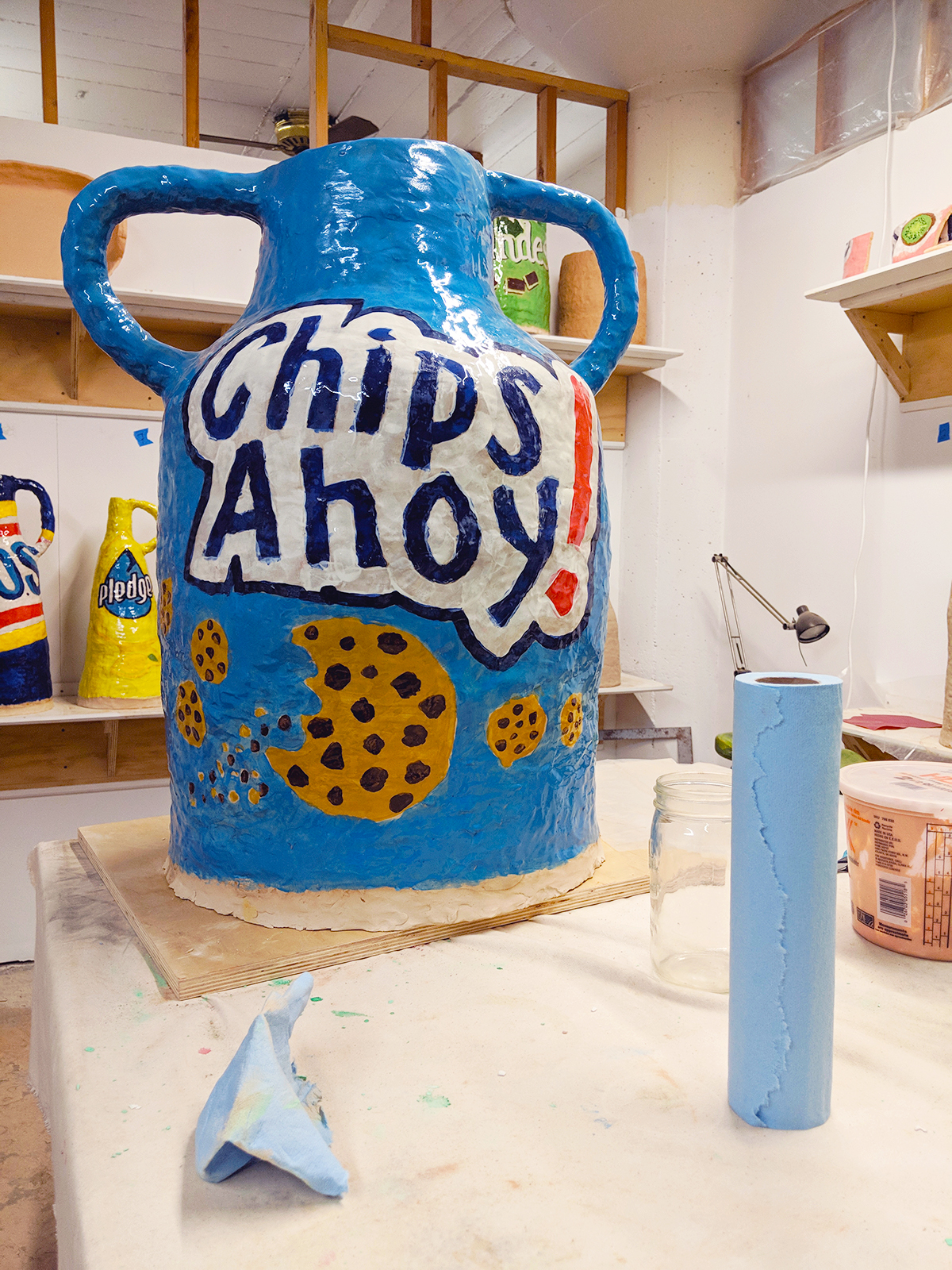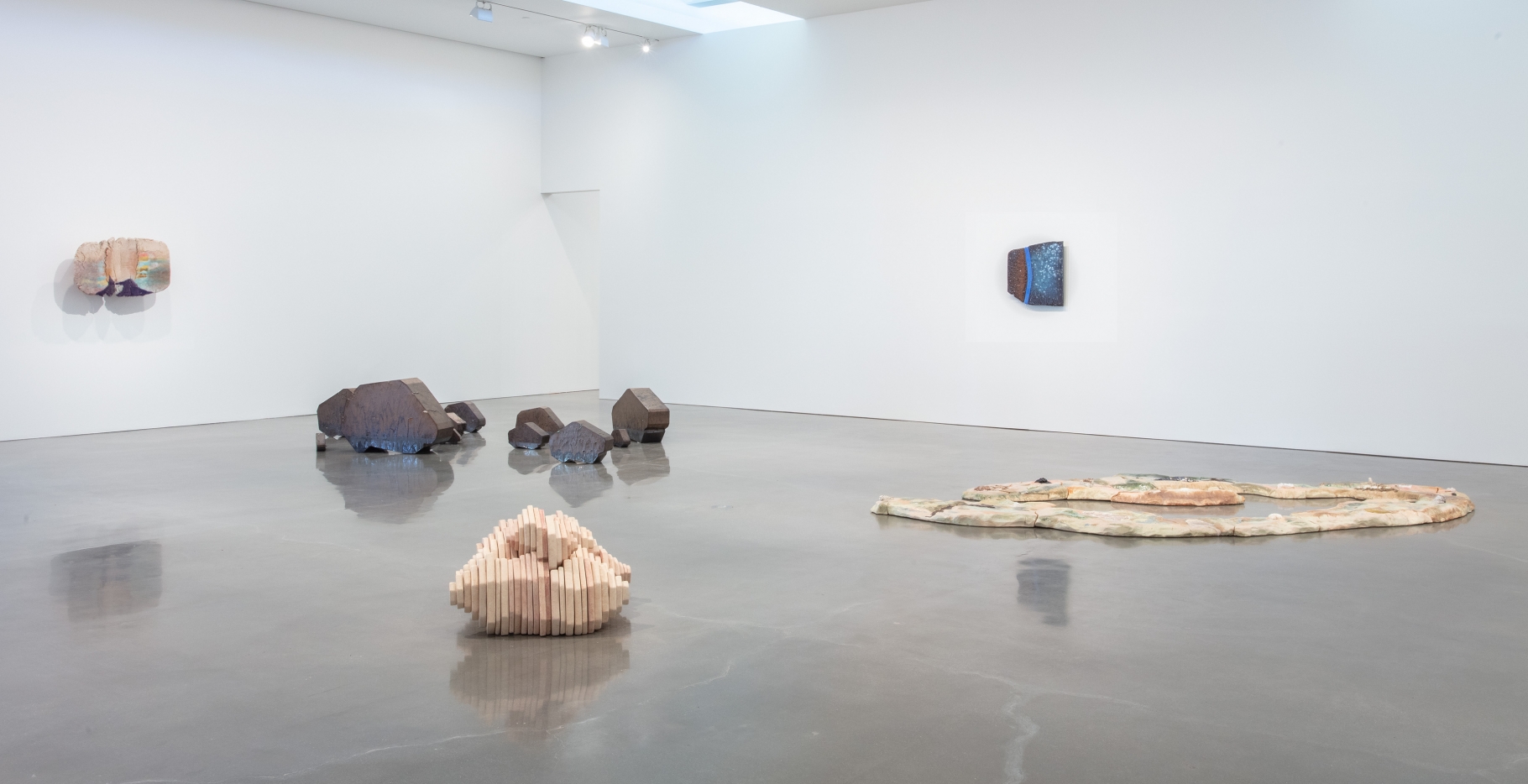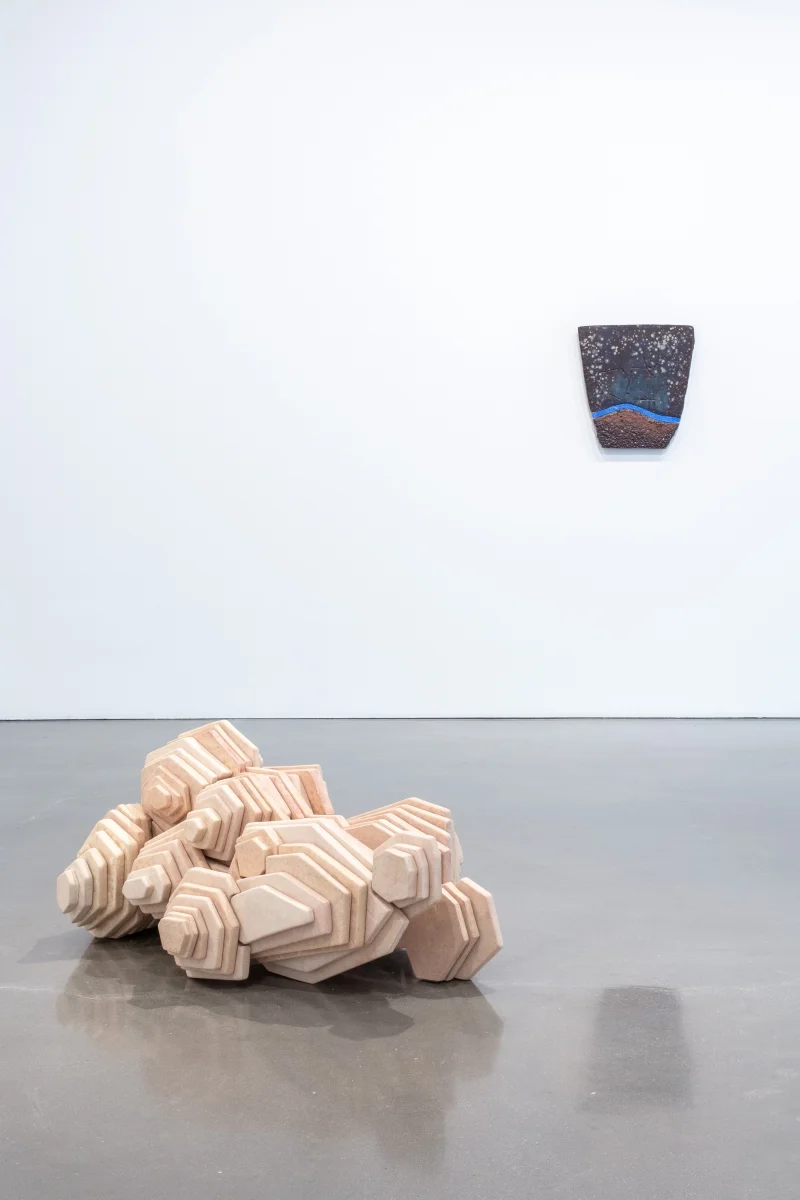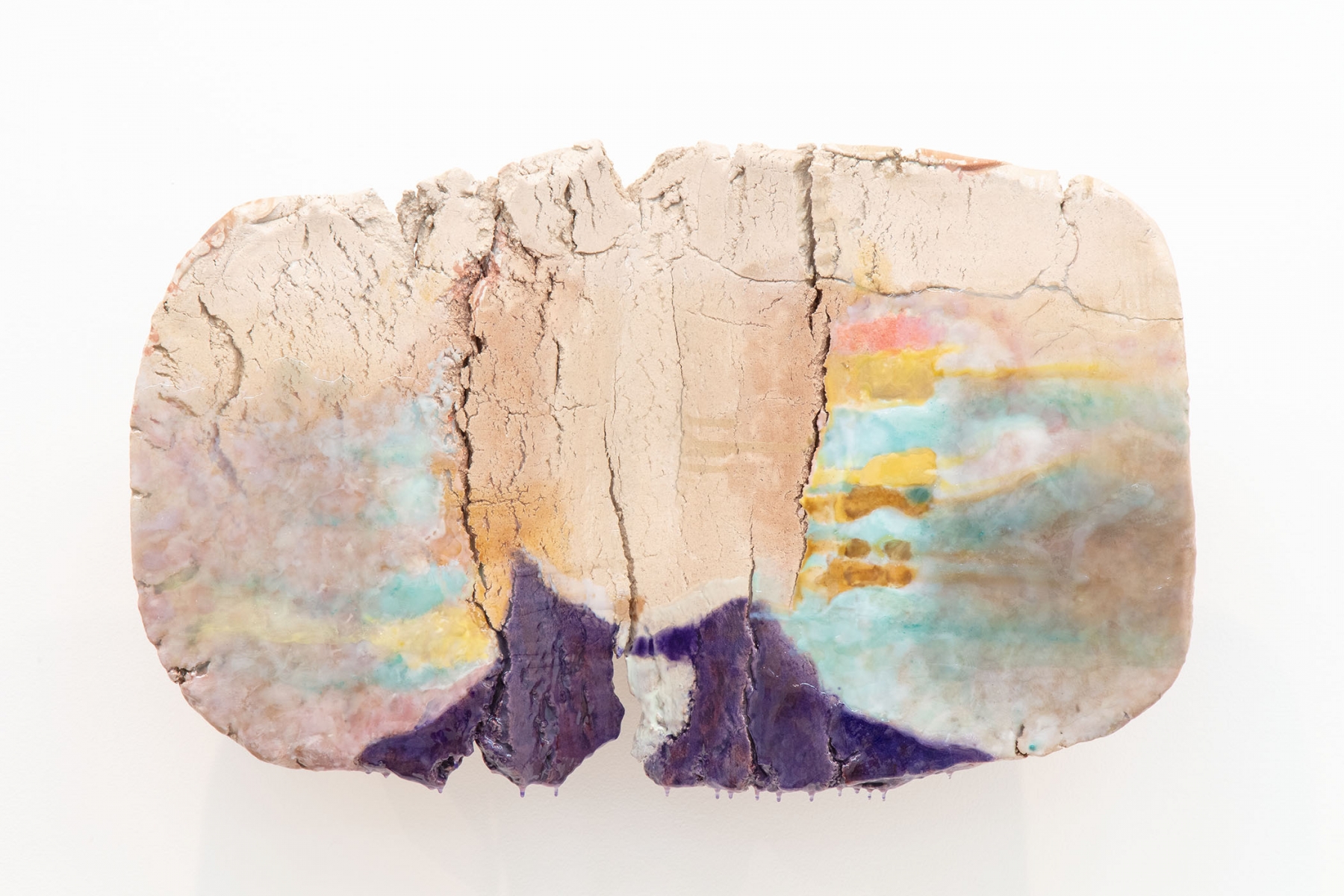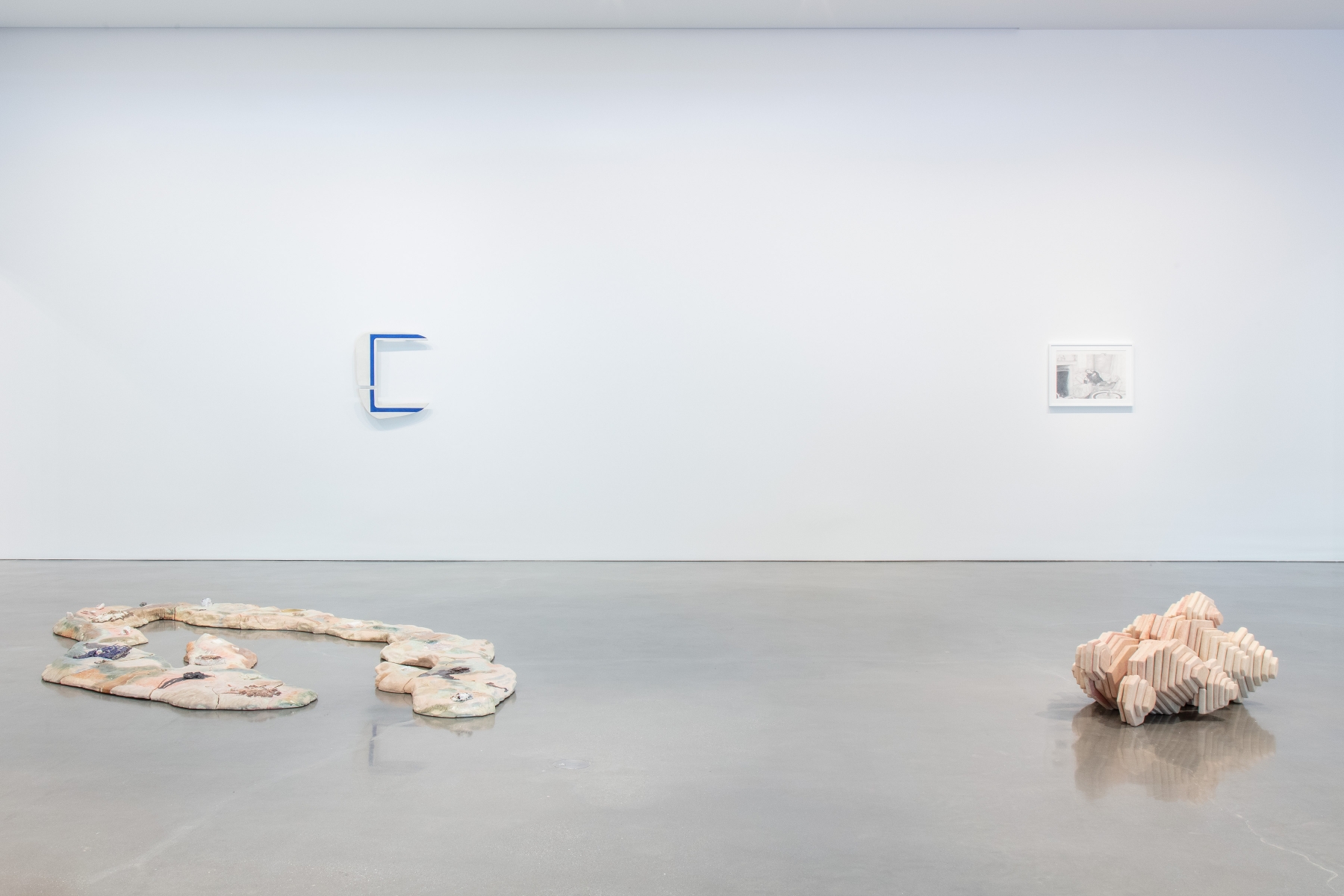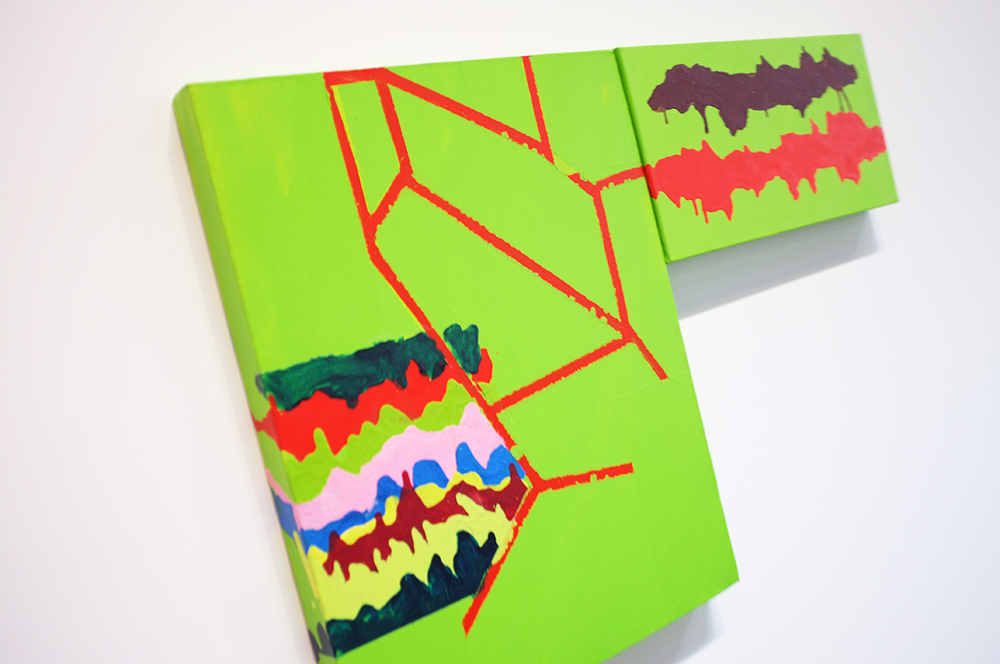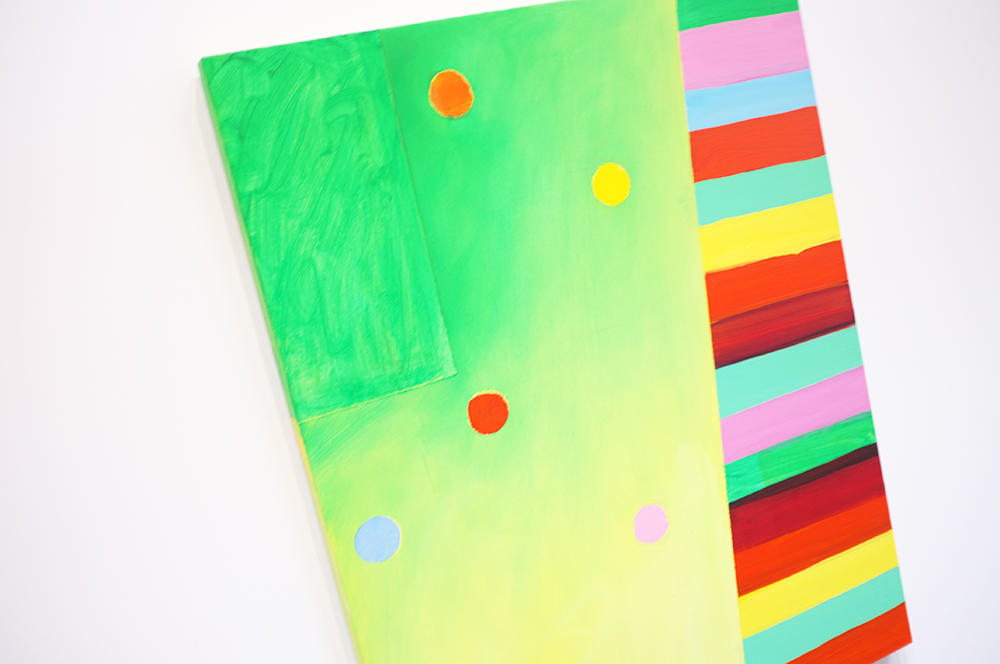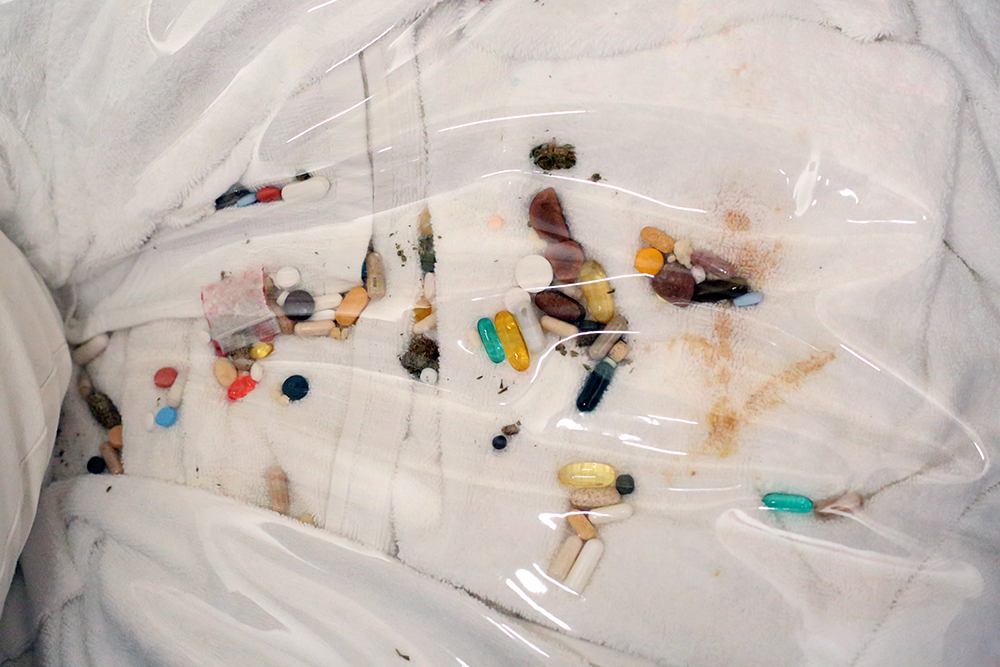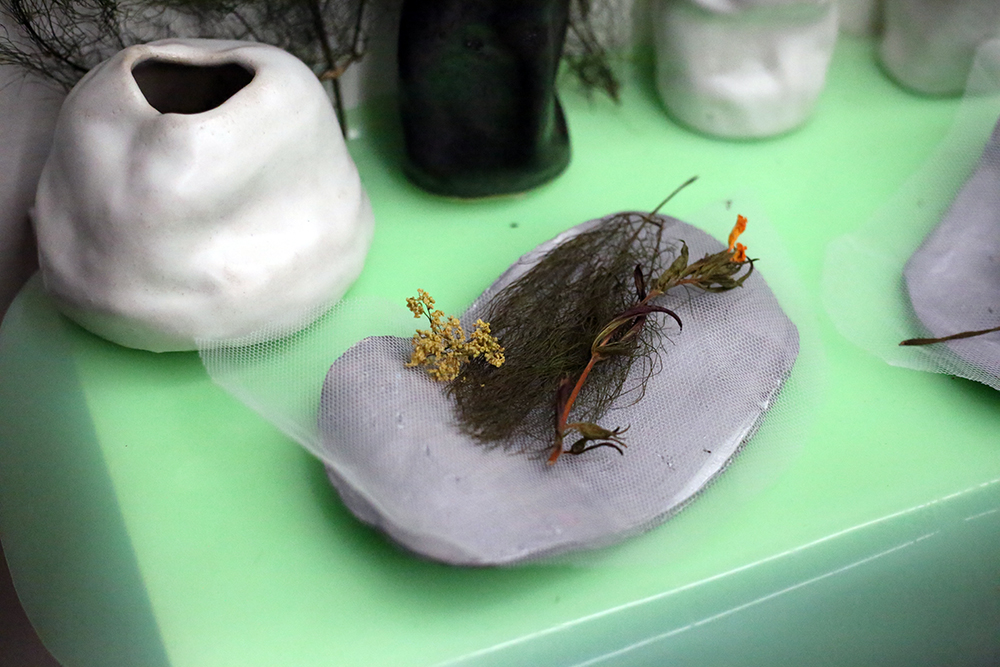
photograph by Stefan Simchowitz
text by Michael Slenske
In the northeast corner of the dining room at Blossom, the art-filled Vietnamese restaurant tucked into a pocket of Los Angeles’ Chinatown Central Plaza, a massive oil painting hangs high above the tables. It depicts a woman lying in a field of yellowed grass, staring up at the sky with her hands clasped beneath her head. Behind her, a near-limbless tree and a blackened roadside sign tilt ominously into the frame. She wears a burgundy cardigan, a denim skirt hugging the contours of her thighs, and a turquoise T-shirt emblazoned with what looks like a black-and-white graphic reminiscent of Peter Saville’s pulsar design for Joy Division’s 1979 album Unknown Pleasures. Her face is obscured, but the soles of her tennis shoes jut toward the bottom edge of the canvas, almost pushing into the restaurant itself. The perspective is disorienting and uncanny, a haunting image painted by and portraying the late Los Angeles artist Jasmine Little, who died tragically this February at age 41. The news of her unexpected passing from liver failure sent shockwaves through the city’s art community in the weeks leading up to this year’s LA Art Week. Simply put, the intimacy she imparted to her work, fellow artists, and friends was undeniable.
“That’s one of my favorite paintings,” says Roger Herman, who was one of Little’s undergraduate professors at UCLA in the mid-aughts. “The painting at Blossom is so beautiful and so sensitive. This girl is just laying in the grass. It’s a masterpiece. It reminds me of this painting she showed me to get into my class.” This somewhat obscure self-portrait might seem like an outlier within Little’s broader oeuvre. But Jasmine Little was full of complications and contradictions. She was fiercely ambitious and competitive in her practice, yet she went out of her way to champion the work of her friends. She loved the solitude and serenity of nature in the high desert and Rocky Mountains, yet she craved the buzz of the Los Angeles art community. She wanted to be known as a painter, but made her biggest mark in sgraffito-carved ceramics, which were really just paintings veiled as sculpture. Her vessels were steeped in classicism and, truth be told, she wanted them considered against those made in the eras of Greek, Roman, and Egyptian mythology that she pulled from, but she also had a blast hawking hand-carved soaps and coffee cups at artist markets, including the Ooga Booga Flea Market and one I organized around LA before and after Covid. Most tragically, she spent a decade sober and largely out of the spotlight but in Colorado honing her craft while hiking, ice climbing, and working in real estate appraisal, though her highest points of art world acclaim arrived when she was back in the city and at the lowest points in her addiction to alcohol. The irony is that it was probably because of, not in spite of, these contradictions that her work emerged with such frothing urgency and intensity.
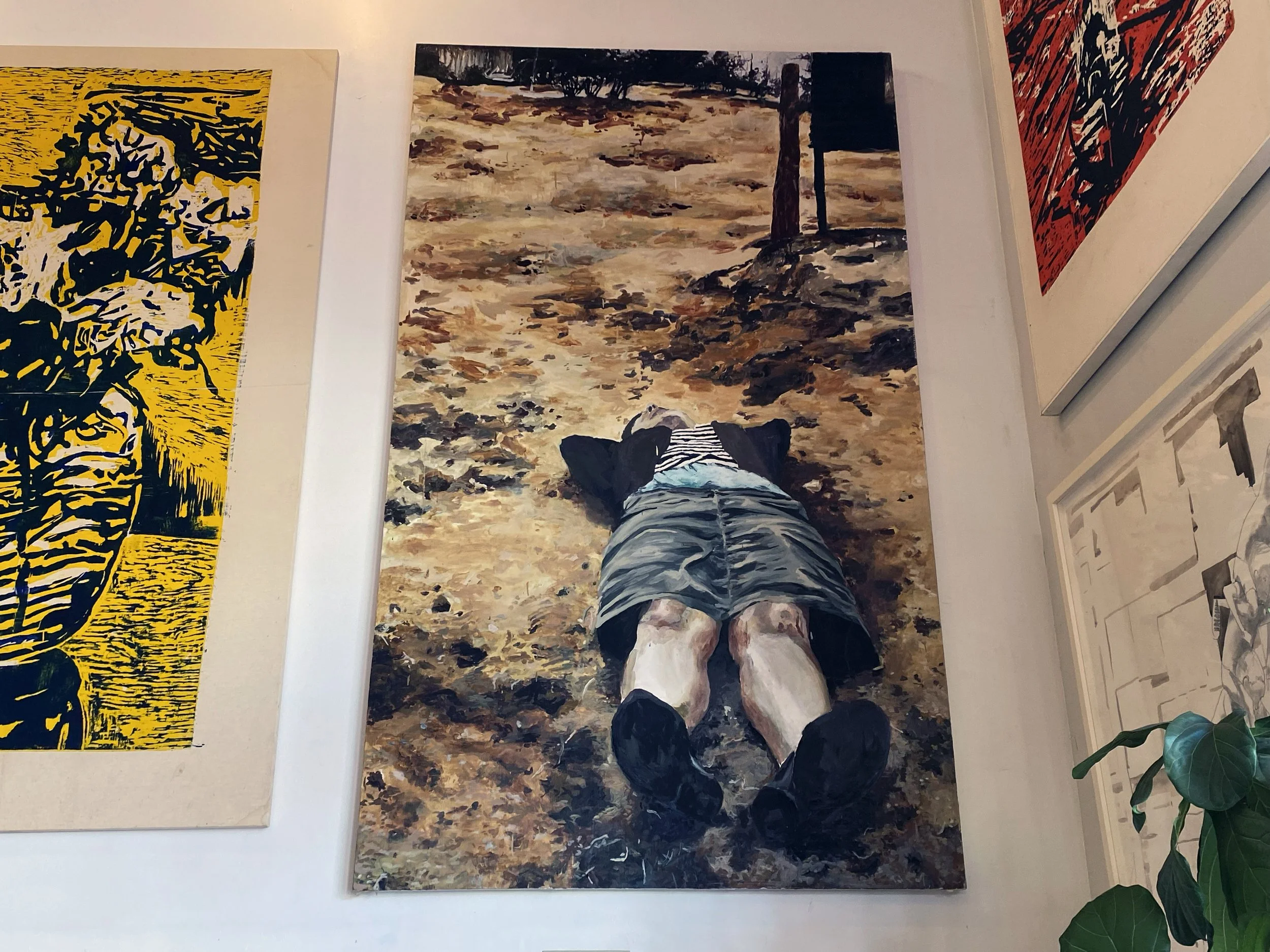
Self-portrait at Blossom. photo Marty Schnapf
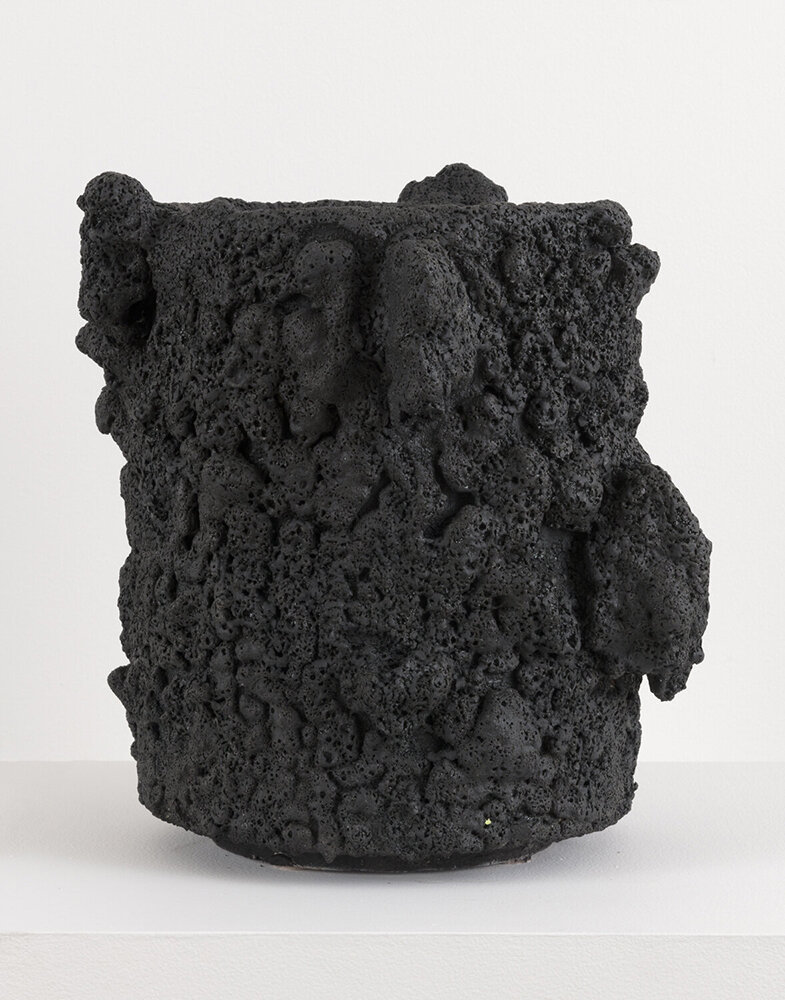
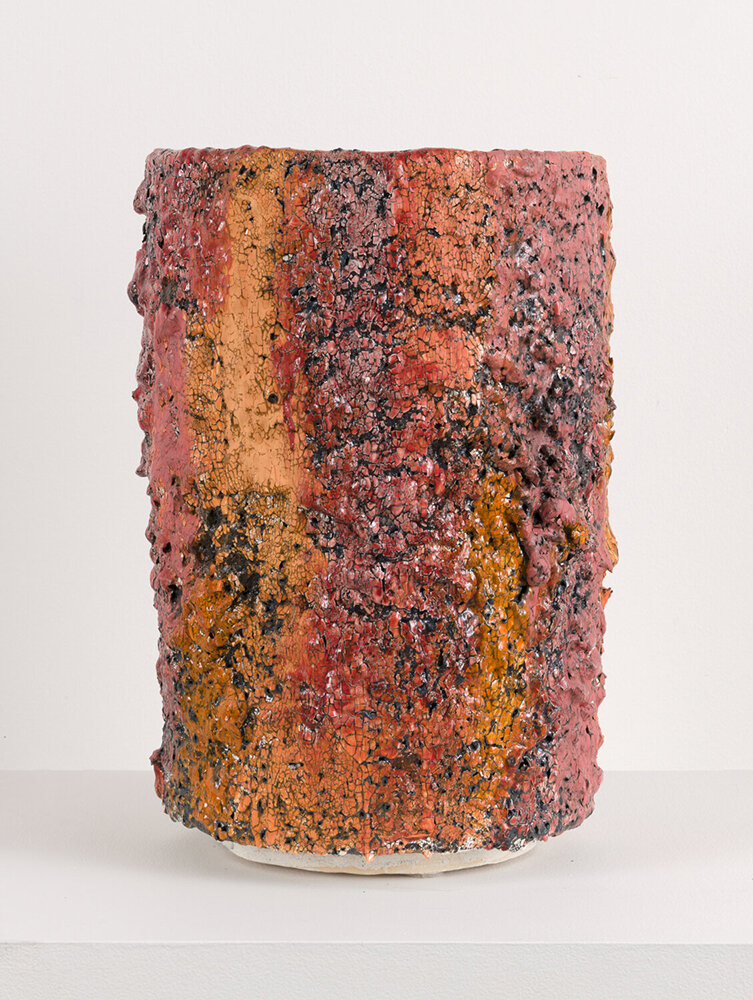
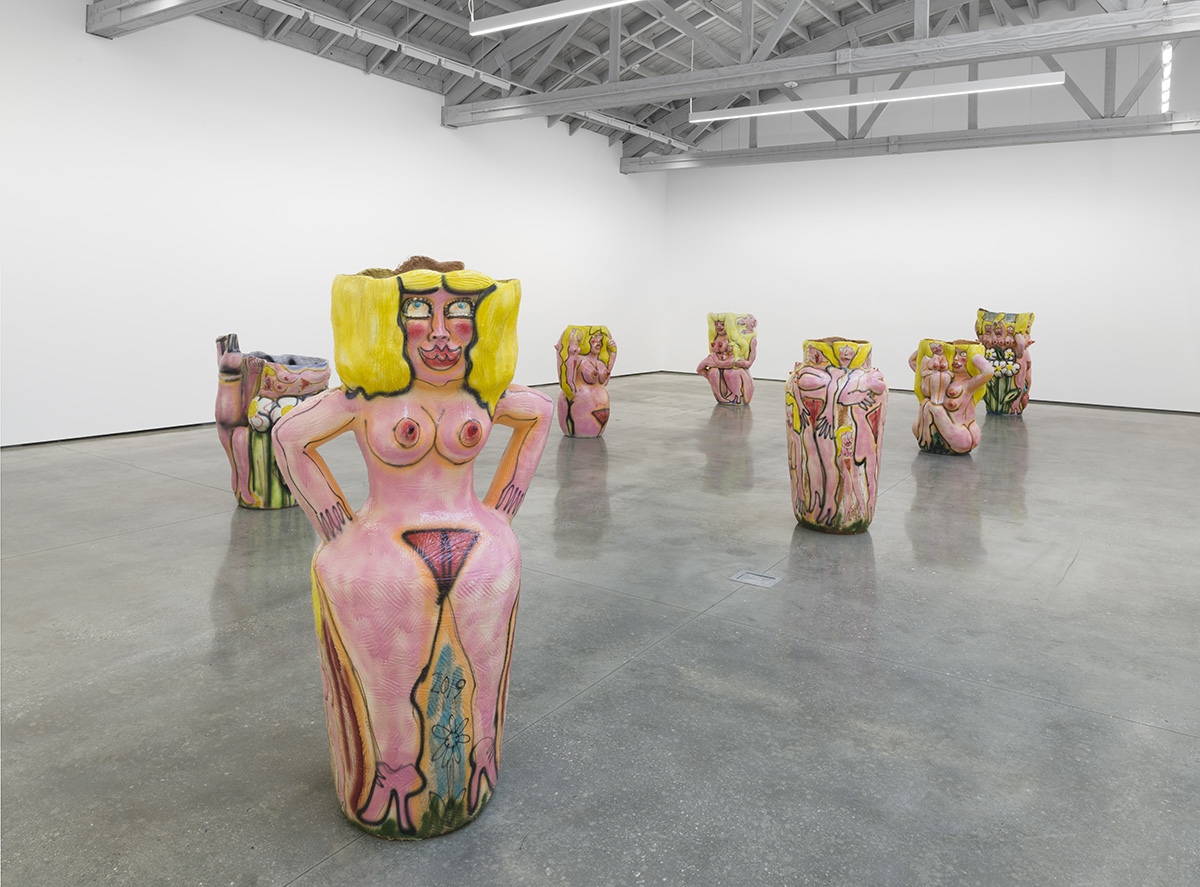
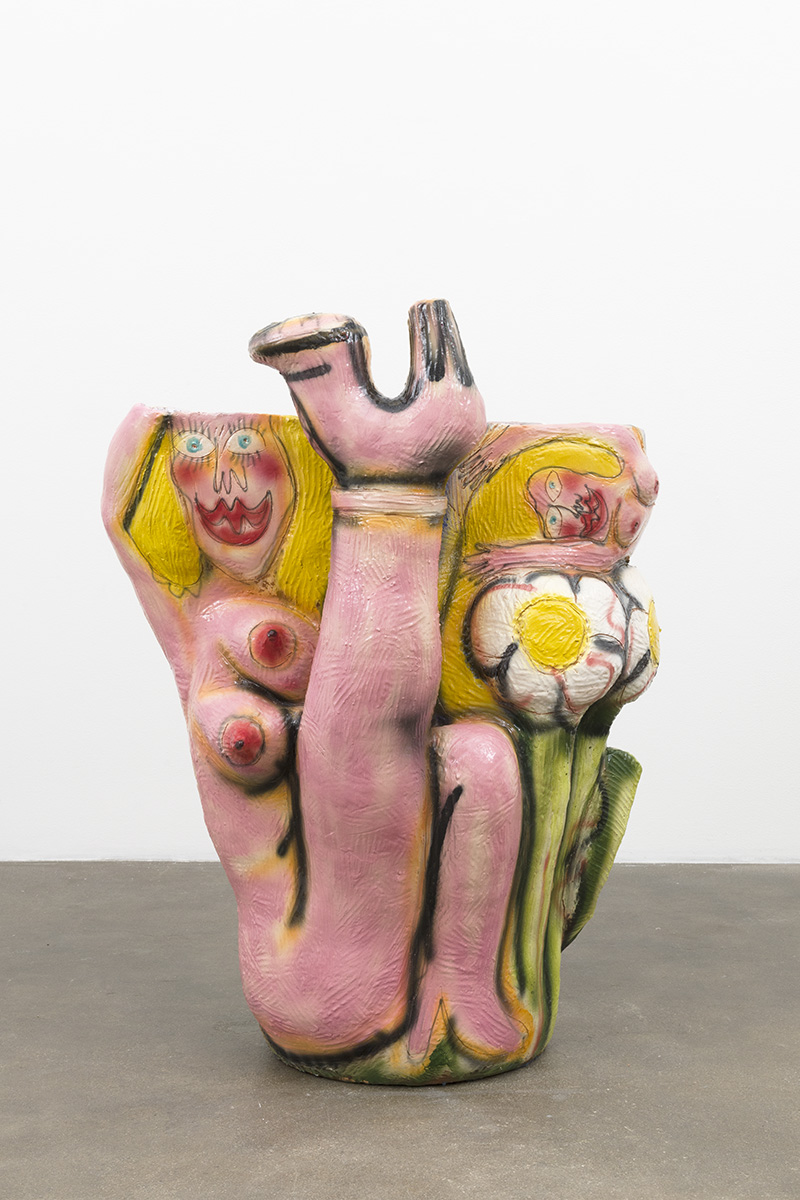
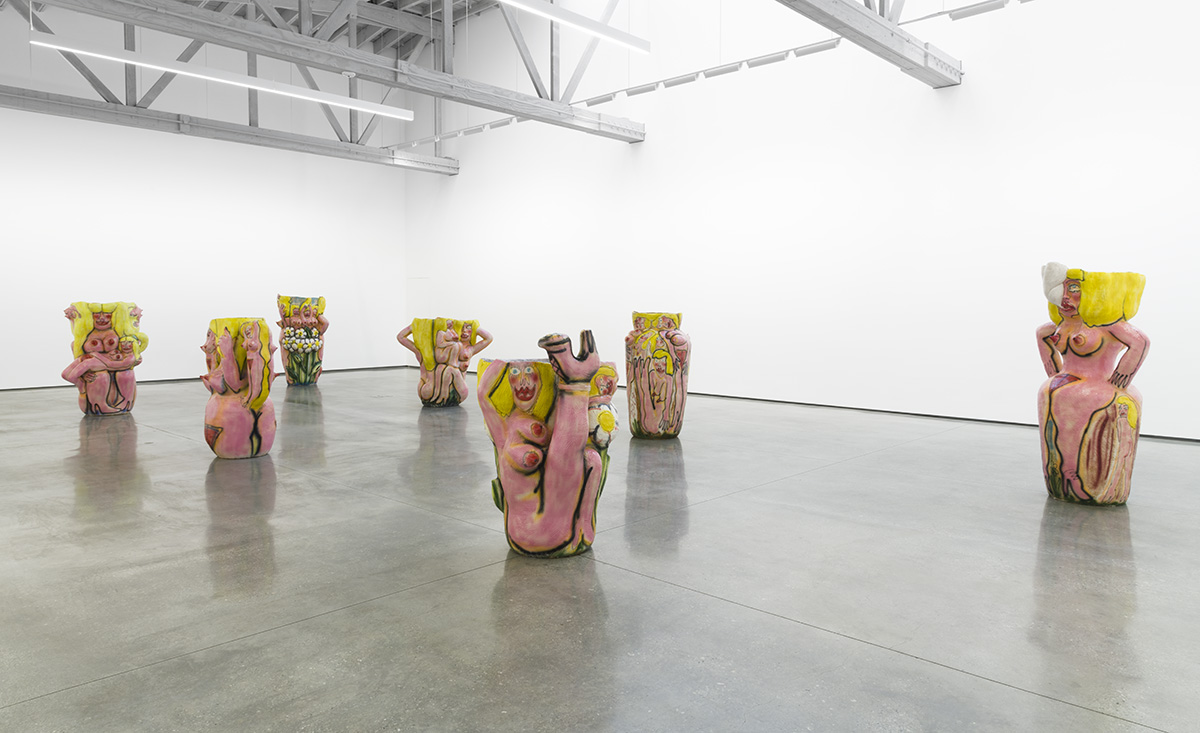
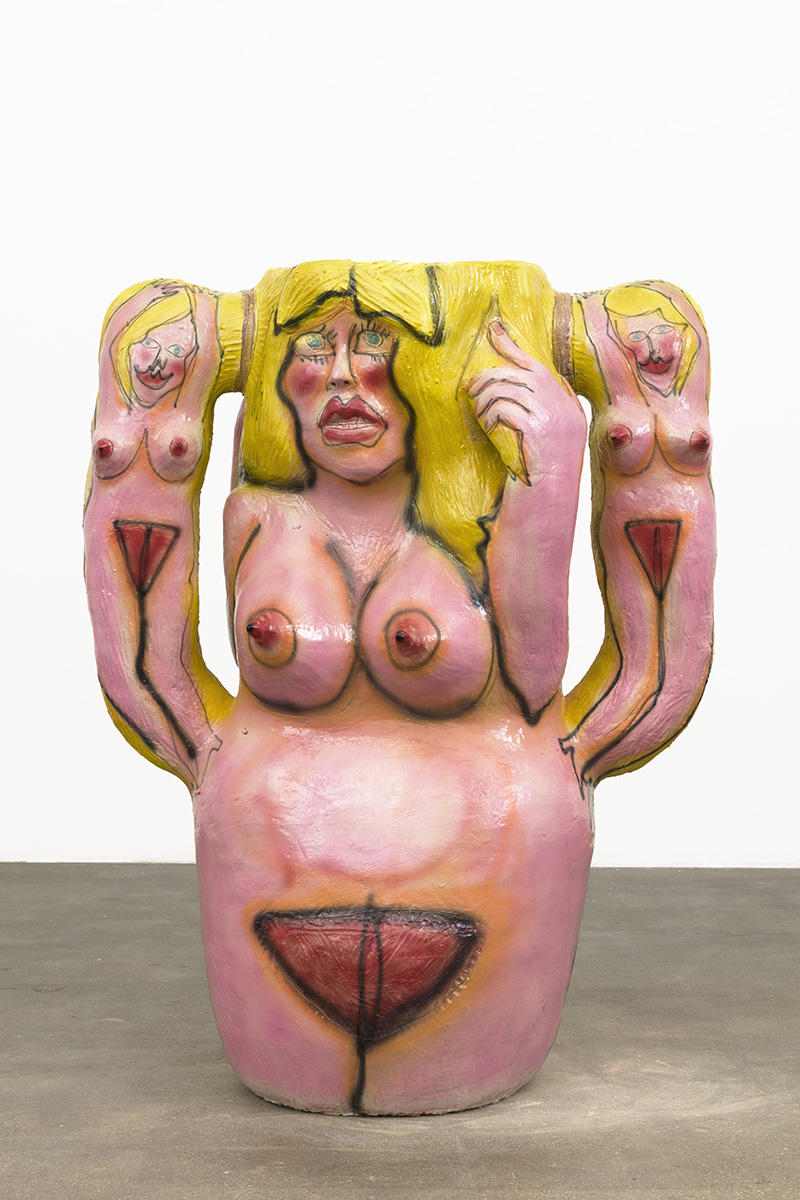
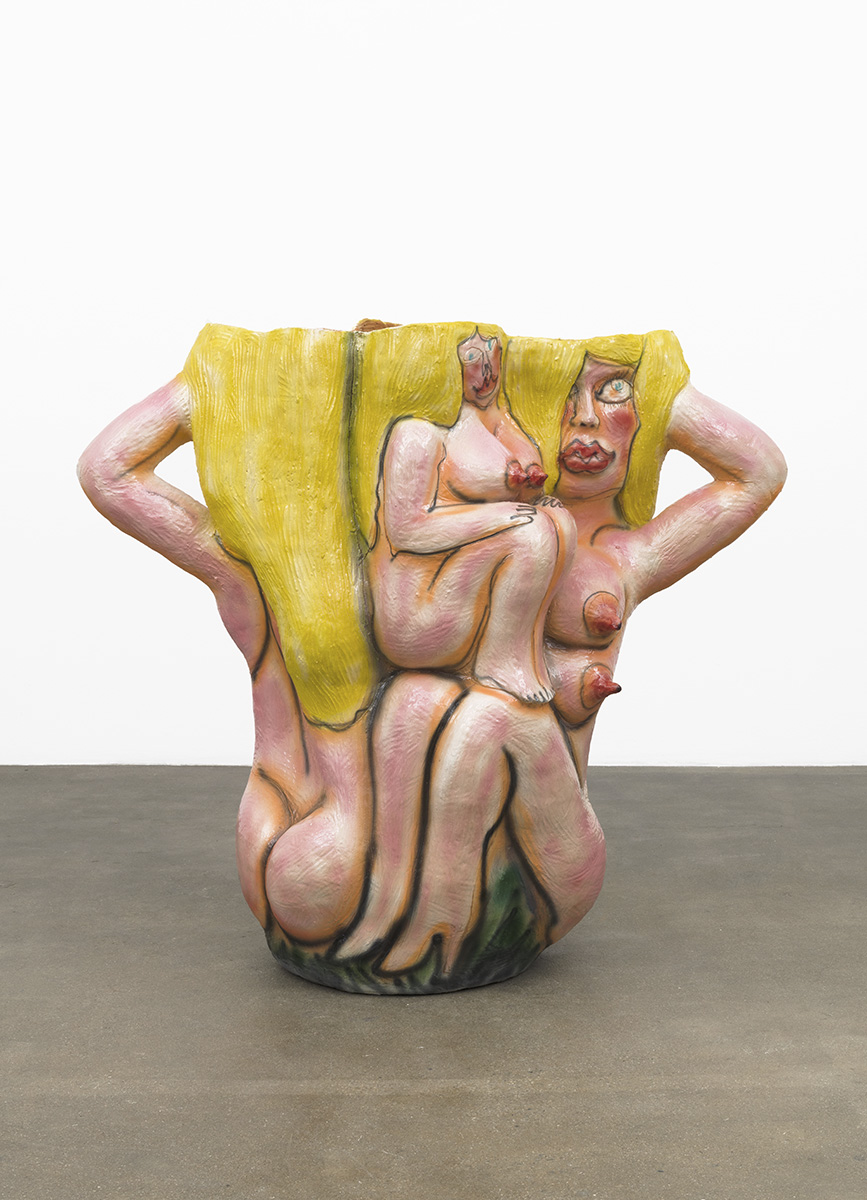
Her career also had its complexities. Jasmine came to UCLA as a figurative painter focusing on self-portraits in the vein of YBA artists like Jenny Saville, but she gravitated toward performance and relational aesthetics with her classmate Jamie Chan, who formed one half of the collective Little Chan. In recent years, she expanded her practice into monumentally scaled stoneware vessels carved with references to medieval manuscripts, Renaissance painting, Safavid carpets, Grecian pottery, Japanese woodblock prints, Roman orgies, and her own Californicated landscapes and myths. She was an archaeologist of antiquity who strip-mined classical forms to remake them in her own inimitable style.
“It was contemporary California language meets Joshua Tree meets antiquity, and then she’d put it all together into some stoneware that would probably last 30,000 years,” says Kirk Nelson, owner of La Loma Gallery, which represented Little during the last years of her life. “Her vessels are gonna wash up when all the buildings have burned down and you'll see a Jasmine Little sticking out of the sand somewhere.”
These clay works were hewn from a proprietary clay mixture—dubbed Jasmine Red—embedded with gravel, porcelain, rocks and even bricks salvaged from an Arts and Crafts-era house in Pasadena. During this same period, she also produced lush, tumescent still-life paintings invoking the Dutch Masters with astonishing speed in a studio practice that would run into the morning hours for days, sometimes weeks, on end.
“When she was working she would sleep till noon and then she'd paint all the rest of the day and all night, and she just wouldn't quit for 18 hours and she'd do that for months,” says her father, Dusty Little. “She was very dedicated. You can't imagine how much time she put into it, actually.”
“Her work seemed really unique and very specific to her. Not like it was jumping into different artist gene pools, you know? It was more like, okay, this is a clear voice. And that's something you look for, that person who is making their own thing that's very identifiable,” adds Nelson. “Nick Aguayo introduced us in 2018 and after I met her I thought, this is a voice that I want to follow.”
“Everyone knew she was a magical artist. Jonas Wood collected her art. I collected her art. Everyone knew that she was spiritually connected to that creative soup that we all know is true. There’s a truth that real artists connect to and it’s aesthetically coherent,” adds collector and gallerist Stefan Simchowitz, who bought Little’s work in bulk over the past decade. “We can't explain what it is, just like you can't explain why a joke is funny or why a Zen saying has meaning. It just does.”
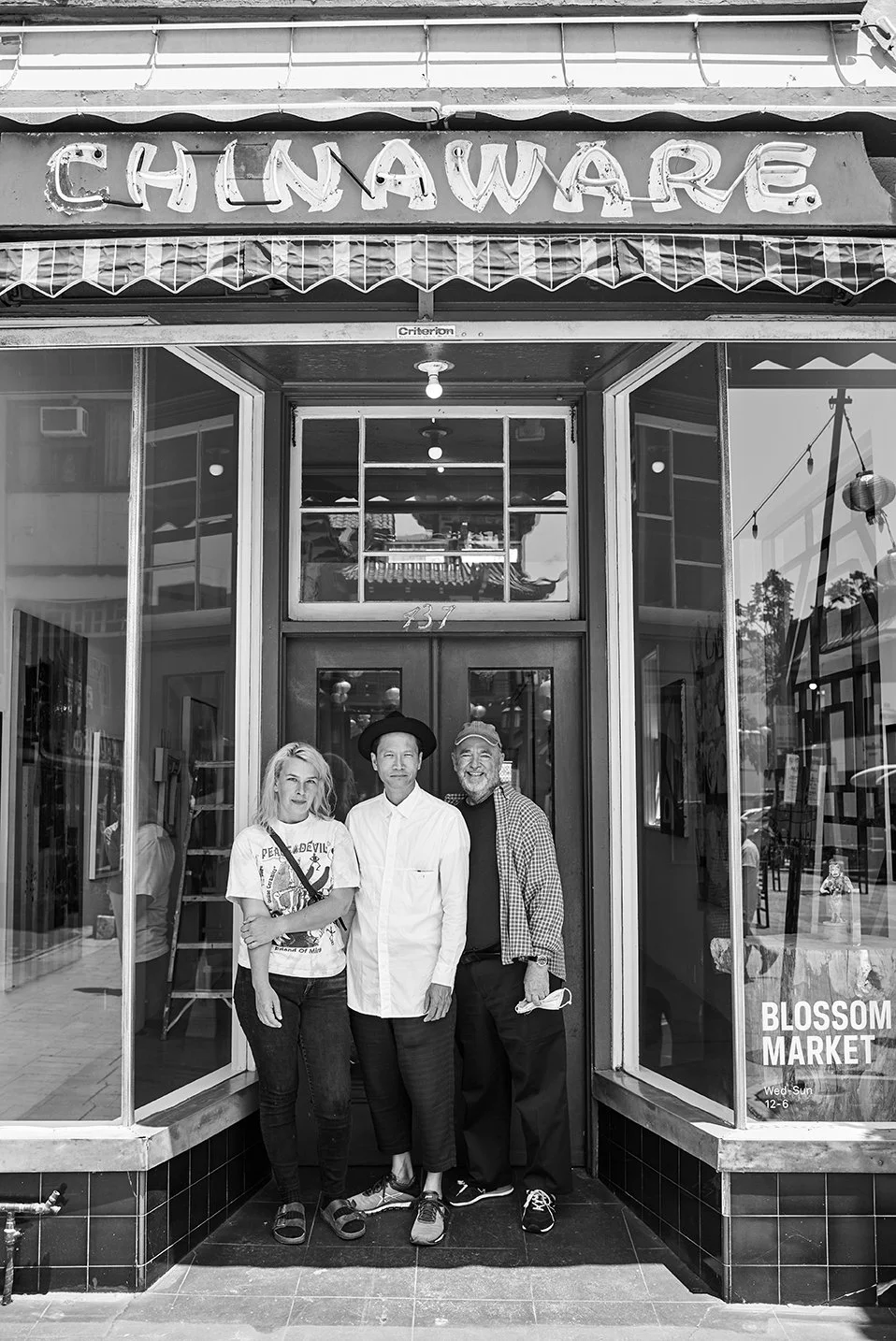
Born in 1984 in Portsmouth, Virginia, into a Naval family, Jasmine spent her grade school years as a prototypical Naval brat hopping between Norfolk, Chicago, San Diego, Long Beach, and Los Angeles. Her parents divorced when she was in junior high, and she went to live with her mother in the high desert military town of Twentynine Palms. While she struggled academically in high school, she attended Copper Mountain College in Joshua Tree before completing her undergraduate studies at UCLA. She later became part of the burgeoning Chinatown scene, exhibiting at spaces like Black Dragon Society, which was co-founded by Herman.
“Jasmine probably had shows at every space in Chinatown over those ten years. She was just very present,” says Josh Callaghan, who was an MFA student at UCLA while Little was there.
“She was a force,” remembers Herman. “My class was full and she came and said, ‘I want to be in your class.’ And then I said, ‘I don't know. I really have no room, but can you show me some work?’ And she showed me these paintings of herself that were bigger than life, you know, like a real frontal with a bra on. She was unbelievable and very pure and it's tragic for me because I think she got messed up from the art world more than from her alcoholism. It ate her up. You know how the art world is.”
On the heels of graduating from UCLA and after a hard run with partying in Chinatown, Jasmine moved in with her father in Alamosa, Colorado, and spent the next decade exploring the wilds of the San Luis Valley, where she focused on sobriety, got married, and earned her MFA at Adams State University, which still has a massive two-panel landscape depicting an almost alien vantage of the Rockies hanging in its halls. It was during this sojourn that she got into ceramics and even became a licensed real estate appraiser.
“She was brilliant. She picked it up and passed the test the first time, got her license, and if you look up the national registry you'll find her in there until it expires,” says Dusty Little. “She used that same skillset in appraising and looking at art and deciding what was good and what wasn't.”
This skillset surely bled into her practice at times, which borrowed heavily from the high points of art history.
“I think a lot of the different periods of her work could be seen as Jasmine just loving different types of art and doing homage and falling in love with different art forms, like the way she did with ceramics,” says Jamie Chan. “She met someone who was really encouraging and ran a ceramics lab and ceramics is a community-based practice, you know, and painting is extremely isolated. So I think she got some relief from the pressure of trying to turn out amazing paintings, which can be exhausting.”
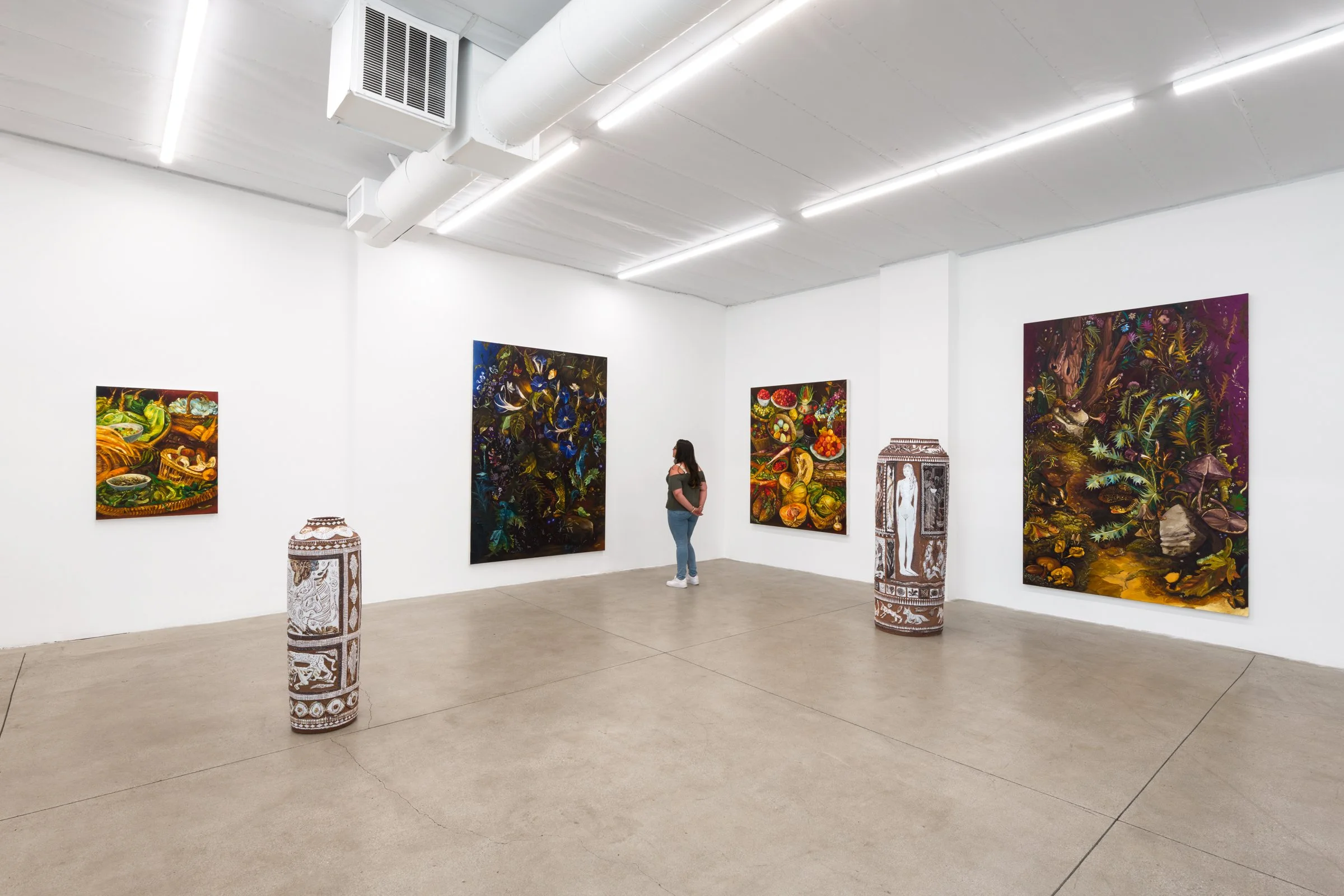
Jasmine returned to Los Angeles in 2021 and quickly reengaged with the broader art community just as her career accelerated. Her ceramics and paintings appeared in exhibitions across Los Angeles at Night Gallery, Five Car Garage, and Wilding Cran Gallery in a show I curated a couple summers ago, where she exhibited a fulminating eight-foot-tall still life incredibly titled A Child’s Garden of Taxonomy. (She collaborated with her brother, Justin, to title all her paintings.) She showed in New York at Deitch and Johannes Vogt, in Miami at Nina Johnson, and curated a big group show at Tif Sigfrids in Athens, Georgia. Her work was also shown internationally in Paris, Shanghai, Brussels, and Salzburg. During this period, her ceramics entered the permanent collections of the Smithsonian Archives of American Art, Pérez Art Museum Miami, the Detroit Institute of Arts, and the Nevada Museum of Art. For a time, Jasmine Little was on fire.
“I think she just loved making work. She got so excited about it, and that excitement was contagious. We’d feed off it together,” says Nelson. “The final works she was making were these eight-foot-tall vessels. She’d stay in the studio until two in the morning for weeks on end. That drive was innate. She had this inner fire to make work around the clock, and that’s why she was so prolific. It was thrilling to be around.”
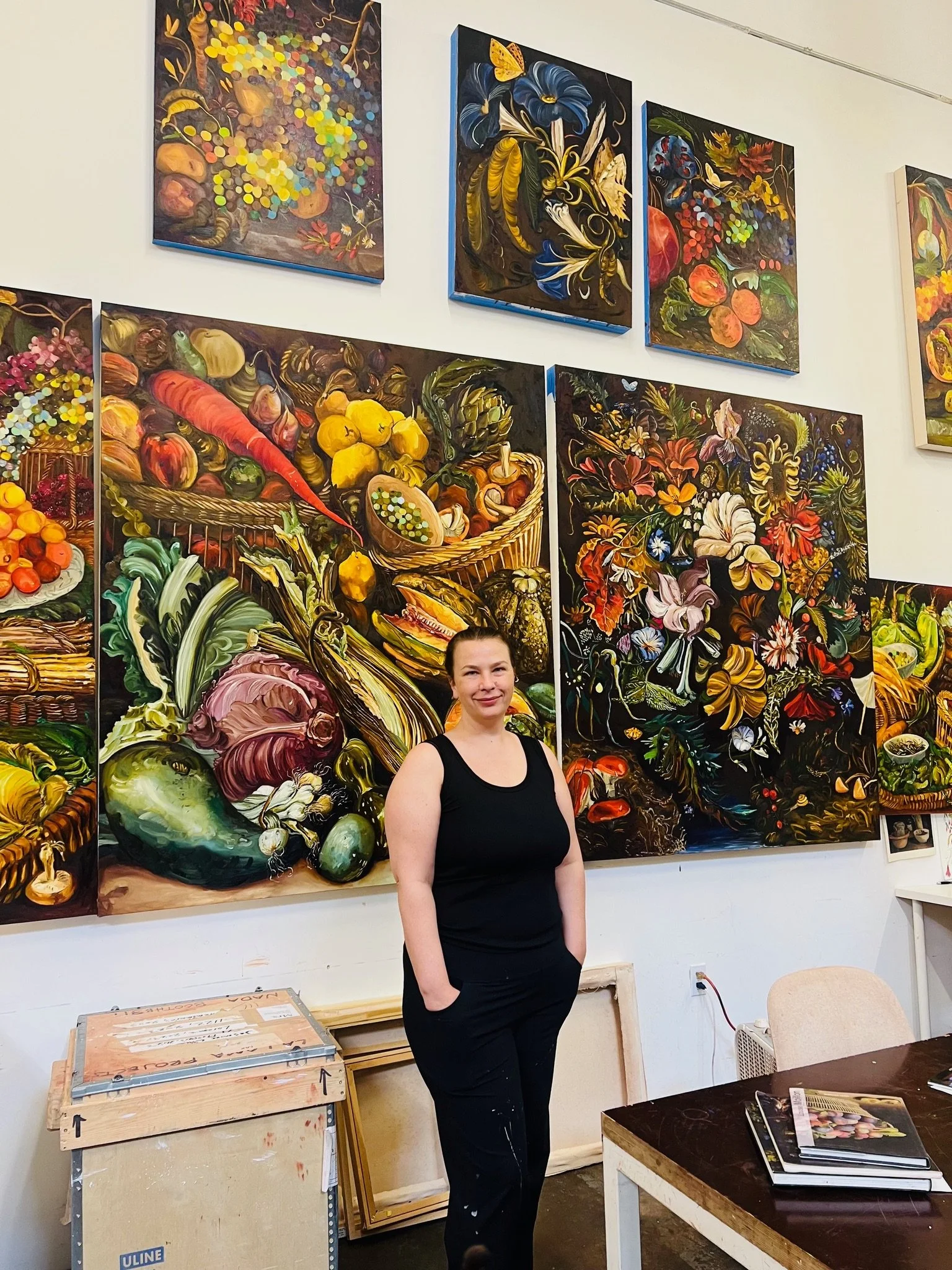
For “Modesto Hoover Wagon Meet,” her final show at La Loma, Jasmine tapped artist Niki Ford to create a sprawling high-low charcuterie tableaux filled with Humboldt Fog, fresh baked bread, prosciutto, bortadello, squash, grapes, cantaloupe, M&M’s, gummy bears, homemade hummus, all wrapped in ivy and accented with crystal. It was as if you were eating from one of the engorged tableaux in the still-life paintings on the surrounding walls, and at the standing-room bacchanalian opening last June, artists and friends ate and drank nearly everything in sight, including the entirety of a Fluffy’s Ice Cream Cart.
“It was like you were beamed down into ancient Greece at a feast for the eyes and gut,” says Nelson.
In the spirit of harnessing that energy, La Loma is organizing a memorial (with another feast styled by Ford) this Saturday, May 30, from 2 to 5 p.m. in the Lanai Gallery at Vielmetter Los Angeles. In lieu of flowers, donations in Little’s name can be made to the Pearson Center for Alcohol and Addiction Research at Scripps Research or another charity of choice.
“There will be some sculptures and paintings on display, but this isn’t a show. It’s a memorial for friends, collaborators, and admirers to gather, reflect, and share memories,” Nelson says. “Later in the fall, I’m thinking about organizing an exhibition with artists who were connected to her and inspired by her.”
Here, her friends, artists, gallerists, curators, and collectors give voice to the magical presence Jasmine Little carried in the studio, the wilderness, and the art community of Los Angeles.
Childhood / Origins
DUSTY LITTLE, father
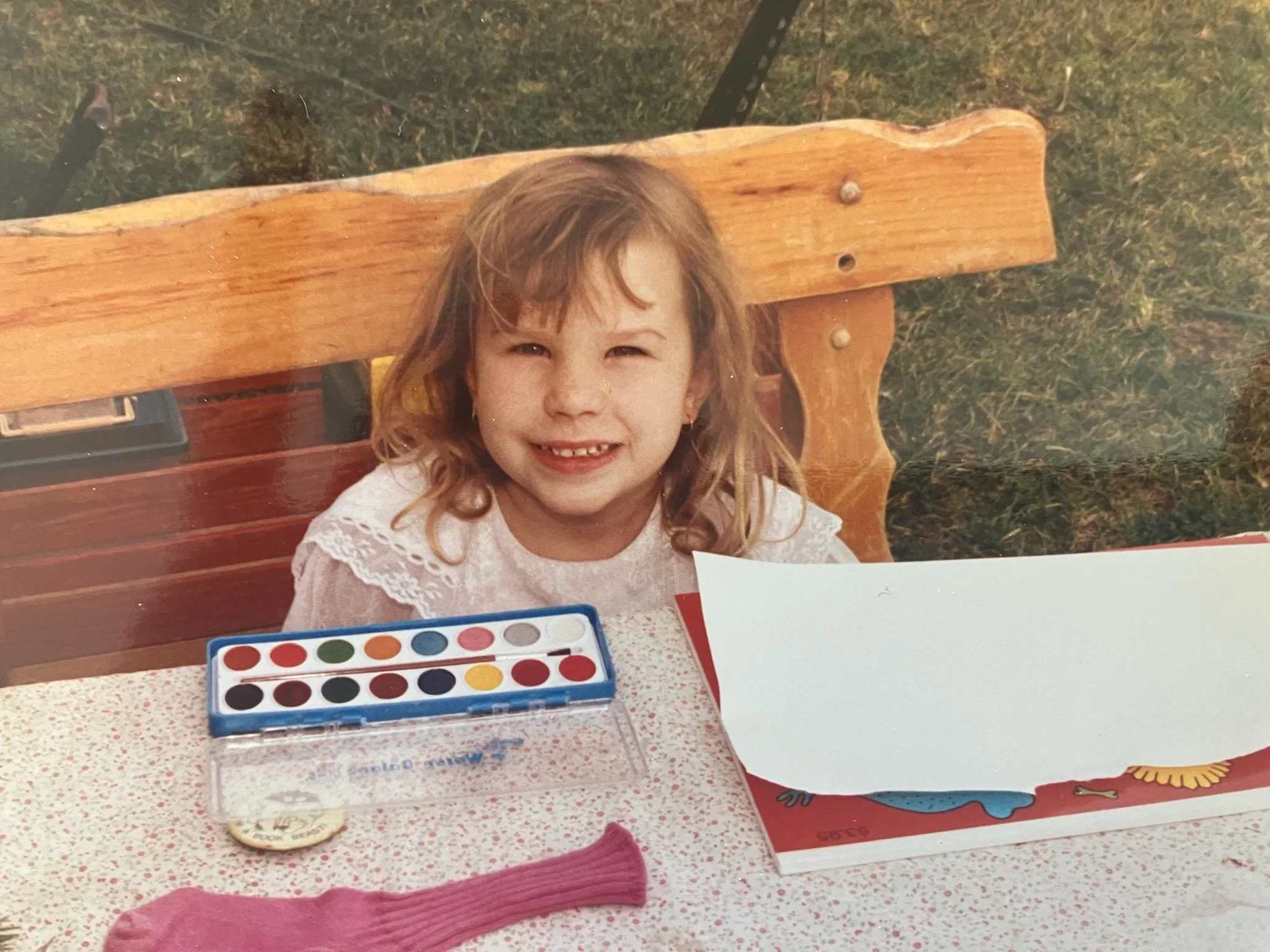
When she was a baby before she could talk, like 1 or 2 years old, she didn't like to go to sleep. She was a night owl from day one. So I used to carry her around the house and we'd look at every picture in the house. We had quite a few paintings, and I would just discuss what I could see in the paintings. And she was always enthralled. I'd say, “See how they make the zebra,” and I'd bring her up close and we'd just talk about the process of making the art. And then, of course, I had books about art.. I play guitar and if she couldn’t fall asleep I played guitar for half an hour, but she just loved to walk around the house and look at every painting again and again.
NICK AGUAYO, artist and classmate at UCLA
I think one of the first people I really became friends with in the art department. I remember, you know, you know, the art department was in the middle of Westwood at the time. And there was like a lot of energy there, and it was down the street from Whole Foods. I remember I was in line at Whole Foods and I was wearing a t-shirt for a record store that's in San Diego, and Jasmine was behind me, and, and she was like, “Oh, Lose Records. I have a friend that works there.” I'd seen her around the art department and then we got to talking and she grew up in the high desert, kind of near Joshua Tree. I grew up in the low desert near Palm Springs so we grew up going to the same mall, the Palm Desert Town Center. She went to Copper Mountain College up in the high desert and I went to a Communion College in the lower desert. And we had shared a teacher there, so it was like even before UCLA, we had kind of been taking the same steps even before we knew each other. Even though we didn't meet until our early twenties there was a kinship based on our interests. We just grew up kind of in the same place more or less. We had those connections, desert kids, you know.
photograph by Stefan Simchowitz
UCLA / Little Chan / Chinatown
JAMIE CHAN, artist, classmate at UCLA, co-founded Little Chan
We met in Roger Herman’s class and became best friends pretty quickly. She and I just kind of clicked for some reason that is somewhat mysterious to me, but I was really fortunate to be able to have somebody like her to be around. She was a transfer student at UCLA and I also had transferred in from being an undecided major. In painting class we were next to each other in our studios and we both just started talking, getting to know each other, and I think there was just a type of energy that really coalesced around the UCLA art department at that time, because we were off campus at Kinross. It was an offsite building where the broad was still being deconstructed to be reconstructed. And, so there was kind of like an art school energy that was a little just different. because we weren't on campus. We used to hide in the bathroom to stay and work in our studios after hours. The security guards would come in check all the stalls and then turn the lights off. As Little Chan, the first things that we did was form a residency. The first one was in our senior painting studios. Jasmine and I just started building structural architectural stuff. We also started camping in the desert. I met a lot of her friends in Twentynine Palms. Her mom and dad had just divorced and her mom was still living in Joshua Tree at that time. Jasmine's studio became something called Giant Rock, which is a site in the desert which used to be the largest freestanding boulder. Actually Jasmine has written Yelp reviews of many Desert places,including Giant Rock. They're worth reading.
The residency was designed to be like Jasmine's studio at UCLA. The senior studios are not given to everyone, they’re awarded and she used it to share the space with other people. So we built this cardboard facade to look like a rock. There were wooden pallets that she brought in so there was levels, there was a downstairs room with all these books we borrowed from the library. Upstairs we painted on the wall like a desert landscape so it seemed like you were outside. There was also a bedroom. We did performances in that space that were based on George Saunders’s Pastoralia. We had a camping party in the Giant Rock set up and that’s kind of crazy because it's in a campus building and we had a propane stove and we were smoking in there. We smoked in the studios all the time and people drank a lot in the studios. I mean, it was just was a different time.
NICK AGUAYO
It was an exciting time at UCLA. It was kind of the tail end of when Roger was running Black Dragon Society on Chung King Road and Jasmine was very much a part of that, much more than I was. I lived in Westwood and was really like a college kid. Jasmine lived in a house downtown and was very much part of the art scene already back then. I remember Roser giving me a talk, saying, “You've gotta be like Jasmine. She is a go-getter. She makes her opportunities.” She was fearless. She just said so much moxie. Before the pandemic, she had a bunch of her ceramics in the back of her car, and she just rolled up to South Willard when it was in Mid-City and she just started talking to Ryan Conder. She was like, “I studied with Roger.” And she showed him her work and he just offered a show on the spot. Her work spoke for itself, but she was very charming and I think she knew how talented she was and was on a mission and it was cool. It was fun to be her friend.
RYAN CONDER, owner of South Willard
She really liked the artists that I had shown and she drove over with a bunch of ceramics she wanted to show me. I loved them immediately. It was like this new body of work with mermaids and the ocean. There was one particular one that was so beautiful. It was sort of an oceanscape and the waves were made of ceramic so beautifully. Sort of like Lucio Fontana. It was all ceramic with a glaze and there was a lot of blues in them and a lot of whites. She showed me her paintings and I loved those as well. She was just so prolific as an artist. She had such a nice touch to everything she did. So immediately I wanted to do a show.
JOSH CALLAGHAN, artist and former UCLA MFA student
She had this clique of undergraduates that I got to know. They were all really cool kids in my eyes. I was already in my thirties so I definitely saw them as these youth, but she had this whole circle around her and they were really living their art lives to the fullest. After grad school, I finished in 2005, Chinatown was really going on and I would see her in that circuit. She was DJing with Jamie Chan and they organized art events as Little Chan. I went to several house parties at this old Victorian house she lived right off Temple just outside of downtown.
JAMIE CHAN
She lived on Boyleston Street and Temple. It was a very beautiful house but it was this artist house and it just was falling apart. She stayed there until they were totally evicted. She was the last one there.
Early Promise
ROGER HERMAN
If I showed you this painting that I have of her with this little old dog under the table… and I have another one that she gave to me. It’s a huge bed, and it's just an unmade bed, and it's rough. It's not a painting I want to hang really, but it's brilliant. I think she wanted to be successful, and she was somewhat naive in that way. It's like how people think I'm not enough when I'm honest, so I have to be more polished or more articulate, more, more something else. She was a tortured, tortured person and the alcoholism didn't help much.
NICK AGUAYO
She had been drinking in our twenties in a pretty serious way, like more than I even realized at the time. And she moved out to Colorado and she got married and was sober for 10 years and we kind of reconnected. I had a show in Santa Fe and she drove from Alamosa to Santa Fe and that rekindled our friendship. That was in 2016, and she'd gone to school in Alamosa, but it was like she wanted to be in an art center. She wanted her work to be seen. She stayed at the Simchowitz house or crash with friends. She would be here for a week and meet up with a million people and she did that for quite a while.
Colorado / Wilderness / Reinvention
KIRK NELSON
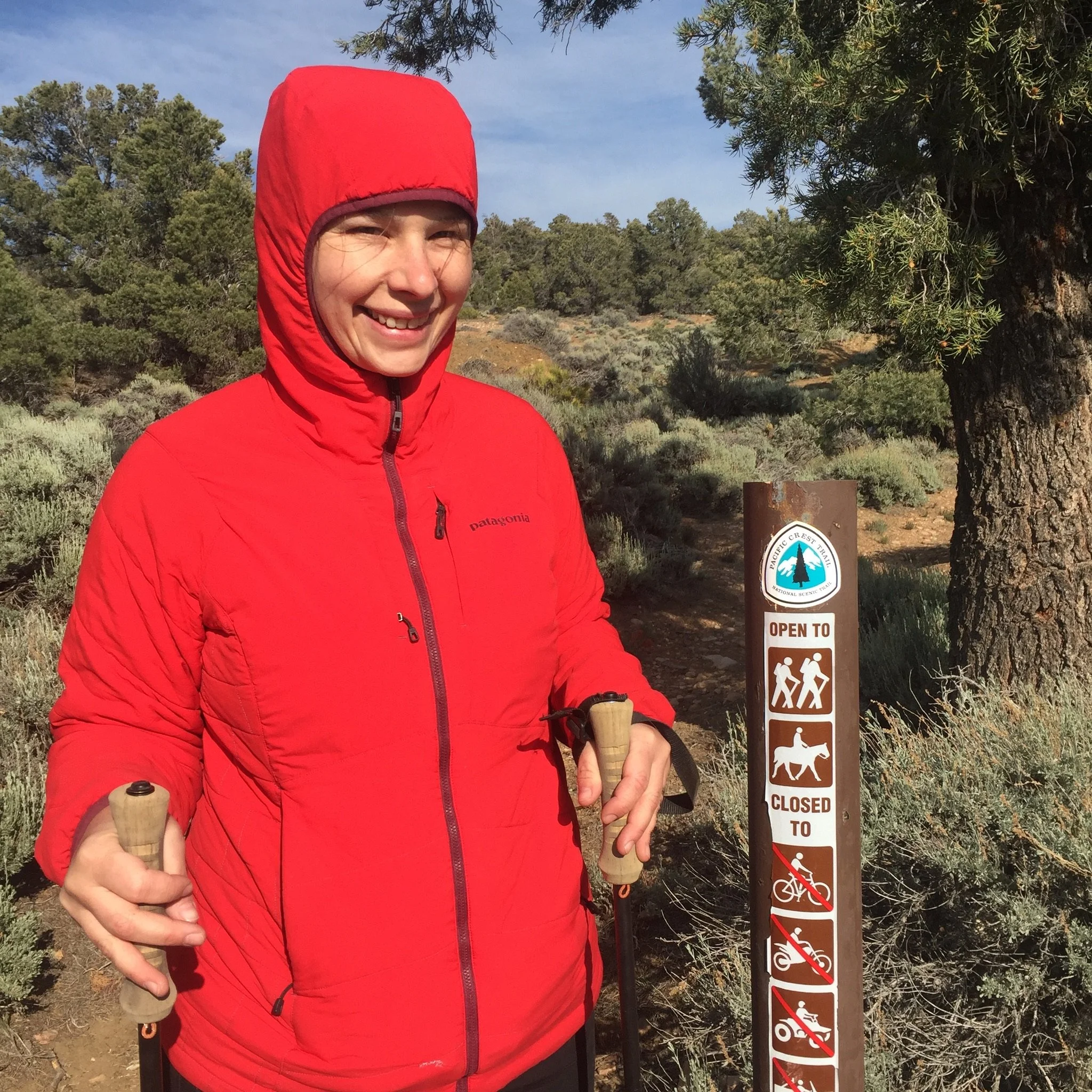
The hard part to talk about is her addiction. So the addiction to making art was the same addiction that was happening, you know, off camera. And that's such a hard struggle. But she found peace in places like Joshua Tree and Colorado. Her sketchbooks were filled with road trips and observations from nature. I think Los Angeles could be emotionally harder for her because of that disconnect from the landscape and natural environment she needed.
DUSTY LITTLE
She liked the wilderness. If it was mushroom hunting season she’d be out. She thought nothing of getting on her bike and riding 20 miles. And she was really into mountain climbing and ice climbing up on waterfalls in the Rockies. Last time she was here, it was winter and she rounded up some guys that she knew and went climbing some waterfall on Wolf Creek Pass Yeah. So she was doing ice climbing and, and she was just always into that. She also loved going to the hot springs. It was an hour drive away, but she would go there just to relax. She loved Ojo Caliente down by Santa Fe and the one over in Pagosa Hot Springs. She’d go out of her way to take a day off and just go hang out in the springs. But you had to take separate cars. She wanted to take her own car, didn't really want company.
LILY SIMONSON, artist and longtime friend
One thing I always think about is that she painted the natural world a lot and so do I and that’s sort of where our interests overlapped. When she was living in Colorado she did this show in 2013 and I have a painting from that show that is mushrooms on the ground and I remember her saying when you’re hiking you’re mostly looking at the ground and that’s a straightforward observation but that’s why she was painting these views of the ground instead of these big landscapes and I thought that was really cool.
Ceramics Breakthrough
STAN EDMONSON, LA artist and friend
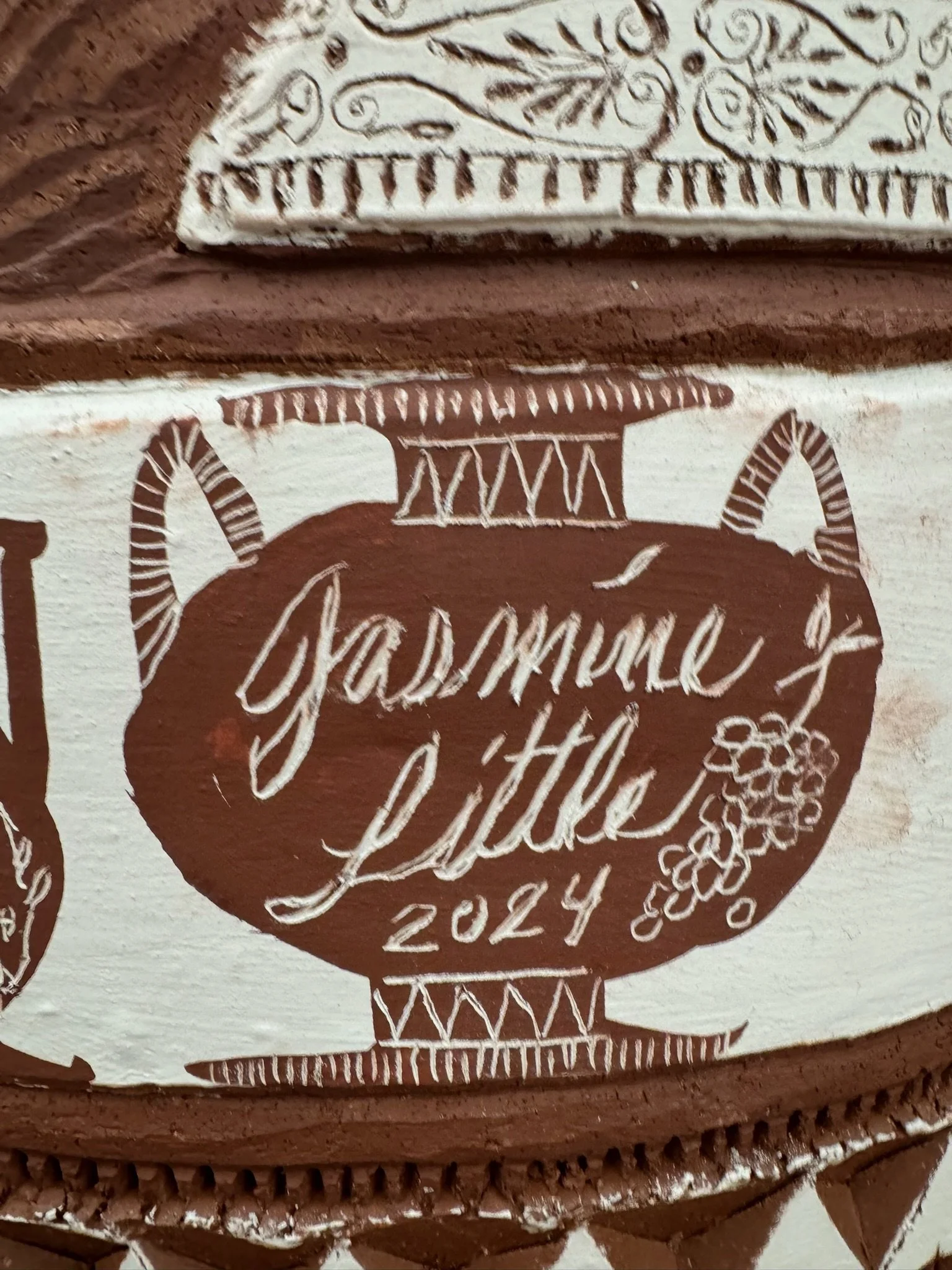
I first met Jasmine Little at an artist-in-residency program in France less than a decade ago. We became fast friends and made plans to hang out in Los Angeles. She was living in Colorado with her then husband but needed a change and wanted to come back to LA. I invited Jasmine to work in my studio for a month around 2018. It’s where she made her first larger incised vessels that she is known for. I walked her through the process, came up with a clay recipe that I thought would work both technically and aesthetically, and fired her work in my large kiln. Luckily they came out beautifully!! She was getting some attention and selling work from my studio. People like Jonas Wood and Stefan Simchowitz stopped by to purchase work.
JONAS WOOD
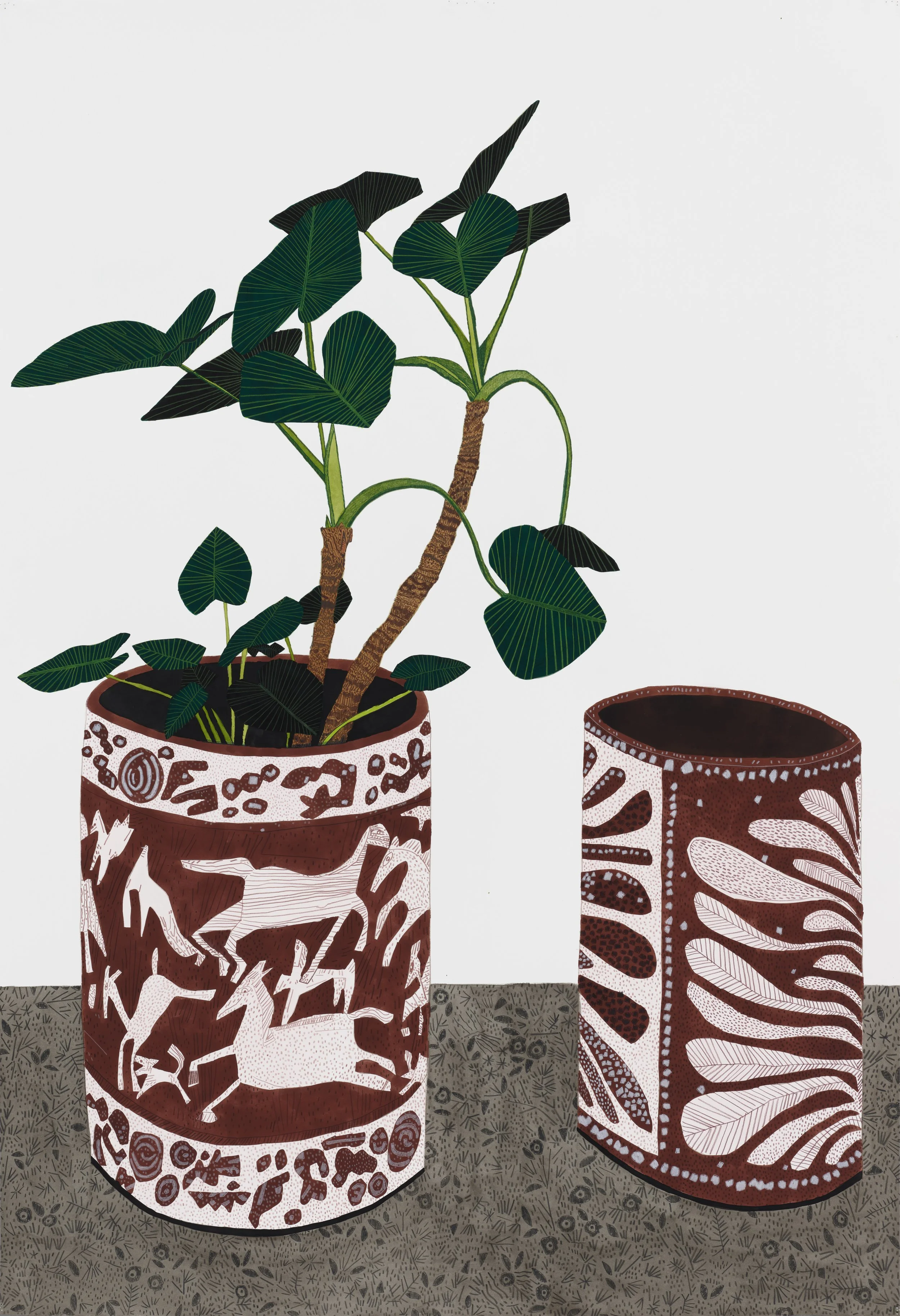
She studied with Roger and I was like, “Oh this is another super-talented kid from UCLA.” She was in the mix for a really long time and her work was getting people's attention, that's for sure. I saw a bunch of her shows and purchased stuff from her early on. They’re like architectural pottery size you can fit a very large plant in. I got four or five maybe all at the same time. After she passed I made a drawing of all the pots that I own.
Jonas Wood
Jasmine Little Still Life, 2026
Gouache, ink, and colored pencil on paper
59 3/4 x 41 inches
Artwork © Jonas Wood
Photo: Marten Elder
STAN EDMONSON
We ran in the same circles and often hung out at openings. She would greet me with a “Hey buddy!!” and a hug and we would shoot the shit and go our separate ways. I was aware of her alcoholism and always let her know that I was available if she needed to talk. I am an addict myself and am aware of the downward cycle that we can fall into. Artists are sensitive souls. There can be a need to numb our feelings for a while. I was a huge fan of Jasmine’s and enjoyed seeing her work around town. I will not soon get over the loss of her.
RYAN CONDER, owner of South Willard
Stan would offer women artists like Jasmine a place to just work in silence where no one bothered them. And there'd always be like three women working there, and Jasmine was one of them. Stan was so generous that way. He would just help them set them up with clay, a place to fire everything and just let them work in peace. Stan's been that way to so many people. It's a shame he does not have the house anymore.
JENNIFER ROCHLIN, artist
Jasmine and I were not close, but I think we both respected each other. I know I really respected her. I was absolutely in love with her work. Her solo show at Night Gallery in 2019 really blew me away. It was like she was defying the nature of clay. I did a month-long residency in England, and then she did a residency in Paris, but what she produced versus what I produced, I was like, “How did she do it?" And I was working 10 hour days. Stan Edmondson made her a clay body that enabled her to work big and quickly. It had a lot of grog in it, I think. She had some things that she had put in place for her to work at such a fast, big, obsessive scale. The whole act of sgraffito is so addictive. And it is a way to kind of deal with anxiety to like scratch into the clay. It might have just been that she just had a compulsion to work at such a manic pace, you know? We obviously shared a love of terracotta or earthenware clay with a white slip with the sgraffito. Our work had a lot of overlaps in that respect, even though she was dealing with more archetypal imagery where I was dealing with more personal imagery, but we were in a lot of the same group shows together, and I find that just when we would see each other at openings, we would seek each other out to just discuss clay shows, what we were making, just shop talk really. And I really enjoyed that with her. I thought she was a great artist.
KIRK NELSON
She was competitive in the way that her career was looked at. She would compare and contrast like, “Why is this person getting this show at this giant New York gallery or in this institution?” And that was a kind of a piece and when I would talk to her about that, I would say, “Well, this happens in this moment for this person. It may happen in a year for you, it may happen in five years for you. But the work is great. So that part's the part that you don't have to worry about so much. Just keep making work. Keep trying to make the paintings better.” And she kept working on the stoneware and the sculpture, but there's no rhyme or reason to why it all plays for some earlier than others. I think she had a hard time managing those expectations.
ROGER HERMAN
I'm speaking for myself, but I think you get a little bit in a manic thing when you are always producing whether it's good or bad. There's no off button. And I think her way to maybe be able to stop is to get really drunk. It's a break, you know? I feel relaxed when I'm in a plane. I don't have to think about things. I can finally go read. There's a manicness about production that is sometimes scary in some people.
DAVIDA NEMEROFF, owner and founder of Night Gallery
She had such a tenacity for making art and art was her life. So I would believe that she had a tenacity for life, you know? I met her because she reached out to me and she basically had the confidence to say, “You need to show my work, and I wanna show at your gallery.” And that was kind of the beginning of the conversation. It’s not the first time that it's happened to me, and it's also not the first time that it's happened to me and it's worked. I like artists who are confident in their practice and artists who are willing to do the are really interesting. In many ways the kind of people I want to work with are willing to put themselves on the line, willing to drive their work 3,000 miles and willing to do it all. That to me is somebody who can't do anything but make art. And that is magnetic. I thought that her work was great at the time that I showed it. And it honestly got so much better even after that. You know, her most recent work to me is by far her strongest work. And that's what, you know, makes it all the more painful is that she was like on a ascension for her artwork and sort of succumbed to the demon of addiction.
NINA JOHNSON, founder of Nina Johnson Gallery in Miami
I was always drawn to the detail and painstaking labor involved in Jasmine’s work. Her pieces unfurled worlds that felt timeless. They were sexual, dark, funny and heavenly. I am forever grateful to have had the opportunity to show her work.
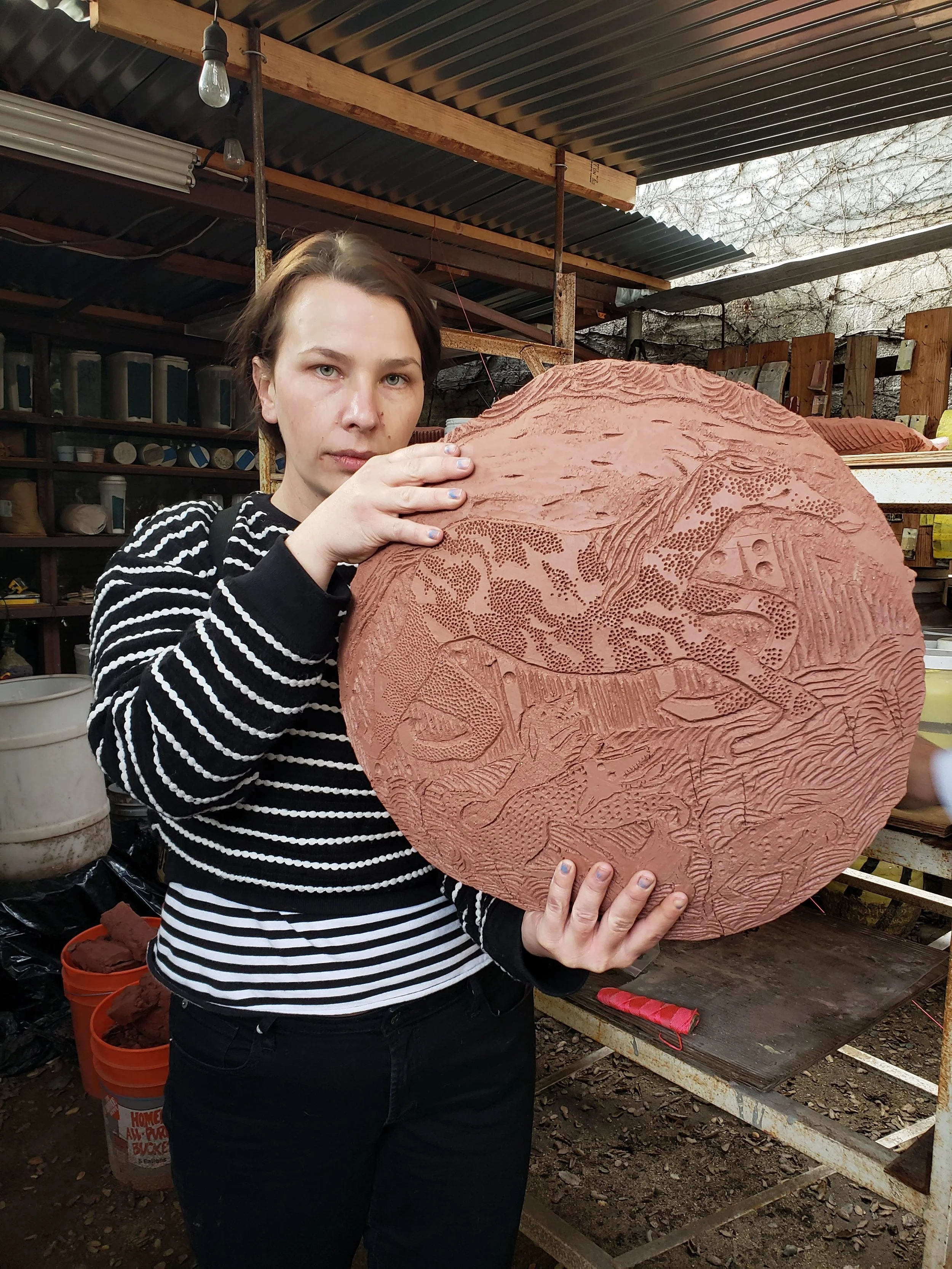
photograph by Stefan Simchowitz
Studio Practice: Los Angeles
JAKE SHEINER, LA artist who worked in same studio building
It’s hard to remember how I met Jasmine, but it was probably shortly after we both moved into our Lincoln Heights studio building. We became studio pals and spent time shooting the shit over cigarettes. At first in the alleyway outside her studio door, but then the cig breaks moved inside. I asked her if it was actually alright to smoke in there, and her response was basically “Whatever, I’m friends with the landlord, he'd never kick me out.” I think that’s just how she lived her life, the way she wanted to, with a force that if people didn’t like it they could just kick rocks and move out of the way. She was so prolific in her work output. It felt like she never left the studio and every time I’d swing by she'd have three more vessels made or two more giant paintings nearly completed in only a few days. The studio smelled like cigarettes and cats and her one, then three then four cats were the friendliest and would meet you at the door and climb all over you once you sat. She was immensely talented but when I’d come and look at a painting or sculpture she’d ask “do you think it’s good?” Of course I’d always say yes but I think she already knew it was good. She made so much work I don’t think any of it was precious to her, because she knew she had endless work left in her, there’d just be more soon anyway. Once, I was in her studio when she had someone over for a visit and they said “I love that small vase, it makes me think of my mom” and she just said “cool, take it.” I probably said “damn I want one” and she said “Okay, take one.’ She let me use her kiln for my own projects as well, which was a life saver. She was incredibly affable, a true character, and a person I always enjoyed running into at openings. She is gone too soon and will be greatly missed by me and the community.
ROGER HERMAN
Her last show at La Loma with all the flower paintings and these big vases and all this the food. It was great, and she was so happy, but there was something off and she was always on the go. I thought it was really technically impressive and she had such a virtuosity, she could do anything, but I think something was lost for me. I didn’t tell her that because Jasmine was a very vulnerable person and a very sensitive person and it was all just about artistry. Maybe I’m too harsh, I just didn’t see Jasmine in them, even in the vessels.
RYAN CONDER
I think Jasmine is such a good artist that you could give Jasmine two sticks and some charcoal and she would've made something incredible. She was just that kind of artist. So the material of course was important. And the beautiful thing about Jasmine is she always gave the material so much integrity. She always respected it so much, but I feel like she could work from material to material and be successful at everything she did. I'm sure if you trace Jasmine's work back to six years old, it's fantastic. She's one of those artists. I'm sure in her eighties she'd be making the best art of all. It was always such a sincerity with her. It was like a raw nerve, just exposed, but it sure made for beautiful art.
EMILY MARCHAND, LA artist at the Cal State University Long Beach Center for Contemporary Ceramic
Last summer when we were working together at CCC some of my pieces cracked really badly. I was pretty devastated and she was very supportive emotionally and also offered me her clay to remake my pieces. I never took her up on that, but she was so generous with her knowledge, words and even her custom clay. One thing that I thought was really cool about Jasmine is she had Laguna Clay make her custom batches of clay and it was called Jasmine Red. Thousands of pounds would arrive at CSULB on pallets. I was saying to my husband, Sam, the other day that someone should make a monograph of her work and the book should be titled Jasmine Red.
DARREN ROMANELLI, artist and collector
Jasmine’s works carried a spirit and mythology that completely pulled you in. The way she channeled imagery, iconography, and stories from other times was unlike anything I had ever seen. I’ll always be grateful for her friendship, her generosity, and the incredible worlds she gave all of us through her art .
JONAS WOOD
She was making some really big pots at the end, and they're really, really beautiful and intricate. The scale was pretty radical as was the delicacy of the patterning. I remember she used to shove rocks in the pots early on and then she'd figured out which rocks always melted. I was just really into the way that she was using the materials and how contrasty and poppy they were in this hippie kinda way. And I obviously liked Greek pots and other ancient pots, and she was referencing some of that too. I think it garnered her a lot of attention when she started making those pots.
EMILY MARCHAND
We talked about joining her again at Long Beach in October to share some of her clay and start new work (each of our own, not collab), and when she posted recently that she was back down at Long Beach in January we chatted about being excited to be down there together again. Long Beach is such an intimate place for friendships to begin and I am so grateful for our brief sweet friendship.
LILY SIMONSON
She was so unpretentious, and her productivity was unbelievable. When she died, she was working at Long Beach and the last photo she sent me of herself was on the 2nd of February. I've been thinking a lot about Groundhog Day and addiction and Infinite Jest, and there’s so much there in terms of the life cycle that feels like this loop that addicts get stuck in. She was working on these huge pieces that were like the size of a shed. And she made made everything by herself. Her ex-husband used to help her a little bit lifting things. And sometimes she had assistants, but it was really just because she was so generous and somebody would be like, “I need money.” And she'd be like, “Come be my assistant.” But really, she made everything alone.
We would often paint on FaceTime together and just sort of keep each other company in the studio that way. But last spring I was stuck working on a commission and I don't do well without a deadline, so I was just totally puttering with these paintings and she came and just like body doubled me in my studio and painted alongside me. I hadn't been with her through an entire painting before, but she made two huge paintings in a week. And she wasn't even working most of the time. She was just chatting with me most of the time. Her talent was just unbelievable.
NICK AGUAYO
We never really talked philosophically about our work, but I feel like she sort of inserted herself in tradition. She pulled a lot classical themes and inserted herself into that. I would go to her studio and look at her bookshelf and there was a wide range of interest and I could kind of piece together what would feed the work, like hieroglyphics she saw in Colorado. I think of the desert being in her work—the sand and the dirt and clay— and a real physicality, especially with the ceramics. And her brother would title all of her work. They would collaborate a lot and he would title all of her paintings, all of her work. She would send pictures to him and then he would title it. There was some frustration on her part because I think her ceramics were in such high demand, and some people would be like, “I love your ceramics, but I don't like your paintings.” She really felt like she was a painter first and I think she was painting more and they were going into new places. She was always a great painter, but I feel like she was just getting really deep into those paintings. I can only imagine in the back of her mind it was like, “But I'm a painter.” I think we're all just like, “Dude, it's good. This is a good thing. You'll make paintings, everything you make is great.”
ROGER HERMAN
Hubert and I curated a show in Salzburg and we put Jasmine in it and we all flew out together. The first night we all went to a restaurant drank and ate, and all of a sudden Jasmine was gone. We found her later, it was like midnight, brought her back to the hotel, then at three, she left the hotel on her own. She doesn't speak a word of German, but she took a taxi, apparently to the next town that is a gambling town, and gambled all of her money away. And so the next day we, there was a press thing, and we had her there. She borrows money from Hubert and I, and then disappeared again to gamble. She’s like a Fassbender character. I mean, she was just crazy. I didn't know it would lead to such a destructive thing. Later on she was in AA. I'm sitting sort of on the fence now because I'm really against these, eulogies making people who have tragic ends into these heroes, you know? It’s a bad precedent. I got really mad when she died, and then all these people wrote to me, “Oh my God, how devastating. This is horrible.” And these were people who didn't even come to her openings.
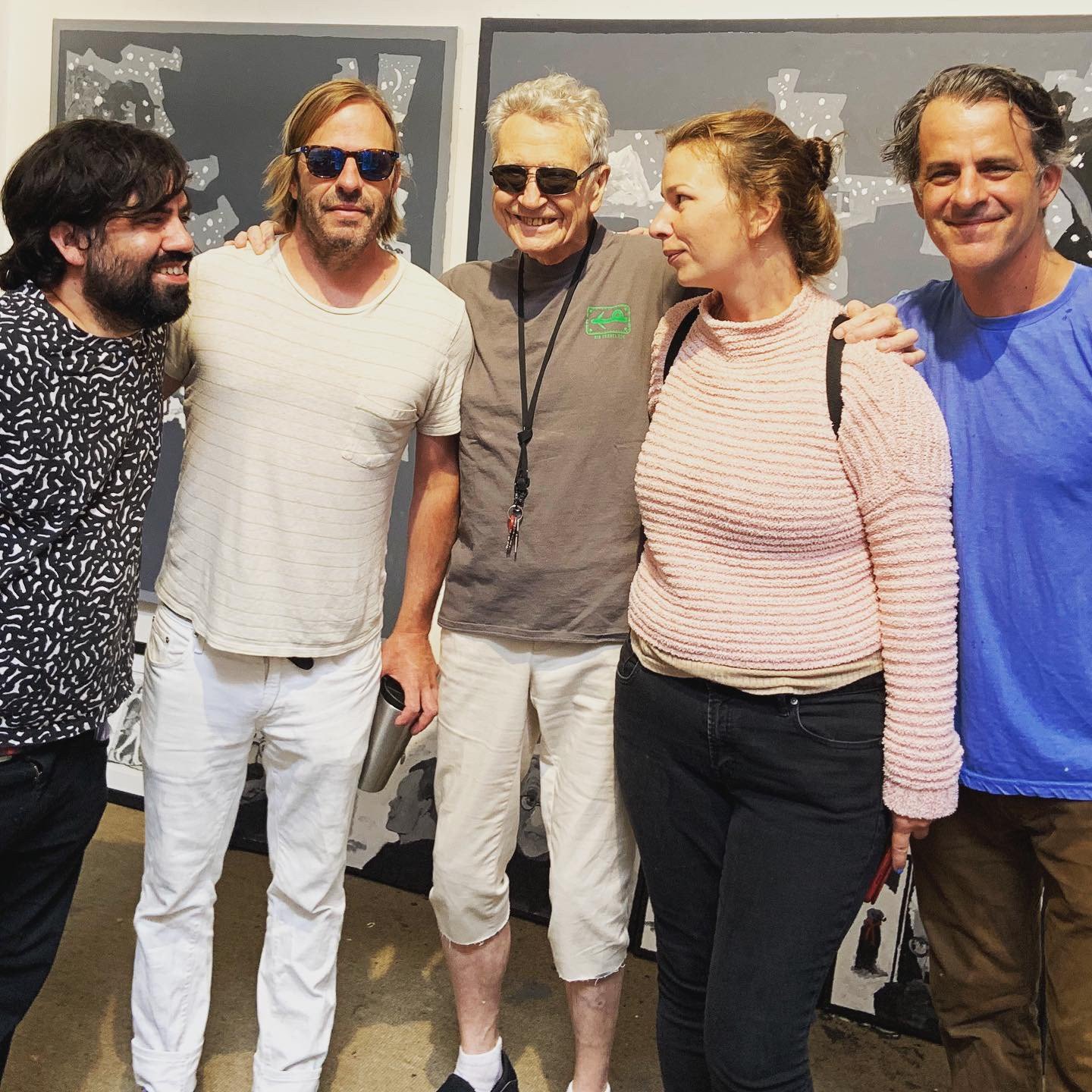
Community Pillar
JONAS WOOD
We started the poker tournament in 2020 during COVID and that's when she started playing. I think she was already playing poker before that. I didn't really play that many hands with her, but she came to most of the tournaments and she passed just before this year's one. A couple people had passed away and it was very, very close to when she passed away and I mentioned that we lost some people in our community and that you should call your friends and be in touch. She was talked about a lot.
KIRK NELSON
She was really, really selfless about wanting to support her friends. It was like, “You should show this person's work. You should look at this person's work.” So I think that was something really special about her that a lot of other artists don't offer. She was just a good friend like that, which is cool.
LILY SIMONSON
I have a lot of friendships with artists and there's always this hint of competitiveness because the opportunities feel so scarce. But Jasmine never bought into that. She would always try to share opportunities. She would always introduce me to whoever, bring me to things, tell people about my work, and make it sound really interesting. She really worked hard to lift all artists up. I really felt it, and it was really important to me.
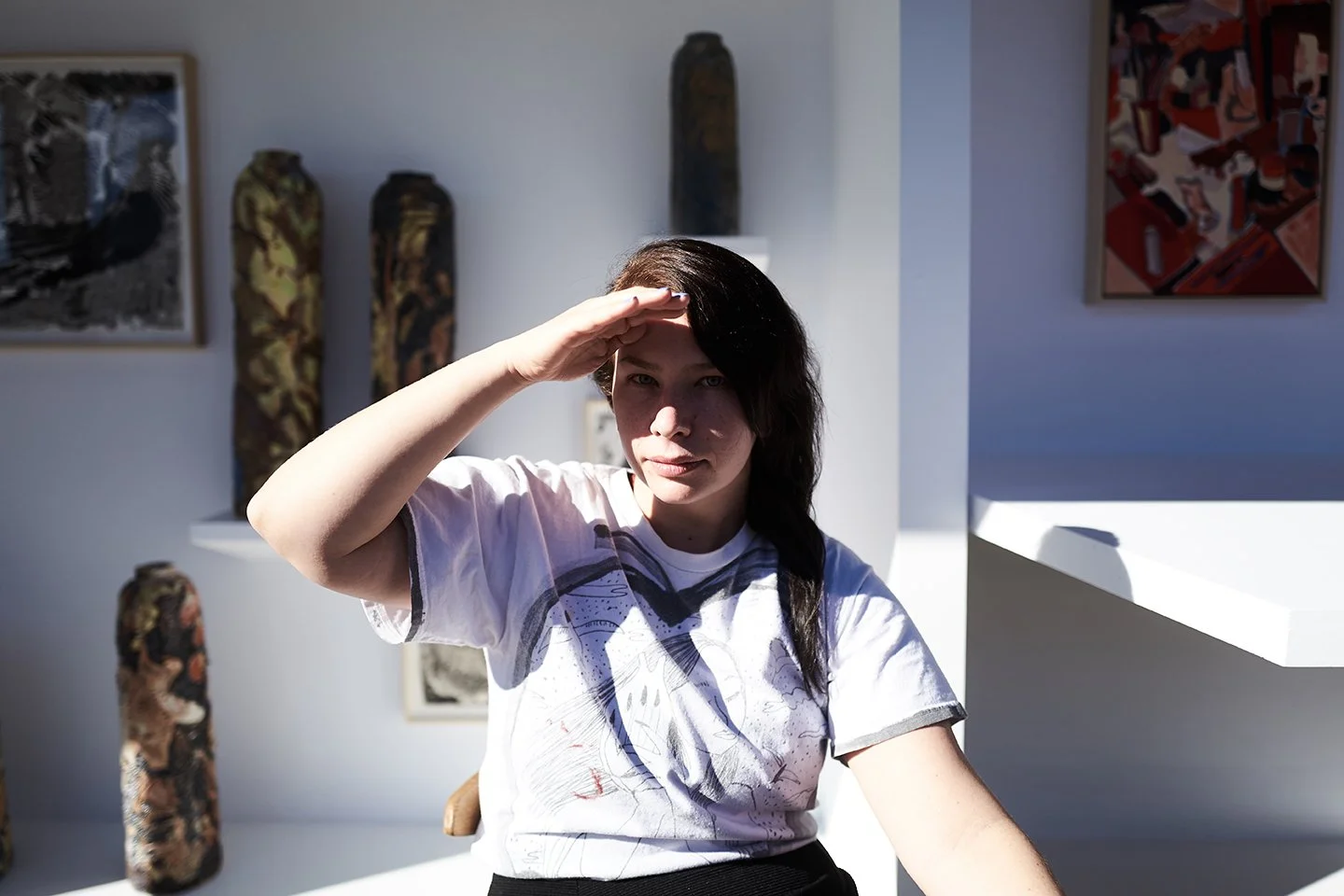
photograph by Stefan Simchowitz
Last Days
DUSTY LITTLE
It’s hard to believe, it really is. And it's incredibly sad, but on the other hand, believe she was ready to go. She sent me a series of text messages back and forth the week before she passed. She was on the beach in Seal Beach, and she would send me pictures. She said, “There's something out there near the horizon and I wanna see what it is.” She seemed kind of distracted and I didn't think of anything of it at the time, but I think she knew it was time… she was going to go. She died in her own bed with her cats at her feet. I understand that she knew from the doctors that she had liver failure and that her days were numbered because of it. She didn't talk about it, but I think she was aware of what was happening. Her body kind of just couldn't hold up anymore.
Our time comes, every one of us. You don't know when. And she sure lived life to the fullest while she was here. She didn't back down off of anything. If there was anything she wanted to do, well she just did it whether it was making the biggest painting or pottery you’d ever seen, or going to Paris for a residency. She just did it.