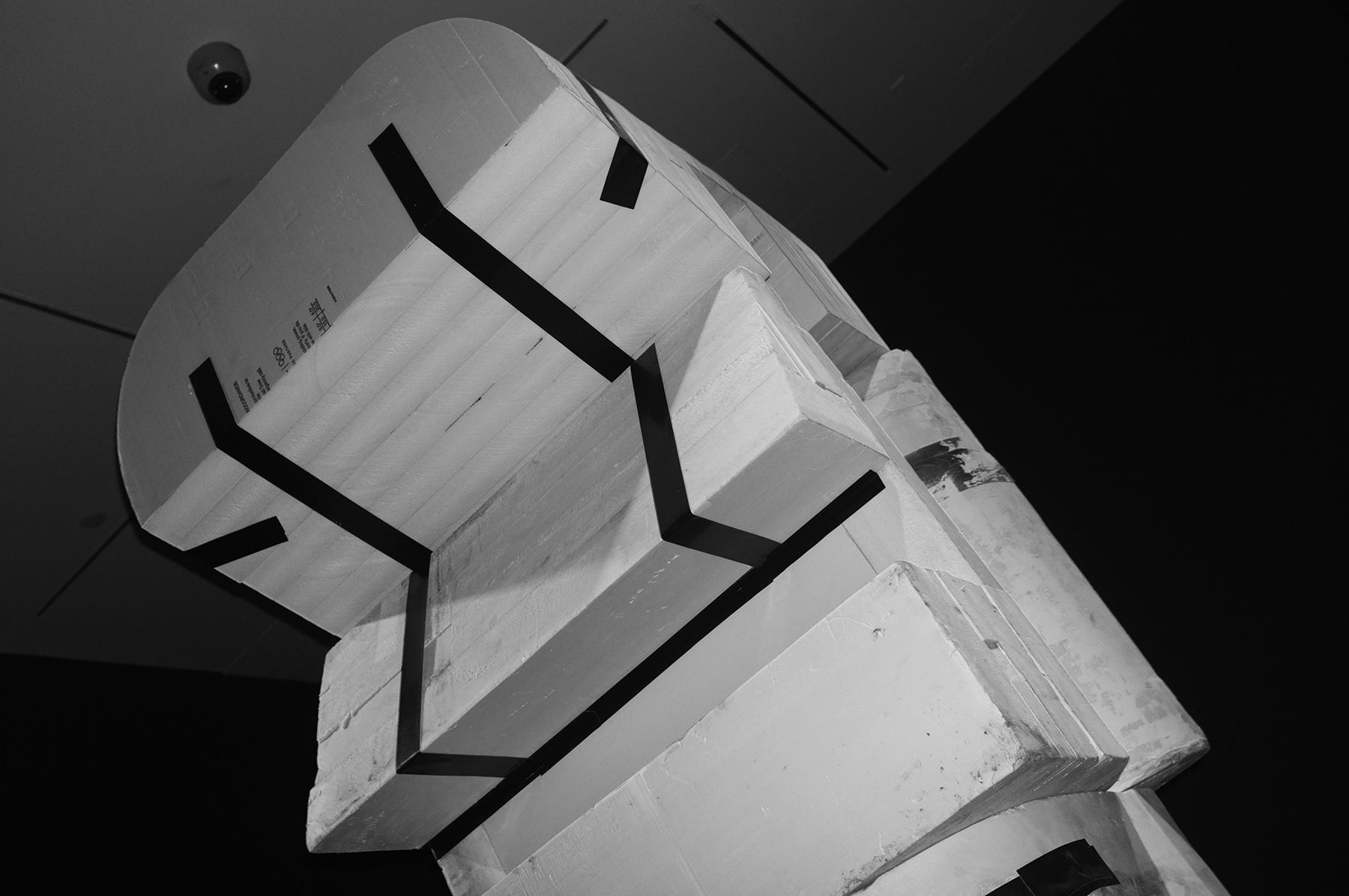
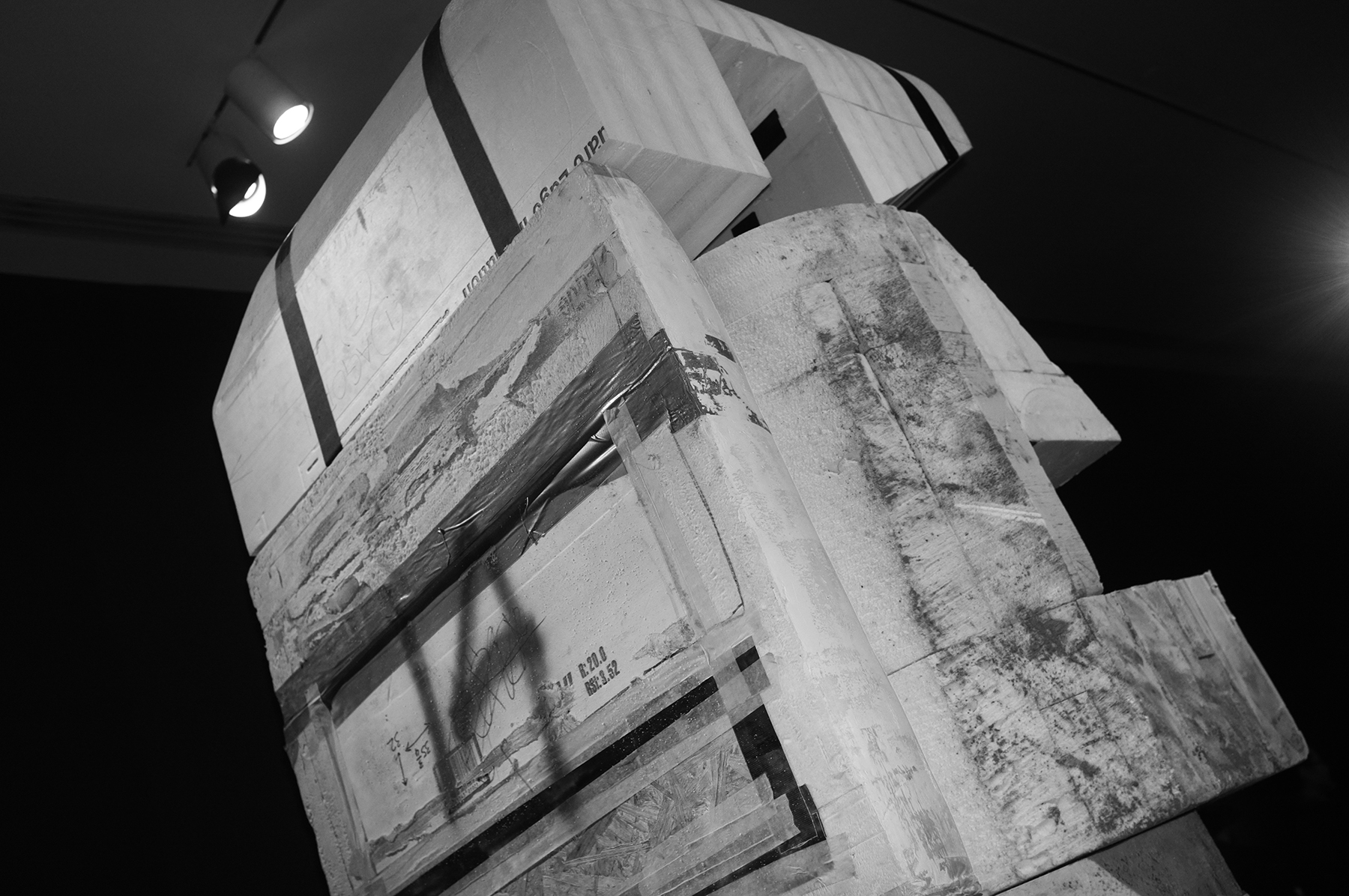
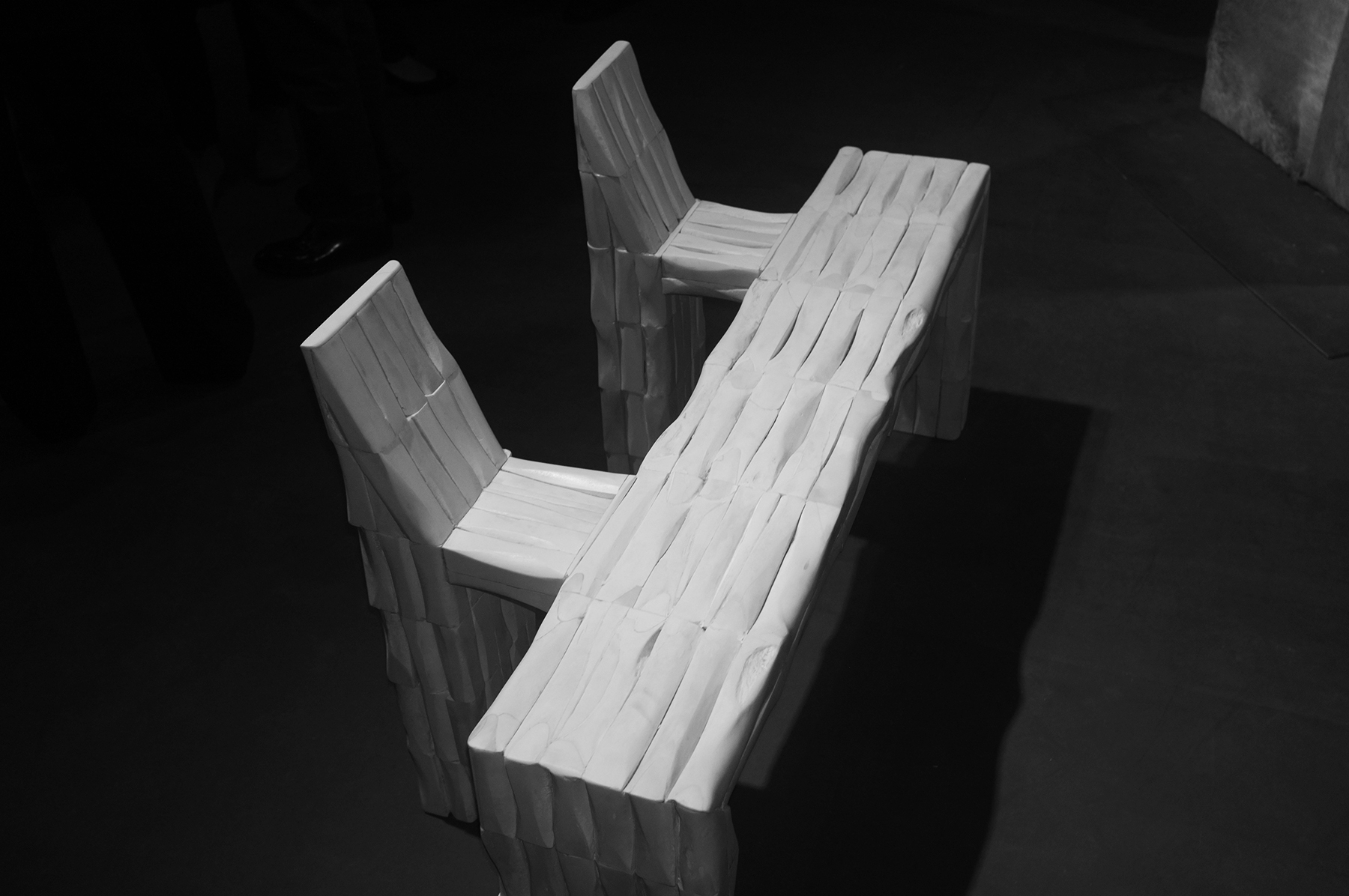
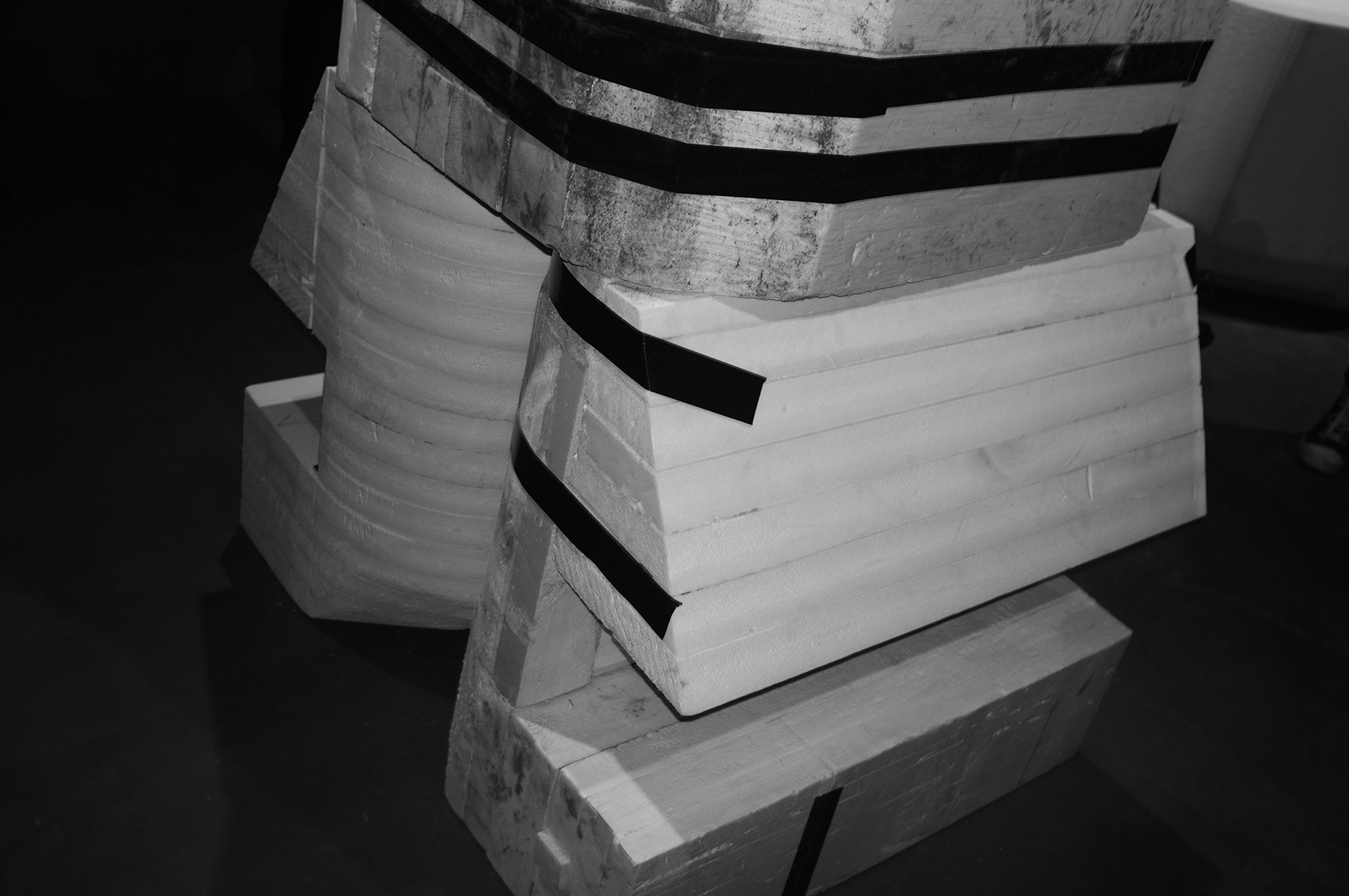
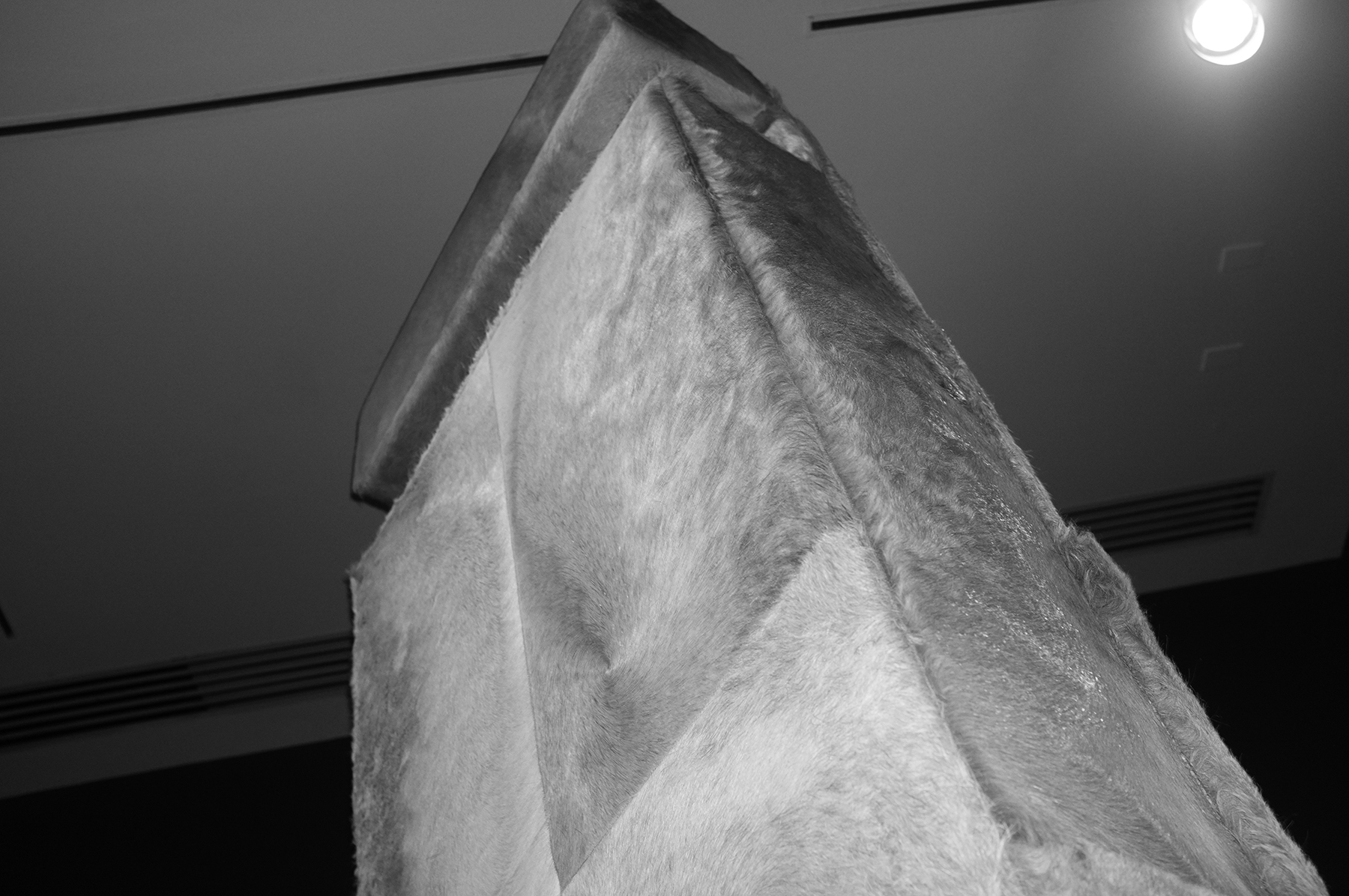
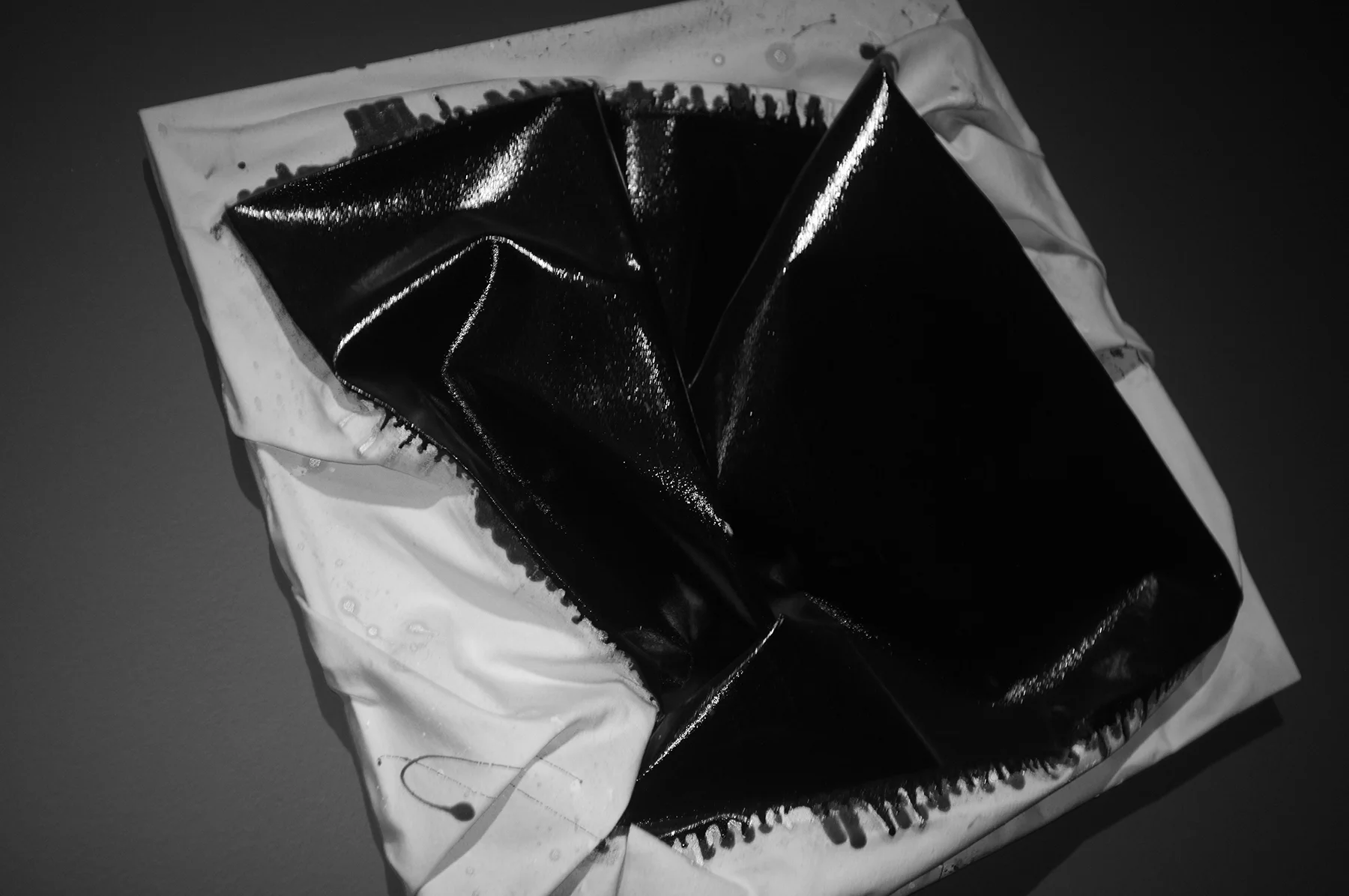
Mixed-media sculptor Skylar Haskard reprocesses the ‘lost and found’ of greater Los Angeles into labile statements of hybrid corporeality.
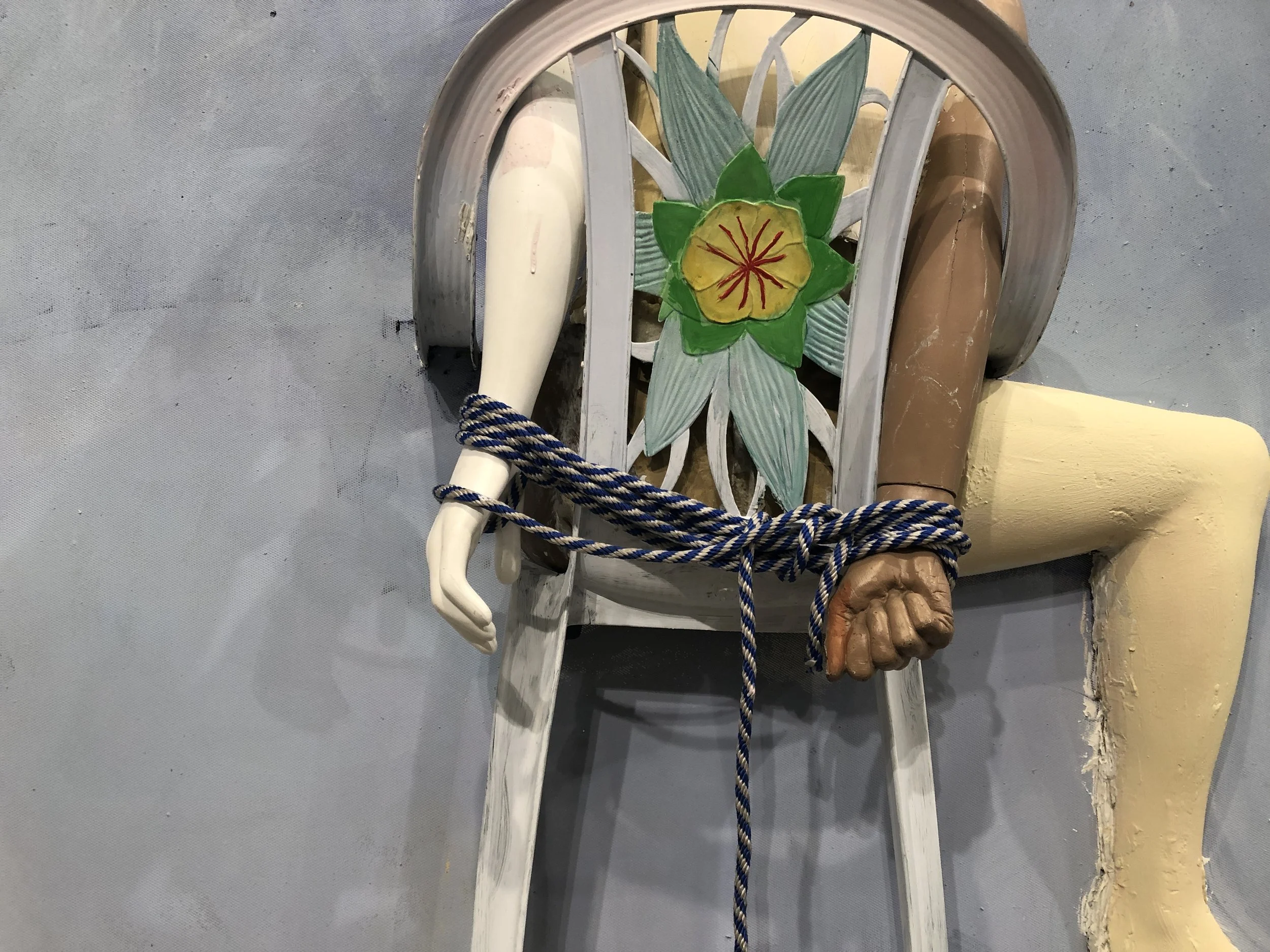
Skylar Haskard
detail of Kid-Nap-eee, 2025
photo by Hannah Bhuiya
text by Hannah Bhuiya
“We have not found a dozen reliefs, but a whole artistic period that lay buried and forgotten!” —Alexander Conze, 1878 (archaeologist and director of the Berlin Museums) upon the rediscovery of the Pergamon Altar.1
“Never retrieve a dirty tennis ball before breakfast.” —Snoopy’s Philosophy, Charles M. Schulz, 1977. 2
As a child, I always wanted to be an archeologist. (I became a writer instead.*)
A ‘midden’ is the archeological term for a repository of the discarded remnants of past human settlement. These inadvertently preserved trash piles are heaped full of evidence of our quotidian existence: cracked mollusk shells, their soft valves devoured. Animal jaws with teeth attached, once prized cutting and scraping tools. Food scraps: split seeds, gnawed bones, peeled skins. Broken pottery, fingerprints still pressed in the clay. Bodily excretions hardened into stony coprolites. The layers of accumulated refuse become revelatory strata, which, like those in which fossils are found, deliver telling clues. By digging through what has now crumbled into dirt, the diet, trade-route access and labor division of the location’s long-dead inhabitants can be reconstituted. The irony, of course, is that a midden pile or pit was never meant to be preserved—it’s just there. Wholly unlike a carefully dug burial chamber or proud hilltop temple, precisely laid with sacred objects and precious offerings symbolically placed, these common waste dumps only survived because no one ever thought to move them. These heaps of cross-generational refuse that grew without plan, before the cities they served were abandoned or obliterated by a cataclysm. This uncontrived origin means that the stories it offers up are raw, bare, honest. A midden tells the truth.
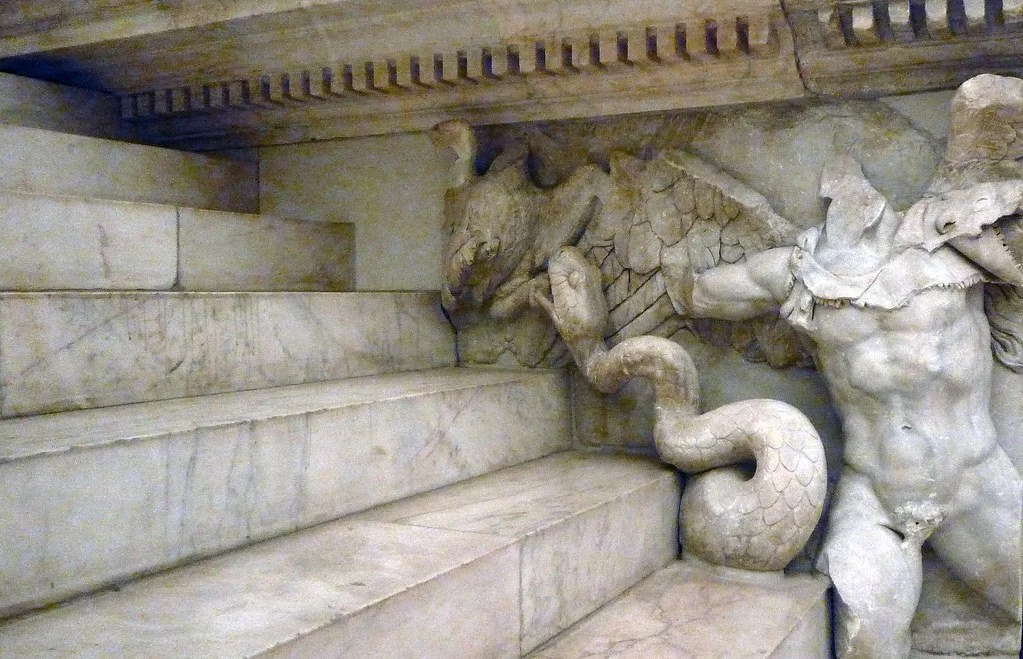
The Pergamon Altar, 2nd century BCE, Pergamon Museum, Berlin via Smarthistory/Flickr
The Pergamon Altar, 2nd century BCE, Pergamon Museum, Berlin via The Museologist
The Pergamon Museum in Berlin is one of a series of monumental structures built by the order of a succession of Prussian kaisers from 1830 to 1930. It is a central edifice of ‘Museuminsel,’ an unstable artificial island protrusion reclaimed from the muck of the Spree River. It houses, as its name suggests, the “Pergamon Altar”. ‘Pergamum’ (now Bergama, Türkiye) was an important outpost of Alexander the Great’s empire, and the majestic marble friezes were transported block by block to Germany upon their rediscovery. The endeavor can be construed as either a rescue mission or an opportunistic theft.3 Also housed inside the museum are life-size reconstructions of the Ishtar Gate of Babylon in bull-and-lion embossed blue glazed brick (circa 575 BCE), and the imposing Market Gate of Miletus (2nd century CE). Despite the goals of kings and later, the State, to enshrine imperial and then national strength in great architecture, the grand idea to set buildings full of weighty ancient stones upon a 40-meter-deep mud layer was not at all practical. Visitors to modern Berlin notice the large pink pipes in the area, through which the groundwater gush is pumped upwards; it is a constant hydrological battle to keep the reclaimed land claimed. The museum’s walls and the gargantuan, transplanted urban infrastructure they house are calculated powertecture, both ‘restored’ in a patchwork of ‘original’ and impersonated elements. A museum does not tell the truth.
When I first moved to LA, I read a quote about Aldous Huxley’s own late 1930s relocation from Europe, which set up a direct correspondence between golden California and the Golden Age of Ancient Greece. I remember that the paragraph was in a book and on the left-hand side of the page and although I did not note the exact words, the idea they conveyed has never left me. It went something like, “with its abundant sunlight, ocean, and year-round Mediterranean climate, Los Angeles possesses all the essential factors to become a new Athens on the Pacific;” that the city-states shared a rare set of natural conditions and latitudinal band (34° N and 37.9° N, respectively) that had already proven their potential as a crucible for intellectual flowering. This was a place with endless toga weather, where the body and mind could resonate in peak health. Where those attracted to dwell here could lead the planet into a glowing new age of philosophy and peace. While the City of Angels has undoubtedly made massive contributions to global creative culture, we all know that’s not what happened. At all. Whatever glimpses there are of any Utopian ‘harmonic order’ are quickly eclipsed by the eyewitnessed reality of life at street level. The lost quote that I never wrote down is merely a tantalizing ideation of ‘what might have been.’
Skylar Haskard
Ran$om, 2025
photo by Paul Salveson
Ten years later, the fecund, roiling miasma that is the Los Angeles contemporary art scene delivered a way to integrate the fascinations above. This came in the form of a chance encounter with Skylar Haskard at a screening at Emma Fernberger Gallery on Western Avenue of T.S.O.Y.W. (2007), a dual-screen, over three-hour-long film by Drew Heitzler and Amy Granat. Patterned after The Sorrows of Young Werther by Goethe. Playing protagonist in the atmospheric literary-art film was not ‘an actor,’ but in fact, an(other) artist. Mainly silent, Haskard delivered a brooding young Werther for the 21st century, wending over Southwest roads on a Harley-Davidson. His singular passage was followed by two cameras capturing the real-time monotony of dry desert highways, punctuated by American monuments, landmarks such as Spiral Jetty, Roden Crater and the Hoover Dam. I was soon to discover that Haskard, a practitioner of what he has described as the ‘humorous conceptualism’ of Los Angeles, is a bricoleur extraordinaire. A closer look at his recent work opens up a conversation about how ‘the city’ functions to generate art that reflects itself. And into the powerful urge that, across time and space, compels independent artists to continue to create it.
A tall international American with a layered British-West Coast timbre, Skylar was born in LA in 1977. Being raised partly in London, he later completed his BFA at Glasgow School of Art in Scotland, a renowned incubator of aesthetic rebelliousness. The young graduate was then lured back to the USA to enter the ‘New Genres’ MFA program at UCLA, where instructors included California’s finest boundary-pushers Chris Burden and Paul McCarthy, as well as Swiss eccentric Pipilotti Rist. “At the time, I was very much invested in the performative, particularly in terms of materials, and of course, ‘The Body.’ I was building sprawling maximalist installations, then setting them up in different locations, mainly outside. Modular, architectural things that would then find their way into the gallery space, in whatever state they were in.”
Skylar Haskard
The Man Who Works, 2025
photo by Paul Salveson
Visiting We Blue It, Haskard’s most recent solo show at Chapman University’s Guggenheim Gallery, I am confronted first by four major works built on circular trampoline bases set at an angle to the floor, with truncated body parts and sliced furniture emerging from their blue-painted discs. One figure, sporting a Pepto-Bismol pink canine snout, wrists bound, is splayed astride a generic white Monobloc-pressed plastic chair, sliced in half. A chopped-up odalisque with a ratty Powerade-blue wig is titled “The Melancholy of a Beautiful Day,” after de Chirico, suggesting that she is reeling, overcome with beauty. “Ran$om” is a Froot-Loops cereal bag-clutching man, encircled by a plush snake. Details: a toy gift heart, the protruding pink tongues, oversized joke-store teeth, tease and surprise. Around the walls are set smaller works depicting everyone’s favorite cartoon dog, Snoopy, drifting out to sea upon an incongruous wire cage, and another dog, strapped with a hobo bindle. Most are sketches on paper, with one distinct in blue biro, Sharpie, and flat paint on thick plywood. An Absurdist fusion of cannibal slaughterhouse and a defunct Toys ‘R’ Us, it’s all somewhat deranged, but the bright, friendly colors make it fun and ‘funny’ too.
Skylar Haskard
The Melancholy of a Beautiful Day, 2025
photo by Paul Salveson
Haskard devised a rough-and-ready method to more quickly birth his life-size humanoids, several of whom are also missing arms or legs. “I’m always trying to work with things that already exist. I’d bought a set of mannequin-makers molds from a guy who had gone into retirement—I liked the idea that these bodies were not only sculpted, but also ‘found.’ Then I came up with basically the shittest way possible of casting them, and the quickest, using plaster and detritus from around the studio.” The result was that the ‘bulk’ of the figures is formed using expanding polyurethane foam. It’s a very flexible technique, in stark opposition to those necessary for hefty marmoreal constructs of similar proportions. “Say I need an arm here, or a part of a torso, I take the mold in two parts, and spray a very thin layer of plaster into that, and then I’ll build it up, let the plaster dry, put bits of cardboard in, some wire. Everything is material to me. I sometimes go to Costco and collect all the cardboard there, ’cause then I don’t have to spend so much on the foam. Because I’m not dealing with stone, this is detritus and waste, and it’s about employing strategies to try to make that stable.” The semiotic language of the show is in continuum with motifs Haskard has been circulating for several years (the hobo dog, the upturned thumb sconces, and reworked chairs are a longtime obsession), but lent a new orientation: “The current pieces were originally weird assemblages of figures and dogs and other stuff, and they just weren’t working. Then I started sawing everything in half. I realized that this profile, or ‘relief’ form was really freeing me up—I was getting two sculptures out of one, and I could also put them on the wall.”
A panoply of art history’s greatest hits stepped up to inform the progression from Eureka moment to actualization. “You’re not really aware of the intricacies of reliefs until you’re actually making them. So I looked at the Pergamon Altar, which brings along with it the complexities surrounding how the stones were recovered by German archeologists and reconstructed in the museums of Berlin. At that time, the marble of the friezes was being crushed and burned to make lime mortar, or had been used to build other local structures—they dug it out of walls. I also looked to Trajan’s Column, and also Marcus Aurelius’ ‘Snail Column.’ Both have scenes of battle and war set around in a spiral, which ties in to what we’re living through now.” When what we’re living through now is to bear witness to a UFC ‘Octagon’ fighting cage being built right outside (what is left of) the Neoclassical White House (soon to have gaudy Corinthian capitals tacked onto its elegant Ionic columns) and a current President of the Republic who longs for his own Triumphal Arch, the assertion holds. The stuffed serpent twisting around one dismembered figure can also be linked to the fractured masterpiece ‘Laocoön and his Sons,’ currently on display in the Octagonal Court of the Museo Pio-Clementino at the Vatican Museums. Arguably the finest marble carving ever made, the composition derives from a Greek original of around 200BCE, but we only know it through this Roman copy made a couple of centuries later, lost and then unearthed again in 1506. The amputee of circumstance is currently again fitted with his original right arm, which only came to light in 1906, and was affixed in 1957.
Skylar Haskard
Untitled“ (Just Because), 2025
courtesy Guggenheim Gallery
Skylar Haskard
Untitled (Tis Not Too Late), 2025
courtesy Guggenheim Gallery
The install dextrously offers an immediate antidote to the horror factor present in the central pieces via the comforting and familiar figure of Charles Schulz’s Snoopy, who features in multiple works set along the gallery perimeter. In one, Charlie Brown’s best friend floats on a wavy ocean in a cage with the line “Tis not too late to seek another world” from Alfred, Lord Tennyson’s Ulysses emblazoned above him. So, why Snoopy? “I really like to draw with ballpoint on plywood; you can be quite scribbly and expressive.” With this particular series, “these blobby shapes were coming out; I was like, “What are these things?” Then I realized that they all looked like Snoopy. That was the first time he popped up, completely unconsciously.” The enigmatic philosopher-pup has been included in this show, Skylar continues, because: “We blew it. It’s not working anymore. So now let’s trust the animal, let’s listen to him.” The Odyssean pups lead on to Haskard’s sensitively drawn ‘Hobo-Dog’ character in “Untitled (starburst fellow).” Dogs also deliver us to the street-level origin point of Western philosophy. In tandem with their remarkable sculpture, Ancient Greek culture produced distinct philosophical schools—their appreciation for the refinement of the physical form in sport and art was matched by pursuit of intellectual refinement via inquiry and debate. While the later Stoics taught from the shade of the ‘Stoa Poikile’ (the painted porch) in the center of Athens, insouciant pioneer Diogenes of Sinope willfully lived in a discarded wine amphora out on less-traversed streets. He lived like, as his contemporaries observed, a stray dog. He had nothing and wanted less, rejecting social mores, money, and grooming standards. Through him, our term ‘cynic’ derives from kynikos, ‘doglike.’ With his dry wit and practical wisdom in the face of numbing suburban inertia, Snoopy, or Peanuts creator Schulz, can be construed as one of the most influential modern cynics.
Skylar Haskard
Untitled (Lost at Sea Empty), 2025
photo by Hannah Bhuiya
Just as artifacts are dated from the carbon-bearing items found nearby them, I decide to pull back and examine the wider strata around Haskard. I deduce that Haskard is very much an artist’s artist; after all, I had met him in an art gallery flickering on the dual-screen, the avatar within the art. Wife Nevine Mahmoud is a sculptor of amorphous forms, mainly using marble, showing at the latest Frieze LA with Sebastian Gladstone, with whom Skylar exhibited his Rickle Works (chair-component assemblages and vitrine collages) in 2023. Not only did he study under Burden and McCarthy, around the time he left UCLA, he also became John Baldessari’s gardener. “We would sit around and have drinks. He didn’t have a green thumb much.” Gardening then, and now, reinforced Haskard’s dedication to the circular economy, on the most basic level. “I feel that composting is foundational for people to be educated in that whole cycle of reuse—holding nutrients and organic matter to feed into the cycle that exists beyond our control. There is a parallel there with reusing objects in art.” Baldessari then asked Haskard to collaborate on a piece that was a reinvention of an Allen Kaprow work, Apple Shrine, as part of the Art as Life retrospective at MOCA LA. “John didn’t really want to put that much energy into it, so he was like, ‘Why don’t you do this?’ I think the curators were a bit pissed. I spent a solid month at the Getty Research Institute in Allen Kaprow’s archives, and we’d meet every two weeks and go over ideas. Kaprow’s legacy is tied to the ‘happenings’ he did, but to me, he’s an incredible materialist. I’m far more into his use of materials, the elaborate installations he made out of found things.” This approach is evident in Haskard’s Squaresville Pio Pico solo in spring 2025, which brings to life the adventures of heroic Hobo Dog ‘Souperman,’ sceptred with a broomstick and seated in an upended wheelbarrow throne, anchored by a stack of gravy cans.
Skylar Haskard
Souperman (seated with stick), 2025
photo by Charles White
In 2016, Haskard was brought in to coordinate the landmark Rick Owens furniture show at MOCA LA. “I have to say that I keep my own work and my work for other artists quite separate. But here, I was injected into this world where design, art, and fashion were all one, and that to me was fascinating. For Michèle [Lamy], everything is ‘one big thing;’ there’s no separation between art and life. I think it really helped me approach my own art practice from a different place, like ‘Let’s get back to what your vision is,’ and I did. I started making work again, objects that could be categorized, formally, as ‘furniture,’ but were also about the body; I was trying to create a new, ergonomic relationship using furniture as sculpture.” Uncovering imagery of his work from this era, I am reminded of a statement by Robert Horvitz, found within one of the first critical reviews of the work of Chris Burden in 1976, wherein he claimed that the work resembled “isometric exercise equipment more than sculpture.”4 Rick and Michèle appreciated the series, selecting for their private collection Haskard’s tubular-chair-integrated-with-grey-hoody-guy “Body Object 1” (2017) as debuted at London’s DOMOBAAL gallery in a duo-show with his also-an-artist brother, Aubrey Haskard.
Skylar Haskard
Untitled (Body Object 1, ii), 2017
photo courtesy the artist
Skylar Haskard
Untitled (Body Object 2, ii), 2017
photo courtesy the artist
Continuing to sift through his extant digital footprint, I discover the time Haskard put in as Raymond Pettibon’s studio assistant, and also that he was part of the team which constructed French artist Vincent Lamouroux’s arresting Projection installation on Sunset Boulevard in 2015. I locate an Instagram post of the art worker up on a fully extended boom-lift, applying the obliterating whitewash to a palm tree. Everyone in LA remembers the strange ‘permanent snow-storm’ effect, which blanked out the entire 4301 Sunset Boulevard plot and was visible all the way up until 2023 when the old motel was finally demolished. The continuous actions of tireless ‘makers’ like this, even the smallest, has causal impact; the countless other jobs that support a dedicated contemporary practice are the connective tissue of the enmeshed ecosystems that sustain this boom-bust, rise-fall, but ultimately entropic, metropolis.
On the subject of his city of birth, Skylar observes: “If you look at it on a map, LA’s on the edge of the world, and people here live like there’s nothing beyond it, you know? I’ve always felt where we’re decades ahead, here, is in the devolution of the world we live in. In one way or the other, it’s ever-present in all of our peripheral vision, and this manifests in a lot of the things you can see out on the street.” So, as I also often stop in my tracks in wonder at random compositions of street-side detritus, I ask Skylar about an amusing anthropomorph posted on his Instagram, wherein bare wooden slats tacked to a municipal post sprout fingered arms to reach out and ‘hug’ another shorter post. “I saw those in Frog Town. I don’t know who made them, but they’re just brilliant. They say pretty much what I want to express with my own work … I’m on the verge of trying to come up with some kind of ‘manifesto’ for myself. It’d have points like, “You will not show in galleries.” “You will make work and leave it where you make it.” Not exactly that, but something like that. And that piece, whoever did it, represents my feelings towards showing in galleries, or defined ‘art’ spaces. A lot of times, I’m trying to fit work into those more defined spaces to be able to show it. I’ve made so much work outside of those, a bit more guerrilla, because I firmly believe that my works are ongoing, and the only way that they come to appear ‘resolved’ is purely because time’s run out and they need to get into wherever they’re being shown. It’s hard for me to resolve things.… They’re all really collages. Ongoing collages.”
Los Angeles, February 2026, photo by Skylar Haskard
And that contingent nature is what allows Haskard’s Pergamene contortions, which he chooses to craft from the brightly-colored matrix of our condition of consumer overload, to offer a biting snapshot of the conflict-molded contemporary psyche and our position at the End of (Art) History as digitized and virtual remixes take over from more corporeal formalism. When we discussed references, Skylar had noted Giovanni Anselmo’s Struttura che mangia (1968), literally, “structure that eats,” as a key conceptual touchstone. The hinge of the seminal Arte Povera work is a head of lettuce set between a smaller and larger granite block, ‘secured’ with a copper wire. As the lettuce withers, it must be replaced by a human hand to stop the smaller block from falling, and potentially shattering. The city is that structure which eats. Work like this spits back what grows from its accumulated compost. Haskard’s rough-hewn hybrids tell the chaotic truth of life in our times, especially in Los Angeles, a place where grotesque imbalance is to be observed everywhere. The unholy tension of begging amputees passed by others with plastic-augmented bodies and lips pumped up to ideals uncanny. Bound into our own frameworks of comfort, we walk past persons making the street their philosophical pulpit, just like Diogenes, but we have become too cynical to stop and listen to what they have to say.
Giovanni Anselmo
Sans titre, (granit, laitue, fil de cuivre), 1969
image via Centre Pompidou
Every era gets the art it ‘deserves.’ Commissioned by kings and conquerors, paid in war booty gold, artists of antiquity used valuable, durable stones cut with strenuous effort from the calcified cliffs of mountains formed millennia before as the seabed rose, because that is what they had access to. We have more access to more materials than ever imagined; global supply chains end in our laps. Because, whether cave painters or frieze carvers, artists have never truly worked alone. Each is dependent on access to supply chains and the alliance of commerce to material systems for their work to exist, just as each human being is. But we’re no longer reliant on Silk Road camels or buccaneers’ raids for access to the novel and exotic. It’s all only one click away. If the Ancient Greeks had discovered plastics, I do not doubt they would have used them to create colorful, vivacious art—spectral imaging has detected traces of bright-toned paint on the pale stone and even bronze of both their sculptural figures and architectural decor indicating that in their own time, this statuary was closer to department store mannequins than the austere purity we have received via blanched ruins and Renaissance mimicry.5 More than any time in history, this is a moment of ‘civilization’ versus environment. Froot Loops will revert to sugar, but their petroleum-derived LDPE plastic bag and the woven polypropylene of the trampoline mats will remain revenants much longer. Those billions of Monoblocs made so quickly, so cheaply, will overtake several human lifespans before they crack and warp. Still, they’ll never truly disappear, degrading into minute microplastics that last virtually forever. Even when the install has left the gallery on the back of his truck and been disassembled into constituent parts, on a molecular level they will last longer than marble, which began as seashells crushed into limestone, and will return to such, following the natural cycle. The elegant arms of the Vatican’s Laocoön will disintegrate long before we lose these spray-foam limbs.
If the artists of antiquity had cracked the alchemy of petrochemical conversion, museums worldwide would be full of glass jars of plastic dust, not resonant masterpieces. The greatest artworks of our time are perhaps our vast landfill sites, our great middens. Trash heaps that encapsulate telling clues, and will allow researchers to time travel back to investigate our predilection for obsolescence after all digital communications are erased in a colossal Coronal Mass Ejection or solar EMP. And what of our museums, and their contents, that we set so much store by? In the far distant future, will the heavy angles of the Zumthor-Govan LACMA concrete bunker be dug out of the tar pit into which they will sink? Transported to another city as a prized possession, will its Brutalist style be fetishized and gloated over, walled inside another museum’s walls? With none of us left alive to defend the remnants of our material culture, would this be an act of theft, or preservation? Locked into a perpetual cycle of wonder-to-waste, and back again, what we create will inevitably come up against systems of rigorous re-evaluation, either as recovered beauty, dusted off to be prized again, or crushed to powder to make way for new shapes to reign.
As a child, I had always wanted to be an archeologist. I became a writer instead. *I’ve discovered that it’s almost the same thing.
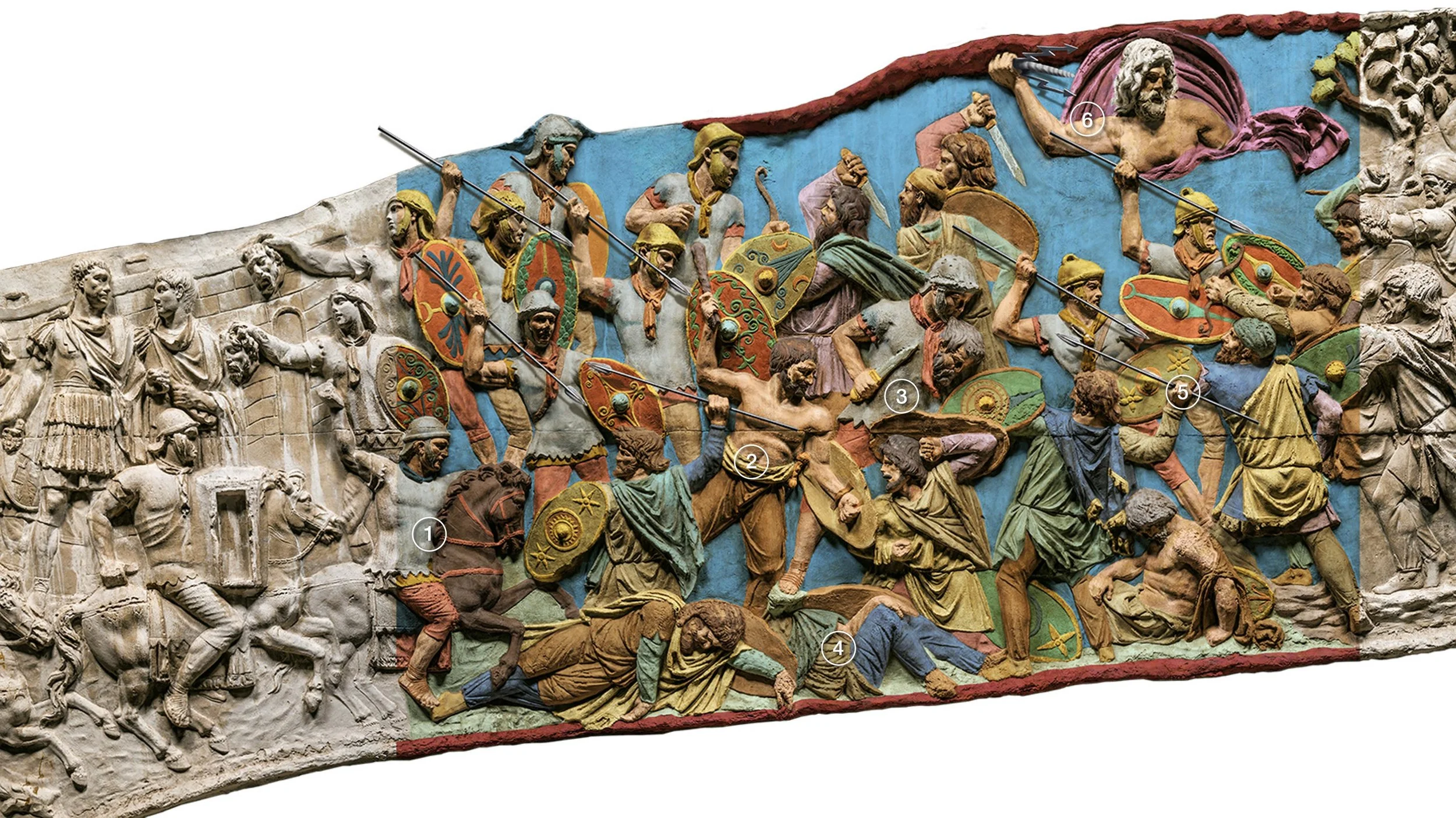
“Scene 24” (The First Battle) from Trajan’s Column, 113 CE. Source: National Geographic / Direct reconstruction based on casts from the National Museum of Romanian History or Museum of Roman Civilization, via “Trajan’s Column — Reading an Ancient Comic Strip,”
1 Alexander Conze, “Greek Relief Sculpture”, 1887. ↩
2 Because we should always remember: “Whenever your spirits sag, or your day seems droopy, you can always cheer things up with a gem of thought from Snoopy!” by Charles M. Schulz, Hallmark, 1977. Snoopy’s Philosophy ↩
3 As discussed in the documentary Pergamon Altar – A Looted Monument?, 2023, Medea Film Factory, part of Who Owns History? The Battle Over Cultural Heritage. ↩
4 Robert Horvitz, ‘Chris Burden,’ Artforum, Volume XIV, No. 9, May 1976, pages 24-31. ↩
5 See Gods in Color: Painted Sculpture of Classical Antiquity, Vinzenz Brinkmann, Stiftung Archäologie, 2007; and Gods in Color: Polychromy in the Ancient World, issued in connection with the exhibition held October 28, 2017–January 7, 2018, at the Fine Arts Museums of San Francisco’s Legion of Honor. ↩