photographs by The Cobrasnake

Two decades after its quiet beginnings in Queens, Telfar turned the streets of New York into a runway and the community into the main event. This was not just a fashion show; it was a reminder that independence, creativity, and cultural impact are what fashion is all about.
Courtesy of Jason Nocito
What began twenty years ago in a Queens apartment by a teenage Telfar Clemens has evolved into the largest Black-owned fashion brand in the world, and likely the longest-running genderless brand in history. The brand has charted its own path entirely, remaining 100% independent, without investors and little entanglement with the fashion industry. Yet, with its captivating DNA, Telfar managed to build a loyal following of over three million customers along the way.
Telfar has long stood out as a brand that simply gets it right. It’s visionary, equitable, and deeply in tune with its audience. From the beginning, it gained a loyal community drawn to its commitment to cultural storytelling, accessible pricing, and customer-first values. This integrity helped elevate the iconic “T” bag into one of the most sought-after accessories of the past decade, carried by A-listers and aspirational shoppers alike.
Over the weekend, following a five-year hiatus, Clemens took to the streets of New York City to make his return to the runway.
Courtesy of Telfar
At the show, the support and love were undeniable. Fans, friends, family, and industry insiders all came crowding to the street behind the Telfar store, fittingly on Juneteenth weekend. Among them were familiar faces like Luar’s Raul Lopez and Solange Knowles, who’s often cited as the one who promoted the brand in its early years. Her sister, Beyoncé echoed that same support in her 2022 Renaisssance album, closing it with a shoutout to the brand: “This Telfar bag imported, Birkins them shit’s in storage,” encapsulating everything the brand is all about.
As always, Telfar did things their own way. Instead of a traditional runway cast, the show featured people directly from the brand’s community. Through a series of open castings at the Telfar store called New Models, anyone could take part. The final lineup was chosen not by insiders but by the public, who voted live during the first episode of New Models, streamed on Telfar’s own platform on June 19. Friends, family, and longtime collaborators all walked the show, making it a true celebration of the people who have shaped the brand.
Telfar’s Spring/Summer 2025 collection was a bold celebration of community and creativity, and every look was met with cheers and applause. It opened with reimagined suiting and shirting, crafted from deconstructed jersey T-shirts that honored the brand’s twenty-year history. Loose-fitting jackets, flared trousers, and relaxed silhouettes offered a fresh take on fashion staples; easy streetwear, and polished tailoring—echoing the brand’s ability to capture New York’s forward-looking vibe. The collection continued with khaki in tones of beige, black, and camo as a foundation, denim spanning vintage to futuristic rib knit dresses, and logo jelly sandals in various colors, just in time for the minimalist footwear wave.
Courtesy of Jason Nocito
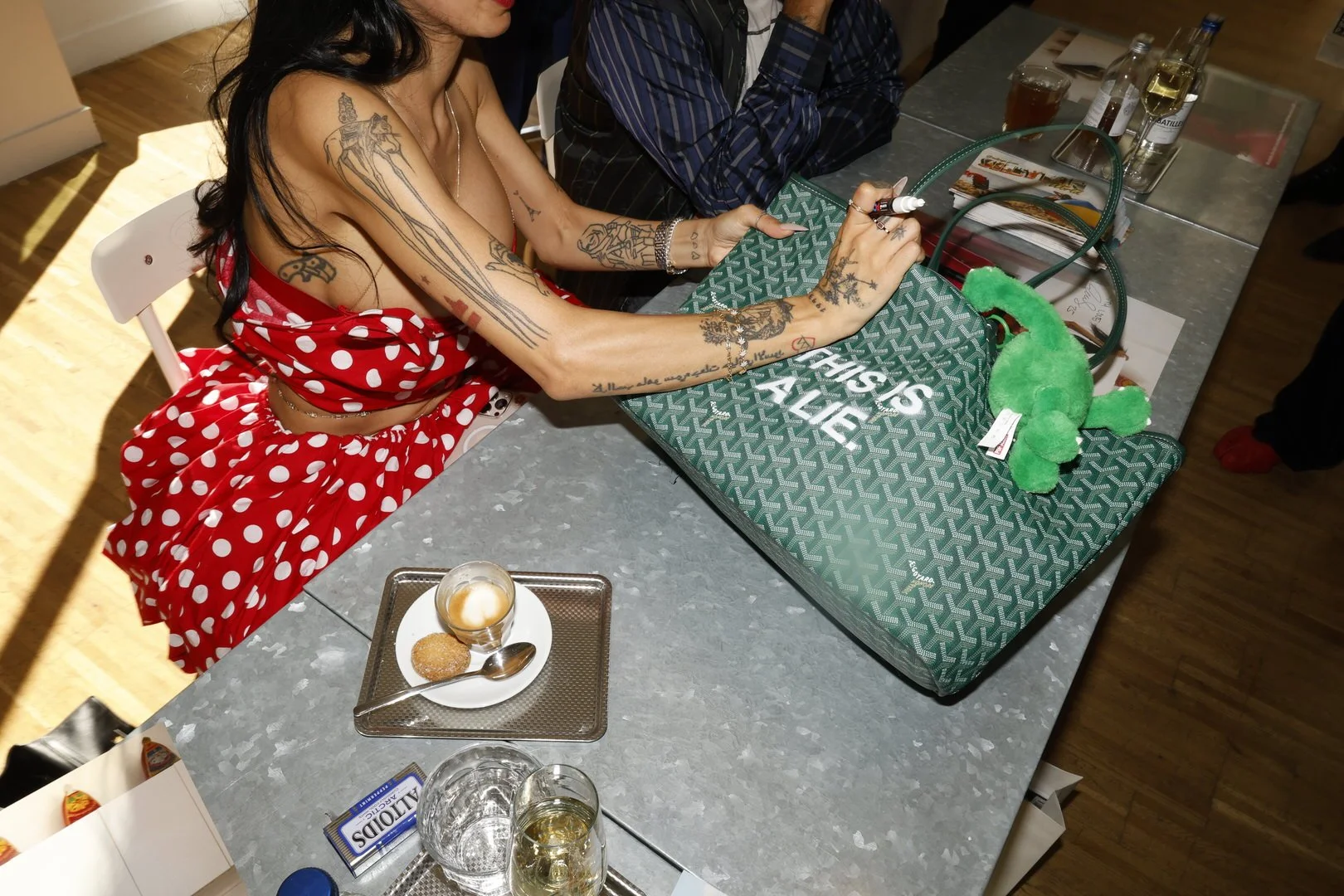
Accessories took center stage as much as the clothing did, proving once more why Telfar changed the way the industry thinks about “it” bags. The debut of the Tie Bag—an evolution of the Telfar shopper as a slouchy hobo tote—is available in three colors and one perfect size. Of course, the legendary Shopping Bag was also present in spirit, reminding everyone just how Telfar became the brand known as Bushwick Birkin. Together, these pieces underscored Telfar’s core message that quality design and cultural resonance need not break the bank.
Twenty years in, Telfar has proven that good things are worth the wait. The fashion industry constantly demands speed and instant reinvention, often leaving creatives forced to accumulate. But Telfar Clemens has built an empire that allows him to listen to a slower, more authentic rhythm, and he understands the value of risk in fashion. As he celebrates the brand’s platinum anniversary, it’s never been more clear that Clemens is still winning the game, with rules he made himself.
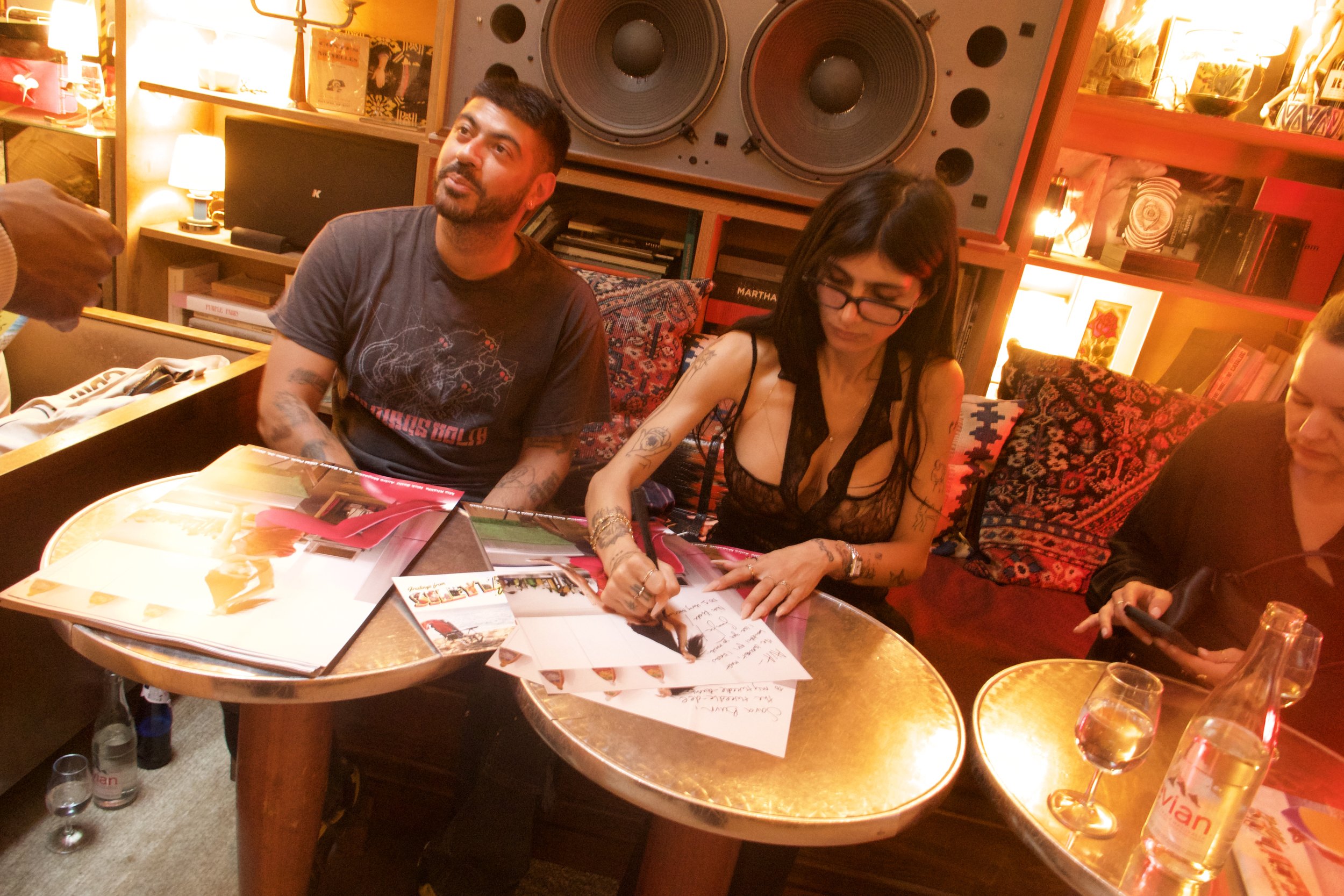
A queue snaked around Rei Kawakubo’s transportive forest installation all the way to the streets of Le Marais for Mia Khalifa and Nick Sethi at Dover Street Market Paris’ Rose Bakery. Photographs by Oliver Kupper

Diane Arbus, Constellation, 2023–2024, The Tower, Main Gallery, LUMA Arles, France. All artworks © The Estate of Diane Arbus Collection Maja Hoffmann/LUMA Foundation. Installation Photo © Adrian Deweerdt
Diane Arbus’s photography has long unsettled and fascinated viewers, defying easy interpretation. In Constellation, the newly opened exhibition at The Armory, curator Matthieu Humery brings a second life to her work; not to explain or categorize, but to invite quiet, intimate dialogue between the viewer and the photographs. Featuring 454 photographs from the artist’s archive, including many rarely seen, the exhibition defers any chronological or thematic structure, favoring a layout without linear direction, making every encounter entirely unique and unpredictable. The experience is haunting, dissociating the viewer from the fact that they’re in an art show, and instead allowing them to sink into provoked emotions, completely immersed in an entirely human experience, dissolving the distance between audience and the subjects.
In our conversation, Humery shares what it means to curate with restraint, how working with a posthumous body of work introduces both freedom and distance and what it felt like to place each image by hand in the space, listening for their rhythm. Read more

From June 26 to 28, 2025, chef Walid Sahed and fashion designer José Lamali present BARBARE, a multidisciplinary artistic project at the Book Bar in the Hôtel Grand Amour in Paris. Blending fashion, food, and storytelling, BARBARE is a three-night celebration of the duo’s shared Amazigh heritage—an intimate encounter between tradition and contemporary expression. The project was born from a dialogue between two creative practices: the kitchen and the atelier. For Walid Sahed, cooking is a deeply human act, shaped by memory, migration, and material. Born in Algiers and raised in Pantin, Sahed is the founder of the beloved neighborhood restaurant Les Pantins. His journey has taken him from the kitchens of the Stafford Hotel in London and Le Bristol in Paris to far-flung kitchens in Melbourne and Delhi, experiences that inform his generous, worldly, and emotionally resonant cuisine. Grounded in French culinary craft and open to global influences, Sahed creates food that speaks of belonging and transformation. José Lamali, co-founder of the fashion-art label Études Studio and current artistic director of Aigle, brings a parallel sensitivity to material, memory, and reinvention. A Franco-Moroccan designer whose practice began with secondhand clothing, Lamali’s work blends urban aesthetics with minimal structure and conceptual depth. Over the past decade, he has redefined French fashion through more than 20 Paris Fashion Week shows and, more recently, through his leadership at Aigle—where he has reimagined the brand’s outdoor heritage with a focus on sustainability and transmission. A recent foray into culinary studies marks his growing interest in the sensorial and ritual aspects of creation. Together, Sahed and Lamali have imagined BARBARE as a living installation—where traditional Berber flavors, garments, gestures, and stories unfold in a contemporary setting. The evenings will feature a menu inspired by North African cuisine, including mechouia salad, a light chicken tajine, and other seasonal dishes. Guests are invited to share in an immersive experience that honors the past while celebrating transformation, hybridity, and cultural resilience. BARBARE is not only a tribute to Amazigh identity—it is a space of exchange, warmth, and creation where roots become routes, and where tradition and modernity meet at the table. Read more.
The iconic brand convened a who’s-who of modern British music in four cozy listening sessions at their flagship London store.

Image courtesy of Alexander McQueen
From ’80s godparents of goth rock Siouxsie and the Banshees to electroclash feminist Peaches to mercurial IBM auteur Aphex Twin, Alexander McQueen’s runway shows have always been soundtracked by music on the cutting edge. Just as Lee McQueen knew how to build a whole world from a collection of garments, a set, and a soundtrack, contemporary fashion labels are no longer content with simply being looked at or purchased; they want to be experienced.
Last Thursday, Alexander McQueen hosted four listening sessions over eight days with A.G. Cook, Bar Italia, John Glacier, and Nilüfer Yanya at their flagship location in London, the latest in a growing trend of high fashion labels merging music and style in intimate settings. Curated by creative director Seán McGirr, the musicians chatted about their influences and style with four influential musickers: editor of EPOCH Francesca Gavin, indie label founder Cyrus Goberville, NTS Radio founder Femi Adeyemi, and creative strategist Cynthia Igbokwe.
These listening spaces mine a common line between music and fashion: inspiration. Within the room walled by mirrors, some of London’s most innovative young musicians explored why and how they create. “We made music together because there was nothing else to do,” said vocalist Jehzmi Femi about the band’s beginning in 2019. “So you’re a lockdown band,” joked Cyrus Goberville.
Notorious genre blender A.G. Cook—whose mega-sized solo albums 7G, Apple, and Brit Pop draw on everything from ’90s Europop to garage rock to nightcore to hushed acoustic songwriting—had a typically omnivorous take: “That’s the thing that I like about music in general: not just the layers, but the slight sense of time travel I get hearing this. The details of it, unnecessarily going that extra step…. It’s what we’re gonna do now, not in terms of genre, but in terms of extra effort and weirdness,” Cook said, rocking an oversized, baby blue Alexander McQueen button down.
Between musings, artists played out their own personal soundtracks from classic love songs like “In My Life” by the Beatles to post-punk freak-outs like “Hypnotize” by Scritti Polliti. Check out playlists from Cook, Bar Italia, and more below.

Vaginal Davis and Peaches

Vincent Wechselberger

Gigi Spelsberg and Slava Mogutin

Vaginal Davis

Hakan Solak and Camille Ange Pailler

Christopher Wierling

Vaginal and Peaches and Ellison Renee Glenn

Susanne Sachsse

Slava Mogutin and Vaginal Davis

Toby Grimditch

Max Jolivet and Toby Grimditch


Dustin Lynn

Vaginal Davis

Toby Grimditch and Gigi Spelsberg

João d´Orey and Clemens Bobke


Christian Fritzenwanker

Assaf Abraham Hochman

Myriel Walter and Vaginal Davis

Martin Major

Gigi Spelberg

Peaches

Slava Mogutin and Peaches
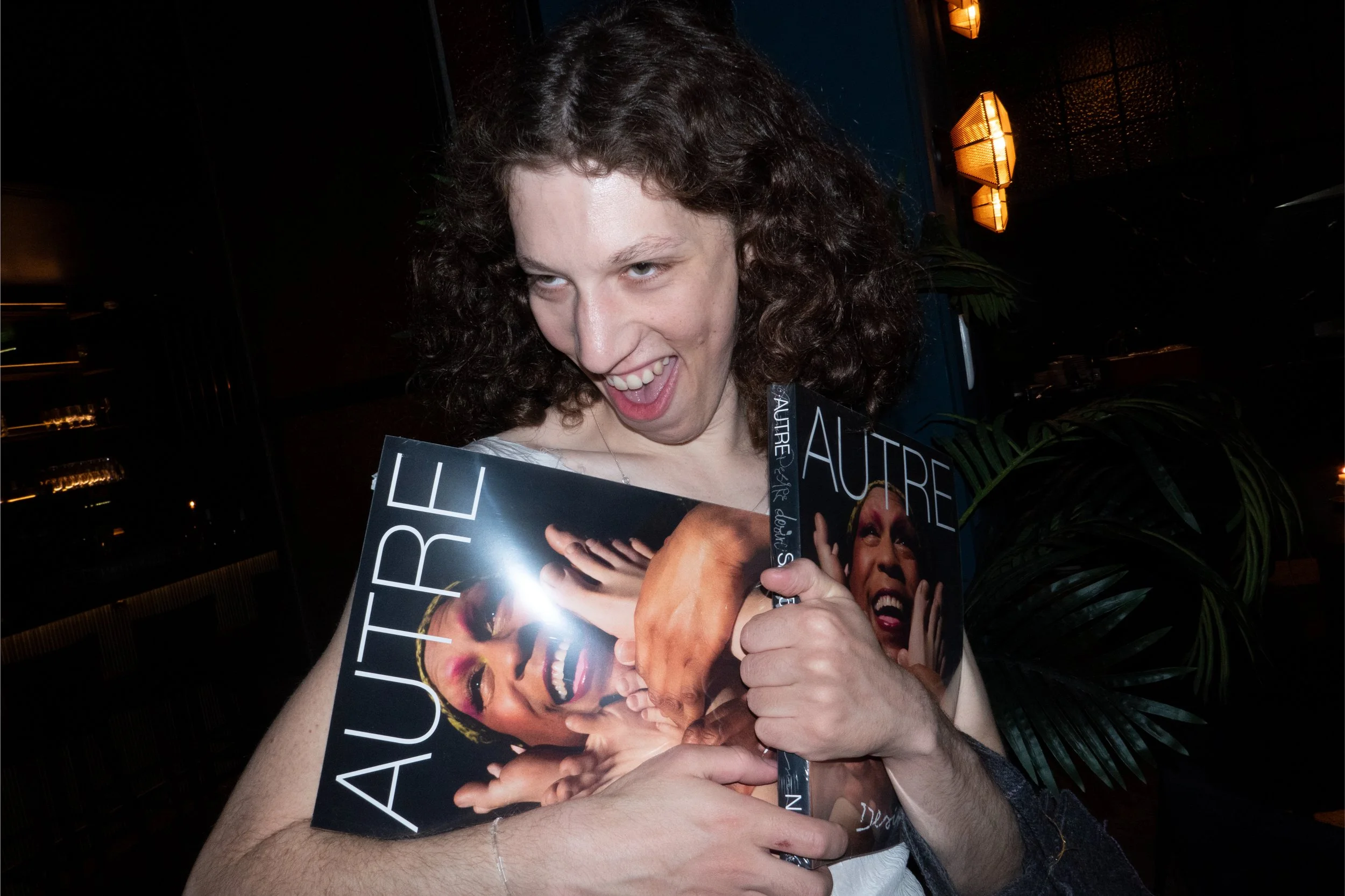
Following a signing event at Voo Store to celebrate Autre magazine’s SS25 Desire issue, a private dinner was held for Vaginal Davis at The Golden Phoenix, located inside the Provocateur Hotel in Berlin. The dinner was organized by Autre magazine and brought together a small group of invited guests, including artists, writers, curators, and members of Berlin’s queer creative community. The atmosphere was informal and intimate. photographs by Oliver Kupper
Vaginal Davis and Matt Lambert held a signing at Voo Store for Autre’s Desire issue. Berlin’s creative scene showed up, with guests sipping CALOW spritzes, which were served throughout the evening. photographs by Oliver Kupper

Phoebe and Sam, 2025. Photographed by Luke Soteriou in London.
Despite the oh-so-competitive fashion industry and the unpredictable nature of the creative job market, young designers Sam Macer and Phoebe Bor demonstrate that there are many different ways to achieve results in this turbulent world. Both designers, who have been friends for several years, have forged their own way and achieved great success. Bor, who has recently graduated from Central Saint Martins (CSM) and is currently experiencing all the attention that comes from an outstanding degree collection, discusses her experience of university, her inspirations, and how she feels about the industry that awaits her.
Sam Macer, who completed the Central Saint Martins foundation course alongside Phoebe, was not accepted into the undergraduate degree program. However, before finishing his year of studying, his final project, which was a beautiful performance piece involving setting a skirt on fire and letting it burn, received a lot of online attention, giving him the platform to grow on his own. Five years down the line, Macer has dressed stars such as Rosalía, Julia Fox, and SZA.
Both artists discuss their experiences in a way that only friends can. They have a very candid conversation concerning the pros and cons of the type of environment somewhere like CSM creates, their different ways of working and how they have, and continue to remain inspired and authentic. They provide great insight into what it’s like being a young designer; whether you’re just entering the industry or already fully immersed. Read more.
From new-age designers reinventing fashion to centuries-old handlooms, textiles, and design systems, it's an epicenter for everything.

Image courtesy of Swadesh Online
The Western fashion industry is increasingly recognizing the importance of sustainability, inclusivity, and individuality, values that India has prioritized for centuries. Here, each region has a fabric, a drape, and an aesthetic of its own. It is through the balance of this diversity that we establish harmony.
India has been one of the origins of the slow fashion movement, where every household has sarees and garments that are decades old but still worn with pride. There are over 2,000 documented craft clusters, and 70% of India’s textile production is handwoven or artisanal. India isn’t adapting to sustainability; it’s returning to its roots.
“India never needed to be taught sustainability. It was always our way of life. We just need to remember what we already know.” — Bandana Tewari (Editor of Vogue India).
In recent years, Indian voices have not just entered but are actively shaping the global fashion dialogue.
With global ambassadors like Alia Bhatt for Gucci, Priyanka Chopra for Bulgari, Deepika Padukone for Cartier and Louis Vuitton, Sonam Kapoor for Dior, Ananya Panday for Chanel, Gauravi Kumari for Jimmy Choo, and recently KL Rahul, one of India's top cricketers, named brand ambassador for Paul & Shark are helping spotlight India on world stages.
Indian celebrities with growing online platforms are expanding India’s visibility as a cultural capital. The film and fashion narrative has been shaped exclusively by the West, and this signals a long-overdue dismantling of Western-centric fashion hierarchies, making space for Eastern and Global South narratives.
In addition, Indian designers like Rahul Mishra at the Paris Haute Couture Week (the first Indian designer), Gaurav Gupta’s sculptural gowns on international red carpets, Falguni Shane Peacock’s edgy fusion shown at New York Fashion Week, as well as Sabyasachi Mukherjee, Manish Malhotra, Anita Dongre, and Tarun Tahiliani, are representing India’s style narrative on runways worldwide.
These designers are doing an exceptional job of showcasing fashion heritage from back home while seamlessly blending it with contemporary silhouettes. They have pulled out textiles and techniques from India's intense fashion archive, like brocade, aari, cording, and combined them with international garment construction techniques.
Beyond household names, India’s rising crop of indie labels—like Bodice’s minimalism, Dhruv Kapoor’s futuristic tailoring, or NorBlack NorWhite’s color-forward storytelling—are quietly redefining what global fashion can look like.
They are reinterpreting homegrown fashion aesthetics and styles to bring them to mainstream global fashion consumers. The stylistic identities are resonating deeply through the diaspora as more people are opting for sustainable fashion initiatives, slow fashion, and unique designs that help represent individuality and personality. Not a trend, but traditions reimagined.
In addition, online fashion platforms like Aza, Pernia's, and Ensemble are curating Indian designers for global discoverability and access.
We have also seen international celebrities adorning Indian designers—like Zendaya in Rahul Mishra’s moonlit sari gown at NMACC, which marked a defining moment in the mainstreaming of Indian couture; Naomi Campbell walking the ramp for designers like Manish Malhotra; Paris Hilton vocalizing her love for the subcontinent’s sartorial scene and wearing sarees by designers like Tarun Tahiliani and Papa Don’t Preach on numerous occasions; Beyoncé at Ambani’s Holi party; and the Kardashians at the Ambani wedding.
We’ve also seen Indian-inspired styles in Western pop culture—in Eat Pray Love, 27 Dresses, Sex and the City 2, and more.
This recent gain in media recognition marks a historic repositioning of Indian fashion as not only an anchor in current trend cycles, but a noteworthy innovator in contemporary couture. couture-worthy
Adding to this global momentum, India Weekend at Lincoln Center in New York this September, will be hosted by the Nita Mukesh Ambani Cultural Centre (NMACC), aiming to spotlight India's cultural and fashion prowess on a world stage. Featuring runway shows, textile exhibits, and performances, the event will not just be a celebration, but a statement of India’s influence on the global creative map.
India is not just an emerging market—it’s a global contender, a vibrant and rapidly growing sector, experiencing significant shifts in consumer behavior and technological advancements. With a surge in Gen Z and aspiring luxury buyers, the market has exponential potential.
It's a mix of traditional and modern fashion, influenced by both domestic and international trends.
With a projected growth from $102.8 billion in 2022 to $146.3 billion by 2032, India’s fashion market isn’t just expanding—it’s exploding with potential, driven by Gen Z consumers and conscious luxury buyers.
Western Luxury houses and premium prêt-à-porter brands are not just launching new stores in India; they are releasing their first original Indian collections.

India's handmade textiles are embedded in every aspect of its identity. The history of these fabrics dates back at least 6,000 years. Courtly splendor was proclaimed by sumptuous fabrics, while religious worship still finds expression through sacred cloths. Centuries of cross-continental trade have been shaped by the export of Indian textiles and patterns, from the Romans obsessing over cotton muslin to Chinese traders exchanging silks.
Furthermore, Indian textiles like Kutch embroidery and Banarasi are also recognized as UNESCO crafts. A fashion legacy woven in resistance, resilience, and reinvention.
With textiles like Kanchipuram, Madras checks, ikat, and Mysore silk in the South; to thicker wool and Mughal-inspired textiles like pashmina, phulkari, and kinnauri in the North; the West, being home to royals and the rich, has a lot of printed and embroidered textiles like leheriya, bandhani, gota patti, aari, ajrak, and paithani. In the East, intricate weaves like Baluchari from Bengal, Eri and Muga silk from Assam, and vibrant motifs from Odisha form the soul of indigenous luxury.
India’s fashion story is a living, breathing archive of its culture. This diversity serves as a platter of inspiration for not just Indian designers, but for all designers working within the legacy fashion capitals.
“India is the only country where they still make clothes by hand, and not only the embroidery. Everything is handmade: the weaving, the dyeing, the stitching.” — Karl Lagerfeld
Global designers have for years taken inspiration from India for their collections—like Jean Paul Gaultier’s SS2013 Haute Couture collection, often referred to as his ”Love Letter to India collection,” Dior’s 2023 India show at the Gateway of India, and Schiaparelli’s use of Indian embroidery techniques. These collaborations weren’t merely symbolic, but true partnerships with Indian artisans.
Today, India is also creating, exporting, and developing collections for many of these couture brands.
In this ever-evolving landscape, the pulse of Indian fashion beats to the rhythm of change, giving rise to myriad trends and innovations that are set to redefine the very essence of style. Indian fashion today is not just being seen—it’s being celebrated. In every drape, dye, and design, India is claiming its rightful space in global fashion history—not as an influence, but as an origin point.
DEMO 2025 offers a glimpse inside the work of NEW INC, which helps tech savvy creatives craft immersive VR art, community hubs, and everything in between.

Image courtesy of Nathalie Basoski
text by Karly Quadros
Now I’ve been known to get down to some strange tunes, but it’s not every day that I find myself strapped into a pair of headphones listening intently to a rock.
I’m seated at one of four wooden desks arranged in a square around a sapling in the atrium of WSA at 180 Maiden Lane. The building is all elbows, intricate metal scaffolding from floor to ceiling and a tangle of indoor foliage overhead. To my left, I’m flanked by an enormous man with an enormous coffee with his eyes closed, communing with a craggy chunk of ore that’s over 2 billion years old. To my right is a little girl with a black ponytail, scribbling intently in a notebook, headphones twice the size of her head.
The sonic installation is from Bay Area and New York City musician and technologist Dan Gorelick. Rocks are the product of hundreds of millions of years of eruption, erosion, compression, and transformation—with his technological interventions, Gorelick has managed to squeeze all that time into just a few seconds of sound.
He is one of 115 creatives who presented work and spoke as part of NEW INC’s DEMO 2025 festival, running now until June 22. Beginning in 2014, NEW INC has served as the New Museum’s “creative incubator” for everything from immersive art to innovative proposals for third spaces, providing around eighty artists and entrepreneurs working with new media each year with creative and professional mentorship. Now, with a permanent space on the way in the New Museum’s futuristic new digs on the Bowery, designed by OMA and Shohei Shigematsu and Rem Koolhaas, DEMO 2025 was a peek inside NEW INC’s next chapter.
Things these days are fraught for emerging artists and creatives working at the porous boundary between art, design, and technology—and heaven forbid the work have any components that are socially, environmentally, or politically-oriented. As the Trump administration takes ruthless aim at the curatorial independence of museums and other cultural institutions, opportunities for exhibition, funding, or mentorship have diminished, whether out of actual lack of resources or fear of retaliation. Meanwhile, the future roles of museums as more than white rooms full of aging paintings has been called into question.
“It’s core to the ethos that artists are thinking about the real world impact of what they’re making, and they’re thinking from the onset about the audience in the reach of their projects,” said Salome Asega, director of NEW INC and DEMO 2025.
Asega, herself an artist, was a NEW INC fellow in 2016 where she received mentorship for her collective nonprofit PWRPLNT, a space for young creatives engaging digital tools, social justice, and innovative storytelling. Her team received mentorship and the assistance they needed to formalize the project including help developing a fundraising strategy and mentors to join the advisory board.
Other artists found a home in NEW INC with work that was too unconventional for traditional art world channels.
“[My brother and I] were raised in and culturally came up in the art world. We speak the same vocabulary and look at similar references,” said Sam Rolfes of Team Rolfes, a DEMO 2025 presenter. “But because that ground was largely infertile for the kind of things we were trying to do, we had to find and create new spaces.”
Five years later, in a full circle moment, Asega became the director of NEW INC. She grew the incubator’s showcase from a small day in which fellows would display their work for a select group of curators, investors, and philanthropists into a three-day festival with installations for the public lasting the entire month. And, of course, admission is free.
“There were never really wide funding opportunities for some of the ideas in our programs,” said Asega. “This has always been us creative problem solving with our members. Even in this moment we’ll continue to do that. We’ll continue to think and dream up new opportunities for sustainability.”
Other presenters from the festival include a kinetic sculpture from MORKANA, a rice cooker symphony by Trevor Van De Velde, plans for an innovative relief hub for NYC gig workers by architect Elsa Ponce, an augmented reality app documenting Black life in Pittsburgh by Adrian Jones, and radical screenprinting from Secret Riso Project. In between interactive installations, viewers were able to catch Collina Strada creator Hillary Taymour talking with writer Kimberly Drew about integrating environmental advocacy and brand strategy or cultural critic Whitney Mallett discussing digital brainrot aesthetics with David Lisbon, curatorial assistant at the Whitney Museum, and Bri Griffin, community designer at Rhizome.
“We’ve always been a program that has embraced the new, the unknown, the not yet named,” said Asega.
NEW INC’s DEMO 2025 showcase installations are on display at WSA at 180 Maiden Lane now until June 22.
Prada Mode, Osaka
Courtesy of Prada
At a time when fashion’s cultural events are so often reduced to surface-level branding, Prada Mode’s second edition in Japan is a serious meditation on how architecture can reimagine the ecosystem of an island. In the heart of Osaka, the brand collaborates with architect Kazuyo Sejima, inviting guests to participate in a critical dialogue, exclusive performances, and an immersive exhibition.
Open to the public through June 15th, Prada Mode Osaka takes place in Umekita Park, a rare oasis nestled between Osaka’s glass towers and directly connected to the country’s busiest train station. This is the twelfth edition of the brand’s cultural journey, which has landed everywhere from Miami to Hong Kong and now, for the second time, in Japan. This particular edition is curated by Pritzker Prize-winning architect and head of SANAA, Kazuyo Sejima, a frequent collaborator of Prada.
Prada Mode, Osaka
Courtesy of Prada
In 2008, the Fukutake Foundation, which manages the Benesse Art Site Naoshima, invited Sejima to reimagine and shape the built environment of the small Seto island of Inujima. At Prada Mode, the architect shares this ongoing work through models, videos, and other materials at a SANAA-designed pavilion in the park. In the days leading up to Prada Mode Osaka, Inujima Project offered a private preview of Inujima, introducing the history of the island, Sejima’s projects there over the past 17 years, and her vision for its future. During the Inujima Project, Prada and the architect unveiled a permanent pavilion at Inujima Life Garden, designed by Sejima and donated to the island by Prada.
“On Inujima, a tiny island rich in nature, visitors will encounter and experience symbiosis - a landscape that combines history, architecture, art, and daily life. In Osaka, a city with historical ties to Inujima, this experience will be shared and expanded to reach a wider audience. At this edition of Prada Mode, Symbiosis will take shape through conversations and discoveries, creating a new landscape that continues to grow with the participation of all,” says Kazuyo Sejima.
Kazuyo Sejima at Prada Mode, Osaka
Courtesy of Prada
The programming reflects that same ethos. The week-long schedule is a soft collision of art, intellect, and experimental sound curated by Craig Richards, featuring performances by Nik Bärtsch, Reggie Watts, and C.A.R. (Choosing Acronyms Randomly), the latter being an incredible post-punk performance. Guests lounged on floor cushions, sipped Prada-branded negronis and olives, while watching film screenings by Bêka & Lemoine and a dance piece by choreographer Wayne McGregor, joined by composer Keiichiro Shibuya. Shibuya also presented “ANDROID MARIA,” a newly created android developed with a team of leading developers, produced and presented by ATAK.
“It’s not about promotion here. It’s about architecture, music, ideas. The curation is unique. Prada genuinely wants to support culture.” says Shibuya, who is known for challenging the boundaries between humans and technology through his compositions and collaborations with artists and scientists, such as his Android Orchestra.
Indeed, Prada Mode has never really been about fashion, instead, it's about the contexts that shape it: cities, people, materials, and memory. In Osaka, that vision reaches a new level of clarity.
Prada Mode, Osaka
Courtesy of Prada
Prada Mode is on view through June 15th at Umekita Park, Ofukacho, Kita Ward, Osaka, 530-0011
The art world got a dose of hyper-digital club theater from the minds behind Team Rolfes and Club Cringe.
text by Karly Quadros
images by Janice Chung
There’s no getting around it: there’s a lot going on in Diskokina.
Drawing from the ‘more is more’ digital aesthetics that have mostly closely come to be associated with hyperpop – cyberpunk slickness, glitchy heaven-or-hell graphics, a sweet chirpy virtual companion named Kina – the show is one part club night, one part live theater, and one part mo-cap freak out. The brainchild of Team Rolfes and Club Cringe, the show – which features a rotating cast of musical guests and has previously included GFOTY, Frost Children, and umru – found its home in late night clubs and experimental music festivals across Europe, but last Wednesday at 8 pm the collective found themselves not in an industrial nightclub or a warehouse rave but the glittering glass atrium of WSA at 180 Maiden Lane in the heart of New York’s Financial District.
On June 4 and 5, Diskokina performed two nights of their immersive club theater for a mix of club kids and fine art lovers as the closing programming of a showcase for talent nurtured by the New Museum’s art and technology incubator NEW INC. The night was hosted by upbeat “AI” avatar Kina (voiced and performed by Maya Filmeridis whose facial expressions were captured in real time) and comedian Lauren Servideo. The show was a triptych of shorter narratives performed by 321 Rule featuring Team Rolfes and rapper Lil Mariko; Passage Live A/V by Kevin Parker He and DJ Bobby Beethoven; and Club Cringe featuring godmother of 2010s electroclash Uffie, Mother Cell, DJ Wallh4x, DJ Trick, and 502 Bad Gateway Studio.
“We had historically always been doing our work outside the art world, working in music or fashion, doing what we could because the art world in the US is fraught,” said Sam Rolfes, co-founder of Team Rolfes. “The stuff we wanted to do, working with musicians and combining all these different things, there wasn’t a support network for that. I think that this New Museum showcase is an important inflection point where that is starting to change.”
Rolfes, along with his brother and creative partner Andy, has been active in the music and fashion world for years, designing the album packaging for Lady Gaga’s Dawn of Chromatica and directing music videos for Gaga, PC Music OG Danny L Harle, cyborg pop producer Arca, and new wave innovator Danny Elfman. They’ve collaborated with brands like Nike, Dior, Louis Vuitton, and Kenzo, but their style is unmistakable. There’s an element of the digital uncanny and distortion, nods to early PlayStation graphics and gauche social media overdrive, but also a carnivalesque playfulness that hints at the queer potentiality of digital spaces.
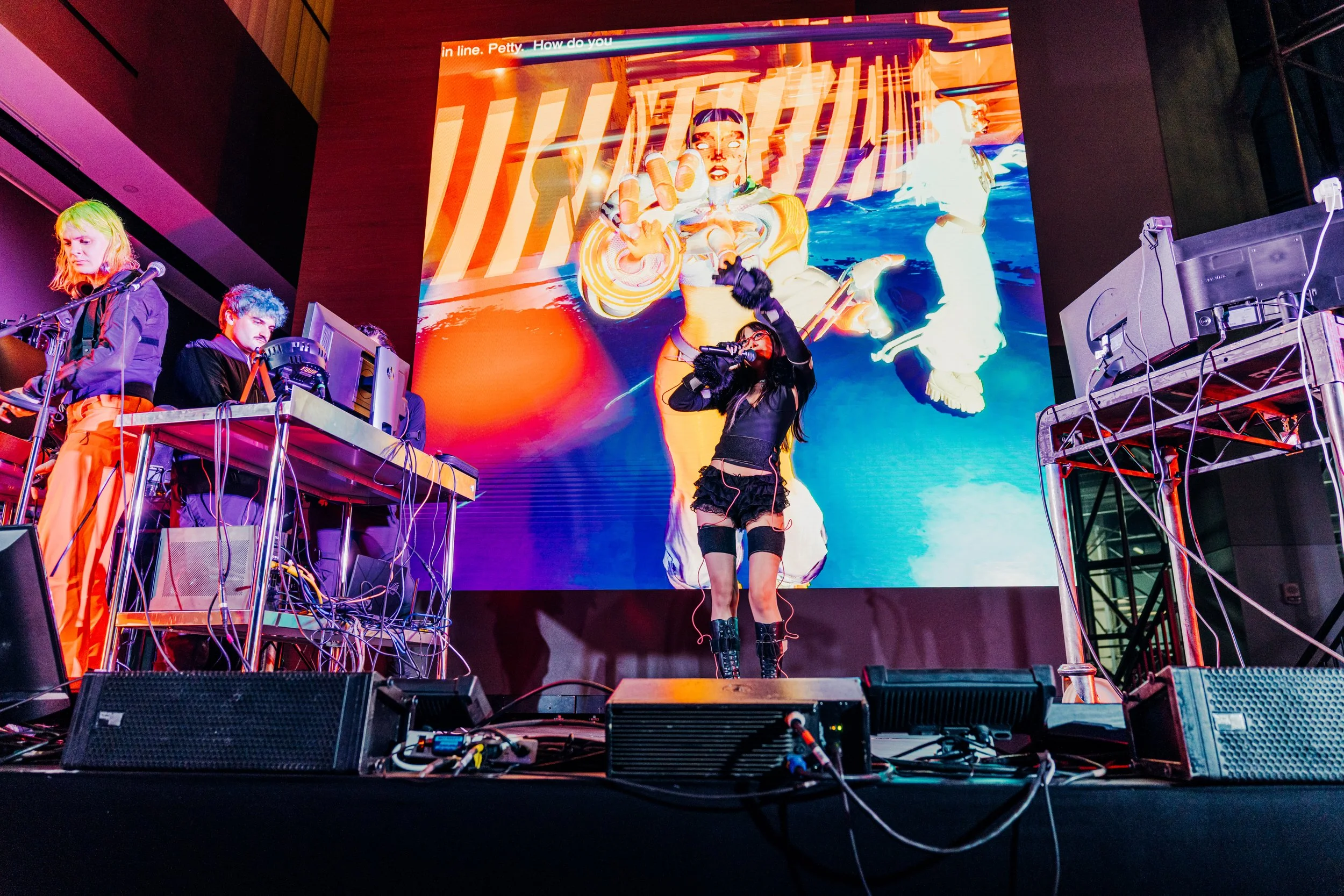
Diskokina’s onstage vibe falls somewhere between a sweaty Gen Z club night and a competitive gaming tournament. The stage is flanked by computers and wires, exposing the hardware that goes into the cutting edge projections onscreen, which are generated in real-time from musical performers that are strapped into motion capture suits. Ultimately, the audience is seeing performers twice: once onstage and again in the world of the screen where coders manipulate their avatars in an act of VR puppetry. The onscreen narratives are, of course, dystopian: a far flung future where memories are the most valuable currency sought after by ruthless bounty hunters or maybe a suspiciously contemporary moment where AI aesthetics are everywhere and corporations are tracking your every move.
“Theater, narrative, music –the tech unites it. It’s very front and center because it’s experimental and wild, but what we’re really aiming for is the story, the sound, or the emotion,” said Rolfes.
Mixed reality performances shot into the public consciousness during Covid when lockdown orders threw the live music and theater worlds into a tailspin. Travis Scott held a record breaking mixed reality performance in Fortnight with over 27 million views, while Billie Eilish mounted similar largely digital performances. At the time, Meta was going all-in on virtual reality, but it was smaller artists like Panther Modern (aka Brady Keehn of Sextile) and Reggie Watts who were experimenting with the artistic potential of virtual club spaces. Even after in-person concerts and dancing resumed and the public’s interest turned elsewhere, the idea of AR and live performance has lingered whether it’s Rosalía’s heavily mediated Motomami stage show or Magdalena Bay’s live show promoting Mercurial World in which they and the audience teach an AI named Chaeri how to be human.
Rolfes points to even older inspirations though. Max Headroom, the “digital” news anchor from a British sci-fi TV film who satirized the commercialization of everyday life, seems to be an obvious inspiration. The fact that the character leapt out of the world of fiction and into commercials as an official spokesman for Coke only added to the reality warp (as did the first successful TV hack in late 1987 in which a full minute of a Chicago Dr. Who broadcast was interrupted by someone sporting a Max Headroom mask.) Rolfes said he hopes to bring the same kind of mischievously satirical energy to the NEW INC showcase.
After all, tech is a tool, neither positive nor negative, although it’s often caught up in the same whirlwinds of speculative capital that Diskokina so sharply satirizes. For Rolfes, it’s all about finding new ways to use it.
“It’s not just tech demos. There’s a real need to hack it, to do something beyond what Microsoft or whatever company designed the tool might’ve intended,” Rolfes said. For now, he and the rest of the Diskokina team will be jamming the signal, one show at a time.

One of the most undeniable visionary designers in history, Jonathan Anderson was just tapped as the first sole creative director at Dior since Christian Dior himself. To understand this new era for the designer and this iconic luxury house, we’re looking back at Anderson's origins, tracing his artistic growth, and exploring his key influences.

Photo by Oliver Kupper
The fashion world in 2025 looks increasingly like an elaborate game of musical chairs, with creative directors joining, defining, and leaving major fashion houses at breakneck speed. While few truly new faces have emerged (Julian Klausner’s appointment at Dries Van Noten in January being a notable exception), the same familiar faces are leaping from house to house, most recently with Demna Gvsalia departing Balenciaga for Gucci and Glenn Martins taking over for John Galliano at Maison Margiela. This reluctance to introduce fresh talent, though disappointing to those hoping for a more dynamic industry, isn’t surprising given brands’ desire to protect profits by relying on familiar names. However, seeing tenured creative directors adapt their aesthetics to new brands is rather engaging, hinting at potential revivals for houses in need of revision.
One exception to the rule is Jonathan Anderson, whose distinctive vision and forward-thinking approach to design turned Loewe into a critical and commercial darling. Now as he departs the Spanish-brand after more than a decade to take over at Dior, we’ll delve into his journey: from his early life to launching his own label, his pivotal role in Loewe’s revival, and his upcoming tenure at Dior, exploring what his time with the luxury house might bring.
Jonathan Anderson was raised just outside of Magherafelt, a small town in Northern Ireland, during the final decades of the Troubles, a time when conflict seeped into everyday life. Although his family home was not directly exposed to violence, the weight of tension, fear, and division was always present. Armored vehicles in the streets, news of bombings, segregated communities, and a sense of uncertainty shaped the backdrop of his childhood. Living through such a politically charged and emotionally fraught environment gave the young designer a heightened sensitivity to contrast, conflict, and identity.
As a child, Anderson turned inward, developing an early fascination with objects, theater, and the power of imagination used as tools of escapism from a reality that felt brittle and divided. He has spoken about feeling like an outsider, not only because of the surrounding political unrest but also because of his own queer identity in a conservative landscape, feelings that later translated into his designs.
In his adult work, we see this reflected not in political statements, but in his aesthetic of disruption and fluidity: clothing that refuses fixed categories, silhouettes that question proportion, and a deep love for craft and heritage. Anderson tried to reassemble something fragile and broken into something beautiful and whole.
Jonathan Anderson’s love for fashion started was initially triggered by an obsession with James Dean, dressing like him, even taking up smoking to better resemble Hollywood’s original bad boy. Later on, while Hedi Slimane was in his prime at Dior with his signature skinny suit, Anderson worked at a department store that put everything which was too small to sell on the discount rack. Now with affordable access to the aesthetic, in lieu of donning the “real thing,” the aspiring young designer started going out regularly to gay nightclubs in Dublin. After notoriously being rejected from Central Saint Martins, he went to the only university that accepted him—London College of Fashion, joining a menswear course.
Struggling to launch his menswear brand, JW Anderson, Jonathan felt like an outsider, due mostly to the fact that he wasn’t considered a real craftsman like McQueen or Galliano, and by not qualifying for a top art school. Recognizing his own talent and potential, Anderson persisted in a system that wasn’t for him, he kept full confidence in his ideas, knowing even from the ripe age of twenty that one day he’d be one of the greatest in the industry.
Founded in 2008, JW Anderson quickly stood out for its bold, gender-fluid designs and intellectual approach to fashion, but it was still considered a niche market and was known mostly in fashion circles in London. The true turning point came in 2013, when Jonathan Anderson’s breakthrough womenswear collections led to a minority investment by LVMH and his appointment as creative director of Loewe, a moment that catapulted him into a global spotlight overnight.
Jonathan Anderson’s first collection for Loewe in 2014 made a big splash in the fashion industry and was widely discussed by many fashion critics who were struck by his decision to completely reset the brand’s aesthetic while still honoring its heritage. Quickly, young and relatively unknown Anderson, was considered a groundbreaking designer, praised for his modern, playful, intellectual vision grounded in minimalism, craft, and originality. Anderson positioned Loewe as a leader in artistic luxury and for the following eleven years he kept confirming his status as one of the most distinct and intelligent designers ever.
With each season at Loewe, Anderson continued producing visionary clothing and accessories that became signature, viral pieces, while enhancing Loewe’s market presence and financial performance with each collection.
After many speculations and rumors, in March it was finally announced that Anderson would be leaving Loewe stating: “While my chapter draws to a close, Loewe’s story will continue for many years to come, and I will look on with pride, watching it continue to grow, the amazing Spanish brand I once called home.”
Sidney Toledano, adviser to LVMH chairman and CEO Bernard Arnault considers Anderson “to be amongst the very best,” stating, “What he has contributed to Loewe goes beyond creativity. He has built a rich and eclectic world with strong foundations in craft which will enable the house to thrive long after his departure.”
Leaving Loewe on a high note, Jonathan Anderson’s next move quickly became a speculation amongst the fashion crowd. Following Kim Jones’s departure from Dior in January and persistent rumors surrounding Maria Grazia Chiuri’s potential exit after nine years, many began to suspect that Anderson would soon take the reins at the French house. In fashion, rumors often become reality, and by mid-April, it was confirmed that Anderson would indeed be joining Dior, though initially only as the creative director of menswear. Many considered this role to belittle Anderson’s ability to make womenswear and a missed opportunity for his talent to be translated into Haute Couture. However, just three days ago, Dior officially announced that Jonathan Anderson would become the sole creative director of the entire house.
Anderson’s appointment marks the first time a sole creative director has been employed at Dior since Christian Dior himself. A decision so rare that it makes Jonathan Anderson the first non-founder designer in history to control all creative fronts in the history of fashion. For LVMH, it’s a major risk and privilege—demanding not just fashion talent, but a deep understanding of cultural storytelling, stamina, and longevity.
This leads us to consider why such an unprecedented opportunity was given specifically to Jonathan Anderson. By now, we know his talent is undeniable: he managed to produce sixteen collections a year across his label, a collaboration with Uniqlo, and his work at Loewe. He was critically acclaimed for honoring Loewe’s heritage while elevating the brand’s relevancy and commercial success through his strong artistic vision. He is also known for his professionalism and humanity in the workplace, a vital quality in today’s fashion industry. But when a role of this significance is given to a single designer, with so much at stake, we’re left to think; perhaps there’s something deeper at play?
Perhaps it’s his ability to not just design clothes but to shape the cultural and emotional language of a house as iconic as Dior.
Jonathan grew up in the shadow of conflict, and while the influence may not be overt, the butterfly effect of those early experiences can be felt in the tension, nuance, and depth that define his work today. Christian Dior grew up during World War I and later witnessed the devastation of World War II, which directly preceded the launch of his legendary “New Look” in 1947. Dior’s signature designs, such as soft shoulders, cinched waists, and full skirts were more than elegance, but a response to the austerity he had experienced. He was expressing his desire to escape and dive into a world of harmony and balance. Dior designed so he could restore beauty from the ruins, he created a sense of femininity, dignity, and hope for a world that longed to be renewed. Despite their differing origins of both history and location, Anderson’s and Dior’s creative aspirations might be driven by the same place of grief and devastation; a consummate aptitude for sartorially sublimating humanity’s darkest moments.
For the future of Dior with Anderson, we can safely predict that the brand is poised for a bold new chapter; a yet-to-be-seen approach to design through the lens of modern artistry.
Although the demand for a designer to produce eighteen collections per year, two of them being haute couture is controversial, the prospect of the Dior house operating under a cohesive artistic vision is intriguing. Anderson is unlikely to continue his signature gender-neutral approach, and his interplay between menswear and womenswear will definitely be highly anticipated in the coming fashion weeks. What remains to be seen is whether Anderson will opt to steer Dior away from romanticism, suiting, and streetwear, leaning potentially into a more radical direction that aims not only to sell but to change the fashion landscape.
Watch Jonathan Anderson’s final collection as Creative Director at Loewe, via Vogue Runway

courtesy of Cartier
At Expo 2025 Osaka, Cartier made a bold and enduring statement about the future—not through products, but through purpose. The Maison’s long-standing commitment to empowering women found tangible expression in two landmark moments: the inauguration of the Women’s Pavilion and the 2025 edition of the Cartier Women’s Initiative (CWI) Impact Awards. Together, these initiatives underscore Cartier’s belief that when women thrive, humanity thrives.
The Women’s Pavilion, co-created by Cartier with the Japanese government and Expo 2025 organizers, is more than an architectural feat—it’s a cultural and social force. Designed by architect Yuko Nagayama and envisioned as a space of global dialogue, the Pavilion serves as a living platform for discussing gender equality, showcasing innovation, and amplifying women’s contributions across sectors. Events like the WA Dialogues brought together leaders from UN Women, grassroots organizations, and the private sector to explore systemic change, while art performances and ceremonial design wove together tradition and contemporary thought.
A centerpiece of the Pavilion’s launch was the message from Cartier’s leadership. “Women’s empowerment is the beating heart of our collective future,” declared Cyrille Vigneron, Chairman of Cartier Culture and Philanthropy. This ethos permeated every facet of the Pavilion—from the cymatics-inspired stage, to the reuse of its materials in future environmental projects, ensuring that its legacy continues beyond the Expo.
The spirit of the Pavilion found its most poignant expression in the 2025 Impact Awards, a celebration of nine extraordinary women entrepreneurs whose businesses are improving lives, preserving the planet, and creating economic opportunities around the world. Selected from a pool of over 330 past fellows, these women represent the power of scaling local solutions into global movements.
Each awardee received $100,000 in funding and joined a year-long fellowship designed to support impact measurement, leadership development, and strategic growth. But beyond the numbers lies a powerful narrative of resilience and innovation. From Ireland to Rwanda, India to Jordan, these women are solving critical challenges—from menstrual health to clean energy, emergency response systems to education for refugee children.

courtesy of Cartier
For example, Kristin Kagetsu’s Saathi produces biodegradable sanitary pads from banana fiber, reaching over 114,000 women and cutting down plastic waste. In East Africa, Caitlin Dolkart’s Flare has reduced ambulance wait times from hours to minutes. And in Armenia, Mariam Torosyan’s Safe YOU app now supports survivors of gender-based violence in five countries with AI-powered emergency services and financial empowerment tools.
These aren’t isolated successes; they’re proof points in Cartier’s larger vision of business as a vehicle for social transformation.
The Impact Awards Week, set against the backdrop of the Women’s Pavilion and the broader Expo, brought together 180 global changemakers for panels, workshops, performances, and shared meals. The week was as much about forging new connections as it was about celebrating achievement.
Events like the emotionally resonant “Letter to Our Younger Selves” video, or the keynote by Sandi Toksvig OBE, reminded audiences that leadership is not only a matter of innovation but of courage. June Miyachi, President & CEO of Cartier Japan, underscored this in her opening remarks: “The Women’s Pavilion is a space for the elevation of voices, of ideas, of perspectives—and a reminder that lasting equality is within our reach when we choose to build it together.”
The week closed with a performance choreographed to the theme “Forces for Good”—a fitting end to a program that wove together cultural celebration and civic urgency.
The Cartier Women’s Initiative continues to evolve. Applications for the 2026 edition are already underway, with plans to spotlight 30 entrepreneurs across ten award categories, including a new Science & Technology Pioneer Award. As the Initiative grows, so does Cartier’s investment in fostering a global network of visionary women.
In a luxury industry too often focused on surface, Cartier’s alignment with structural change feels not only authentic but necessary. The Maison’s efforts remind us that the future of luxury lies in long-term thinking, cross-sector collaboration, and a profound respect for human potential.
At Expo 2025, Cartier didn’t just stage an event—it illuminated a movement. And in doing so, it offered a blueprint for how heritage brands can lead with meaning, beauty, and impact.
A truly unmissable exhibition that offers a rare personal experience in a dynamic dialogue between the artist, his art, and the admirer.
David Hockney
"Bigger Trees near Warter or/ou Peinture sur le Motif pour le Nouvel Age
Post-Photographique" 2007
Oil on 50 canvases (36 x 48" each)
457.2 x 1219.2 cm (180 x 480 Inches)
© David Hockney
Photo Credit: Prudence Cuming Associates
Tate, U.K
text by Kim Shveka
In the largest exhibition of one of the most influential artists of the 20th and 21st centuries to date, David Hockney takes over the entirety of the Louis Vuitton Foundation building. This truly monumental exhibit encompasses over 400 works, including a wide variety of media, from traditional oil and acrylic paintings, ink, pencil, and charcoal drawings, as well as digital works on photographic, computer, iPhone, and iPad devices, alongside immersive photo and video installations. Hockney himself curated and was deeply involved in every aspect of the exhibition's design, personally overseeing the sequencing of each room. With the artist creating his own retrospective, visitors get to have a rare, intimate insight into Hockney’s creative universe and process, revealing the evolution of his art over the past three-quarters of a century. The exhibition is an explosion of vibrant, relatable, joyful, and deeply immersive works, radiating the artist’s characteristic joie de vivre and effortlessly infecting viewers with a ray of emotions.
The exhibition unfolds across eleven rooms within the foundation, each thoughtfully organized by theme, period, and medium. This thematic progression aims to provide viewers with a profound and multifaceted understanding of Hockney’s diverse artistic universe. The journey commences with an impactful introduction, showcasing Hockney’s most iconic pieces, including A Bigger Splash (1967), Portrait of an Artist (1972), and Portrait of My Father (1955). This deliberate choice to open the exhibition with such emblematic and grand works strongly establishes Hockney’s primal artistic direction throughout his extensive and prolific career.
David Hockney
Portrait of an Artist (Pool with Two Figures), 1972
Acrylic on canvas
213.36 x 304.8 cm (84 x 120 Inches)
© David Hockney
Photo Credit: Art Gallery of New South Wales / Jenni Carter
The following room features four large paintings that mirror one another, all interconnected by a profound theme exploring human communication—both with others and with oneself. Two almost identical paintings face each other: Pictured Gathering with Mirror (2018) and Pictures at an Exhibition from the same year. Both depict an exact replica of twenty-five figures seated and standing in various positions. In the former, they face a mirror, while in the latter, they face a vibrant exhibition. This visual dialogue creates a compelling interplay of reflection and perception, drawing viewers into Hockney’s intricate world and capturing their attention at the start of the journey.
Installation views David Hockney 25, galerie 4
© David Hockney © Fondation Louis Vuitton / Marc Domage
The foundation’s first floor is entirely dedicated to David Hockney’s time spent in Normandy during the COVID-19 pandemic. Here, he completed 220 works solely on his iPad in 2020, all under the sentimental title Do Remember, They Can’t Cancel the Spring. Overflowing with hope and a renewed admiration for life, Hockney discovered an infinite number of subjects in his surroundings, celebrating the subtle nuances of change, the shifting seasons, the mundane, painting plants in all their varied states. By embracing the iPad, he allowed himself to revisit the same motifs, continually and rapidly renewing his artistic output, while also being able to document his entire creative progression from a blank screen to a finished work of art. While the medium of art painted on an iPad is often subject to criticism, the preceding display of Hockney’s previous works affirms his skill and clear artistic vision. This daring embrace of new technology, particularly at the age of eighty-two at the time, is truly admirable, indicating his fearless willingness to experiment with practices often associated with younger artists.
David Hockney
"27th March 2020, No. 1"
iPad painting printed on paper, mounted on 5 panels
Exhibition Proof 2
364.09 x 521.4 cm (143.343 x 205.276 Inches)
© David Hockney
The next section transitions to showcase Hockney’s dialogue with other painters, displaying his respect for those who inspired him. He pays homage to artists such as Fra Angelico, Cézanne, Picasso, and Van Gogh, reinterpreting their works with his own vision and aesthetic. As seen in A Bigger Card Players (2015), where he directly references Cézanne’s Card Players (1890-1895), Hockney creates a powerful mise en abyme by incorporating the same work in the background, alongside Pearblossom Hwy, which is positioned in the same room. The interior wall depicted in the image echoes the very room we are in, creating yet another mise en abyme, this time for the viewer themselves. The understanding of the painters who preceded him, and their contributions to the art world and to Hockney himself, allows us not only to admire Hockney for his deep respect for these grand artists but to perceive art in its totality from a much broader perspective.
As we approach the end of the exhibition, we discover Hockney’s passion and love for opera. In 1975, the artist was commissioned by the Glyndebourne Festival to design the sets and costumes for Igor Stravinsky’s The Rake’s Progress, and since then, opera and set design have remained deeply close to his heart. In this installation, we discovered his latest creation, Hockney Paints the Stage, a musical and visual reinterpretation of his drawings and sets for various operas. This room truly adds another dimension to the exhibition, not only through the overflowing operatic scores of Mozart, Wagner, and Stravinsky, but also by firmly establishing Hockney’s comprehensive artistic background. Within this 360-degree, light-filled room, one truly realizes the depth and sustaining love for life that Hockney has and can communicate, and by this point, you can feel it too.
Installation views "David Hockney 25", galerie 10
Hockney Paints the Stage, 2025
Creation of David Hockney & Lightroom
Conception 59 Productions
Installation views "David Hockney 25", galerie 10
© David Hockney © Fondation Louis Vuitton / Marc Domage
Leaving the opera room, filled with emotion, the exhibition climaxes in a more intimate space that unveils David Hockney’s most recent works, painted in London, where the artist has resided since July 2023. These particularly enigmatic paintings draw inspiration from Edvard Munch and William Blake, exemplified by After Munch: Less is Known than People Think (2023) and After Blake: Less is Known than People Think (2024), directly inspired by Blake’s illustrations for Dante’s Divine Comedy. The title appears three times within the painting, feels like a deliberate mantra, beautifully combined with a landscape depicting the abiding cycle of night and day, perfectly aligning with the artist’s profound notion that “it is the now that is eternal.”
Hockney concludes the exhibition with his latest self-portrait, a deliberate choice that felt like the perfect finale to such a comprehensive, personal exhibition. In this portrait, he portrays himself drawing outdoors, holding a cigarette, adorned in colorful attire and his signature framed glasses, gazing directly at the viewer. It can be viewed like his own personal valediction, a way of saying goodbye and a heartfelt “thank you for being here, and I hope you understood.”
David Hockney
"May Blossom on the Roman Road" 2009
Oil on 8 canvases (36 x 48" each)
182.88 x 487.7 x 0 cm (72 x 192 x 0 Inches)
© David Hockney
Photo Credit: Richard Schmidt
David Hockney 25 is on view through August 31 at the Louis Vuitton Foundation 8, Avenue du Mahatma Gandhi Bois de Boulogne, 75116
Portrait by Austin Sandhaus
In this intimate conversation between gallerist Carlye Packer and painter Ireland Wisdom, what begins as a reflection on their creative partnership unfolds into a meditation on intimacy, eroticism, play, and mortality. Wisdom, whose portraits are painted from live models in prolonged silence are charged with a psychic intensity. She speaks with Packer candidly about her relationship to the body, desire, and the mythic tradition of being seen—and of seeing. As they revisit their early collaborations and look closer at Wisdom’s new Dance Macabre series, the dialogue dances between the sacred and the scandalous, from Goya to Dorian Gray to Georges Bataille. As friends and colleagues, they muse about works that are made like someone chasing the moment before it is lost. Whether you are a sitter or simply a viewer, you are invited to enter that entanglement with her. Read more.
Jim Shaw
Study for “The Bride Stripped Bare” (2016)
Pencil on paper
Jim Shaw, Drawings
Gagosian
On view through June 14
For over thirty years, American artist Jim Shaw has mined the depths of Americana, popular culture, personal memory, and dream logic to create a body of work as chaotic as it is compelling. Now on view at Gagosian, Drawings is an exhibition of works on paper made between 2012 and 2024, showing Shaw’s intellectual inspirations in his artistic journey. Known for his ability to weave together the threads of America’s subconscious through surreal and symbolic visual language, Shaw here turns to the intimacy of graphite and ink, using sketch-like drawings to offer a direct window into his thinking; raw and unfiltered. These drawings are freely associated with references drawn from the artist’s mind and memory, as he imagines and recalls scenes from his own life and the collective American memory, translating the images in his mind’s eye onto paper. Jim Shaw’s “Drawings” is a deeply personal and evocative exploration of identity, nostalgia, and American culture.
Sam Moyer
Boca (2025)
Marble, acrylic on plaster-coated canvas
Sam Moyer, Subject to Change
Sean Kelly
On view through June 14
Multidisciplinary artist Sam Moyer is known for her distinctive approach to merging abstraction and materiality, often redefining conventional sculptural forms through her innovative use of natural elements. Her work blurs the lines between painting and sculpture, creating wall-mounted pieces that highlight variations in surface and light.
Now showing at Sean Kelly Gallery, Sam Moyer’s fourth solo exhibition features a dynamic body of new work. The exhibition showcases Moyer's fondness for inconsistency and contradictions across a variety of artworks. Featuring Moyer’s latest stone paintings from 2024, which combine reclaimed stone and painted canvas, alongside oil on panel paintings and handmade paper. In these new works, Moyer meditates on life's inherent dualities; decay and growth, loss and perspective, endings and emergent beginnings; capturing a moment of balance during trying times. The palette draws inspiration from Claude Monet’s late paintings, interpreting his shift towards purity of color and light as an investigation of essential visual language, ultimately reflecting Moyer's continued exploration of color and light as the core building blocks of abstraction.
Salman Toor
Cross Street (2025)
Oil on panel
© Salman Toor; Courtesy of the artist, Luhring Augustine, New York. Photo: Farwad Owrang
Salman Toor, Wish Maker
Luhring Augustine
On view through June 21
Salman Toor is renowned for his evocative figurative works that explore vulnerability within contemporary public and private life, particularly in the context of queer, diasporic identity. His paintings delve into the opportunities, anxieties, and humor inherent in the search for selfhood and the immigrant experience. Now showing at Luhring Augustine, Wish Maker, Toor’s first major New York presentation since his pivotal 2020 Whitney Museum show, spans both gallery locations, featuring paintings at Luhring Augustine Chelsea and a dedicated presentation of works on paper at Luhring Augustine Tribeca. Toor's new paintings, drawings, and etchings place imaginary yet relatable figures in diverse settings, examining the complexities of our paradoxical times. His work vibrates between heartening and harrowing, often employing a distinctive viridescent palette that illuminates both beauty and violence, liberation and entrapment, reflecting how perception shifts with perspective. Toor skillfully fuses art historical references with contemporary concerns, creating a rich compilation of traditions, popular culture, and lived experience.
Installation view, Atsuko Tanaka, Yayoi Kusama, Paula Cooper Gallery, New York, May 8 - June 14, 2025.
Courtesy Paula Cooper Gallery, New York, Photo: Steven Probert.
Atsuko Tanaka and Yayoi Kusama
Paula Cooper Gallery
On view through June 14
Atsuko Tanaka, Yayoi Kusama, is an exhibition that brings together the groundbreaking works of two of Japan’s most innovative and influential artists. The exhibition presents a diverse selection of Tanaka’s works on canvas and paper, alongside early pieces by Kusama in various media, highlighting the parallel yet distinct artistic concerns of these pioneering figures.
Both Atsuko Tanaka (1932-2005) and Yayoi Kusama (b. 1929) matured in post-World War II Japan, a period of profound societal transformation that spurred radical shifts in the arts. Tanaka, a key female member of the Gutai movement, is known for vibrant works like her iconic “Electric Dress” (1956), where circles and lines dynamically interact. Kusama, active in 1960s New York, explored hypnotic repetition, creating immersive works evoking hallucination and boundlessness. Both shared a broadened approach to artmaking, incorporating textiles, sensory environments, and performance, developing personal abstract languages with repeated motifs in large, enveloping scales. The exhibition includes Tanaka's early drawings and paintings, Kusama’s pioneering “Infinity Nets,” rare collages, photographs, and historical films.
Dozie Kanu. Chair [ iii ] (Dark), 2022
Poured concrete, steel, rims
35.9 x 16.5 x 20.5 in. 91.4 x 41.9 x 52.1 cm.
Courtesy of anonymous gallery, New York, NY
the chair by the window is an old friend featuring work from Jane Dickson, Kamil Dossar, Nan Goldin, Felix Gonzalez-Torres, Dozie Kanu, Mike Kelley, Carolyn Lazard, Klara Liden, Elliot Reed, Josef Strau
Anonymous Gallery
On view through June 14
The chair by the window is an old friend explores the emotional layers of domestic space. It focuses on how our homes can feel safe and familiar, but also confining or heavy with memory. The objects we live with become more than decoration, they carry personal meaning, reflecting who we are, who we were, and who we might want to be. Some artworks, such as Nan Goldin’s My Bed, Hotel La Louisiane, seem to capture the trace of a moment that has just passed, preserving an atmosphere of intimacy and lingering presence. Others, like Elliot Reed’s leaning umbrellas, convey a sense of stillness and resistance to functionality, evoking suspension rather than resolution. Across the exhibition, everyday materials such as wires, fabric, and furniture are reimagined as vessels of emotion and meaning. Through these transformations, the works articulate themes of care, closeness, imbalance, and quiet shifts, drawing attention to the subtle psychological states embedded within domestic objects and spaces. In this way, the exhibition invites us to think about what ‘home’ really means. Is it a space where we can rest, or does it sometimes hold us back? As life outside moves faster and becomes more overwhelming, our interiors can become places where comfort and loneliness exist at the same time. They are both a retreat and a mirror of our inner world.