photographs by Flo Kohl

“Civilians” is the inaugural music video release from Clark’s latest album, Steep Stims, which drops November 7 on gatefold double vinyl, CD, and streaming with Throttle Records. This new album is the latest in Clark’s long, illustrious, and varied career, which has seen everything from becoming a Warp Records mainstay alongside fellow luminaries Aphex Twin and Squarepusher, to headlining Royal Albert Hall for a reinterpretation of Bach, to composing multiple significant scores. Judging by this initial teaser, which opens with gyrating gelatin as inspiration for the dancers’ movement and devolves into increasingly debaucherous deportment, we can only presume that the rest of the album has a cadre of sinuous surprises in store.
We are living through a time when the worst human suffering imaginable is both televised and ignored, when disorientation is used as a tool of control. In direct response to this intractable cognitive dissonance, Simulacra, choreographed by Megan Paradowski, insists on the urgency of embodied memory. Paradowski’s 30-minute choreographed piece premiered September 11 at LA Dance Project’s LAUNCH, featuring dancers Jessy Crist, Maddie Lacambra, Travis Lim, Nadia Maryam, Jonah Tran, and Marco Vega. Paradowski’s choreography unfolded alongside a 40-pound ice sculpture by Heidi Ross, with a soundscape by Ian Wellman, costumes by Gabrielle Kraus, and lighting by Caleb Wildman—each element contributing to a fully immersive environment. What emerged was a work both haunting and hopeful, one that situates itself within a global landscape of suppressed truths and performative power.
Referencing Alexei Yurchak’s Everything Was Forever, Until It Was No More—a study of the Soviet Union’s descent into “hypernormalisation,” where repetition transformed falsehoods into reality—Simulacra responds to the collapse we are currently living through: the wars in Ukraine and Gaza, mass deportations, the digital fog of misinformation, and the slow, aestheticized demise of the climate.
The stage was intentionally configured in the middle of the audience, dissolving any hierarchy of perspective and forcing viewers to confront the work from every angle. Ross’s monumental ice sculpture, carved from frozen beet juice, stood at the center, steadily bleeding onto the stage, staining the floor, and eventually the dancers’ garments. The sculpture became both a visual anchor and sonic participant, as Wellman incorporated the crackling and fracturing of the ice into the score. Its gradual dissolution mirrored the choreography’s central theme: that violence leaves a stain. The red liquid’s gradual seeping into fabric and skin became a quiet insistence that history persists in the body.
Paradowski transforms the performance space into a site of collective witnessing. Her choreography doesn’t merely present movement—it reveals what we might otherwise refuse to see. The dancers’ bodies are both medium and message, extending and releasing with a tension that exists even in levity. Watching them push and pull, fall and catch, resist and support—this continual ebb and flow—called to mind the properties of water: its ability to buoy, to drown, to hold, and to erode. Grief, care, and survival are traced in gestures that feel both urgent and inevitable.
Having worked with Paradowski in the studio over the past few months, I’ve seen how she uses choreography as a tool for inquiry—how movement can reshape ideas and give form to what is otherwise unspoken. Simulacra is the fullest articulation of that philosophy. Her performance positions the body as both vessel and witness, capable of absorbing violence and preserving truth long after the events have passed.
Because she sees the world through movement, each phrase of choreography is like trying on a garment. In rehearsal, I might move a certain way and she’ll say, “Yes—that looks good on your body.” I thought about that often while witnessing Simulacra evolve—how certain gestures don’t strive for beauty, but for truth. Some are erratic, others jarring or uncomfortable, but each one fits. Each one says exactly what it must.
The more I’ve come to know Megan—both as a choreographer and as a person—the more I’ve come to deeply admire this work. Simulacra holds space for a world that feels as though it is unraveling, and in its insistence on movement, it seems to hold the threads together. As Pina Bausch once said, “I’m not so interested in how they move as in what moves them.” Megan’s work embodies that sentiment completely.
Dance has always felt like one of the most powerful tools we have for understanding the world—its violence, its tenderness, its chaos, its grace. Simulacra ends not with resolution, but with an image: of time slipping, collapsing, staining everything it touches. It reminds us that the world is changing faster than we can process—but that memory, like pigment in water, lingers.
Even in the aftermath of destruction, there is room for collective care. Amid dissolution, there is still buoyancy—a possibility for reforming, softening, and holding. Because the body—bearing trauma, rhythm, and breath—may be the last site of reality. And because in times like these, consciousness itself becomes an act of rebellion. We must move to keep ourselves whole.

In Alison Blickle’s work, viewers are invited to witness a glimpse of a world just as realized off the canvas as it is on it. The figures at the heart of her painting—sometimes based on elaborate photoshoots, sometimes an amalgam of disparate body parts from various sources—are characters who signal larger narratives reflecting our modern world, or concocted visions that live outside of time. Her latest collection, Future Ruins, on view at the Kravets Wehby Gallery, invites attendees to inspect a future that infuses a nostalgic melancholy for nature with a glimmer of the beauty still accessible in her perhaps pessimistic view of what lies ahead.
Blickle has effectively been painting her whole life, but went on to study Political Economy when plagued with the feeling that “it felt too impractical to pursue as a career.” After working for Diane Feinstein for six months, her realization that “whatever your job is is what your life is” would send her back to get her MFA at Hunter College and embark on the creative path that sees her work on display in New York City now, over a decade later. As we prepare to discuss her new collection, she reflects to me how she first made the leap into pursuing painting: “I have to pursue what I know fulfills me and what I love.” Read more.
Maurizio Cattelan, Untitled, 1999, photo Zeno Zotti, Courtesy: Maurizio Cattelan Archive
“If you never thought you would be able to hang my effigy in your home, that makes two of us.” —Maurizio Cattelan
Known for his irreverent humor and incisive social critique, Maurizio Cattelan is often described as both an art-world prankster and one of the most influential artists of his generation. In a first-ever collaboration with Avant Arte, Cattelan has reimagined his revered work Untitled (2000) to create We are the Revolution (2025). The work is the latest of Maurizio's revered miniatures—perhaps the most famous of which, La Rivoluzione Siamo Noi (2000), nods to German artist Joseph Beuys and his canonical felt suit.
Maurizio Cattelan, We Are the Revolution, 2025, image courtesy of Avant Arte
Cattelan’s motto, “I am not really an artist,” playfully inverts Beuys’ famous declaration that “every man is an artist.” The statement encapsulates the tongue-in-cheek sentiment of this sculpture: at once a parody of Cattelan’s own role as creator and a reflection on the place of the artist in society.
Each resin sculpture is handcrafted, and meticulously hand-painted by a team of specialized artisans. Limited to 1,000 editions and priced at €1,500 each, We Are The Revolution (2025) is set to be released via a randomized draw. Entries for the draw are now open exclusively on Avant Arte’s website and will close on October 24. Successful entrants will be notified within 24 hours of the draw’s closing.
In anticipation of its launch, Avant Arte is introducing a global scavenger hunt, Where’s Maurizio?, giving collectors the chance to acquire an edition ahead of the official release.
Inspired by Cattelan’s enduring interest in value, context, and power structures—most famously highlighted by Comedian (2019), when the artist’s duct-taped banana fetched $6.2 million at auction last year, sparking global media interest and public fascination about its cost and origins—this treasure hunt will place his sculptures in unexpected, everyday locations, from market stalls to bodegas, across major global cities spanning New York, Amsterdam and London.
From September 30 to October 7, Avant Arte will release two clues per location on their dedicated microsite for the scavenger hunt, inviting the public to join the search and track down the hidden sculptures across the three cities. New York will host a physical scavenger hunt, while London and Amsterdam will offer digital-only hunts, with participants submitting their answers via the microsite.
Cattelan’s sculpture edition will be playfully priced according to its location—ranging from $0.99 at a bodega to €9,999 at an antiques dealership—exploring how context shapes value while offering a whimsical twist on the conventions of the art world. Each location becomes both stage and gallery, bringing Cattelan’s humor directly into the public space.
Philippe Parreno, Anywhere out of the world, Pinault Collection 2022
The development of art as a category in Western thought has historically unfolded alongside shifting regimes of power. The Pinault Collection in Paris, housed in the historic Bourse de Commerce building, embodies three centuries of such shifts, providing a palimpsest of ideological progression. Built in the 1760s as a circular grain hall, its form symbolized the monarchy’s role in securing bread supplies and maintaining social order. In the 19th century, it was transformed into the Commodities Exchange, trading sugar, coffee, cocoa, and other goods, capped with an iron-and-glass dome, and encircled by murals romanticizing France’s colonial ambitions—while simultaneously obscuring histories of dispossession, slavery, and genocide. By the late 20th century, the building’s economic function had faded, and in the 21st century it reemerged as a cultural landmark under the Pinault Collection, marking the shift from mercantile and industrial power to finance and cultural capital.
Architect Tadao Ando was commissioned to erect a massive concrete silo in the rotunda, the most ubiquitous material of capitalist infrastructure. Within, artists such as Philippe Pareno staged interventions articulating a Silicon Valley ethos of big data capture and biosensing. 2022’s group exhibition Une seconde d’éternité featured a Pareno “bioreactor” that controlled lights, sounds, and movement in the rotunda, with a “brain” conditioned by externally captured data—temperature, noise, humidity, and light—effectively turning the space into a responsive, sensing environment. The iron-and-glass dome itself now reads as a kind of observing eye, reinforcing the aesthetic of surveillance and technological governance.
Bourse de Commerce - Pinault Collection
The neoliberal age, and its technologies of administration, are the primary object of study in this collection of essays. The valuation and management of social, attentional, and affective energies—enclosed and expropriated by platform capitalism—are fundamentally restructuring life and producing a distinct aesthetic regime. This regime is administered by what Barbara and John Ehrenreich termed the Professional-Managerial Class (PMC): “salaried mental workers who do not own the means of production, and whose major function in the social division of labor may be described broadly as the reproduction of capitalist culture and capitalist class relations.” The Ehrenreichs noted that this class is increasingly vulnerable to the very systems it sustains, a vulnerability amplified by AI automation of administrative duties.
The Professional-Managerial artist today devotes much of their labor to evaluative, data-centered activities: producing statements, obtaining credentials, developing proposals, submitting applications, building CVs, applying for grants, professional networking, producing social media content, sending and receiving emails, designing PDFs, producing promotional videos, and filling in spreadsheets. Artistic production is often dictated by institutional mandates; demands explicit rhetorical framing, measurable “impact,” and quantifiable metrics. While these tasks have become de-facto expectations for the professional artist, many artists reflexively engage these same practices in their work, while interrogating the logics that govern them.

Taryn Simon, A Living Man Declared Dead and Other Chapters I – XVIII, Neue Nationalgalerie, Berlin, 2011

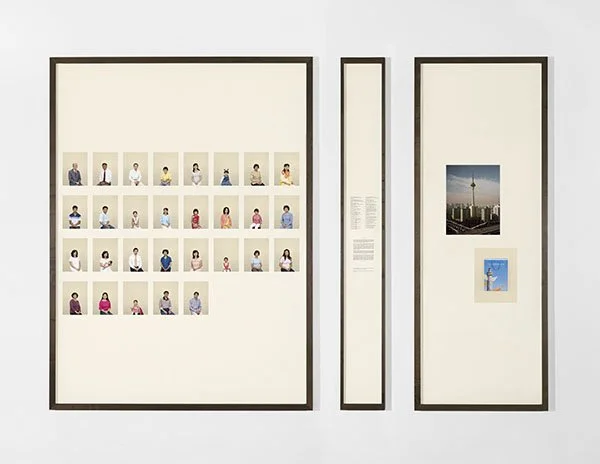
Some of the most compelling examples emerge from artists who deploy these practices with fluency while maintaining criticality. Taryn Simon’s A Living Man Declared Dead and Other Chapters I–XVIII (2008–2011) explores eighteen family lineages across 25 countries, addressing genocide, genetic engineering, human trafficking, and state propaganda. Simon employs a poetic variation of social-scientific methods to comment on how knowledge and institutional systems are structured.
Kate Crawford and Vladan Joler, Anatomy of an AI, 2018
Kate Crawford and Vladan Joler’s Anatomy of an AI is a massive data visualization that functions across galleries, a dedicated website, and contextual texts. The project maps the production of an Amazon Echo in a systemic, planetary-scale cartography, extending beyond supply chain analysis to reveal labor exploitation, material extraction, and ecological impact. In the gallery context, the immersive scale evokes Kantian awe: a sense of sublime cognitive overwhelm as viewers confront global networks of extraction, labor, and data capture. The work highlights the social and ecological implications of corporate superpowers while reflecting the epistemic and administrative protocols of the neoliberal PMC subject.
Forensic Architecture, website homepage, September, 2025
Forensic Architecture describes itself as “a research agency developing and disseminating new techniques, methods, and concepts for investigating state and corporate violence,” comprising architects, software developers, filmmakers, investigative journalists, scientists, and lawyers. Their work employs compelling evidentiary aesthetics toward counter-hegemonic social justice in legal and cultural contexts, representing an expanded notion of multi-authored juridical poetics and political intervention. Investigations address state violence, human rights abuses, environmental destruction, and corporate complicity, using tools such as 3D modeling, satellite imagery, open-source video analysis, and architectural reconstruction.

Jonas Staal Court for Intergenerational Climate Crimes, 2022

Jonas Staal explores intersections of art, politics, and ecological-social systems, expanding democratic practice through experimental public architectures and civic platforms. His projects examine how political ideologies, institutions, and infrastructures shape collective life, engaging with broader concerns of planetary governance and more-than-human agency. Collaborative and ongoing projects include The New World Summit, The Court for Intergenerational Climate Crimes, and The Interplanetary Species Society: a large-scale installation and series of assemblies in a former nuclear facility challenging neocolonial and extractivist logics in space exploration and political organization, while proposing cooperative and multispecies approaches to governance.
These artists, through explicitly political and socially engaged practices, adopt the aesthetic and administrative protocols of the Professional-Managerial Class. Their work of resistance, however, risks structural affirmation, echoing Audre Lorde’s caution against attempting to dismantle the master’s house with the master’s tools.
Otherwise is a series on neoliberal contemporary art and its unbounded remainders by Perry Shimon.
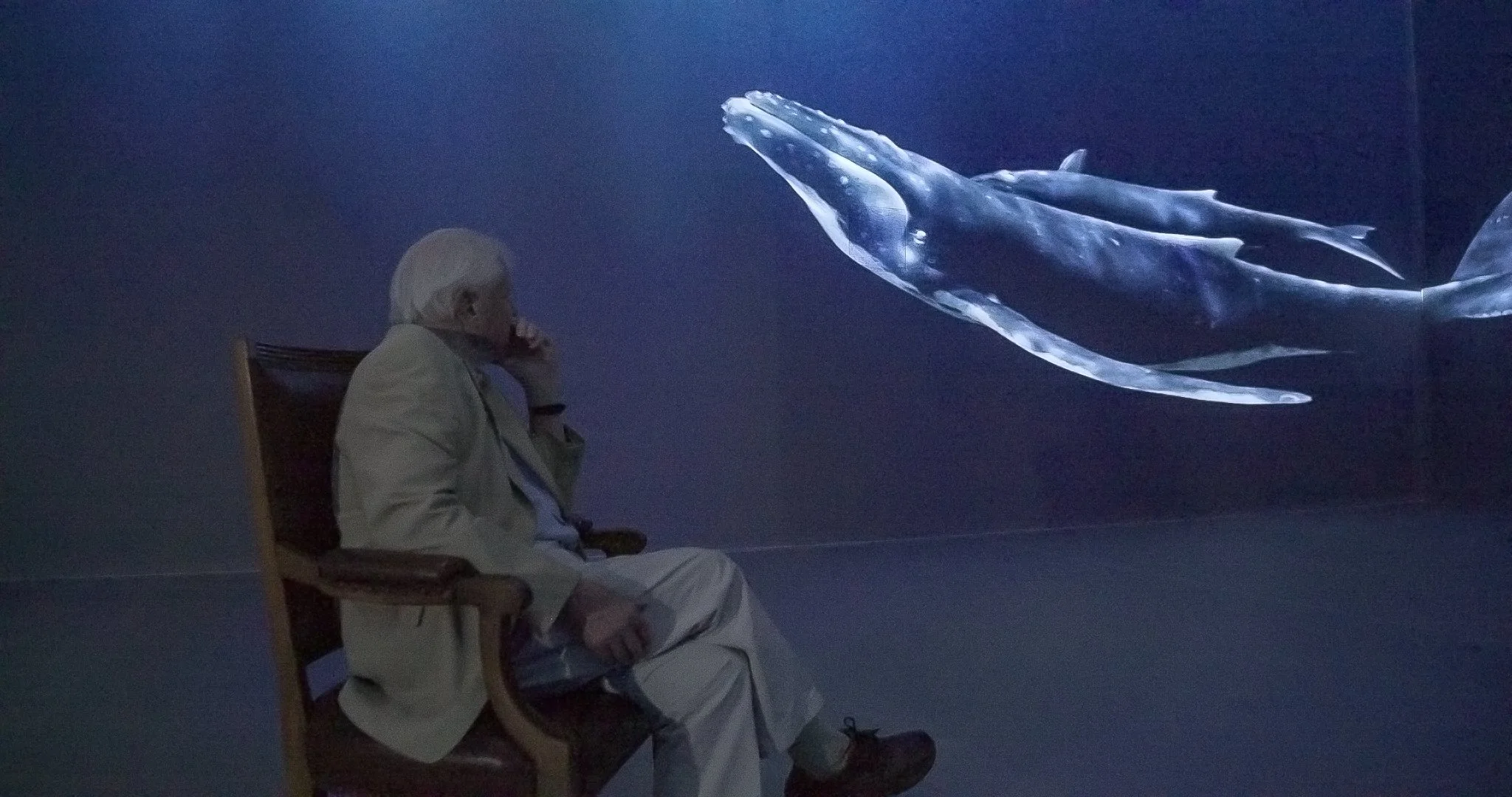
Often described as a national treasure, David Attenborough acts as a grandfather figure to those who have watched his explorations across our planet, a wise adventurer who always talks with warmth and kindness while discussing a subject that is ever-growing in its melancholy. Our Story is a fifty-minute, immersive cinematic experience that takes visitors through the start of human life, to our present, and ends with a hopeful prediction of our future that can be achieved if we are willing to work together.
As summers pass, natural disasters persist, and the world’s balance seems so completely off-kilter in more ways than one, this experience, which explains the development of life and the continuous redevelopment of our world and its inhabitants, leaves your chest tight and heavy with emotion.
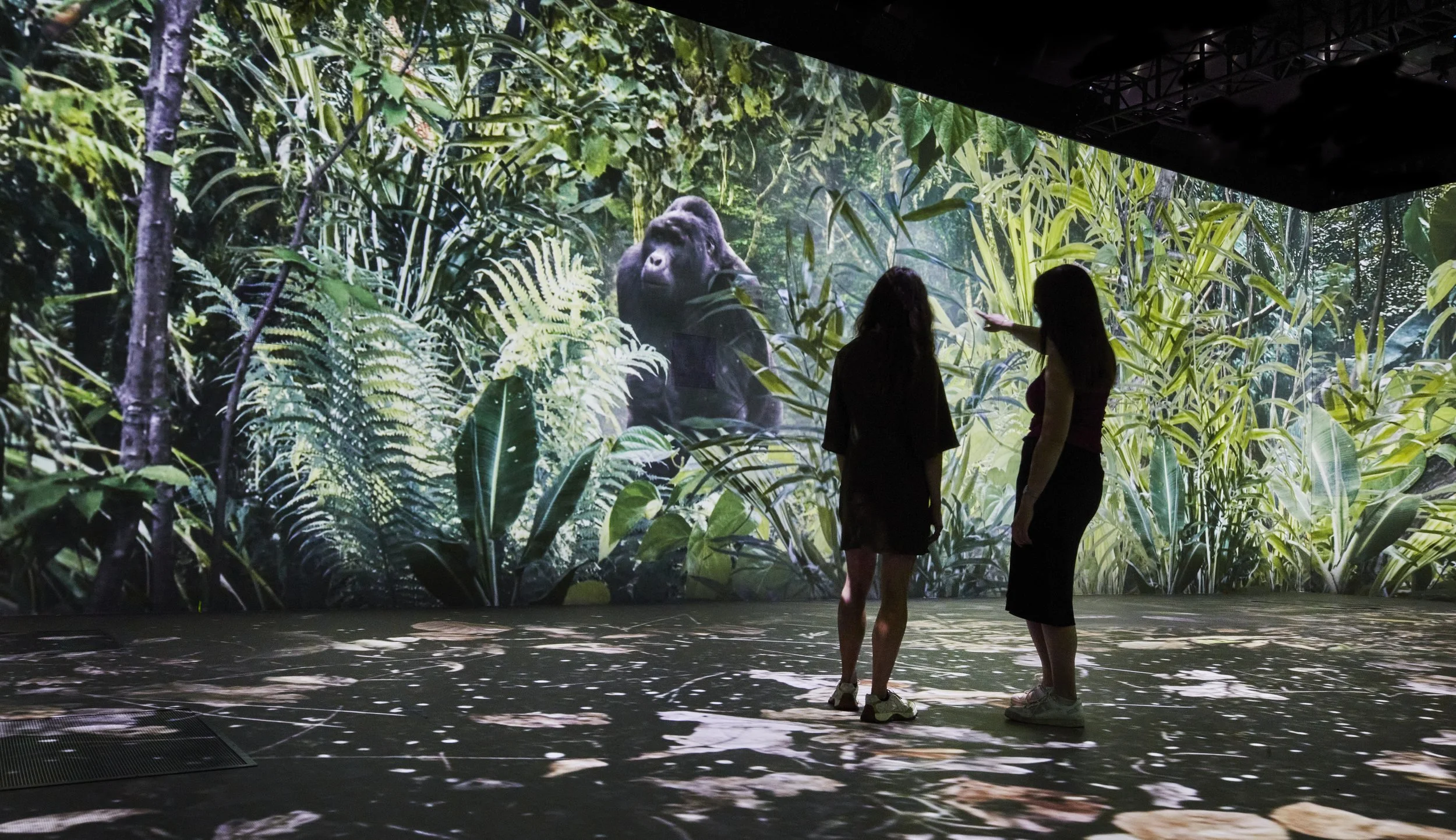
Audiences take their seats in a room full of stars projected onto the surrounding walls. The Hunger Games effect of a room made out of pixels is only felt while waiting for the show to begin. Once it does, you no longer feel surrounded by computers, but are traveling through space with the spark of life fully ignited. Stars begin to pass you, as do galaxies and planets, until we pass over the moon and reach our planet.

What is our significance? Attenborough asks. We are significant because the Earth is significant and the Earth is significant because of us, he answers. Earth is the only planet we know of that thrives in the way it does. Once unable to support life because of its unstable climate, Earth changed when temperatures became predictable and microbes expanded in their complexity. With every asteroid attack, to which Attenborough explains there have been at least six that have led to mass extinction, the last of which was 66 million years ago, our planet rebuilds, and with it so do new biospheres.
After coming face to face with gorillas, being immersed amongst hunter-gatherers, and being told the hopeful story of how great blue whales were saved from extinction, we are brought back up into space with humans’ first mission beyond the atmosphere. This was the moment we gained perspective and the first time humans saw Earth from afar, allowing us to see our home as vulnerable and finite.
Somehow, this perspective, described by astronauts as “the overview effect,” has not been enough to create an adequate change in our behaviors, and today we ourselves are responsible for disrupting Earth’s balance. The show, however, ends with a hopeful message: we can make a difference. We are all important, and there has never been a more exciting time to exist on this planet. David Attenborough sits in a chair to talk face to face with visitors, and there is a feeling that when he is no longer here, the hope that he brings to this conversation will fade, and we will all be left fully responsible, with no grandfatherly comfort to soften our fate.
Our Story is on view through January 2026 at the Natural History Museum, Cromwell Rd, South Kensington, London SW7 5BD
Creative Directors: Miuccia Prada and Raf Simons Talent: Scarlett Johansson Film Director: Yorgos Lanthimos Campaign Creative Director: Ferdinando Verderi
jewelry: uncommon matters
jacket: MSGM
earrings: uncommon matters
jacket: Balenciaga
jewelry: uncommon matters
top: Magliano
bag 1: Jerôme Dreyfuss
bag 2 & belt: Acne Studios
skirt: Our Legacy
earrings: uncommon matters
skirt & jacket: Balenciaga
earrings: uncommon matters
skirt, jacket & pumps: Balenciaga
jewelry: Saskia Diez
top & shorts: Ferragamo
jewelry: uncommon matters
top & jacket: Our Legacy
shorts: Diesel
boots: David Koma
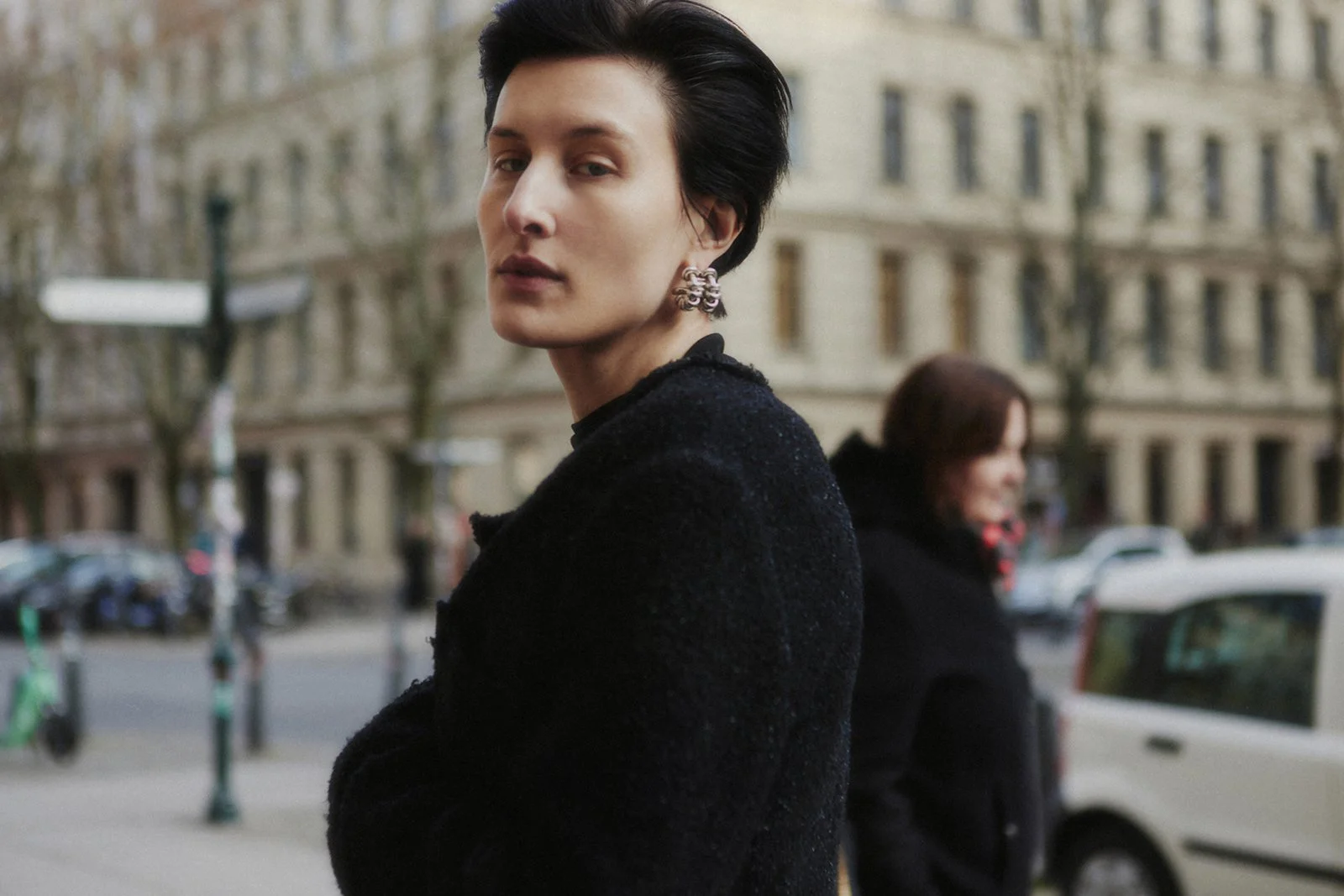
earrings: Bottega Veneta
top & jacket: Magliano
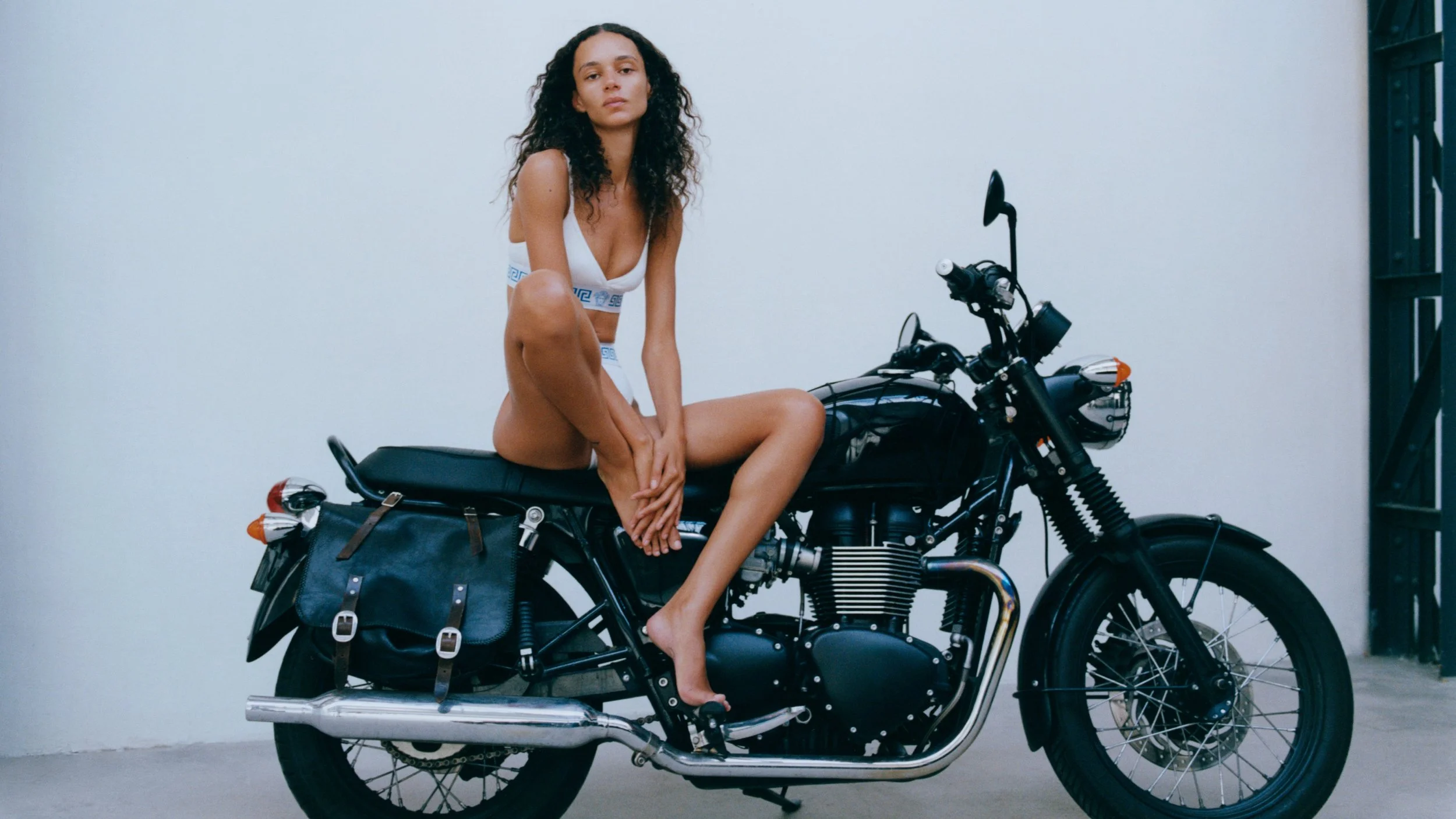
Binx on a bike. Photographed by Stef Mitchell, 2025 Binx Walton, a model and artist, captured by Stef Mitchell. Renowned for her arresting and intimate portraits of independence and youth, connecting with the irreverent and youthful attitude of Versace.
This week, Chief Creative Officer Dario Vitale unveiled “Chapter One” of his new vision for the House of Versace, founded by Gianni Versace in 1978. Described as a “force of expression,” it connects the present with the brand’s historical DNA of unbridled creativity, with a clear path for the future. The project will take shape as a series of visual chapters, “fragments of people, places and emblems that embody its values.” Chapter One includes work from Camille Vivier, Steven Meisel, Eileen Myles, Collier Schorr and more. Photographs, poetry, art, music, and film, alongside objects from the Versace archive capture the house’s “uncompromising strength, rigour and sexuality” and a celebration of pure freedom. Click here to see more.

‘Untitled’. Illustrations by Collier Schorr, 2025 Collier Schorr, an artist and photographer, whose intimate portraits cast a confronting lens on the subjects of her work, responding to the intimacy and sexuality that defines the House with a series of original illustrations.
Click here to preorder

Click here to read.
In the bustling streets of Bandra, nestled in a quiet corner, Polite Society is something new, innovative, and revolutionary. A label doesn't just sell clothes; it builds identity while being honest to itself, its consumers, and the earth. A brand that says” Be rich in your ways,” Surmai Jain, the Founder and the creative mind behind the label, has a diverse take on everything, having lived through different cities and worked through equally different fields; her approach to everything blends her stories seamlessly. In this conversation, Surmai shares her journey of building a label that is more of a community, her cross-cultural influences, and perspectives on sustainability. Read more.
Kaari Upson, Courtesy of Louisiana Museum of Modern Art, Denmark
text by Kim Shveka
Kaari Upson, one of the most significant and versatile artists of her generation, was notable for her ability to merge various media, exchanging textures and techniques from one work to the next. Her boundary pushing complexity is one main motif of Dollhouse - A Retrospective at the Louisiana Museum of Modern Art, the artist’s first career retrospective spanning the last two decades of her life.
Upson wove her own life in and out of her work, clawing at the walls of domesticity, memory, and identity, to re-inscribe herself between body and psyche, fact and fiction.
At the center of the exhibition is The Larry Project (2005-2012), her most discussed work. “Larry” was born when Upson passed an abandoned house in her hometown of San Bernadino, back in 2003. She formed a fictional character based on the abandoned belongings of her unknown neighbor, whom she named “Larry,” basing his appearance on Playboy mogul, Hugh Hefner.
Photo Kim Hansen/Courtesy of Louisiana Museum of Modern Art, Denmark
Larry and his shadows are shown throughout the exhibition, encapsulating the entirety of Upson’s approach to her creation—blurring sentience and the conspicuous into a mirror of self, home, and American culture. Larry might be viewed as a catalyst, accessory, or supplement. He might also be seen as a prop, mirror, or vessel. Whatever he is, he is not the “center,” she said.
Her performance with a life-sized Larry doll, her manic drawings littered with scrawls and body fluids, her forensic adherence to his archive—none of it was really about him. He is not the center.
The center, if there is one, is the house. Kaari Upson has stated that San Bernardino had become the landmark of her art making practice, always circling back to her origins in an attempt to untangle the knot of subject and memory, of desire and trauma. Upson understood viscerally that her core memories cannot be erased, so she found herself looking forward and backward in an attempt to recreate her own neighborhood, in the time and place of its situational trauma, and created her art from that place. In THERE IS NO SUCH THING AS OUTSIDE, first shown in Venice in 2019 and now reinstalled at Louisiana, overlapping models of domestic spaces are obscured from any coherent scale. We peer into corners, stumble through projections, eavesdrop on voices. The effect is both theatrical and intimate, claustrophobia disguised as play, a look inside Upson’s childhood, or perhaps her memories from it. The show’s title, Dollhouse, is an open metaphor: architecture as anatomy, art as a vessel to her soul. Here, the artist was once the puppet, but now she’s the puppeteer.
Photo Kim Hansen/Courtesy of Louisiana Museum of Modern Art, Denmark
By the end of the exhibition, we meet Untitled (Foot Face), a series of 140 drawings repeating the same wide-eyed head and the same severed foot. Her mother’s. A symbol, a scar, the last image Upson left us before she died. Like everything else in her work, it’s both singular and serial, intimate and estranged. She traps us in the loop that she orbited from her early beginnings to her untimely passing.
In Dollhouse, Kaari Upson doesn’t offer resolution, only recursion. Her work doesn’t ask to be understood, it insists on being felt, like a bruise you can’t remember getting. She left behind no manifesto, just fragments, skins, splinters. And yet what emerges is a radical form of autobiography: not a story told from the outside, but one lived from the inside out.
Kaari Upson, Untitled, 2007
Courtesy of Louisiana Museum of Modern Art, Denmark
Dollhouse - A Retrospective, is on view through October 26th at The Louisiana Museum, Gl Strandvej 13, 3050 Humlebæk, Denmark
Ang Siew Ching, High-Rise Pigs, 2025
At EMST Athens, curator Katerina Gregos has staged an ambitious year-long group exhibition, Why Look at Animals?, that insists on confronting the urgency of human-animal relations in an age of ecological collapse. Bringing together over sixty artists across all four floors of the museum, with an extensive public program and a duration that resists the usual velocities, Gregos opens space for more-than-human perspectives, ecological commitments, and sustained engagement.
Perhaps the most haunting image, from my several visits, came from Ang Siew Ching’s quietly devastating film High-Rise Pigs. In a long shot resembling grainy security footage, two pigs in a vast, automated slaughterhouse attempt to communicate across the brutal architecture confining them. Their enspirited distress is unmistakable, magnified by the mechanical indifference of the setting. The film examines one of the largest pig-killing operations in China, exposing the violence hidden in industrial agriculture’s scale and automation. I first saw it in the basement galleries of EMST, and later at its rooftop screening that paired the film with a BBC4 documentary inspired by John Berger’s titular essay “Why Look at Animals?”
Paris Petridis, Eye Witnesses, 2006-2022
The rooftop crowd, gathered under a balmy night sky with the Acropolis glittering in the background, constituted its own form of public assembly—though one seemingly far removed from what might constitute a public discourse, or agora, today. The juxtaposition underscored a recurring tension: the urgency of animal and ecological suffering often being sequestered within esoteric institutional spaces. Precisely for this reason, a show of this scale and depth feels all the more urgent—insisting that such questions not remain peripheral but be brought into sharper collective view.
Sammy Baloji, Hunting and Collecting, 2015
Sammy Baloji’s Hunting and Collecting confronts visitors early in the exhibition with an archive of disturbing colonial images documenting the hunting and display of animals, often in the name of science. Arranged around a minimal architectural structure recalling natural history dioramas, the images are paired with a massive wall listing foreign NGOs operating in the Democratic Republic of Congo. It is a pointed gesture, implicating museums and nonprofits alike in the colonial and neocolonial abuses that shape human-animal relations. At the center sits a book of abstracted cartography, suggesting how gridded systems of spatial control—once used to seize land and wildlife—continue today in the biopolitical regulation of lives, human and non-human.
Janis Rafa, from We Betrayed the Horses, 2025
Janis Rafa, The Space Between Your Tongue and Teeth, 2023
Power is the explicit subject of Janis Rafa’s multi-channel film and installation on equestrian cultures. Horses—long symbols of strength and nobility—are here subjected to a BDSM-inflected mise-en-scène that renders them debased, humiliated, and instrumentalized. Red lighting, metallic soundscapes, sexualized accoutrements, and statistical neon signage produce a disturbing reckoning with the ways power and libidinal desire entwine in histories of domination. If Rafa’s staging verges on spectacle, it does so to force viewers into confrontation with the brutalities often masked by cultural mythologies of the horse.
Wesley Meuris, Enclosure for Animal (zoology), 2006 - 2021
Wesley Meuris offers a quieter but equally scathing indictment: minimal watercolors of architectural typologies designed to contain absent animals. Their bureaucratic banality is chilling, exposing the violence encoded into the very blueprints of zoos. The work resonates with James Elkins’ recent experimental novel Weak in Comparison to Dreams, in which a microbial ecologist is assigned to assess stereotypical behaviors of caged animals worldwide. Both suggest how rationalized, institutional systems quietly normalize the suffering of captive beings. Meuris’s watercolors also recall the paintings of Gilles Aillaud, the philosopher-painter and close friend of John Berger, whose 2022 Pompidou retrospective broadly surveyed his decades of images of animals suffering in modernist captivity.
Radha D’Souza & Jonas Staal, Court for Intergenerational Climate Crimes (CICC), 2021
On the top floor, a reimagined setting of Jonas Staal and Radha D’Souza’s Court for Intergenerational Climate Crimes (CICC) anchors the exhibition’s political horizon. Documentation of previous trials accompanies a speculative tribunal that indicts states and corporations for climate crimes, expands legal subjectivity to non-human witnesses, and frames justice as intergenerational responsibility. Rooted in D’Souza’s critique of neoliberal legal systems in What’s Wrong with Rights?, the work demonstrates how law itself must be reimagined if multispecies flourishing is to become possible.
David Claerbout, The Pure Necessity, 2016
Annika Kahrs, Playing to the Birds, 2013
Across its many registers, Why Look at Animals? insists that the treatment of animals today—whether in factory farms, zoos, laboratories, or postcolonial landscapes—will be remembered as one of the most barbarous chapters in human history. Visitors will find their own affinities among the sixty works, but what matters most is that each piece, in its own way, speaks to the ghastly urgencies at stake: the systematic and exploitative abuse of sentient animals and the ecological implications for all life on Earth. In insisting that these realities not be confined to the margins, the exhibition models how institutions can play a vital role in amplifying what is too often silenced or sidelined.
Acropolis view from the roof of EMST
Oussama Tabti, Homo-Carduelis, 2022
Ang Siew Ching, High-Rise Pigs, 2025
Fleas, lice,
a horse peeing
near my pillow
— Bashō
There is a friendliness towards the abject, a distinctly Shinto, open and capacious reverence in Yuji Agematsu’s daily practice: meditative walks and the gathering of small bits of detritus to make delicate, ikebana-like assemblages inside cigarette-cellophane vitrines.
New York, Agematsu’s chosen home, has been given the rare privilege of seeing two full years of his unwavering practice on view: one vitrine—or ‘zip,’ as he calls them—from each day of 2023 and 2024, shown respectively at Gavin Brown’s house in Harlem and Donald Judd’s former studio in Soho, where Agematsu worked for twenty-five years doing building maintenance and art handling.
The vitrines of 2024, displayed in the airy Judd Foundation gallery, place the two artists in a fascinating conversation. Judd’s cold, machinic, monolithic forms assert and insist on themselves, while Agematsu’s works embody a fluid becoming: daily meditations on the plural forms encountered during his sensitive perambulations.
Donald Judd Foundation, Soho, August 2025
In Absence (2007; trans. Polity, 2023), Byung-Chul Han contrasts the Western concept of essence—identity, duration, inwardness, permanence—with an Eastern notion of absence, which precedes and “gathers” an ever-changing relationality or becoming. One could see this as a fundamental difference between Judd’s paradigmatic modernist objects and the fleeting, friendly assemblages of Agematsu, however stylized and reductive these contrasts may be.
In Shinto thought, there are eight million kami, or spirits, each worthy of consideration and respect. The number is shorthand for the infinite and ever-growing. When Buddhism arrived in Japan in the 7th century, Buddha was welcomed simply as another kami among the rest. Agematsu’s practice can be read through this animist disposition: a reverence for the infinite pluralities of the world, even in its discarded fragments.
At the risk of overdetermining the work, I experienced it as profoundly ecological, illustrative of a disposition that might serve us well in imagining what Anna Tsing calls “the possibility of life in capitalist ruins.” Agematsu’s practice suggests a clear-eyed willingness to look closely, to re-enchant the detritus of our shortsighted and economically ravaged world.
One of the great challenges of our time is to find a balanced, reciprocal relationship to the earth—and especially to our waste. Agematsu’s careful, sublimative approach offers one model, resonant with political ecology, discard studies, and circular-infrastructure thinking. His work reminds us of the need to reorient our relationship to the abject itself, and to transform our systems toward more stable, regenerative ecologies. Our very survival may depend on it.
Drift by Jenny Saville, 2020-2022 © Jenny Saville, Courtesy Gagosian.
Before you have time to fully enter Jenny Saville’s The Anatomy of Painting retrospective, you are faced with a colossal painting of the artist and her sister towering over you, not in an oppressive way, however. Hyphen, made in 1999, is mesmerizing and bright. Light pinks dominate the huge canvas, presenting two fresh-faced, marble-eyed young girls. The composition makes for an interesting opening piece. With one face facing towards you as you enter, but with the subject's eyes looking away, the other looks up, meeting visitors with huge open eyes. You are instantly aware of the emotion and intimacy, although her eyes meet yours, her head is occupied and nestled, resting in her sister's neck.
With a few more steps, you are opposite Propped. A painting again made with pink, red, and brown tones that add brightness to works that are seemingly conveying dark emotion. This painting shows a woman perched on a stall, wearing only a pair of silk shoes. The work at first feels overpowering. The strength of her body is apparent, and her face, only slightly visible at the very top of the canvas, looks down at the viewer, but there is also vulnerability in the subject. Her fingertips cling to her thighs, and there is a feeling that her balance is not completely secure. Lopped writing from an essay by the French Feminist, Luce Irigaray reads, “if we continue to speak in this sameness - speak as men have spoken for centuries, we will fail each other.” It is clear that the power of these pieces comes from their vulnerability, as (Luce suggests) is true of women. Saville considers this piece to be her most succinct of her early works. Early indeed, Propped was exhibited in her graduate collection at Glasgow School of Art, which led to Charles Saatchi buying her work and commissioning new works for his gallery in London.
Reverse © Jenny Saville. All rights reserved, DACS 2025. Courtesy Gagosian
Anatomy of Painting is presented, for the most part, in chronological order, showcasing the development of her practice. As you leave the first wing of the show, a timeline of Saville’s career explains her time studying in Glasgow and her fascination with artists of the Italian Renaissance. An inspiration that is clear as you enter the next room, which is full of detailed charcoal and pastel drawings that dance around the room. They are rich and intimate studies showing the bones behind her mountains of painting, but they are indeed beautiful works in their own right. In Pieta 1, Saville is responding to Michelangelo’s marble sculpture of The Deposition, made in the 1500s to depict three figures supporting Christ after the crucifixion. As with many of her works, when you begin to walk away from the drawing, feeling you have analyzed all the different figures consuming the canvas, you are brought back, realizing you have missed a hidden element.
In the final section of the show, visitors enter back into a room full of paintings, this time more colourful than the works that welcomed you. The end of the exhibition feels just like that, a full stop to her exploration of portraiture so far. Through these works, she explains, “ I wanted to see if I could make an almost abstract portrait,” and whether you interpret that in these works or not, they are truly mesmerising, with eyes and lips showing enormous emotion that somehow seem more real and important than the viewer's own.
Hyphen by Jenny Saville, 1999 © Jenny Saville, Courtesy Gagosian.
Jenny Saville: The Anatomy of Painting is on view through the 7th of September at The National Portrait Gallery in London, WC2H 0HE
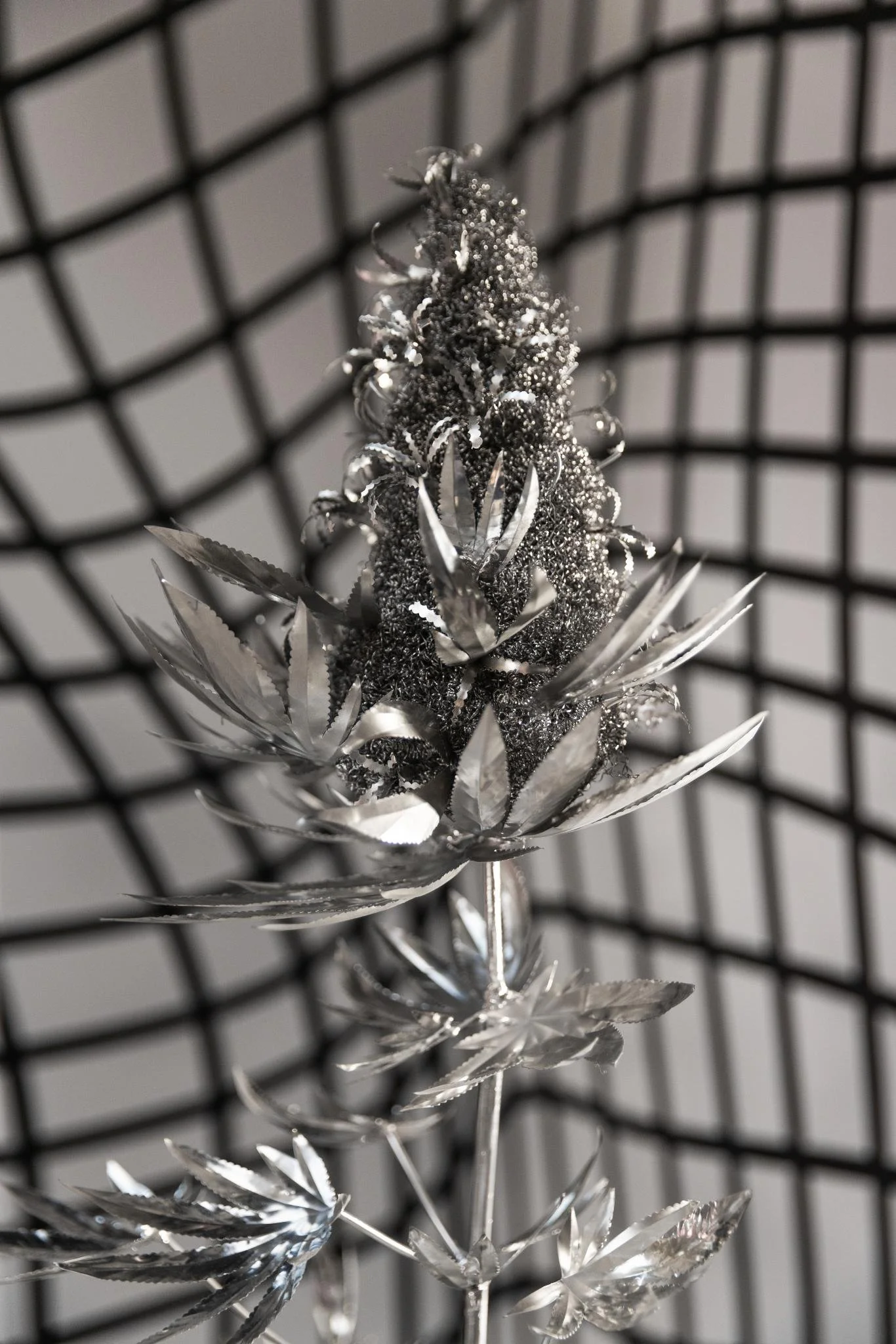
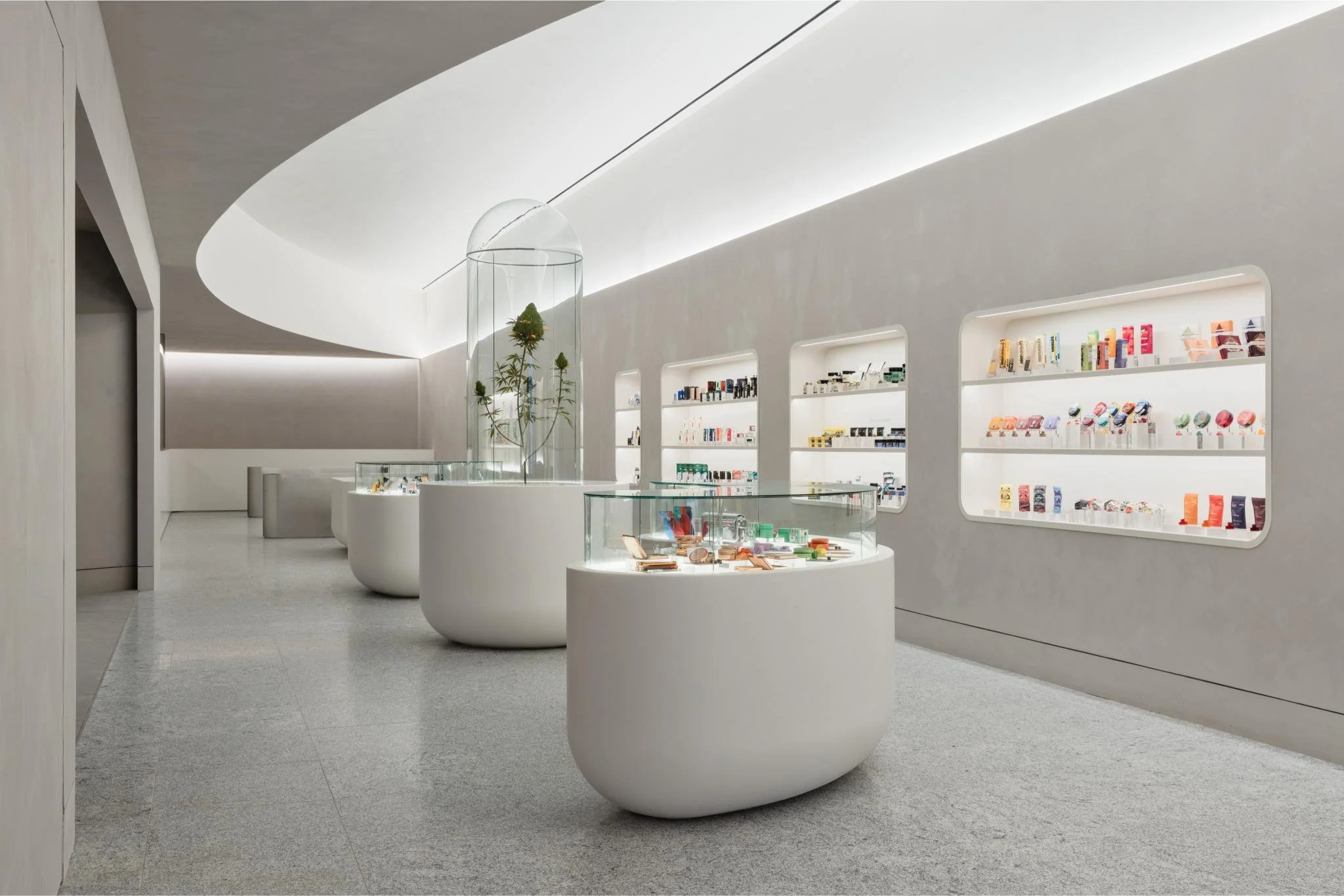
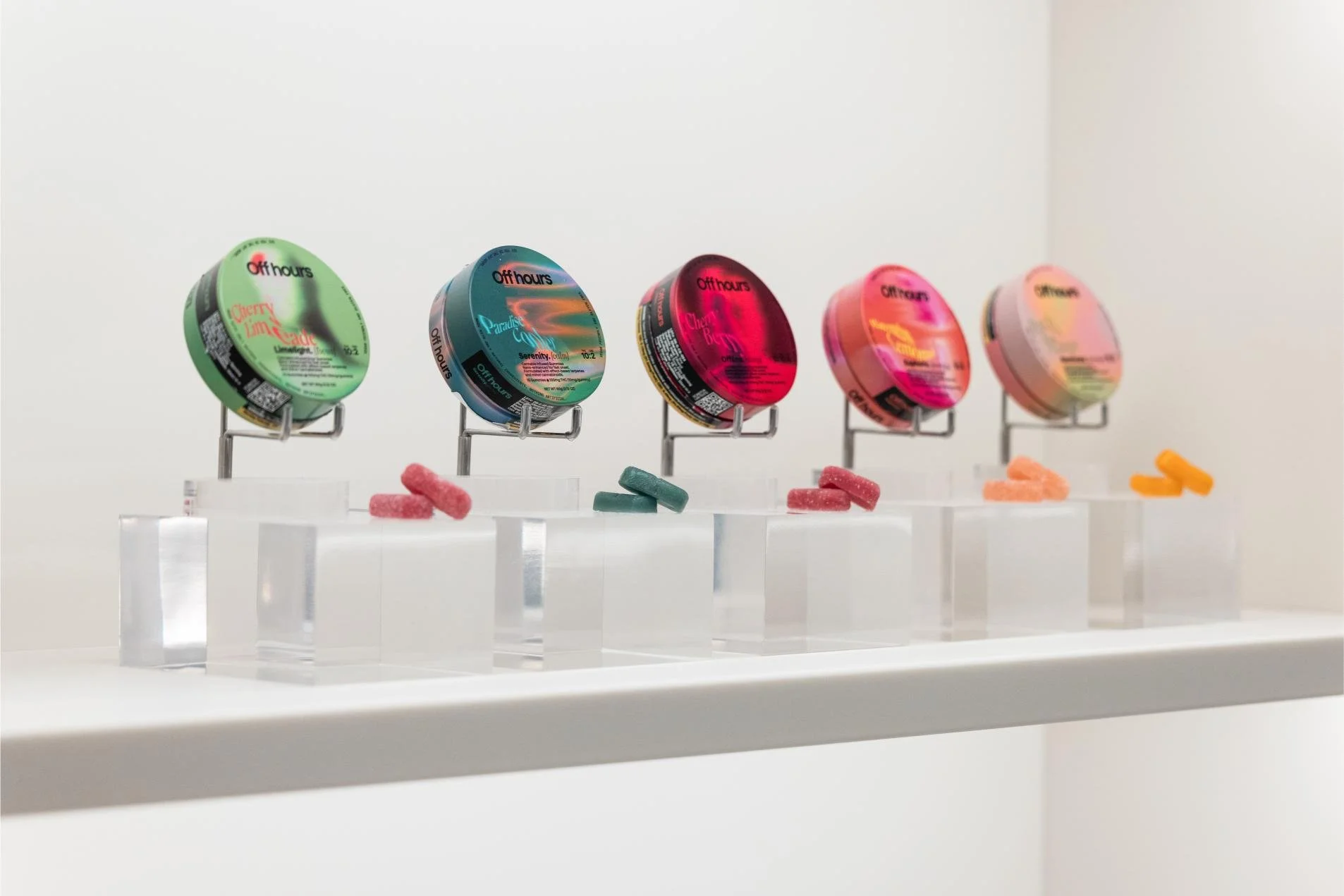
In the heart of SoHo, The Travel Agency’s newest store redefines what a cannabis retail space can be. Designed in collaboration with Leong Leong Architecture and Big Heavy Studios, the space blurs the line between gallery, lounge, and retail environment. Rather than presenting cannabis as a commodity, the store frames it as part of a larger cultural and aesthetic conversation—one rooted in art, design, and community.
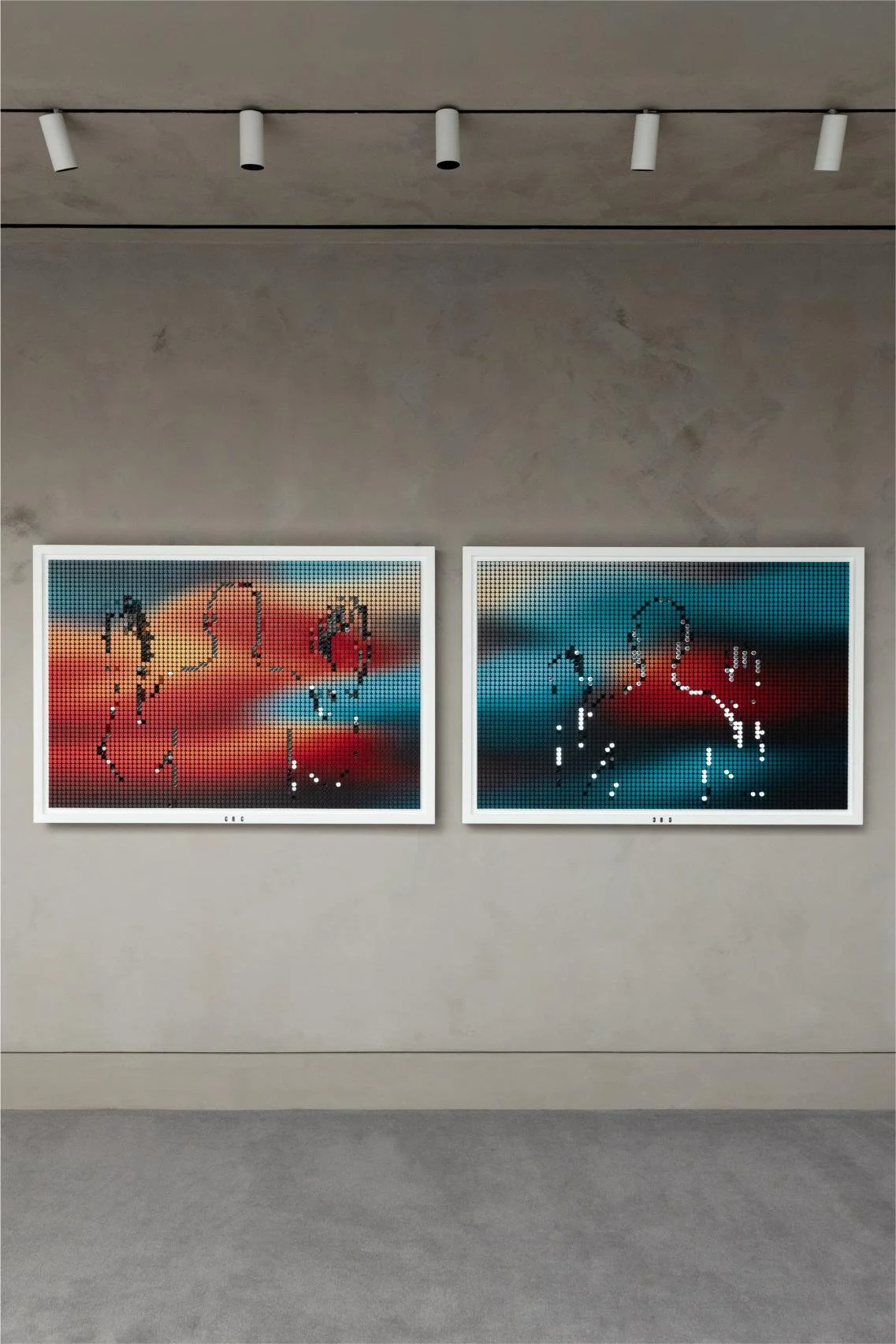
Upon entry, visitors are welcomed into sculptural interiors that emphasize materiality and form. Curved walls, reflective surfaces, and fluid architectural gestures create a sense of movement, encouraging exploration and discovery. This atmosphere is further amplified by a kinetic installation from BREAKFAST, the New York-based studio known for merging technology, art, and motion. Their piece transforms the space into something alive—responsive, shifting, and dynamic—reminding guests that retail can also be experiential.
At the core of the store’s concept is the launch of the world’s first international Bong Gallery, a curated collection of glassworks that treat smoking devices as objects of artistry. From experimental designs to collectible pieces, the gallery challenges stigmas and elevates functional objects into the realm of fine art. This nod to craft and creativity underscores The Travel Agency’s mission: to foster a new cultural language around cannabis that goes beyond consumption and engages with design, history, and innovation.
By merging high design with interactive art and curatorial vision, The Travel Agency’s SoHo store sets a new precedent for cannabis retail. It is less a shop and more an immersive cultural destination—an environment where cannabis is positioned alongside architecture, technology, and global artistry. Here, purchasing becomes secondary to experiencing, and the future of cannabis culture is rendered not only visible, but tangible.
Open TikTok and you’re greeted with a slot machine of women not quite eating. “What I eat in a day” videos, filmed in diffused apartment light, showcase cucumber slices, matcha, a single rice cake with almond butter. It’s not framed as wellness. It’s aesthetic. It’s girl dinner!
The term began innocently enough: a can of olives, a string cheese, a handful of chips. A meal not intended for male consumption or anyone’s approval. Originally it was a joke—a playful nod to the strange, snack-like dinners many women make for themselves when no one is watching. But, as with most things on TikTok, the joke calcified into a trend, and the trend metastasized into something darker. Now it’s a quiet collective agreement of not needing much—a lifestyle built on the soft eroticism of restraint.
I’ve participated too. Once, I posted a photo of my own girl dinner: a close-up of my Prozac, a handful of cherries, a glass of red wine, the rim of the glass haloed in lipstick like salt on a margarita. Also pictured: a vibrator. The caption was self-aware, maybe even funny. I can’t remember.
I joined TikTok during the pandemic. I watched trends rise and fall. I absorbed the platform’s new vocabulary, born from censorship and irony. Suicide became “unalive.” Ass became “dat ahhh.” It was absurd but poetic in its own way. Language, like sea glass, reshaped itself to fit the medium—what was once sharp worn down into something vaguely familiar but entirely different.
These codes are legible if you spend enough time marinating in the app’s glossary of brain rot. But the more dangerous grammar is subtler. The algorithm doesn’t just reflect your preferences—it hones them, coaxing you toward extremity. As The Wall Street Journal’s Tech Briefing podcast put it, TikTok “learns your deepest desires” in an eerie few beats, feeding you more of what keeps you watching. Every observable input is tracked: your search queries, the velocity of your scrolling, the pauses between swipes. Anything over five seconds counts as a view. Each becomes a signal, aggregated and weighted against billions of others to predict your next move. The result is not a mirror, but a statistically optimized version of you—built to keep you watching.
Over time, it can feel more intimate than self-knowledge—drawn from impulse, from the hidden parts of the mind that rise only when you are certain no one is watching. The algorithm pulls from the same place as your late-night searches: the weird medical question at 3 a.m., the kink you’ve never said out loud, the idle thought about disappearing or having an affair. Your search engine has always known. Now that information lives inside every feed you open, refined and fed back until it can predict not just your habits but the outline of your most private impulses.
When I began shaping my own feed, I searched for innocuous terms like “healthy dinner ideas” or “easy meal prep under twenty minutes.” I often forget to eat—not for any alarming reason, but because decision-making can feel impossible. Just figuring out what I want, what my body wants, is enough to drain me for the rest of the day.
At first, the algorithm obliged. Between niche fashion accounts, videos of borzois, and primitive tool survivalists, it offered me recipes: smoothie bowls, salmon with blistered vegetables, quinoa in a jar. I clicked. I bought the ingredients—spirulina, colostrum, collagen powders, and various leafy greens. Everything ended up rotting in the bottom drawer of my fridge.
Then the feed changed. Slowly at first. “What I eat in a day as a model.” “How I stay thin for castings.” Then, carousels of reconstituted pro-anorexia Tumblr images, posted without comment, recycled like vintage. The descent is gentle. You don’t notice the slope until you’re already sliding.
You’d think that, at thirty-two, I would be immune. But that’s the hubris of mortals who believe age can shield us from influence. I began to feel the weight around my hips as a gravitational pull into depression. If I sat and felt a softness in my stomach, I would reach for a fiber pill and a cigarette instead of lunch. Hunger became proof of discipline. A performance of elegance.
And the app cheered me on.
What I didn’t realize was that my own behavior—clicking certain videos, searching specific phrases—was reinforcing the spiral I was already in. When I searched for “healthy” dinners, I was rewarded with aspirational videos that confirmed a deeper belief: eating less is glamorous. The more I lingered, the more the algorithm assumed I wanted proof. And so it offered me more.
TikTok’s algorithm doesn’t care if the content is healthy. It doesn’t moralize. It optimizes. In the span of a month, my vague curiosity about eating better snowballed into a kind of guided fasting: bone broth breakfasts, five-hundred-calorie meal plans, women with translucent skin and visible ribs demonstrating Pilates routines—all to the beat of a Lana Del Rey song slowed down by thirty percent.
The algorithm doesn’t ask if this is good for you.
It only asks: What will make you stay?
Grayson Perry: Delusions of Grandeur at the Wallace Collection.© Trustees of the Wallace Collection.
text by Poppy Baring
Delusions of Grandeur is the Wallace Collection’s largest exhibition of contemporary art to date and Grayson Perry is fully involved in every aspect of this display. From narrating the audio guides, writing the object labels, curating the exhibition from his favorite pieces in the museum’s collection, to creating a new body of work that responds to that selection, Sir Perry is threaded through this complex exploration of identity and mental health.
Through Shirley Smith, an imaginary artist created by Perry, the English artist uses ceramics, painting, textiles, and even wallpaper to bring visitors through a corridor of his mind. “The Story of My Life” tapestry shown in the second room of his exhibition extends this sentiment to museum visitors. It captures how Perry interacts and how he suspects other people to interact with artwork they see at a museum. The large tapestry includes fragments of paintings from the collection that mainly include female characters scattered throughout the canvas. These figures phase into Netherlandish landscapes that also bop and weave throughout the piece, and overall, this tapestry comments on how viewers relate artworks back to themselves and their lives.
Grayson Perry © Richard Ansett, shot exclusively for the Wallace Collection, London
The idea for the fictional Shirley Smith was influenced by the artist Madge Hill. Having navigated traumatic experiences in her early life, Hill challenged her trauma into her art and, surprisingly, considering she was an outsider artist who had no formal training, exhibited her work at the Wallace Collection in 1942. Sir Grason Perry, a title which somewhat dilutes his anti-establishment stance, then invented his own ‘outsider artist’. He envisioned Shirley to be obsessed with the Wallace Collection so much so that she saw herself as the heiress of Hertford House, home to the collection.
Complicating the exhibition even more, Perry brings in yet another identity, the Honourable Millicent Wallace, the alter ego of the alter ego (Shirley’s imagined persona). Delusions of Grandeur follows Shirley’s delusions, delving deep into her emotions and her fantasies of wealth and friendship. This exhibition underscores mental illness throughout the three rooms. For example, in the piece titled ‘A tree in a Landscape’, all the characters that are present in the Wallace collection miniature series have been compiled together into a family tree. Each of these miniature portraits has then been given a DSM-5 (the UK’s standard classification of mental illnesses) diagnosis.
Grayson Perry: Delusions of Grandeur at the Wallace Collection.© Trustees of the Wallace Collection.
Perry admits that these imagined characters were created to somewhat distance himself from the creation of the pieces presented, explaining that Shirley’s existence gave him the freedom to play with colors and pattern that you wouldn’t naturally associate with the museum. However, not all of the new work on view is made by Shirley Smith. Some of the works are that of Grayson Perry, some by Shirley, and even some by Shirley as Millicent Wallace. It’s not usual for Perry to rely on a central fantasy figure when creating an exhibition, but the identities present in Delusions of Grandeur leave you doubting who is real and, indeed, where the fantasy begins and ends.
Delusions of Grandeur is on view through October 26th at the Wallace Collection, Hertford House, Manchester Square, London W1U 3BN
Grayson Perry. I Know Who I Am, 2024. Cotton fabric and embroidery appliqué. 234 x 234 cm
92 1/8 x 92 1/8 in © Grayson Perry. Courtesy the artist and Victoria Miro