Kurt Kauper’s Portraits of Men Are Both Archetype & Simulation @ Ortuzar in New York

Installation images: Installation views, Kurt Kauper: Housekeeping, Ortuzar, New York, January 15 – February 28, 2026

text by Emma Grimes

Kurt Kauper’s current exhibition, Housekeeping, at Ortuzar Gallery presents just over a dozen new paintings. His earlier work often references classic portrait conventions and borrows from recognizable stereotypes (such as film stars and athletes), and in Housekeeping, the subjects remain identifiable while resisting easy legibility.

Kauper steers in a slightly different direction here, presenting a few still lifes and scenes set in unusual circumstances. In Fantasy #1, a nude man floats horizontally beside what appears to be a bus stop and parking lot. The lower half of the man’s body merges into a cloud, and no other part of the canvas acknowledges that strangeness.


Kurt Kauper
Fantasy #1, 2019
Oil on Birch Panel
45 x 58 inches (114.3 x 147.3 cm)


In the same room, a pair of still lifes are painted on round canvases, recalling Renaissance tondos, a format that was usually used for devotional, Biblical scenes. Objects Carefully Organized in front of the Curtains, on the Credenza contains a yellow pyramid, a grey vase with flowers, a comb sitting inside a water glass, and a precise cut of salmon on a blue plate. Nearby, in another tondo, a window-cleaning bottle is posed on a marble countertop before satin green curtains.

The following room is primarily devoted to Kauper’s Watching Men series. Though Kauper has been known for painting nude bodies (mainly men, some women), here he narrows the focus on male faces caught in their intimate rituals: combing hair, brushing teeth, shaving. Each man is depicted in portrait, gazing out past the right edge of the canvas towards an implied mirror.


Kurt Kauper
Objects Carefully Organized in front of the Curtains, on the Credenza, 2025
Oil on Dibond
28 x 25 inches (71.1 x 63.5 cm)


Kurt Kauper
Watching Men #10, 2024
Oil on Dibond
12 x 12 inches (30.5 x 30.5 cm)


Kurt Kauper
Watching Men #11, 2024
Oil on Dibond
12 x 12 inches (30.5 x 30.5 cm)


In Watching Men #10, a young man holds a razor to his neck, gaze fixed on the reflection outside the bounds of the canvas. He wears a yellow v-neck sweater layered over a white button-down, and a red tie tucked loosely underneath. He looks like he could wander into a 1950s romantic comedy and no one would know the difference.

His skin, however, is strangely glossy. It’s too smooth even, like the head of a plastic doll. The hyper-polished details direct attention towards the surface of the canvas and away from the content. His brushwork creates a sense of uncanniness, which in turn distances the viewer and the painting.

Kauper has been explicit about his dislike of explanatory or interpretative language being applied to his work, expressing interest in what he calls “the possibility of the non-linguistic.” In a lecture, he cited Viktor Shklovsky’s essay “Art as Technique” by way of explaining his view of art’s purpose. Shklovsky argues that art exists to “estrange” (ostranenie) the familiar. By doing so, he thought art could interrupt our daily habits and “recover the sensation of life.” Kauper’s paintings seek to operate within this logic.

There are half a dozen paintings in the Watching Men series, each face similarly generic and neutral in expression. Their identities are interchangeable, and this anonymity, coupled with the overpolished surfaces, helps stimulate that feeling of estrangement.

In Watching Men #15 and Watching Men #11, for example, both of the men have their hands extended above their heads, in the midst of fixing their hair. In Watching Men #14, a middle-aged, bald man brushes his teeth. Even in these scenes where one might expect a sense of movement, the paintings feel utterly immobile, hardened into place.

These are the faces of the kind of man that has been (and still is, really) defined as the default, but Kauper here presents them as copies of copies. They are simultaneously the archetype and a simulation. And their masculinity doesn’t emerge as a natural state, but instead as something rehearsed and repeated through particular details: poses, clothing, hairstyles.

These depictions of masculinity point to both the idealized image we have of it and the copies of the image—an incessant rehearsal of a role that was arguably always more fiction than fact. But even here, his work still resists total legibility. The details—a red tie, gelled hair, floral wallpaper—carry obvious cultural significance on their own, yet their familiarity does not result in a cohesive, stable understanding. It only produces opacity. In Kauper’s paintings, you can recognize everything and conclude next to nothing.


Housekeeping is on view through February 28 at Ortuzar, 5 White Street, New York.

Doug Aitken's "UNDER THE SUN" @ Nita Mukesh Ambani Cultural Centre

text by Arlo Kremen

In the third year since the birth of the Nita Mukesh Ambani Cultural Centre (NMACC), the embryonic institution offers its space to realize filmmaker and artist Doug Aitken’s Indian debut. Under the Sun occupies three gallery spaces, disseminating the tripartite show equally among each floor. Considering the historic temporal division of past, present, and future, Aitken applies design, craft, and technology as a means to consider the ways in which the human condition has shifted as a result of technological innovation.

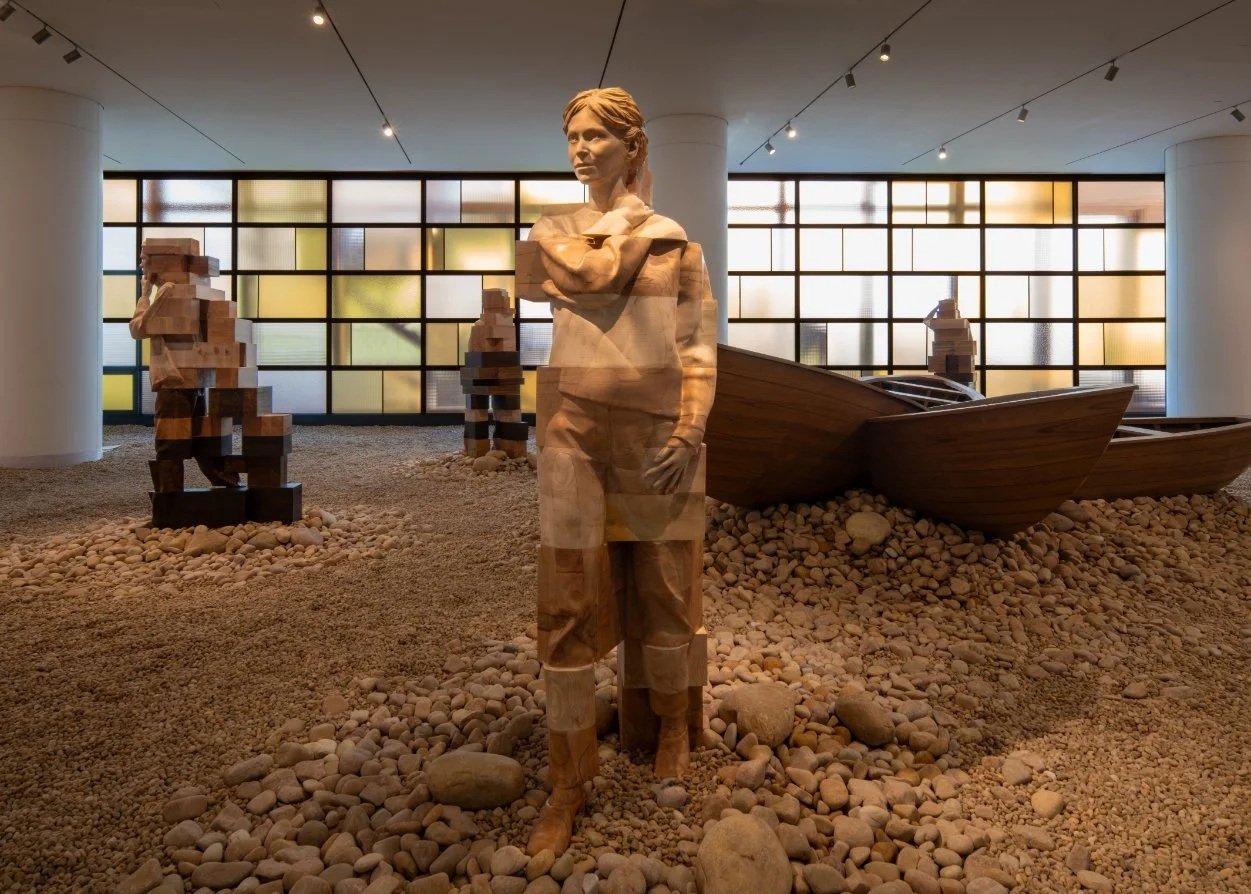
Past, the overarching title of the collection of works that make up this floor, is perhaps the most site-specific of any other floor. A collection of boats sit static aground, where instead of a frictive collision, they merge into one another into a Frankensteined structure. Rocks and pebbles flood the gallery’s floor, with the larger stones collected at the feet of those figures stretching their legs in a circular formation away from the derelict vessels. Sculpted out of reclaimed and raw Gujarat wood of variegated tones, human bodies emerge proportionally defined from pixel-like cubes of wood. Aitken’s use of machine milling and handiwork in the carving of these untitled and unidentifiable figures traces the development of ancient Indian wood carving into the modern age.

The walls hang textile works made by artisans across India who use embroidery and weaving techniques to imagine a selection of Indian rivers, as depicted in digital topographies, as being emblematic of meaning-suggestive hand signs. The works are dynamic, mixing blues with pinks and oranges in a bright clash. And by no mistake, the exhausting handcraft work required to make these works, each titled after the represented river, turns to the hand as the age-old mediator between idea and object, particular to the aforementioned rich history of Indian craft and design. To accomplish these works, Aitken’s studio collaborated with dozens of Indian artisans at Milaaya Embroidery House, bringing these generational techniques into the foray.

The second level, Present, turns to video work, projecting Aitken’s NEW ERA installation into a dark empty space of walls and mirrors. Centered on the history of the mobile phone and its inventor, Martin Cooper. By flitting between narratives of technological development and questions of humanity and personal identity, Aitken’s rightful juxtapositions of these two strains of thought define much of what it feels like to be alive in this current techne. The room is organized around three channels of video with mirrored panels. The mirrors open up the space with nearly endless halls of projections, leaving the viewer floating in an infinite space. Images of phones, roads, the ocean, telephone towers, and Martin Cooper's face and body move on and off the walls in a dance between past, present, and the yet-to-come future. Cooper’s voiceover stresses the existential importance of the cell phone, reminiscing on the site in which he made the very first public cell phone call on 6th Avenue in New York City, 1973. He reminisces, “I was lucky enough to make the very first public cell phone call in the world.” Bridging space from New York to Mumbai, Aitken stresses the global consequences of this act, bridging the two cities into the same technological globalist narrative.

Doug Aitken
NEW ERA
, 2018
Video installation with three channels of video
Three projections, freestanding room, PVC projection screens, mirrors

Future features LIGHTFALL / OTHER WORLDS, commissioned, like Past, for this show. Suspended above a wooden floor, hundreds of vertical LED tubes shape an orb of light. Pushing in and out, visitors are invited to lie down under the orb to focus on feeling the shifting swells of light from above while soaking in a drone composition working in conjunction with the convulsing sphere. This orb is universal, denying spatial and temporal restrictions. Atom, primordial specimen, pagan deity, AI creation, and planet—LIGHTFALL / OTHER WORLDS offers a hypnotic grounding into, ironically, the present, where the present can be felt as the site in which the future is imagined and sculpted.

Doug Aitken
LIGHTFALL / OTHER WORLDS, 2025
Installation view at NMACC
Courtesy of the artist
Photograph by Dhrupad Shukla/Floating Home

The light reacts to sound in real time, changing its form depending on its surrounding environment. As such, the immediate reactive quality of the work necessitates its location in the present. The work’s relation to the future is merely implied, or perhaps its visual allusions to past conceptions of what the future might look like. LIGHTFALL / OTHER WORLDS feels quite of the present, using current technologies and trends, appearing rather similar to those artworks that care less for ideas and more for experiences, so often observed on Instagram explore pages. Although Aitken's installations pre-date, and likely inspired, this trend of experience-based art works, the mass commercial proliferation of these works might warrant a pivot in the use of spectacle in this fashion. For a work so concerned with the mixing of life forms into a single pulsing entity, it would be unfortunate for its spectacle to distract from the deeply meditative ask of the work: what makes something alive and how might the encroachment of digital landscapes onto reality shift these perceptions?

Doug Aitken’s UNDER THE SUN on view through February 22nd @ Nita Mukesh Ambani Cultural Centre, Mumbai.

Narcissister’s “Voyage Into Infinity” Points to the Hidden Instability of the System

Narcissister, Voyage Into Infinity, 2024. Photo by Walter Wlodarczyk. Courtesy of the artist and Pioneer Works.

text by Emma Grimes

Last month, NYU Skirball hosted Narcissister’s Voyage Into Infinity, a one-hour performance that originally debuted at Pioneer Works in 2024 and returned to the stage with a pointed timeliness.

The show’s title comes from the Bad Brains’ song of the same name. Pioneers of hard-core punk, and famously one of the only Black bands of the genre. It’s this disruption of easy assumptions that forms the conceptual foundation of Narcissister’s show. Framed as a “contemporary, feminist revisioning” of The Way Things Go—Peter Fischli’s and David Weiss’s landmark video that presents an elaborate chain reaction—Narcissister interrogates the systems we build while exploring the relationship between control, entropy, and power.

Fischli and Weiss’s 1987 video appears to be filmed in one shot, but it’s actually a tightly edited illusion, splicing together over a dozen individual clips. What looks like chaos was actually planned, and what looks like inevitability was really constructed. Their Rube Goldberg machine is made of an array of heavy, industrial materials, shrouding the work in a way that unmistakably reads masculine—which Narcissister untangles. While Fischli and Weiss present this smooth, inevitable progression, Voyage Into Infinity underscores the speed bumps and hesitation.

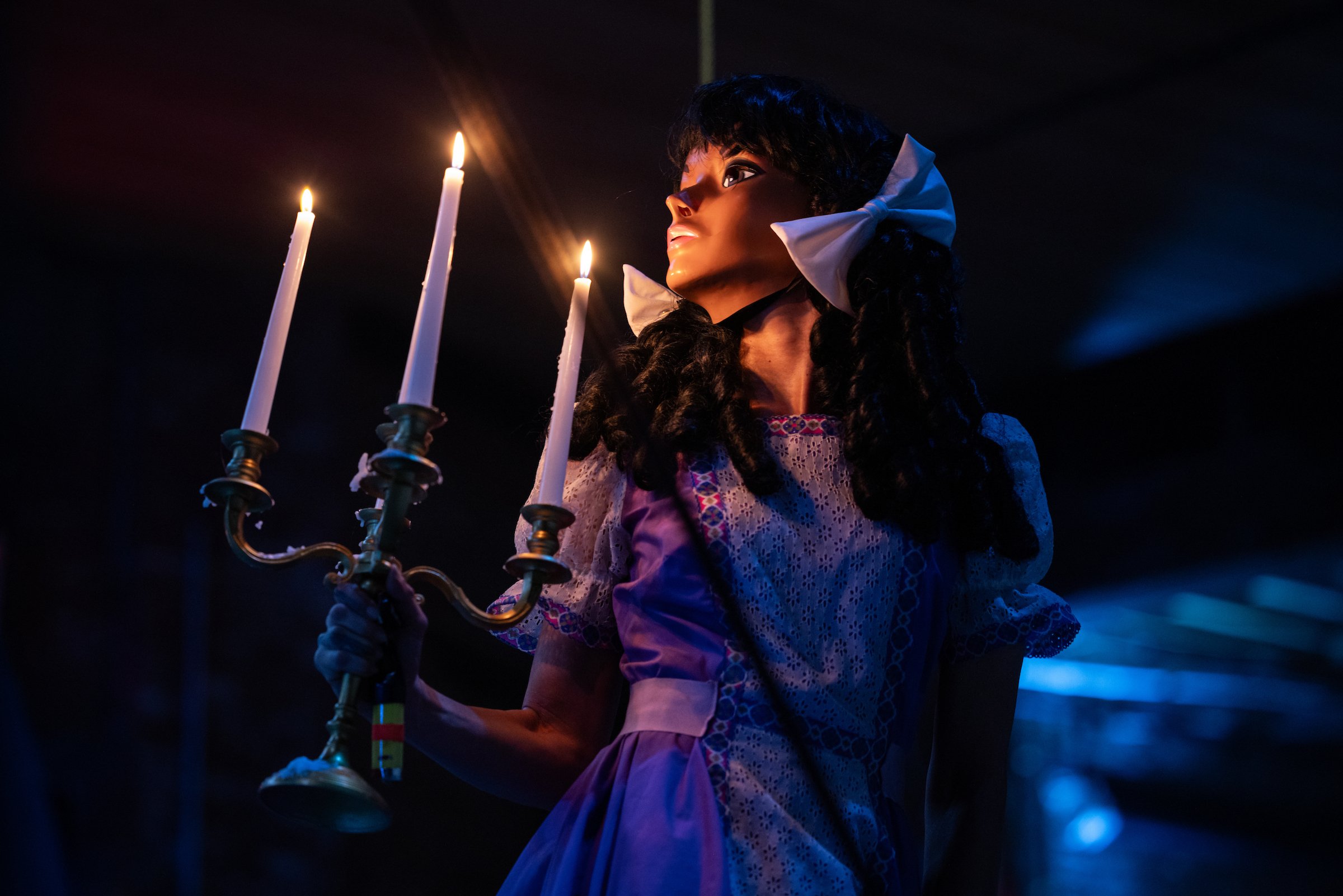
The performance begins with a woman crawling out of a wooden structure that looks like a treehouse; her face hidden behind one of Narcissister’s signature masks—smooth, artificial, and an exaggerated distortion of beauty standards. She wears a hyper-feminine dress, as though it were torn right off a plastic doll, and begins wandering the stage. Unlike the implied male hand behind The Way Things Go, she’s part of the machine.

The stage is crowded with a haphazard array of objects—half look like they’re from a junkyard, half from an estate sale. There are ladders, a marble sculpture of a muscular athlete playing discus, a see-saw, and much more. It’s Narcissister’s Rube Goldberg experiment, waiting to be propelled into motion.

A few minutes later, a second masked woman emerges from the structure, wearing the same dress in another color. Then a third. The characters are figuring out how to initiate the machine, and the experience is like watching a movie that didn’t cut out its dead time. Though most of the performance consists of these in-between moments, it’s never boring or idle.

At one point, one of the performers stacks empty Home Depot-style paint buckets into a pyramid, only to have it knocked over later. Later, those buckets are hung from the handlebars of a bicycle, which another character rides across the stage. 

One could spend hours analyzing every detail, but to speculate too earnestly about each object’s meanings and the characters’ feats would feel almost superfluous. More significantly, the machine rarely behaves according to expectation. Its forward momentum relies on constant intervention from the masked characters, who interfere every time entropy poses a threat. Their role is to enforce the rules of the system and keep the machine working as designed, regardless of whether it makes any sense or collides with the messy realities of human life. 

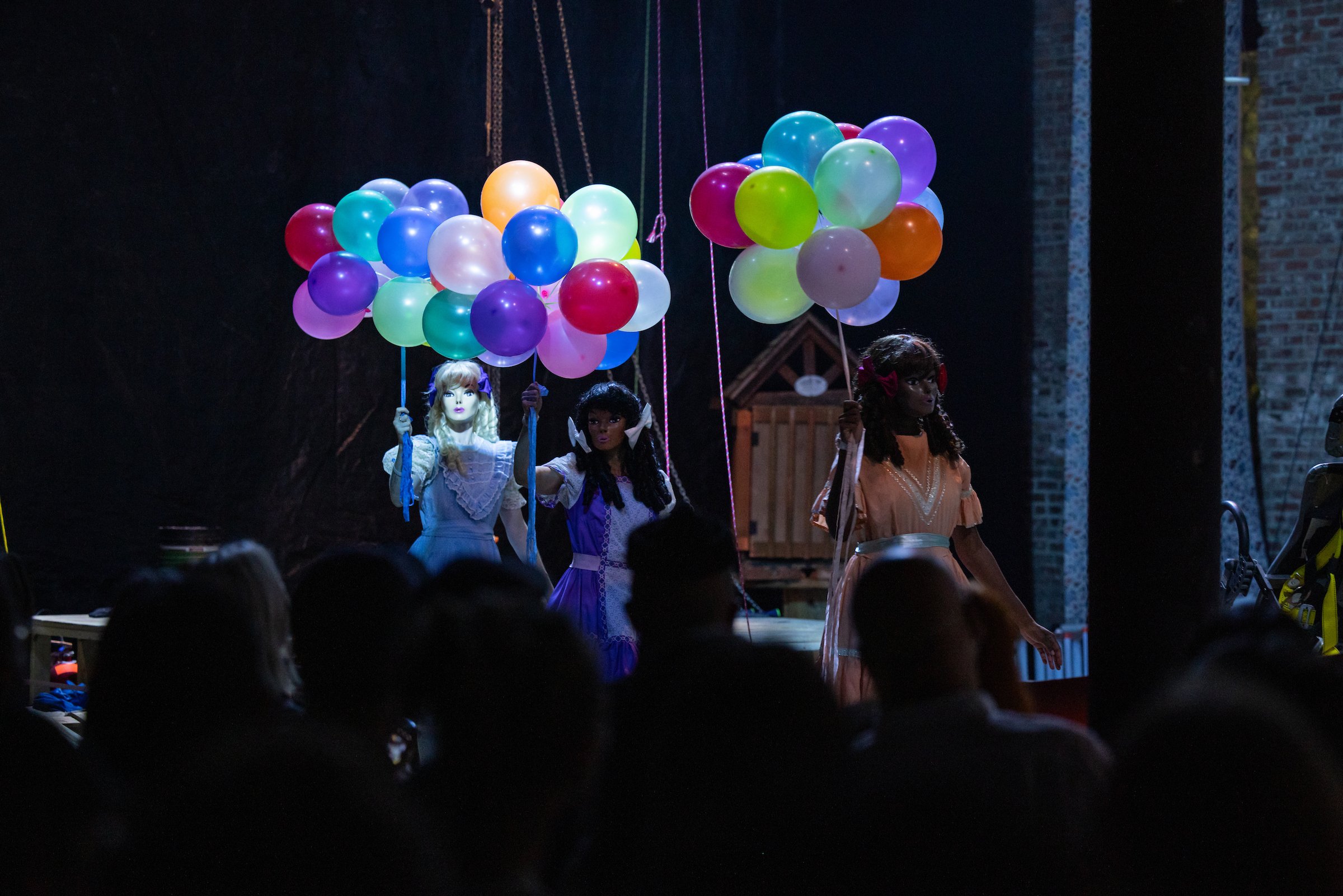
The most unforgettable image arrives at the end of the show, following a wonderful musical interruption by Holland Andrews and a live band. The three characters line up near the edge of the stage, wearing their dresses again, and hold an absurdly long string with a bundle of colorful balloons attached. They pull the string down and begin popping each balloon with their bodies. At times, their actions look like convulsions, spasms of energy wholly committed to wrecking. 

Why inflate balloons only to obliterate them? Why stack a pyramid of buckets only to push it over? Their gestures reflect a form of power whose only objective is in asserting itself.

Narcissister, Voyage Into Infinity, 2024. Photo by Walter Wlodarczyk. Courtesy of the artist and Pioneer Works.

Alexis Rockman Remembers Earth with Bittersweet Resignation @ Jack Shainman Gallery in New York


Alexis Rockman
Lake Athabasca, 2023
oil on wood
48 x 40 x 2 inches


text by Hank Manning

Fire pervades Alexis Rockman’s paintings, on view now at Jack Shainman Gallery in Chelsea. Fires burn down forests, pollute the atmosphere, and even rage through snowy environs. Small nascent flames feel more ominous than those that have left entire forests ashen, as we can easily foresee the death to come. Rockman portrays bodies of water in the foreground, as if he has retreated to the one place where fire can’t burn. These bodies reflect much of the devastation on land, as well as  the exhibition’s title, Feedback Loop. They emphasize the accelerating nature of this destruction. The works’ titles—including Karaikal Beach (India), Lake Tanganyika (East Africa), Osa Peninsula (Costa Rica)—attest to a global reckoning that is pointedly addressed when viewing the series as a whole.

Alexis Rockman
Pioneers, 2017
oil and alkyd on wood
72 x 144 x 2 inches (overall)

Set almost entirely underwater, Pioneers is the only landscape in the show that is completely devoid of fire. It portrays the wide range of lifeforms, from cyanobacteria to a 20-foot sturgeon, found in the Great Lakes. The sun, shrouded by smoke in other paintings, rises in the center like a beacon of rebirth. It is there that the animals turn their gaze. As the largest work in the exhibition, this painting is a reminder of the continually rising sea levels driven by climate change. But this is not a silver lining of global warming for sea life. Even here, reminders of human impact proliferate. The painting, in fact, can be seen as a timeline of our impact on the environment. On the left, a mammoth skull sits by an ice shelf, highlighting the role that hunting played in their extinction during the last ice age. In the center, a sunken ship rests on the seabed. At right, a shopping cart has become the home of zebra mussels, and a still-afloat ship pollutes the sea with an immense green blob of ballast water.


Alexis Rockman
Rio Tigre, 2023
oil and cold wax on wood
48 x 40 x 2 inches


Human life, as opposed to its traces, is conspicuously scarce, visible only on close inspection. In a few paintings, nondescript solitary figures sit on small boats watching the destruction on land. In other paintings, similar boats appear unmanned. They are isolated and powerless in the face of fire. Like the similarly isolated moose, bees, and birds, the remaining people have become victims of our poor stewardship, leading to the loss of their natural habitat. 

Alexis Rockman
Raccoon, 2017
sand from Cuyahoga River, Whiskey Island, and acrylic polymer on paper
12.75 x 16 x 1.5 inches (framed)

In the exhibition’s final room hang sixteen portraits of animals and plants found in the Great Lakes. Unlike the previous paintings, these minimalist drawings—made from sand, soil, or coal dust from the area—mostly contain only one figure, each rendered in an individual color. Without the context provided by the other works, they look like the types of anatomical sketches a biologist might draw and describe in a notebook. These species’ histories have been profoundly shaped by human activity. The horrifying, parasitic sea lamprey followed the Erie Canal after its construction in 1825 to the Great Lakes, where it has been an invasive menace ever since. During the late 19th century, North American wood ducks were introduced into Europe and Asia for their aesthetic appeal as ornamental waterfowl. Shortly after the turn of the century, raccoons were also brought to Europe as part of the growing fur trade. These invasive species rapidly cause disorder and death in their new ecosystems.

Alexis Rockman
Forest Floor, 1990
oil on wood
68 x 112 x 1.75 inches

Looping back to the beginning, we look again at Forest Floor, Rockman’s oldest painting on display, at the entrance. The worms, spiders, and other small beings (an ant dwarfed by an acorn provides a sense of scale) form an intricate ecosystem, somewhat camouflaged, but seemingly more full of life than the larger landscapes. Their size suggests vulnerability, while their diversity—the longer we look, the more we see—suggests both their importance to a natural balance and the strength that comes with numbers.

Rockman admits that while he has continued for decades to paint natural environments, with encyclopedic detail, his motivation has changed. In the 1980s and ’90s, he thought the general public had “an information deficit,” so his work must warn of what’s to come and demand change. Later, he resigned to the idea that “neither I nor my work were going to save the world.” We have entered a feedback loop, where desecration begets further desecration. If we cannot preserve the environment, at least we can remember its beauty through art.

Alexis Rockman: Feedback Loop is on view through February 28 at Jack Shainman Gallery, 513 West 20th Street, New York

A Great Deal of Quiet Drama: Read An Interview of Painter Sosa Joseph

Sosa Joseph Devil’s hour, by the river, 2025

Some landscapes are not merely seen, but remembered. In Sosa Joseph’s canvases, rivers overflow, rain does not simply fall; it seeps into bodies, homes, and time. These paintings do not so much narrate the past as they establish a state of memory that revives it. Figures sometimes become distinct, sometimes fade; like memories, they oscillate between clinging and vanishing. Read more.

Dan Flavin’s Luminous Grids @ David Zwirner Gallery in New York

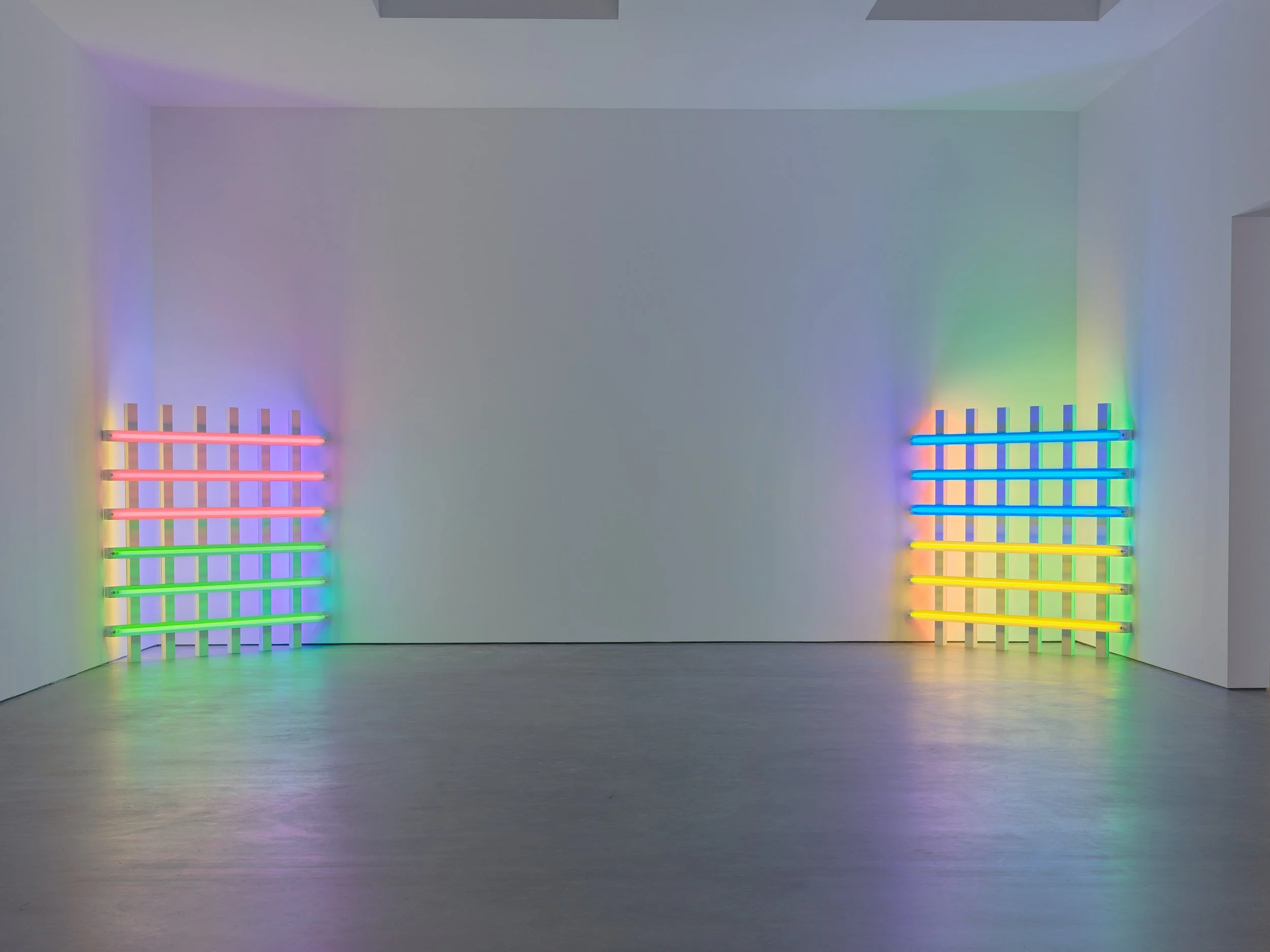
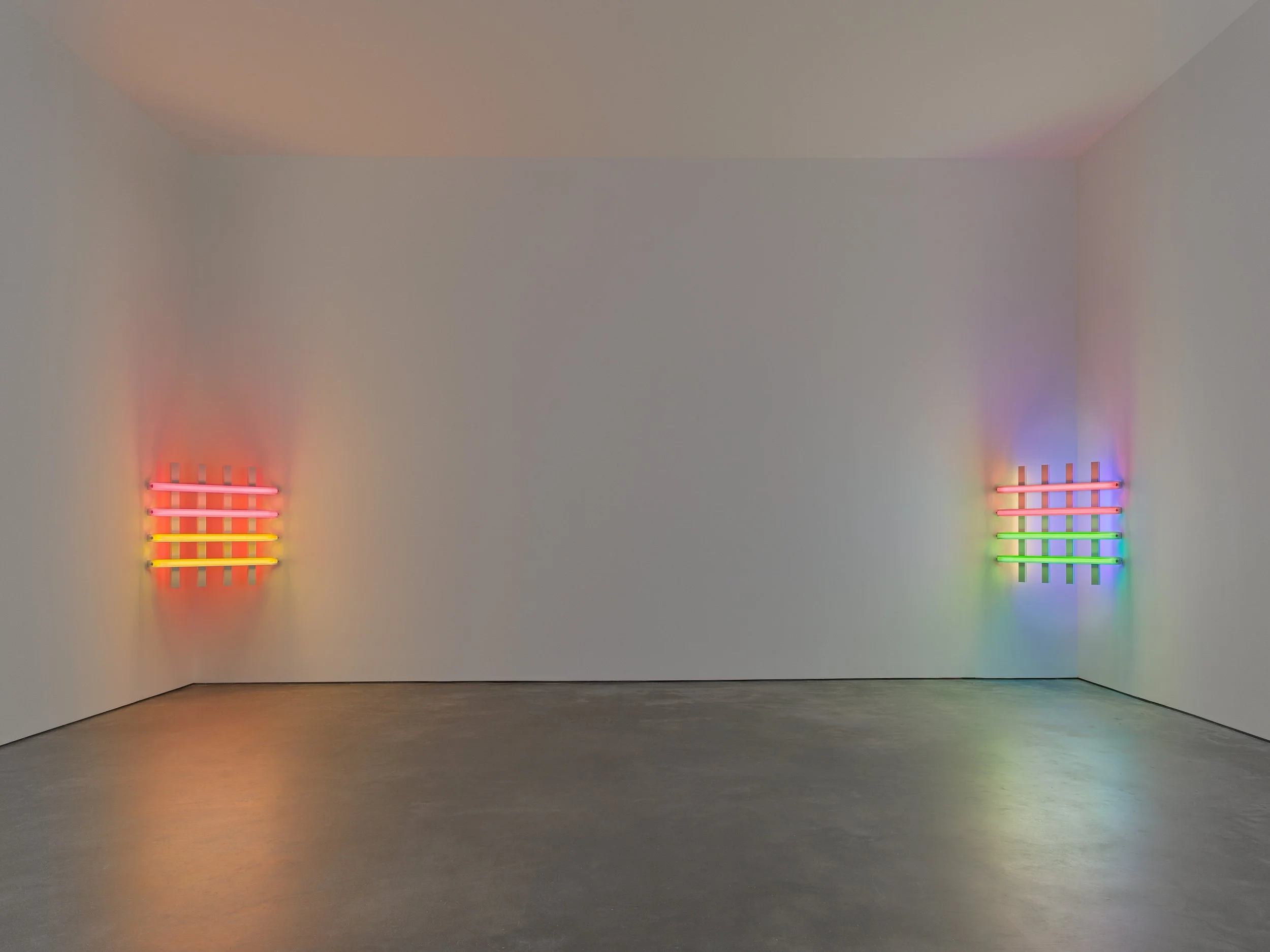
Installation view, Dan Flavin: Grids, David Zwirner, New York, January 15–February 21, 2026.
Courtesy David Zwirner

text by Emma Grimes

Visiting David Zwirner’s new Dan Flavin exhibit feels more like exploring an incandescent expanse than walking through a gallery. Every room contains just one or two of his fluorescent installations, giving each of them the space to settle and saturate the ceiling and walls. The ongoing exhibition focuses on Flavin’s grid pieces, which are a denser and more complex development of the spare, one or two-bulbed installations that first brought the artist to recognition. 

Flavin called his works “situations,” a term that underscores their interdependence with space and context. The word also hints at their delicacy: the light bulbs can always be switched off, the lamps replaced. What matters is not the bulbs themselves, but your experience encountering them: the bulbs of colors radiating off the grids, suffusing the white walls, and one’s own body drifting through the space.

The first room holds the artist’s 1987 untitled (in honor of Leo at the 30th anniversary of his gallery) — one of many pieces dedicated to his longtime dealer, Leo Castelli. Three identical, five-by-five grids adjoin, and each horizontal lamp glows in one shade of the rainbow. On the floor below, the images reflect on the concrete, radiating in an ombre duplicate.

As you walk closer to the structure, the reflection on the floor recedes. As you retreat, the ombre reemerges. The grids themselves are not changing, of course, but your image of them does. Perception reveals itself to be—to use Flavin’s word—situational.

Behind the installation, a purple-pink light bathes the wall. Flavin has been described as a painter because of the way his installations color everything near. But painting feels slightly too vague and inexact as an analogy. The light is soft and diffuse. The neon grids light the walls, saturating them in radiant pastel shades so definitively that they erase the boundary between artwork and space.

In the following room, two grids appear in adjacent corners with opposing color schemes. One is pink and green; the other is blue and yellow. Each reflects the opposite color combination on the wall behind (the pink/green one has a blue/yellow reflection, and vice versa). Whereas in the previous work, you encounter the effect of the light and its source simultaneously, here you first encounter the effect, and only upon walking up close to the grid can you notice that there are lightbulbs on the backside, responsible for the reflection.

Installation view, Dan Flavin: Grids, David Zwirner, New York, January 15–February 21, 2026.
Courtesy David Zwirner

Flavin’s work centers on a compelling paradox: the grids themselves occupy very little space, yet his work fills the entire room. They implicate their container in the completion of the work itself. This use of light set him free from the boundaries of a canvas or 3D form.

His oeuvre also ensnares the viewer’s body as a significant part of the encounter. If you stand close enough, you’ll feel the warmth of the electricity. And if you stare long enough, your eyes will see an afterimage.

Flavin disliked it when critics overanalyzed his work or ascribed excess meaning to it.  There’s humor in the fact that he chose a medium at which you’re discouraged from looking for too long. But if you do, you’ll notice an afterimage; it isn’t quite the work itself, but it isn’t entirely separate from it either.

Dan Flavin: Grids is on view through February 21 at David Zwirner Gallery, 537 West 20th Street, New York.
Otherwise Part V: Landscape Aesthetics and the Liberal Commons

Frederick Law Olmsted

text by Perry Shimon

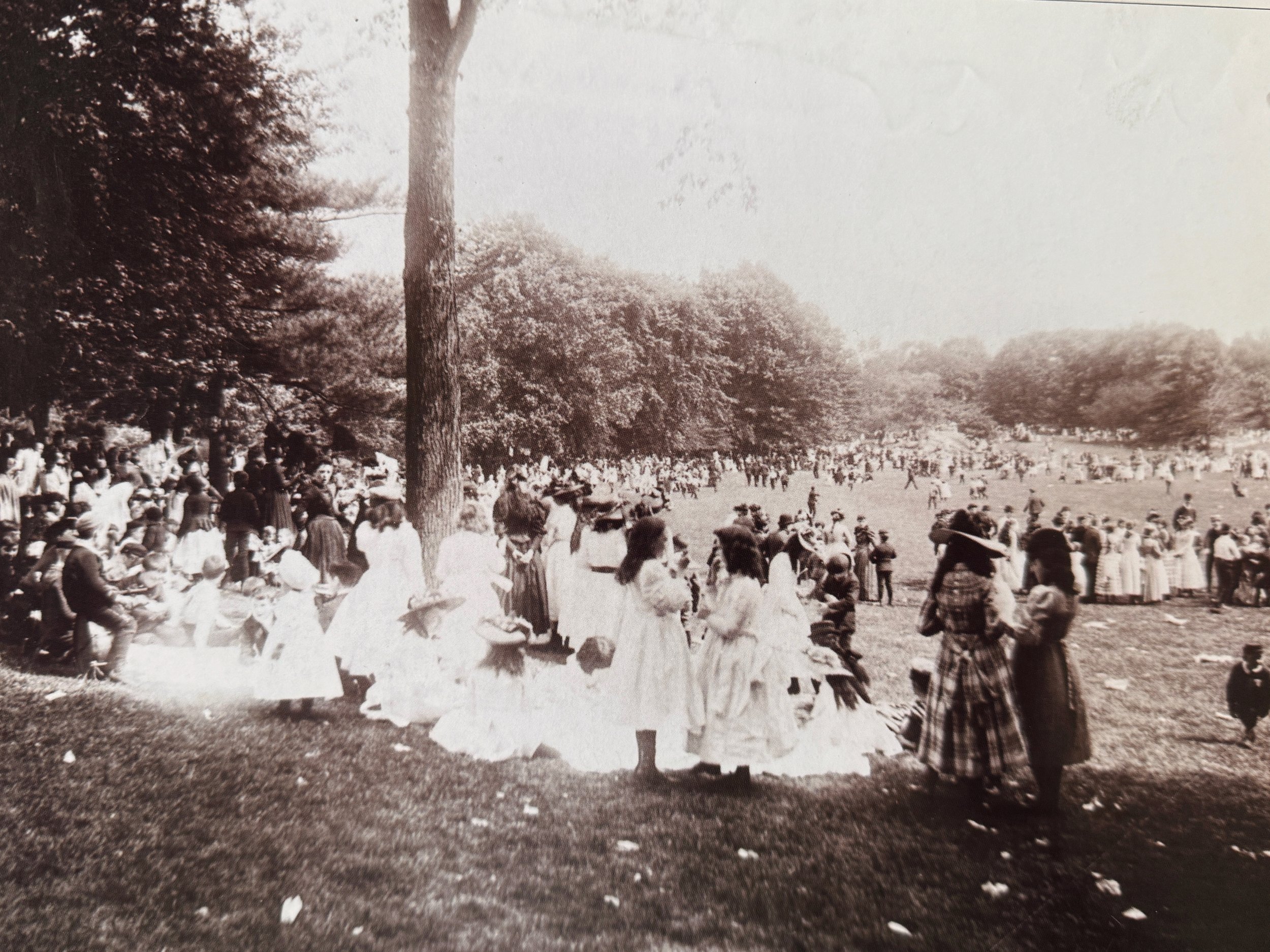
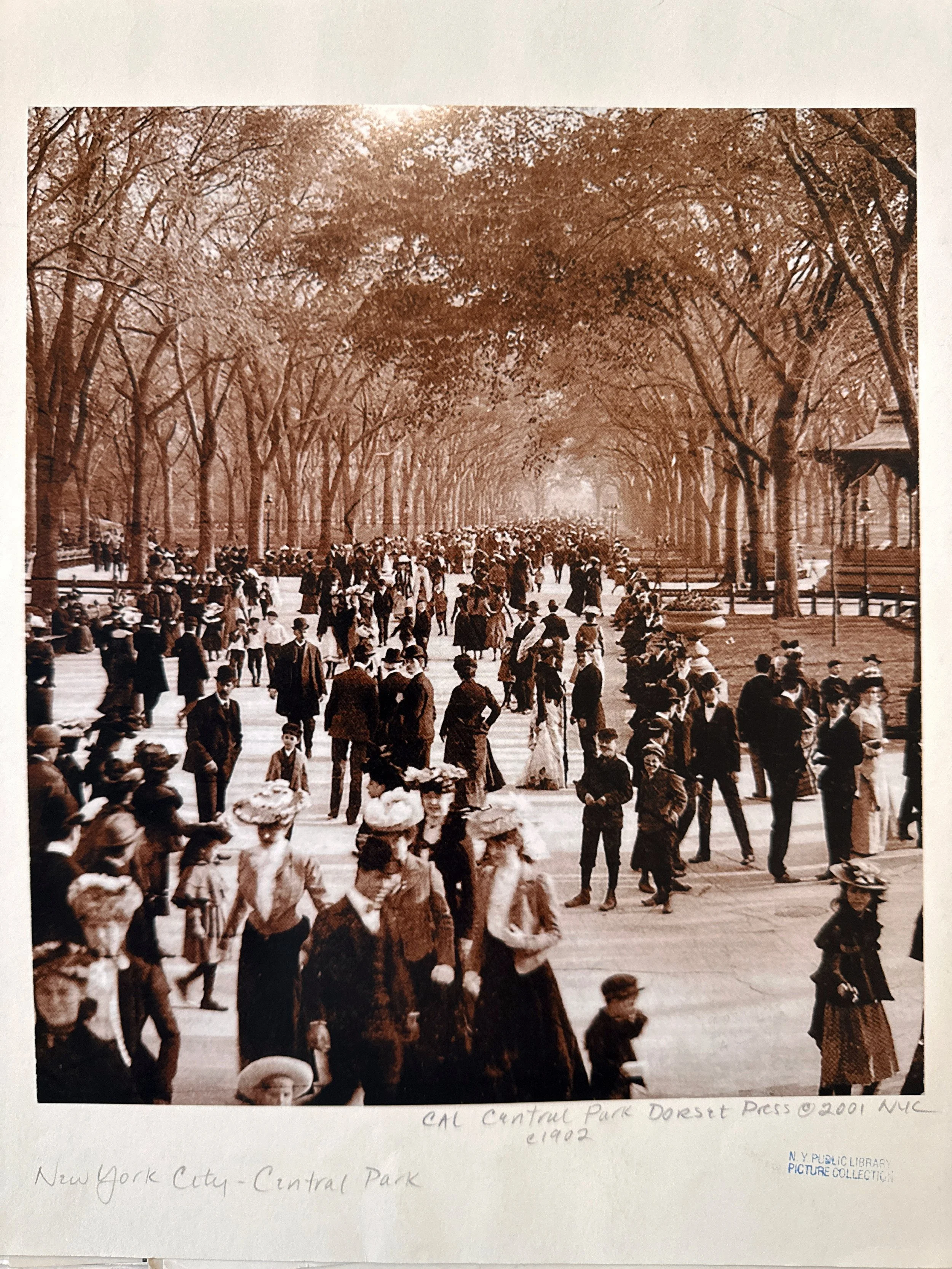
In the nineteenth century, Frederick Law Olmsted offered a distinctly North American adaptation of the English picturesque garden. Indebted to far eastern traditions and deployed at a scale in New York City perhaps without historical precedent, his progressive landscape architecture was realized with the explicitly democratic mandate of providing the most broadly accessible of public spaces. The Greensward Plan, later realized as Central Park and conceived with his longtime collaborator Calvert Vaux, marks a defining moment in world history and one of the most significant artistic interventions in the built environment in North America. He went on to design hundreds of parks, often collaboratively, and was largely responsible for founding Yosemite and the national parks movement.

Yosemite Valley by Aniket Deole via Unsplash

Olmsted’s approach emerged from reformist currents that included abolitionism, public health advocacy, sanitation reform, and early ecological thinking. Before turning to landscape architecture, he worked as a journalist and social critic, reporting on slavery in the American South and on the living conditions of the urban poor in northern cities. These experiences shaped his conviction that environments actively produce social life. Parks were not decorative amenities so much as infrastructural interventions, designed to counteract the physical and psychological damage of industrial labor, overcrowding, polluted air and water, and the accelerating velocity of capitalist urbanization. His landscapes were conceived as works operating at the levels of ecology and social space, and his work was concerned with the working classes rather than the elite.

New York Public Library Picture Collection

While it is impossible to fully separate Olmsted’s legacy from the general trajectory of Indigenous genocide, dispossession, and the manifold forms of subjugation and exploitation organized within the plantation and industrial imaginary, against these historical constraints, Olmsted fought for and won large, common, and beautiful spaces of ecological remediation, species diversity, and psychic restoration. His parks intervened directly in degraded urban sites, reworking hydrology, soil, and vegetation to produce more resilient systems. This ecological realism positioned Olmsted as an early practitioner of environmental design, anticipating concerns with biodiversity, stormwater management, and urban health.

New York Public Library Picture Collection

Also significant was his attention to circulation and movement. Olmsted advanced what we would now call multimodal design. Carriage drives, bicycle paths, and pedestrian walks were carefully separated by speed and use, allowing different publics to coexist with less friction. These systems emphasized gentle grades, curving paths, and continuous routes that connected disparate parts of the city. Movement through the landscape was slow, embodied, and immersive, oriented toward restoration rather than efficiency. Parks functioned as connective tissue, stitching neighborhoods together through shared green infrastructure.

Perhaps the trail, in a general sense—along with the mark—constitutes the basic grammar of art making: defining a frame and coordinates for apprehending the world and inviting its capacity for meaning.

Olmsted considered art without social utility to be ornamental and frivolous. His conception of art required a deep commitment to public use and dignity without sacrificing formal rigor or beauty. He was explicit that his parks were for those with the least access to leisure and health. Working people, immigrants, and the urban poor stood to benefit most, in his view, from fresh air, open space, and unstructured time. Parks were instruments of democratic leveling, spaces where social distinctions might soften through shared experience, and where physical and spiritual health were cultivated together.

These aspirations were never fully realized. In practice, Olmstedian parks frequently reproduced racial and class hierarchies even as they sought to alleviate their effects. The liberal claims to access masked structural inequalities determining who could safely and continuously use these  landscapes. The creation of Central Park required the displacement of Seneca Village, a predominantly Black and Irish working-class community. Policing, behavioral codes, and informal norms often excluded Black residents, Indigenous people, and the poor from meaningful participation. Proximity to parks became a driver of real estate speculation and further displacement, transforming spaces nominally promoted as commons into engines of uneven development. 

New York Public Library Picture Collection

Olmsted, operated in a palliative, pragmatic, political, and preservationist mode. He was an artist who conceived works intended for everyone and for the general health of urban regions that were otherwise destined for ruination by the narrow imperatives of capitalist accumulation. His thinking founded the discipline of landscape architecture, influenced generations of planners and architects, and his works have been enjoyed by millions, occasioning countless social and aesthetic encounters. Today, these parks, beloved and heavily used—though chronically underfunded and threatened by privatization—defend their existence through a limited liberal vocabulary of access, diversity, and quantifiable public health benefits.

The ongoing work of conservancies, friends groups, and community coalitions fighting for these spaces constitutes its own underexamined aesthetic practice. These formations operate within the same liberal logics that produce scarcity and enclosure, yet they enact a coalitional aesthetics of the liberal commons, rooted in maintenance, care, political negotiation, and collective presence. It is not incidental that Trump Tower borders Central Park, nor that similar quasicommons have driven patterns of displacement elsewhere. It’s a paradoxical aspect of ecosocial reform under liberal capitalism.

The picturesque terraforming of quasicommon space in a liberal society built on dispossession and exploitation can also be understood as a precursor to contemporary fantasies of space colonization, geoengineering, and green capitalism as enacted by an emerging planetary technocracy. These projects share an aesthetic vocabulary of rendering, modeling, fundraising, and speculative narration, along with an impulse to engineer nature at a planetary scale. In the longue durée, Olmstedian landscape architecture exists on a continuum that runs through European colonialism and plantation agriculture into modern parks to techno-utopian schemes.

Stanford Torus design proposed by NASA

Olmsted’s work, however, remains unresolved, more than exhausted. His parks persist as sites of protest, informal economies, subcultural gathering, artistic production, mutual aid, and provide a much-needed respite for the urban working classes—when they can free themselves from ever-increasing financial precarity and the expropriation of all their time and energy. For contemporary art, Olmsted marks a path not taken—or at least largely ignored—an art of collectively built and sustained infrastructure rather than individual possession: shared time more than speculative objecthood. The challenge is not so much to simply reproduce the Olmstedian park, but rather to grapple with its contradictions and extend the socioaesthetic project of the commons beyond the limits of liberal enclosure. A project that includes a revisiting of the largely erased practices of Indigenous Americans in the pre-Columbian period who maintained a greater equilibrium within their multispecies ecology. It remains to be seen what kinds of social and aesthetic projects will emerge to expand the liberal commons and perhaps transcend the extractive and growth-oriented systems that occasion it.  

Otherwise is a series on neoliberal contemporary art and its unbounded remainders by Perry Shimon.


Christopher Wool’s See Stop Run Finds Its Home in the Desert

Courtesy of Christopher Wool

text by Emma Grimes


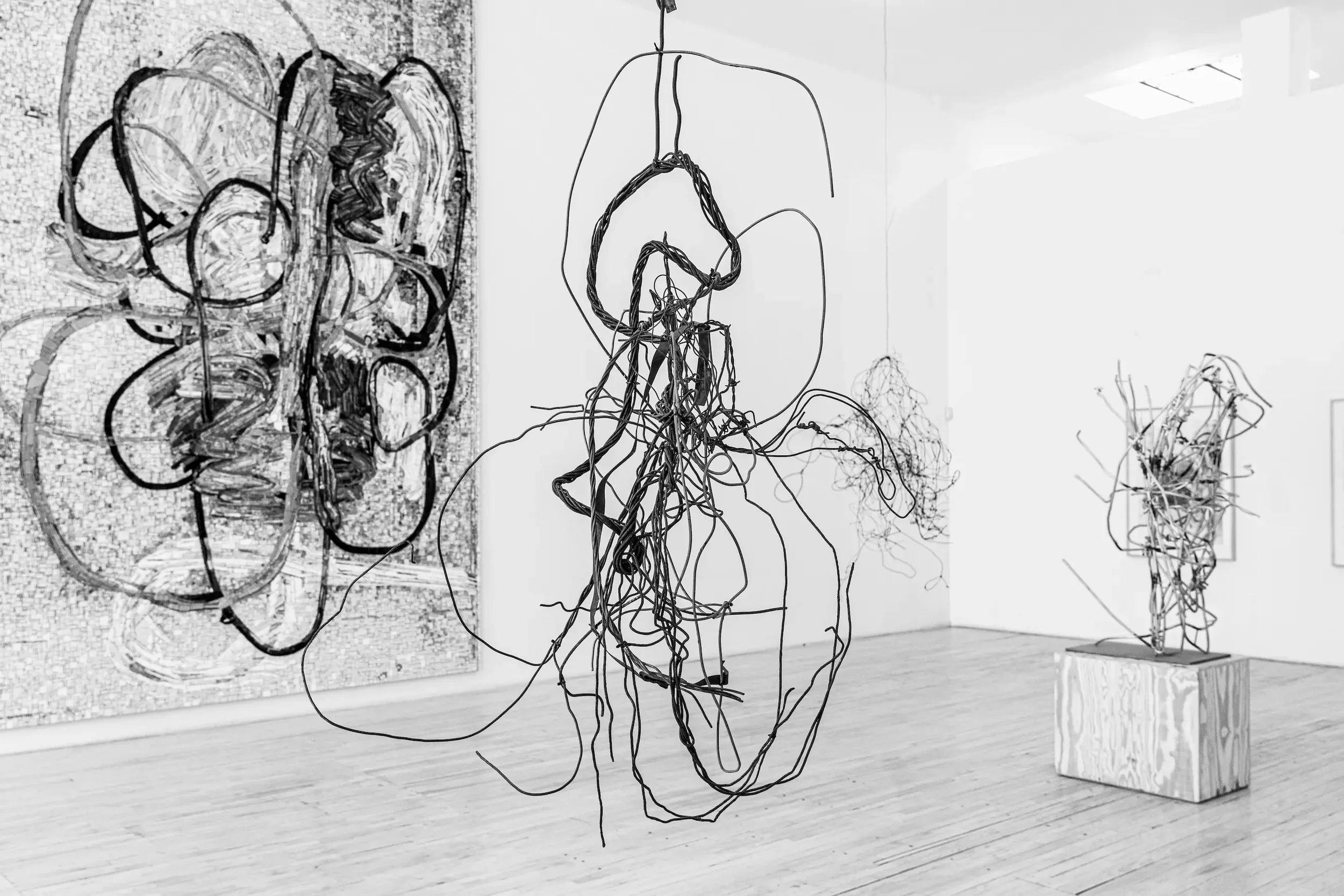
Walking into Christopher Wool’s See Stop Run exhibit in Marfa, you’re first confronted by a massive, spiderweb tangle of cast pipes. The sculpture sprawls across the center of the room without a clear point of origin: knotted and unruly. It feels like some kind of infrastructural system, rather than a single object, mirroring the subjects that fill Wool’s nearby photographs of old tires, scattered debris, and everything in between. To Wool, the natural world is inseparable from human waste.

The show spans four rooms across two neighboring buildings, holding a mix of sculptures, photographs taken locally in Marfa, and paintings.

When curator Anne Pontégnie first conceived of See Stop Run, she said that she wanted to get away from “the neutrality of contemporary art spaces, galleries, and institutions” and find somewhere in New York City—where the show originally ran—where the work “could interact with something other than a blank slate.” The show’s first iteration took  place in an old, derelict office building in downtown Manhattan, and critics praised how the paintings and sculptures engaged with the space’s cracked floors, exposed wiring, and peeling surfaces, creating what a New York Times critic described as “visual rhymes.”

When the exhibition moved to Marfa in the spring of 2025 and took up space in the Brite Building, the presentation changed. It’s now in exactly the kind of pristine, white-walled space that Pontégnie wanted to avoid. Only one of the rooms contains the same wildness as the New York show, and this has the impact of lessening the dialogue between Wool’s work and its surroundings from shouts to whispers.

Courtesy of Christopher Wool

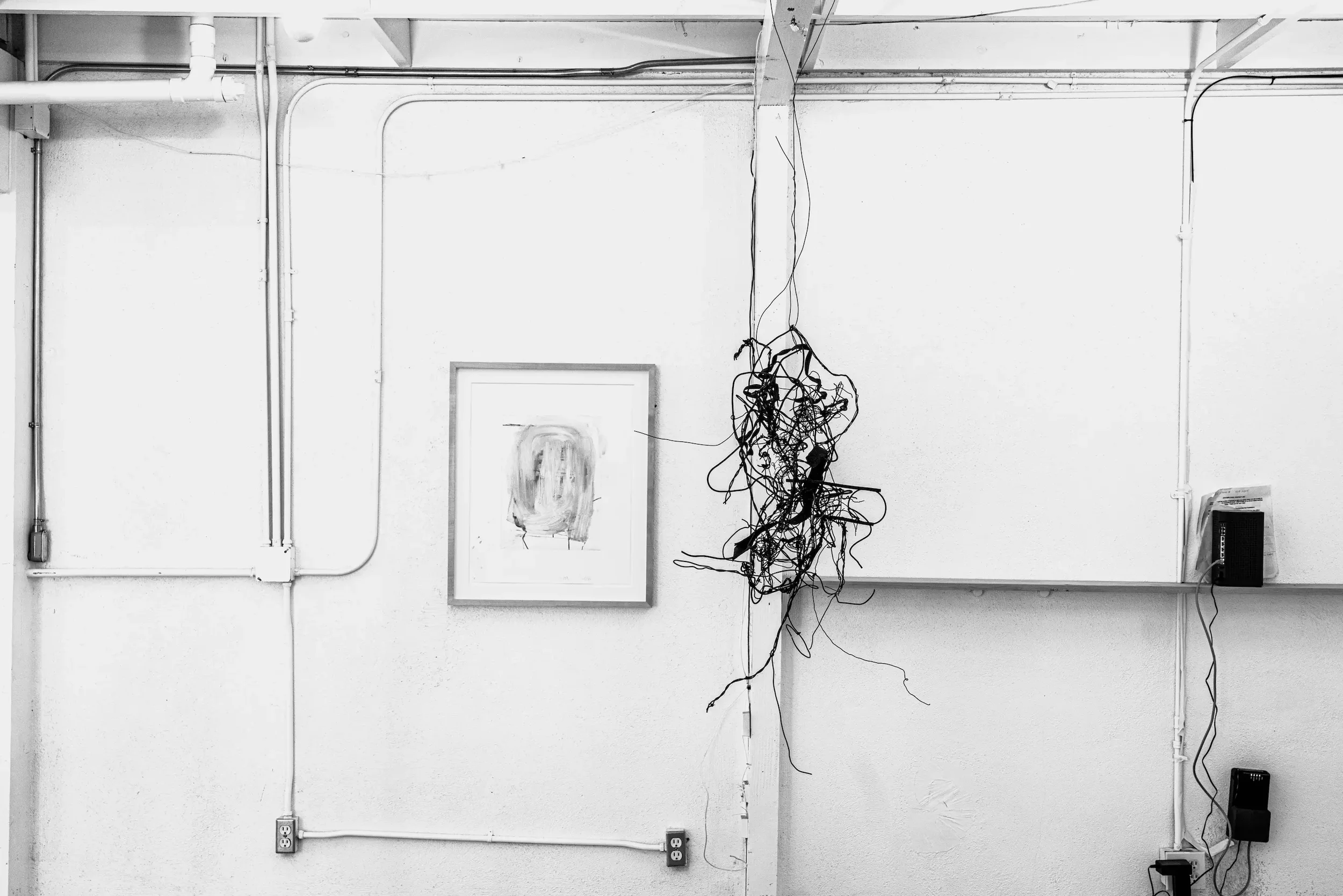
The exhibition here in Marfa is thoughtfully curated, but it doesn’t feel accurate to describe it as controlled chaos exactly, because what makes Wool’s work so compelling is how little it wants to be controlled. Most of the show does unfold in white gallery walls, but one room upstairs has a kitchenette, and another resembles the environment of the original New York show. Here, there are holes left behind by old nails and cracks in the floors. The wear and tear of the building—alongside the refrigerator and sink—feels as meaningful as the art itself because Wool’s work never seeks to dominate the space; it only asks to live in it. 

One of the clearest examples is a wiry sculpture suspended from the ceiling, held by a black cord looped over a silver hook. It’s not immediately apparent where the artwork ends, and the means of display begins. Is the cord a part of the sculpture or just what’s holding it up? Wool seems to be testing the limits of his own work.
If a wire slipped loose or the floor cracked underfoot, or perhaps if one of his hanging sculptures fell to the ground, that wouldn’t change anything. It might even add something. And even though the Marfa iteration of See Stop Run offers less in terms of its setting, it ultimately delivers something even more compelling.

Courtesy of Christopher Wool

Courtesy of Christopher Wool

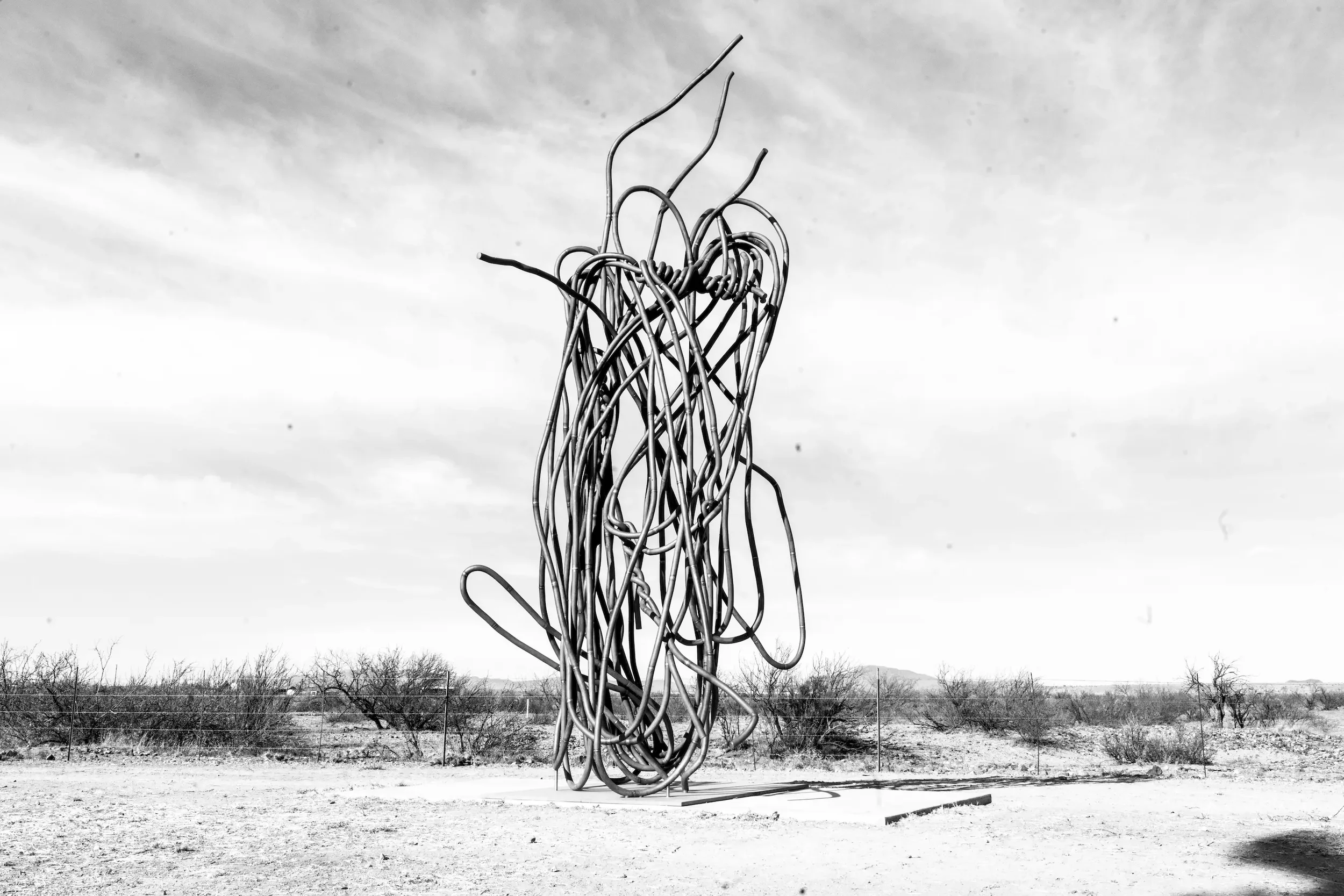
This comes in the form of three outdoor sculptures, which require a short drive to see, that feel like both the show’s natural conclusion and its highlight. Placed directly in the Chihuahuan desert, the works move forward from interacting with artificial space into dealing directly with the natural world as it is.

The steel forms resemble things already scattered across the landscape— tumbleweeds and tree roots and branches—but unlike the natural parallels, these ones don’t move or decay. Gazing at them, you can feel the human hands that meticulously crafted them. And meanwhile, the real desert continues its course all around them, indifferent. The sun rises and sets. The mountains stand tall.

In this way, Wool sets up a confrontation between two kinds of being: the natural world, which is alive precisely because it changes and dies, and his hand-crafted sculptures, which can endure only by refusing to be part of that cycle. Standing among these works as the wind forcefully blows and the Texas sun beams, you hover between these two modes of existence: the steel that combats mutability and the real, organic matter that changes, blows away, disappears.

See Stop Run is on view through Spring 2027 in the Brite Building, Marfa, Texas.

A Look Through the Monocle: 100 Years of The New Yorker @ The New York Public Library

A Century of The New Yorker by The New York Public Library, The New York Public Library, 2026. Photo: Isabella Bernabeo.

text and photographs by Isabella Bernabeo

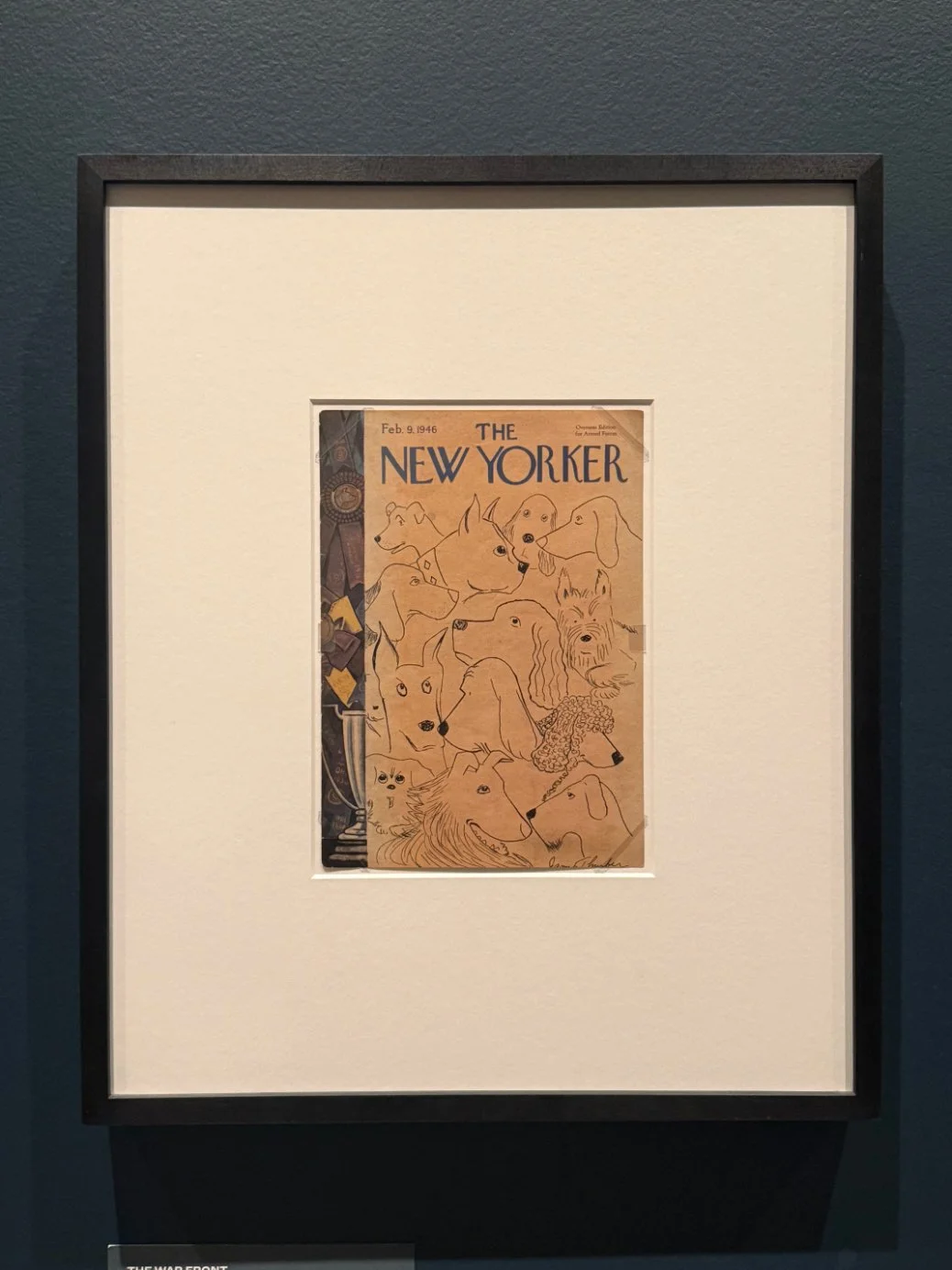
In honor of the iconic magazine’s 100th anniversary, the New York Public Library presents A Century of The New Yorker. Beginning in the light blue wallpaper-covered Rayner Special Collections Wing, visitors are fully immersed in the story of how The New Yorker came to be. High along the walls, the periodical’s most notable covers line the crown molding from end to end. 

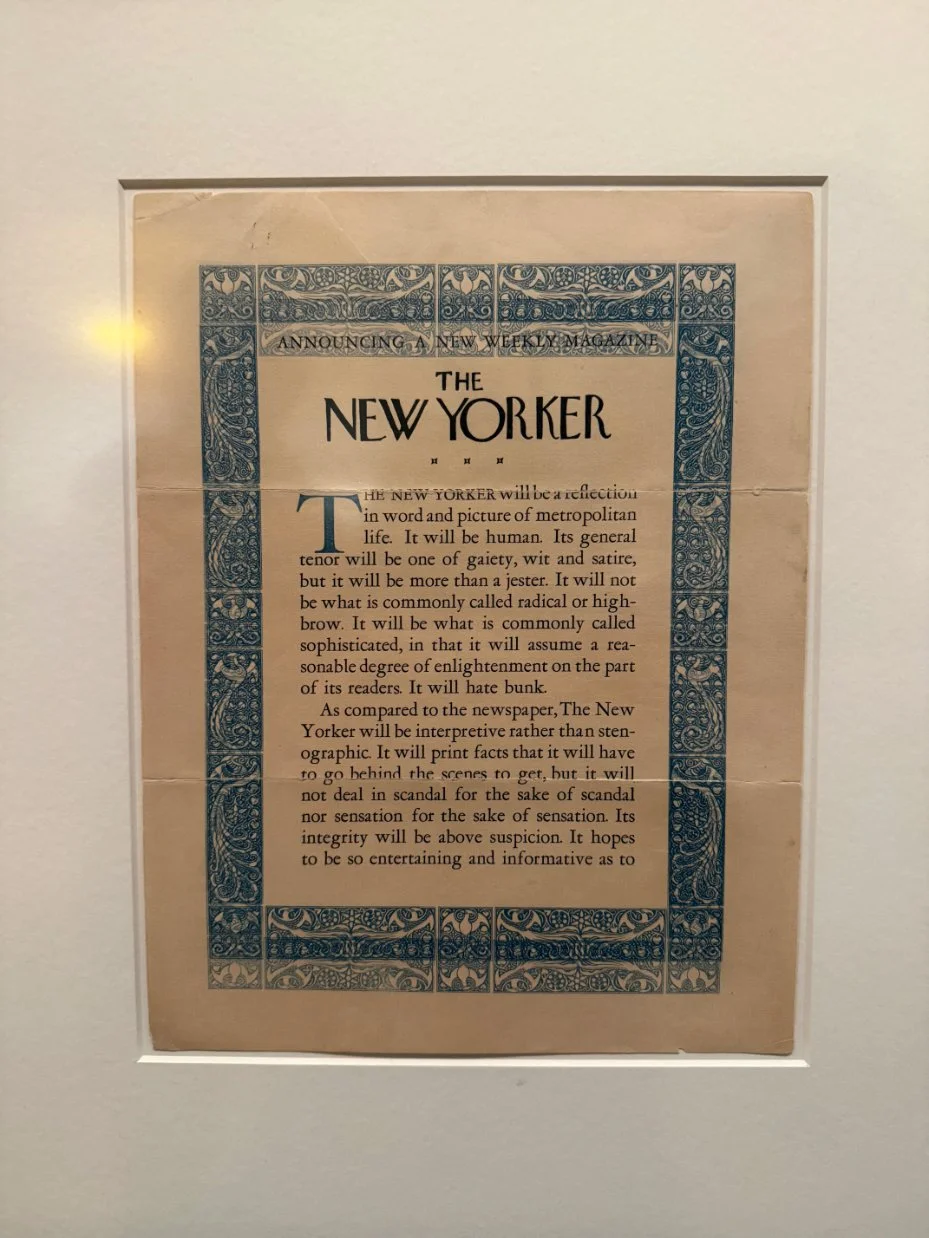
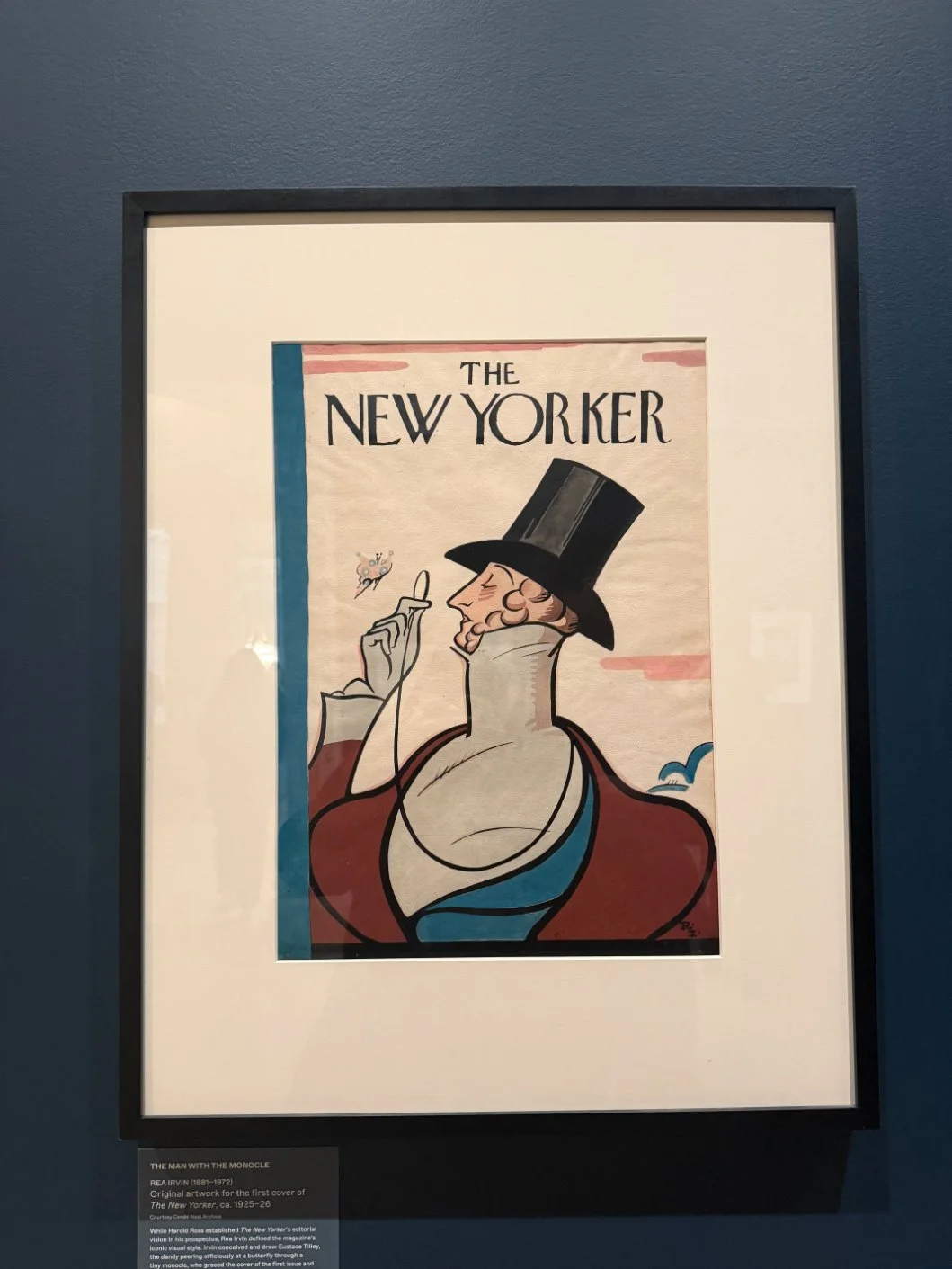
The first section of the exhibit, titled “Beginnings,” opens with the story of husband and wife Harold Ross and Jane Grant launching The New Yorker on February 21, 1925, with the original cover illustration by art editor Rea Irvin—the progenitor of Eustace Tilly aka “The Man with the Monocle.” Through the monocle, Tilly stares at a pink-and-purple butterfly flying about, and with this subtly defiant gesture, a semiotic celebrity was born, thus codifying the magazine’s righteous charge in the pursuit of erudite musings. Here we also see The New Yorker prospectus, written in 1924, where Ross famously declared, “The New Yorker will be the magazine which is not edited for the old lady in Dubuque.” While one might argue this is a hilariously serious sentiment, Ross made his intent to edit a weekly for the unapologetically intellectual.

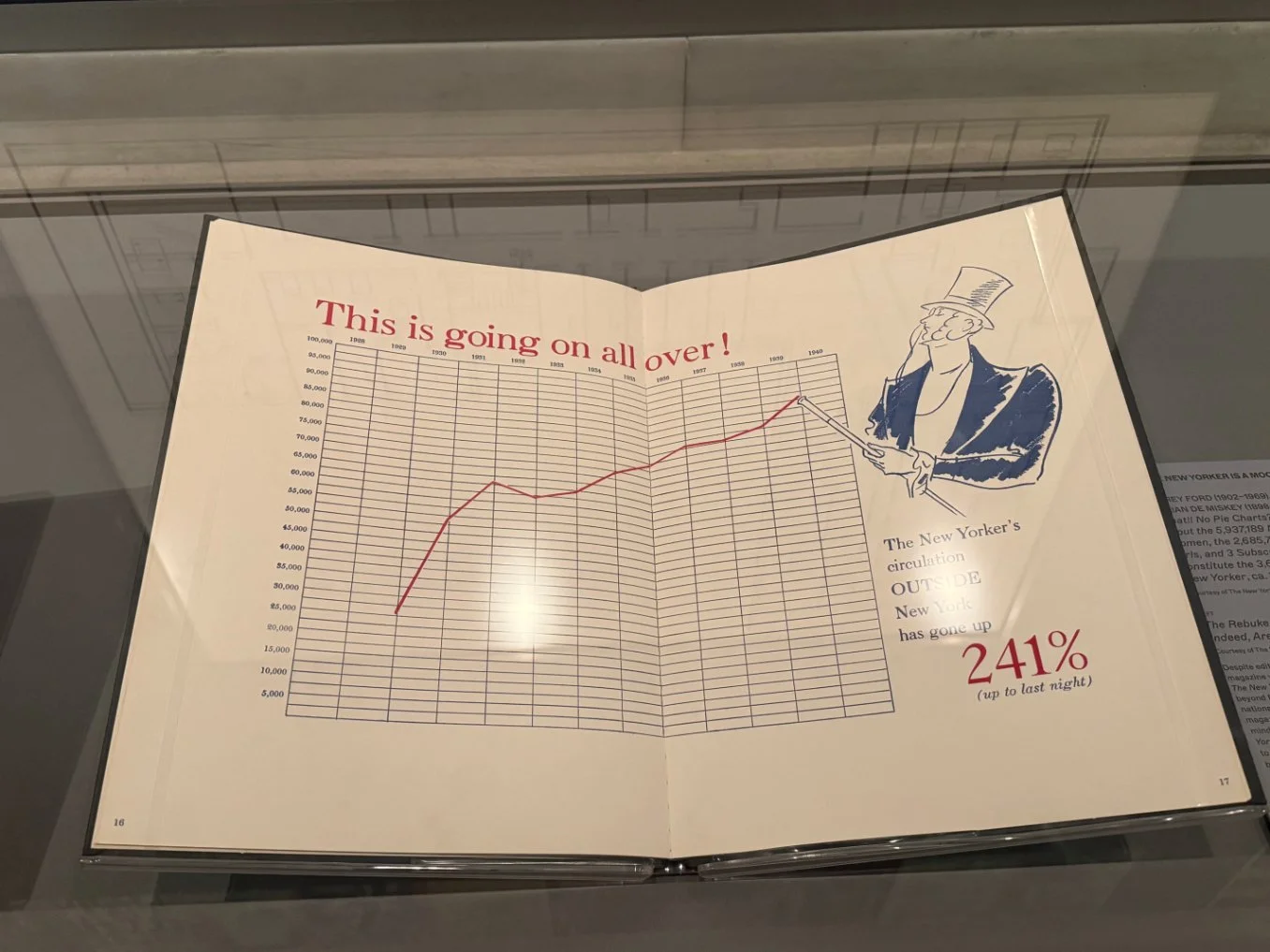
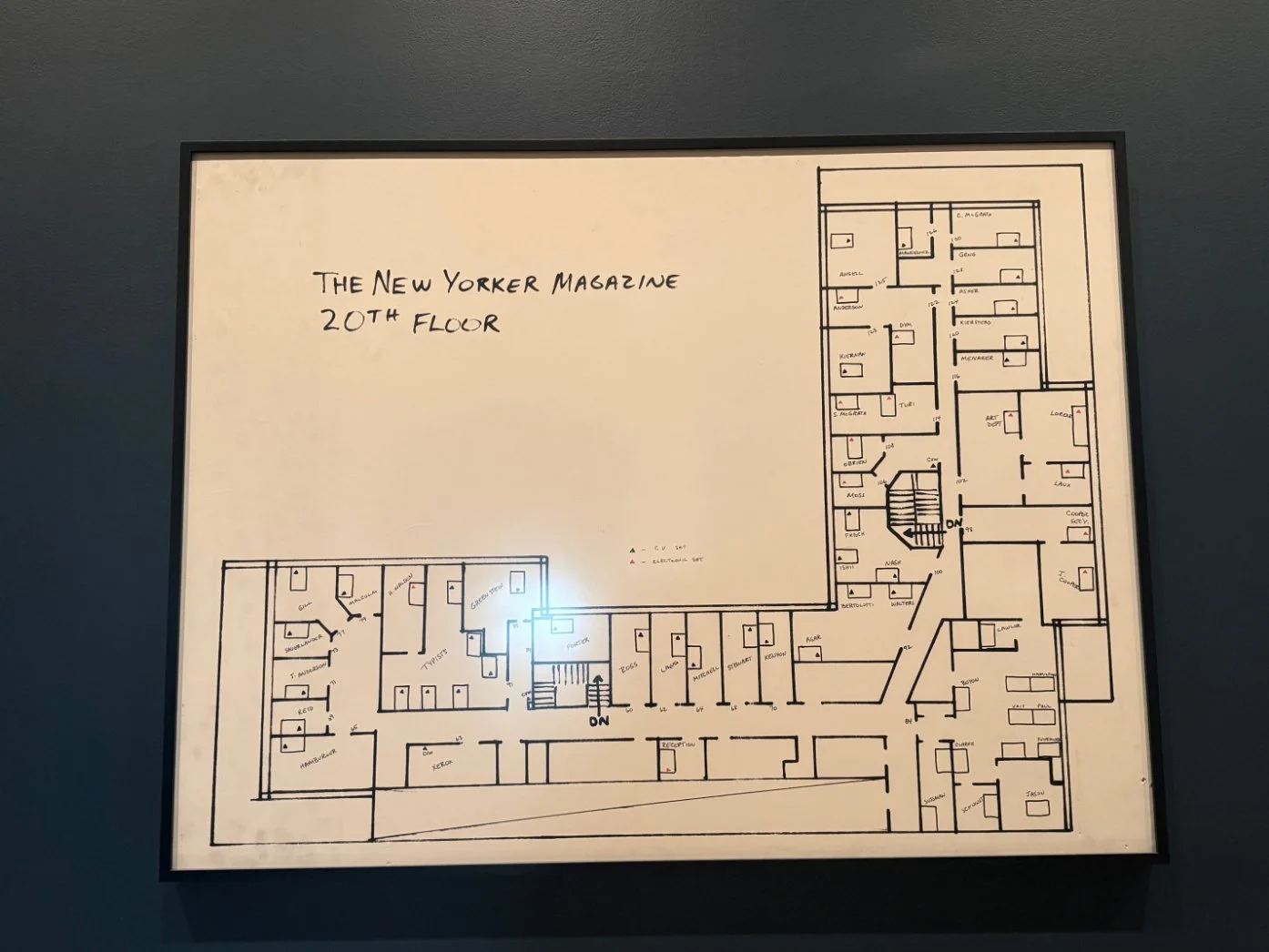
The second section, titled “Anatomy of a Magazine,” features a drawing of The New Yorker’s 20th floor, with names of editors, artists, and more in their respective offices; a remarkably humble team as compared to the current media juggernaut. There are even charts displaying the gradual rise in readership outside of New York from 1930 to 1939, which states, “The New Yorker’s circulation outside New York has gone up 241% (up to last night).”

One of my favorite pieces within this section is from 1927, when the magazine published a profile of the notorious feminist poet Edna St. Vincent Millay that was riddled with errors. Millay’s mother wrote a letter to The New Yorker complaining about the falsehoods, which Ross later published under the title “We Stand Corrected.” Later, in 1970, fact-checker Anne Mortimer-Maddox made a hand-sewn banner featuring Eustace Tilly on the phone with the Latin phrase “Non omnis error stultitia est dicendus,” which translates to “Not every error is folly.” This banner has hung in the fact-checking department ever since, along with a sign that reads “Better perfect than done,” emphasizing their commitment to responsible journalism and correcting their errors.

A Century of The New Yorker by The New York Public Library, The New York Public Library, 2026. Photo: Isabella Bernabeo.

The third section, “The New Yorker Makes Its Mark,” shares the prolific rise of the magazine during the 1930s and 1940s when they acquired numerous well-known writers and artists as contributors, in addition to its vanguard coverage throughout the Second World War.

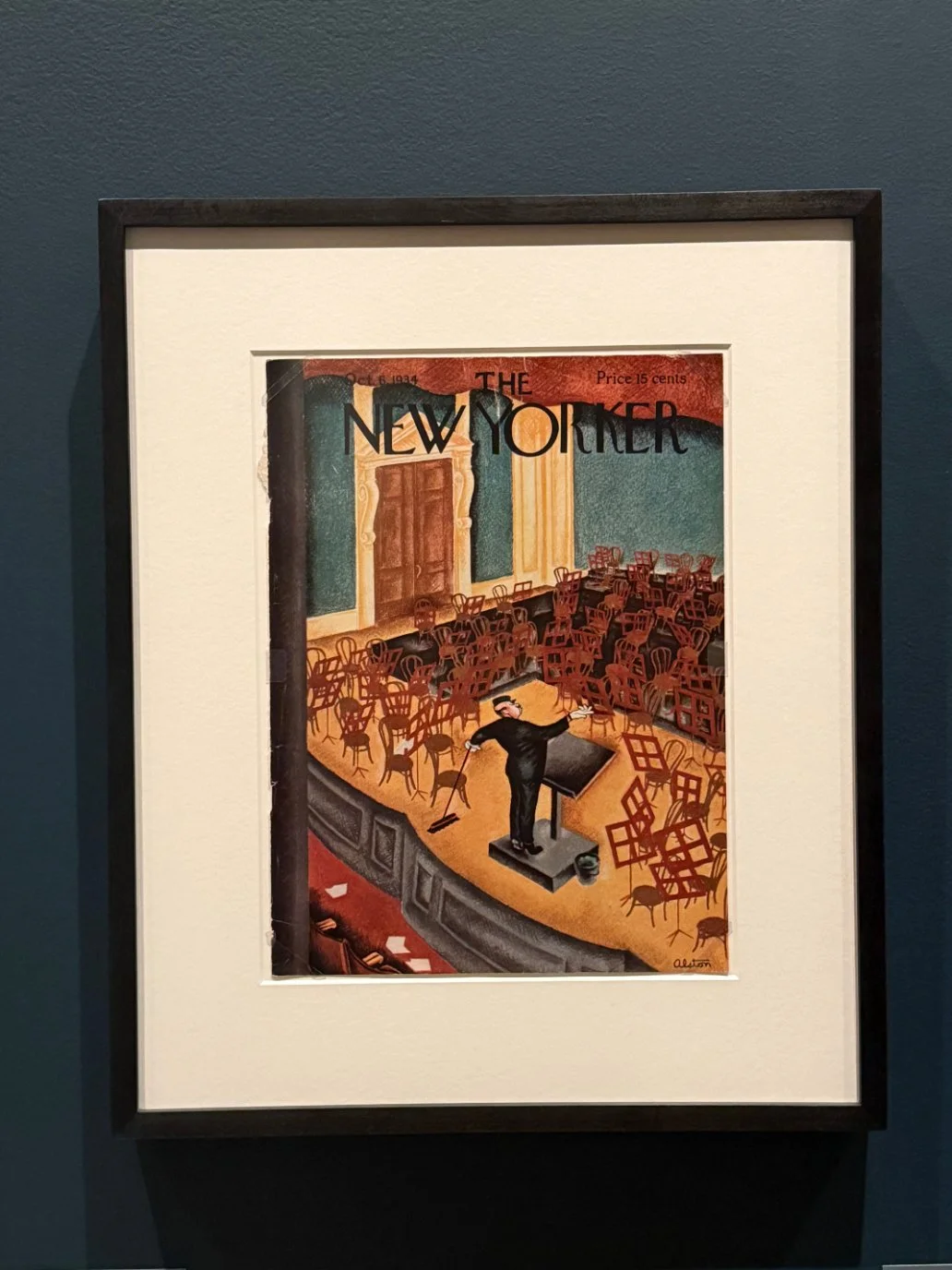
On October 6, 1934, Charles Henry Alston, one of the magazine’s first Black artists to illustrate the cover, drew a janitor conducting an empty orchestra, wielding a mop as his baton. Chairs are thrown everywhere, yet no one else is seen, emphasizing the ubiquity of human ambition, the realization and sharing of which is often only afforded to the privileged few. Alston’s work centered on the Black artists working behind the scenes, who seldom received the credit or fruits of their labor. The New Yorker at this time was mainly made up of a white staff who wrote and drew for white readers; however, this inclusion represented a small stride forward in their stutter-stepping evolution.

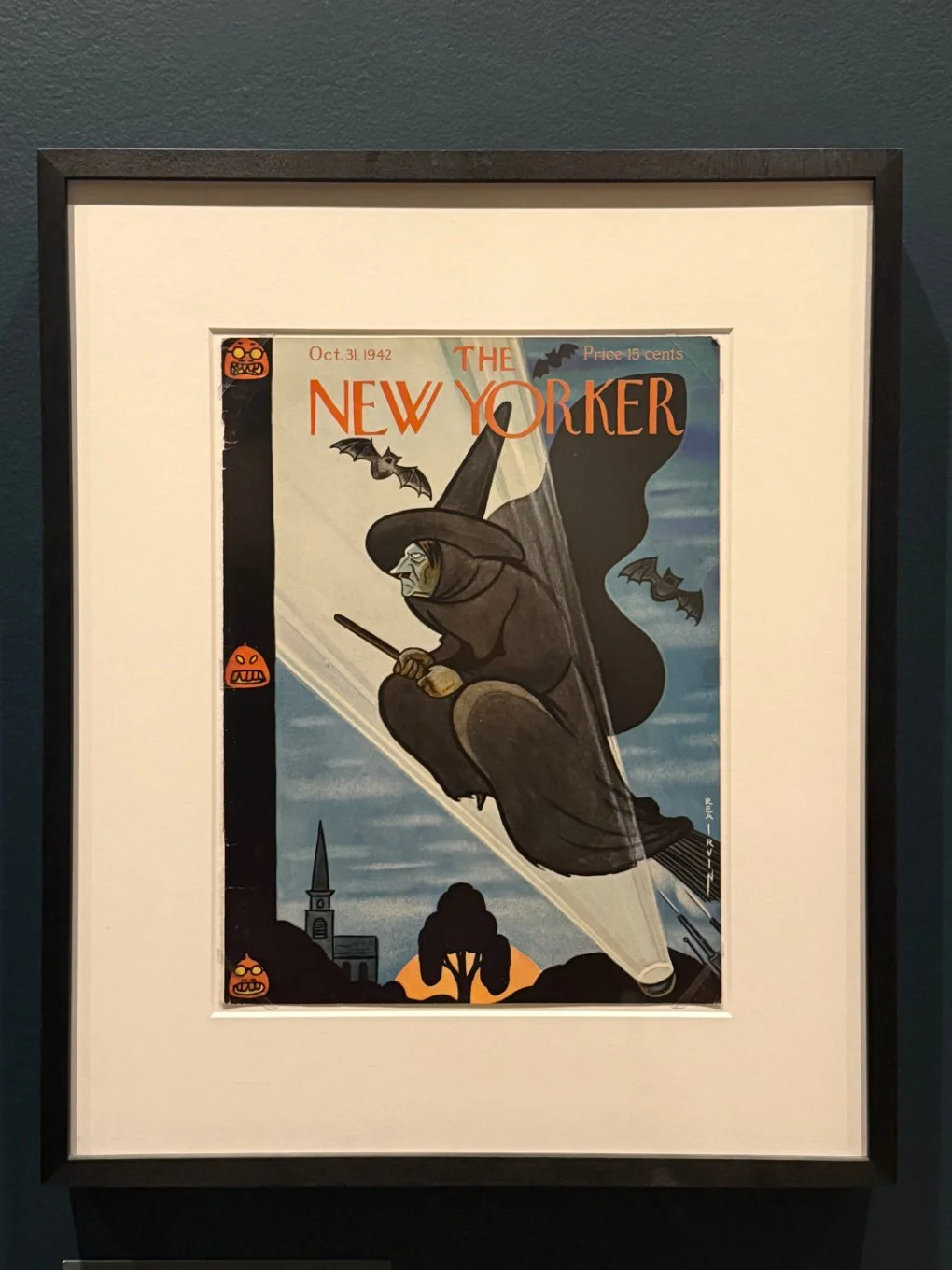
Another notable cover was from The New Yorker’s Halloween edition in 1942. Rea Irvin drew Adolf Hitler as a green-skinned, wicked witch flying in the sky on a broomstick. Ross had typically avoided publishing public figures on the magazine’s cover, however, that was not what made it problematic. The backlash was in response to the three jack-o-lanterns depicted with stereotypically Asian features, othering them as the enemy for siding with the Axis powers. This was also an era rife with racist images of the Japanese that aimed to justify their imprisonment in US internment camps. 

In 1943, The New Yorker began publishing miniature editions of its magazines and sending them overseas for US troops to read. By the end of the war, these miniature editions had circulated more than their standard magazine, leading to their next generation of readership largely belonging to the US military folks.

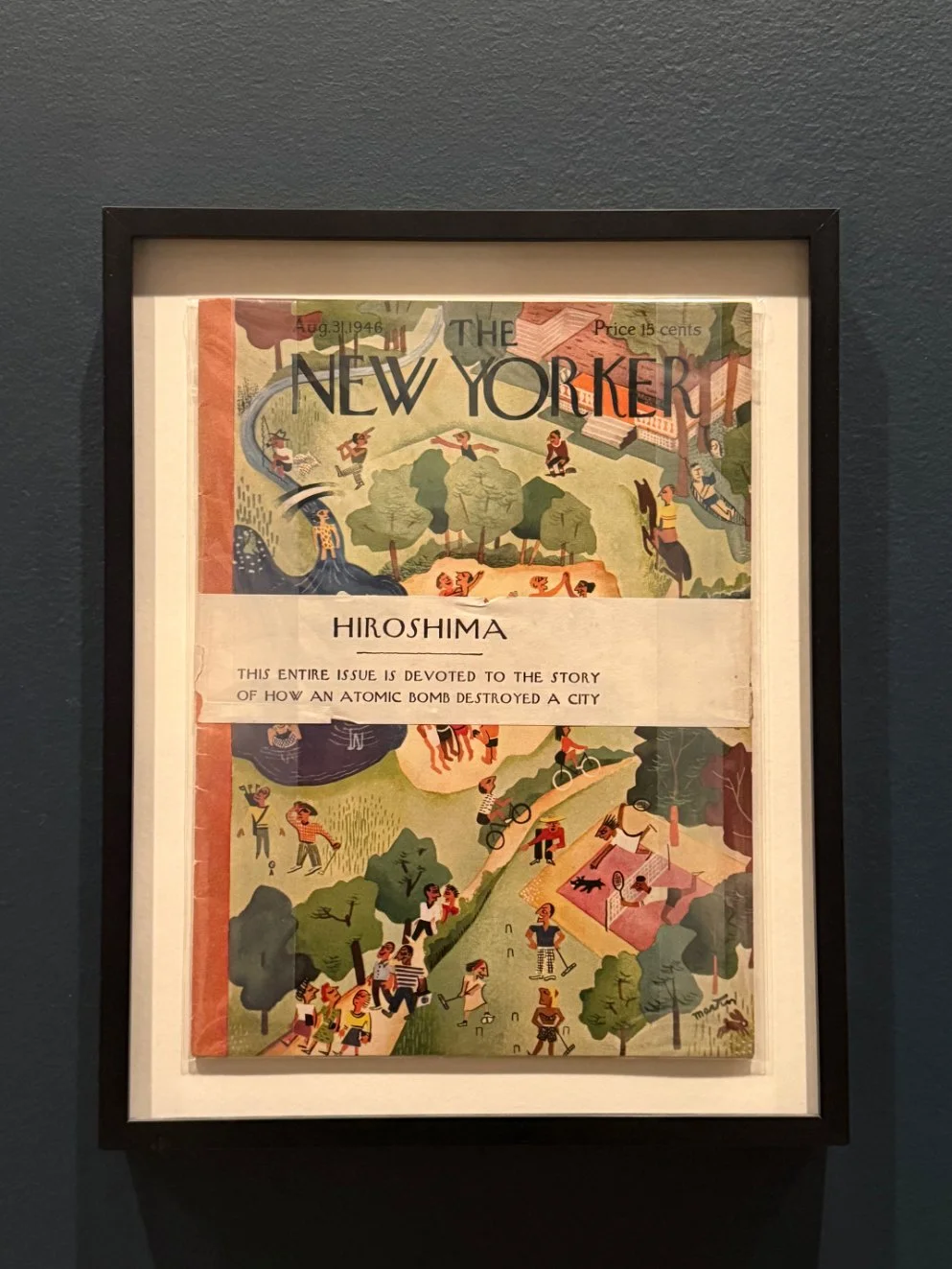
Perhaps the most consequential issue of all time was released on August 31st, 1946, which comprised a single 30,000-word story by war journalist John Hersey detailing the gruesome impact of the atomic bomb on six survivors in Hiroshima. The issue, which sold out within hours, was published with an obi band that stated, “This entire issue is devoted to the story of how an atomic bomb destroyed a city,” however most readers discarded this band, and today, there are almost no known issues that are fully intact.

Continuing across the hall to “The Story of the Century,” the fourth section focuses on Ross’s death in 1951 and on his successor, William Shawn’s, development of a new wave of nonfiction storytelling. One of the most famous issues from this time period was the June 23, 1962, edition, where Rachel Carson’s Silent Spring was first serialized before it was later published as a full book. The cover depicted a whale in the ocean with a seagull on its head as an abstraction of ice melting in the background. Carson’s Silent Spring brought to light the dangers that humans have caused to the environment, specifically through the pesticide DDT, leading to the birth of the environmental movement and the establishment of Earth Day in 1970.

A Century of The New Yorker by The New York Public Library, The New York Public Library, 2026. Photo: Isabella Bernabeo.

The fifth section, titled “A New Era,” details how the global media corporation Advance Publications, Inc. bought The New Yorker in 1985 due to ongoing financial struggles. Chairman S.I. Newhouse promised that the magazine would maintain its editorial independence, but believed it was in desperate need of new leadership to effect a fresh and modernized change, leading to his replacement of William Shawn with esteemed book editor Robert Gottlieb in 1987.

However, this change in leadership was met with strong defiance and backlash from the magazine’s staff, who believed Shawn had been a worthy editor and should carry on. These feelings ran so deep that the magazine staff wrote a letter to Gottlieb urging him to withdraw his acceptance of the position. They signed off the letter with their names, line after line, largely lengthening it and underscoring that he was an unwelcome leader. However, this letter did not change his decision. Gottlieb’s leadership at The New Yorker was brief but effective, as he introduced transparency between departments that had been lacking; however, he failed to keep the staff happy and the magazine evolving.

A Century of The New Yorker by The New York Public Library, The New York Public Library, 2026. Photo: Isabella Bernabeo.

When Gottlieb left in 1992, he made way for Tina Brown, former editor of Vanity Fair, to modernize The New Yorker. This switch in editors was an extremely radical cultural shift at the time, as her background enabled her to bring more celebrity and pop culture-based news to the magazine, attracting a new set of readers. However, Newhouse disagreed with the approach the magazine was headed in, as he sought for The New Yorker to keep its traditional prestige as compared to the flashier era that Brown brought in. Brown ultimately left The New Yorker in 1998 due to these ongoing tensions, causing Newhouse to appoint the magazine’s current editor, award-winning journalist David Remnick who has expanded the magazine into its current multimedia era and allowed subscriptions to keep their finances high instead of their previous ad-dependent approach, leading into the sixth and final section of the exhibit, titled “The 21st-Century New Yorker.”

The internet caused great concern for The New Yorker, as it did for many other publications, over how they would survive in the online world. However, this new era also led the way for the publication to further diversify its staff and publish works on important political topics. 

A Century of The New Yorker by The New York Public Library, The New York Public Library, 2026. Photo: Isabella Bernabeo.

Viewers get an inside look at the evolving office space where the magazine is made. The office moved in 2015 from 20 West 43rd Street to One World Trade Center and has become much more lively in an effort to mature from a simple workspace to a true community. People dash around the open floor plan to meet with other departments, and there are now spaces to relax, eat, and take breaks, fostering a much healthier community than that of the 20th century.

A Century of The New Yorker by The New York Public Library, The New York Public Library, 2026. Photo: Isabella Bernabeo.

Another flashback is a riff from Irvin’s first cover made on March 6, 2017, by artist Barry Blitt. It features Vladimir Putin as Eustace Tilly, looking through his monocle at a butterfly with Donald Trump’s face and the logo spelled out in Russian. A clear indication that Remnick has no qualms with placing public figures on covers. If World War II has taught us anything, it’s that American foreign policy is not an issue that the media can afford to ignore.

However, Eustace Tilly, redrawn as Putin, is one of many symbols that The Man with the Monocle has come to represent. Since its inception, The New Yorker has used Eustace Tilly to embody numerous ethnicities and genders. It has grown into a magazine where writers and artists of all ages and identities are invited to contribute to unabashedly studious discourse without regard for being perceived as pretentious or pedantic.

A Century of The New Yorker by The New York Public Library, The New York Public Library, 2026. Photo: Isabella Bernabeo.

The exhibit is free and available for viewing through February 2 @ the Stephan A. Schwarzman Building, 476 5th Ave.

Otherwise Part IV: Operational Aesthetics: Dopaminergic Media, Deepfakes, CoComelon, the Kardashian–Jenner Conglomerate, and the Long Tail of the CCF


From the White House X account


by Perry Shimon

Following the previous essay, we find that while in the more contemplative corners of the contemporary art world, spatialized philosophical questions endeavor to idiosyncratically suture the anomic wounds of modernity, the more statistically significant mode of visual culture today can be primarily understood as operational (in a less philosophical sense): media produced and instrumentalized through computational vectors with clearly defined goals—largely financial, increasingly automated, and frequently without the necessary involvement of human agents and audiences. The late artist and theorist Harun Farocki offered the concept of operational images to describe images functioning beyond the concerns of representation and spectatorship, which perform operations most consequentially in service of corporate and military interests. This can include security applications, industrial automation, data-driven governance, and automated warfare.

Massive infrastructures supporting the teleological and operationalized image have proliferated since the time of Farocki’s initial conceptualization, and the concept is useful today in describing the vast networks of algorithmically governed visual culture transacted via monopolized social media platforms trafficking in attentional, behavioral, and data-extractive economies. This choreography of operational media within platform capitalism, along with the internalization of the imperatives of attentional economies, shapes our visual culture to a critical extent. Much of the media encountered in increasingly hyperspecified algorithmic operations serves the function of commanding attention, producing commoditized data, generating clicks, realizing advertising revenue, and steering behavior. Images today look back at us, collect intimate information, and act insidiously on that information toward financialized ends.

Sophisticated behavioral industries, built with a scientific rigor almost entirely unmoored from ethical considerations, have contributed to a neurochemically calibrated form of dopaminergic media deployed to addict users. In some cases, particularly among vulnerable demographics such as children and teenagers, users become so chronically habituated to these technologies that they spend the majority of their free time subjugated to them. A consequential and compounding quantity of media today operates at the level of addiction and compulsion.

The exponential rise of data-powered operational media exhausts human-scale consideration, and an opportunistic market endeavors to capitalize on the datafication of the world through ever more energy-intensive infrastructural projects for the capture and processing of data. This creates a Jevons Paradox of compounding energy usage, wherein even technological gains in efficiency do little to stymie the energy expenditures produced by further adoption and intensified use. In the name of data rationalism, its questionable promises, and its primary function of capital accumulation, enormous, extractive, and ecologically ruinous infrastructures are being imposed on the public to our collective more-than-human detriment.

Through the abstracted logics of datafication, we are given quantified glimpses into an ecological polycrisis initiated by the same base economic structures and technologies of administration at work in the monopolization of the internet. It stands to reason that the driving forces of social and ecological devastation—limitless growth-based economies, carbonized energy infrastructures, animal agriculture, automobilism, and so on—are not suffering from a lack of data (or from the massive energy-intensive private data infrastructures required to datafy the world) in order to remediate them, rather from a lack of political and social will, as well as the redeployment and redistribution of rights and resources.

The Kardashian–Jenner conglomerate

The Kardashian–Jenner conglomerate offers a generative case study of an operational aesthetics built on a distinctly liberal, capitalist hypersubjectivity broadly enacted through social and traditional media to market goods primarily produced in industrial and plantation modes. The fetish of liberal subjectivity is superarticulated in their performative, pharmacological, and surgical construction of the fully commoditized and optimized self, and their branded subjectivity is leveraged into endless variations of products, promotions, and other forms of capitalization. The Kardashian–Jenner conglomerate maintains a highly integrated, multiplatform, cross-industry portfolio spanning beauty, cosmetics, fashion, fragrances, jewelry, accessories, food, beverages, health, wellness, media, technology, home, lifestyle, brand collaborations, and luxury partnerships—a Gesamtkunstwerk of neoliberal operational aesthetics.

CoComelon

CoComelon, the second most viewed YouTube channel in recent years—purchased by a Blackstone-funded “next generation media company” founded by former Disney executives for three billion dollars and now part of a vast conglomerate churning out dopaminergic children’s content—provides an instructive case study of profit-motivated operational media targeting children at the earliest stages of development. In this case, the primary operations at work are the capture of children’s attention to earn advertising revenue for host platforms, the securing of streaming deals, spin-offs, merchandise, licensing, or IP franchises, and the training of emerging generations of lifelong consumers. In Jia Tolentino’s 2024 reporting, we are given a snapshot of a capital-fueled children’s content mill garnering sixty billion minutes of YouTube streams in the first quarter of 2023, while lead writers earning barely livable five-figure salaries in Los Angeles are laid off during restructuring exercises. This provides yet another example of the trajectory of unregulated capital in its ruthless expropriation of labor and drive toward market domination—exploiting and automating its own means of production wherever possible while remaining fiduciarily bound to the expansion of children’s attention capture and potential profits.

It remains to be seen what regulatory measures, if any, will be implemented to safeguard children from content designed to capitalize on their biologically evolved dispositions through a hallucinatory sensorium of increasingly machine-generated nonsense. This logic of “optimized engagement” holds across nearly every feature of platform capitalism: from search to social media, and of course e-commerce. The result is an arms race for attention, while a staggering portion of the technologized world has developed acute addictions to dopaminergic media and attendant psychosocial maladies, increasingly acquiescing to the behavioral imperatives of the animating marketers. We might add technologically administered dopaminergic media to opium and sugar on the list of the most widely deployed and socially debilitating drugs distributed by multinational corporations.

The Vatican, Caleb Miller for Unsplash

Anna Church for Unspash

Operational media—media intended to produce particular outcomes in their audiences—is, of course, hardly unprecedented. In the Western tradition, the aesthetic regime of Christianity, with its architectures, crosses, paintings, icons, elaborate clothing, and rituals, accompanied and legitimized perhaps the most extensive imperial bid for global power in human history. The extraplanetary global infrastructure of the internet constitutes an epochal development at an unprecedented scale and the culmination of the so-called Western project in the United States marks the most powerful imperial empire to date.

It is instructive to examine the cultural methodologies of American imperialism during its twentieth-century bid for global hegemony. The Congress for Cultural Freedom (CCF)—a CIA-adjacent organization that at its height in the 1950s and 1960s operated in over thirty-five countries, founded or sponsored more than twenty journals, organized hundreds of conferences, and exerted influence over university departments, literary prizes, translation programs, arts councils, research institutes, and institutional collecting practices—became a primary instrument of liberal imperial soft power. It was among the most influential cultural apparatuses of its era, shaping global definitions of “freedom” through culture and ideas while promoting a liberal conception of individuality and a distrust of socialist forms of art and collective solidarity. Its strategies were complex and often involved the selective embrace of left or socialist positions in order to inoculate audiences and neutralize political power. The paradigm of the lone genius artist, disavowing collective politics and hyperfixated on identity, was bolstered through this coordinated international network and remains dominant today.

It is worth considering which legacies and continuations of these initiatives persist, whether analogous programs remain operative, what values and strategies they advance, and which foundations, institutions, and artists administer them.

In my ambivalent proximity to the art world, I have observed recurring motifs from the liberal project alongside emerging practices that raise questions about their ubiquity and reproduction along vectors of liberalization. These may be provisionally grouped into a schematic that resonates with the CCF program: hyperindividual, hypernormal, science-fictional, ornamentalist, obscurantist, and melodramatic.

Juliana Huxtable

The hyperindividual artist presentation foregrounds the extreme articulation of performative selfhood, often positioning the artist’s own identity as the artwork or producing highly idiosyncratic series that emphasize individual distinction. The American artist, writer, performer, DJ, and cofounder of the New York–based nightlife project Shock Value, Juliana Huxtable, offers one example among many.

The hypernormal, following Adam Curtis’s 2016 documentary HyperNormalisation, is characterized by the production of unrelenting misinformation, misdirection, co-option, distortion, and overwhelm. The result is a paralyzed, passive, consumer-oriented subject incapacitated by epistemic exhaustion. An e-flux text describing Trevor Paglen’s 2023 film Doty illustrates this condition:

Richard Doty is a former Air Force Intelligence operative whose job at Kirtland AFB in New Mexico involved creating and disseminating disinformation about the existence of extraterrestrial spacecraft to UFO researchers.

In the late 1970s and early 1980s, Kirtland AFB was home to a wide range of highly classified technology experiments involving lasers, stealth aircraft, and nuclear weapons. Strange phenomena in the skies above the base piqued the interest of amateur and professional UFO investigators. Doty’s job was to recruit UFO researchers to be informants to the Air Force about goings-on in the UFO community and to spread military disinformation about UFOs among their peers. To accomplish this, Doty supplied fake documents to UFO investigators purporting to tell the “truth” about government involvement with extraterrestrials.

On the other hand, Doty insists that UFOs are real, that the government is in possession of crashed spacecraft, and that he was read into a top-secret military program detailing the history and status of US-alien relations.

In this video, Doty discusses the craft of disinformation, and describes operations he ran against UFO researchers as well as elements of the “real” top-secret extraterrestrial technology program that he says continues to this day.

The film was presented as part of a tour he called "YOU'VE BEEN F*CKED BY PSYOPS: UFOS, MAGIC, MIND CONTROL, ELECTRONIC WARFARE, AND THE FUTURE OF MEDIA" The experience of encountering this work, like much of today’s hypermediated political spectacle, is one of profound confusion and apathy—an affective state that serves a political function in maintaining the status quo and creating a climate of confusion and paranoia.

A proliferation of science-fictional futurisms is institutionally supported across the liberal art world today—Afrofuturisms, Latinx Futurisms, Indigenous Futurisms, Arab and Gulf Futurisms, Sinofuturisms, Queer Futurisms, and others. While these movements are heterogeneous, common tendencies emerge: highly aestheticized, idiosyncratic, and performative representations of essentialized identities produced by professional artists within liberal institutions. These speculative scenarios rarely articulate concrete political demands or enduring institutions, raising questions about how the commodified spectacle of identity representation serves existing power relations as well as the artists who perform them.

Neon Wang for Unsplash

A frequently cited instance of CCF Cold War cultural politics is the celebration of abstract expressionism as a vehicle for depoliticizing art while fetishizing individual self-expression and still, of course, producing an unmistakable series of collectible works. This tendency persists today in the celebration of ornamental art co-emerging with the largest unregulated market in the world. Such works, traded globally, may appear politically anodyne, yet their politics might be better characterized as a form of financialized smoothness, for their ability to move through the circuits of the international art market. The mediagenic immersive installation optimized for social media reproduction can be understood as an outgrowth of these values.

Obscurantism, as used here, refers to the deliberate rendering of historically significant subjects as inaccessible through excessive abstraction, obfuscation, or academic artspeak. This mode is widely recognized across liberal art institutions, where opacity often substitutes for substance.

Melodrama has become one of the dominant narrative forms of late-capitalist culture, not simply as a genre but as a social technology that translates structural contradictions into private emotional crises. In melodramatic storytelling, whether in soap operas, prestige television, or award-winning literary fiction, social conflict is consistently reframed as betrayal, infidelity, moral failure, or psychological damage. Collective institutions appear either absent or corrupt; solidarity is fragile and naïve; and trust is often punished. Structural forces such as economic precarity, class antagonism, or political disempowerment are displaced onto intimate relationships, where they are experienced as tragic inevitabilities rather than as problems open to collective action. This narrative logic produces what Mark Fisher described as a form of capitalist realism: a cultural atmosphere in which social breakdown is endlessly represented yet never politicized, generating a hedonic familiarity and romanticization with fracture that forecloses alternative imaginaries. Social cohesion becomes ever more remote through overexposure to stories in which cohesion is repeatedly shown to be impossible.

Prize culture and elite literary institutions reinforce this dynamic by systematically rewarding narratives that aestheticize rupture, transgression, and psychic damage while treating collective projects as suspect, authoritarian, or artistically naïve. As Frances Stonor Saunders documents in The Cultural Cold War (2000), liberal cultural institutions during the Cold War did not primarily promote positive visions of collective liberal society; rather, they elevated forms of art and writing that foregrounded alienation, ambiguity, and individual moral struggle, thereby positioning collectivism itself as culturally regressive or dangerous. This logic persists in contemporary cultural economies, where awards function as mechanisms of canon formation that legitimate a narrow range of affects and narrative structures. The result is not just the celebration of “dark” or “complex” art, but the normalization of social atomization as depth, mistrust as realism, and betrayal as the basic grammar of human relations. In this sense, melodrama and prize culture operate together as instruments of affective counter-collectivism: rendering collective values implausible within the dominant cultural imagination.

It serves us to more closely examine how operational media—co-emergent with neoliberalism, financialization, platform capitalism, and American imperialism—shapes prevailing conceptions of art and visual culture. By understanding the forces and inertias through which these ideas have come to ubiquity, we are better equipped to look outside and beyond them in the creation of the otherwise.

Otherwise is a series on neoliberal contemporary art and its unbounded remainders by Perry Shimon.


Otherwise Part V: Landscape Aesthetics and the Liberal Commons


Herndon & Dryhurst's "Starmirror" @ KW Institute for Contemporary Art

Installation view of the exhibition Holly Herndon & Mat Dryhurst–Starmirror at KW Institute for Contemporary Art, Berlin 2025

text by Arlo Kremen

Born in Johnson City, Tennessee, and Birmingham, England, respectively, artist duo Holly Herndon & Mat Dryhurst are two of the art world’s most outspoken figures for AI integration. Having attended Stanford while still being partly based in the Bay Area, Herndon’s continued application of AI models in her musical compositions and artwork remains unsurprising, as is her angle on this burgeoning technology. Partnering with Dryhurst, who has a history of advocating for internet decentralization and involvement in blockchain tech (think NFTs and social tokens), they have advanced discussions of AI through their music releases and installations since 2015. The KW Institute for Contemporary Art is the home for their current show, Starmirror

Inspired by the much-admired Benedictine abbess and polymath from the Rhineland, Hildegard von Bingen, the show trains its attention on synchronicities between AI and the abbess’s own vision of divine order, all while considering the new role of authorship, whose precarity has undergone much turmoil in current AI-related discourse. Starmirror ultimately vies to reconceptualize human-AI collaboration and production, imagining beneficial and innovative relationships between two entities that many find existentially at odds. 

Holly Herndon & Mat Dryhurst with sub
Arboretum, 2025
SLA resin, PETG filament, steel nuts, bolts, and pine wood
Commissioned and produced by KW Institute for ContemporaryArt, Berlin and the Kunstsammlung Nordrhein-Westfalen, Düsseldorf

The first room hosts Arboretum (2025), a sculptural work  entirely concerned with Public Diffusion, an image model reared on publicly owned and Creative Commons Zero images, shaping a foundation model solely on ethically sourced images. Arboretum’s model uses no privately owned or sourced images in its training, a feature of nearly all AI image models. Its dataset is free to access, forming a democratized model without specific ownership.

The artists built PD40M, the largest public-domain dataset to date. Compiled from 40 million, it continues to grow through participation. The Starmirror app prompts viewers to add to the commonwealth of images already accessible to the public in an effort to resist the common perception that AI image models force viewers into a passive position. ‘Slop’ is the thrown-around term used to define the visual excrement of internet aesthetics that AI is famed for producing. Here, AI is posited as capable of producing something greater than lowest-common-denominator symbols. Instead of being the receiver of information, the human becomes the feeder, using AI to decode and visualize patterns within shared human activity. This model necessitates escaping the algorithm, going outside, and searching. If anyone remembers the screen zombies of the summer of 2016, the Starmirror app is a lot like Pokémon GO, except it is about seeing the world, not collecting clout in a digital landscape. It is AI between technology and the world.

It’s a challenge to see the good in AI. Coming from a political background far outside the tech bubble, conversations around AI and pattern recognition are primarily centered on ICE’s collaboration with Palantir. That, regardless of intention and dedication to constructing a public-supporting commons, this technology will be appropriated and abused by government agencies and private businesses. Data will be bought, sold, and used to incriminate the most vulnerable. Perhaps this is naive, that all this is claimed without key information and the knowledge to differentiate models, and that fear-mongering over AI is possibly dangerous for other reasons. All of this might be true; none of it might be. But, regardless of how one might feel about such hesitations or the positive excitement provoked by the idea of such a work, the images produced by Starmirror, as one might expect, are layers upon layers of endless pastiche. So why is this at the KW institute? Starmirror is not about art. It is not about the capacity and ability of the image but about making sense of a database. This is where Hildegard von Bingen enters.

At the heart of Arboretum is a layered model inspired by Bingen’s 1151 play Ordo Virtutum. Using neumes (symbols from early Western musical notation) as a base layer, with an overlay of AI scrawlings generated by a model from Algomus, a team of researchers specializing in music modeling, analysis, and creation with AI. Here, the model composes a polyphony to create infinite variations of Ordo Virtutum that seek to pay her tribute by extending her legacy. Of course, the infinite iteration of her work neither pays her tribute nor extends her legacy. Such an approach to the authorship of a woman who died nearly 900 years ago is bizarre, to say the least. The product feels more like a mockery and bastardization than respect. For a play concerning the salvation of the human soul, protecting the soul from the devil who taunts it with worldly pleasures, the construction of a robot Hildegard von Bingen, in a removal of her holy dedication and soul, does nothing other than turn her work into a representation of those very earthly desires with which the devil taunts. The artists appear to care little about the actual work of Hildegard von Bingen, but about how AI can change it, add to it, and what AI can do when her highly interpretable and semi-illegible notation system enters a database.

Installation view of the exhibition Holly Herndon & Mat Dryhurst–Starmirror at KW Institute for Contemporary Art, Berlin 2025

In the main hall, The Ladder (2025) continues the duo’s fascination with the German abbess, who envisioned ladders as hierarchies containing tiers with angels and virtues bridging Earth and the divine. In a convenient synchronicity, computer scientist and psychologist Geoffrey Hinton described machine learning systems’ latent space diagrams, which are based on the stacking of neural networks, from a more foundational bottom to an increasingly complex top, as “ladders of abstraction,” affirming the ladder as a dual referent. In the space around The Ladder, different sounds encroach, charging the hall with the divine. Some works are from The Call (2024–25), a research and development project and exhibition by Herndon, Dryhurst, and Serpentine Arts Technologies; others are from surviving medieval works, some by Hildegard von Bingen herself, but intermixed are AI interpretations of Hildegard’s work. In conjunction with the show, the artists invite the Starmirror ensemble, volunteers, and choirs to visit and  contribute their voices in call-and-response sessions to train an AI choir that is scheduled to debut in the summer of 2026 at the Kunstsammlung Nordrhein-Westfalen in Düsseldorf.
Starmirror, perhaps more than an art exhibition, is a continuation of their experiment. The “art” of the shows is often secondary to figuring out how to coexist with, if not utilize, AI to serve people, not corporations—a highly respectable mission. But to take away a future in which AI might aid human creativity and art-making, at this moment, feels foolish. The show does not demonstrate the same level of care for the image or score as it does for the systems that produce them. So often, the show stressed the collaborative nature of their AI use. All of these folks come and share time, space, and their very bodies with each other and the AI choir they are building. The question that looms over the show: how is training an AI choir any more communal than the traditional choir? What is the difference in the aggregation of voices and beings other than the displacement and invisibility of the body?


Starmirror is on view through January 18, 2026 @ KW Institute for Contemporary Art, Berlin.

Complicated Patterns: Read an Interview of Ian Davis


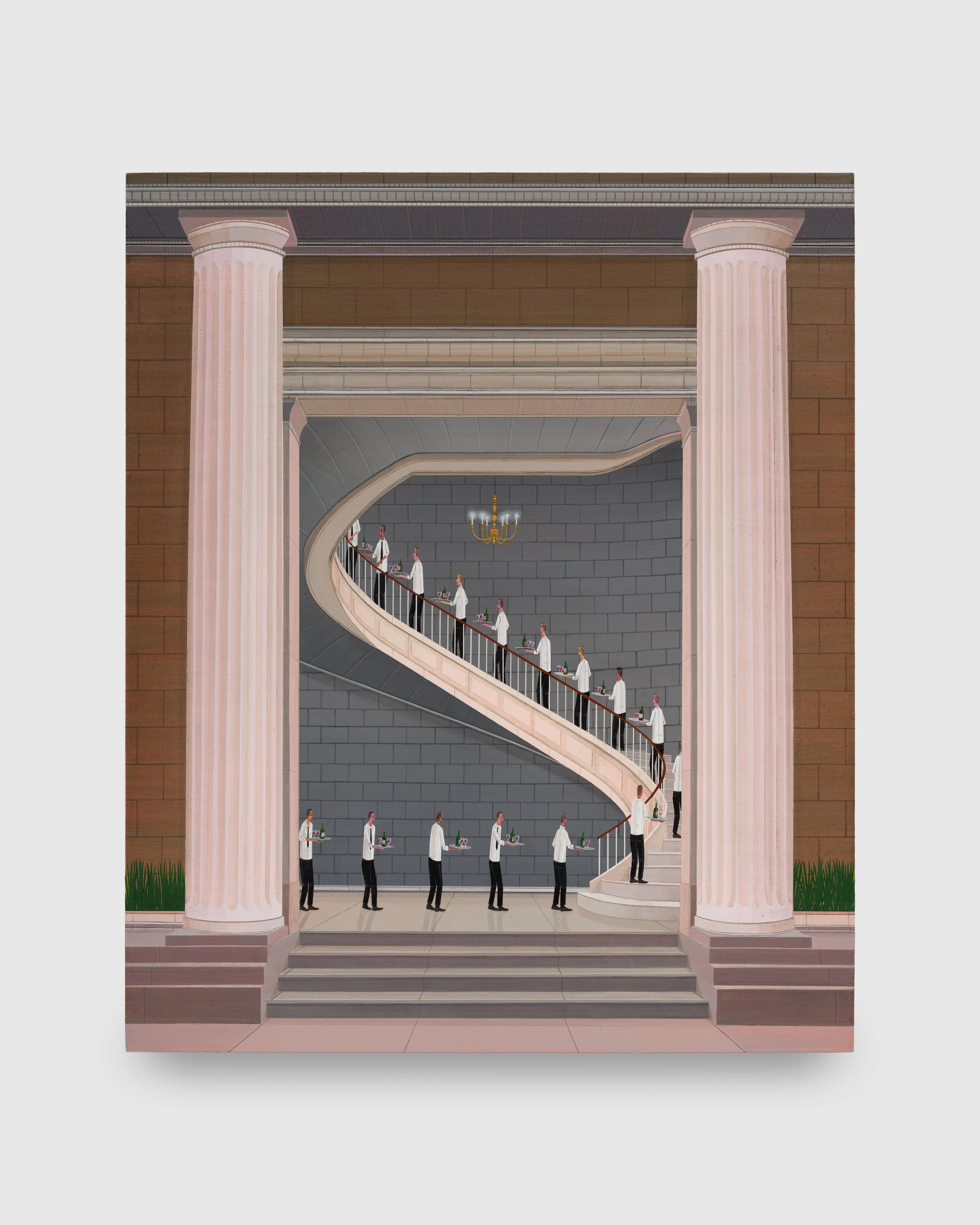
Ian Davis, Waiters, 2025. Courtesy of the Artist and Nicodim.


Connoisseurs of world order fill Ian Davis’s canvases, their picturesque and surreal stomping grounds an ode to both beauty and horror. The eeriness of his hyper-structured displays is overlaid by a rhythmic attitude and hip-hop influence. Davis’s landscapes keep a certain distance from the scenes they portray—the viewer is implicated at altitude, surveying a scene as you might an out-of-body experience. The entrapments of the modern day—wealth, power, surveillance—are articulated by a contemporary rendition of art history’s revered flâneurs. Starting with a blank canvas and a commitment to an idea, Davis’s process is completely inseparable from his final product, which are both uniquely his own. Read more.

Richard Linklater Offers a Sweet, if Tame, Ode to Jean-Luc Godard


text by Emma Grimes


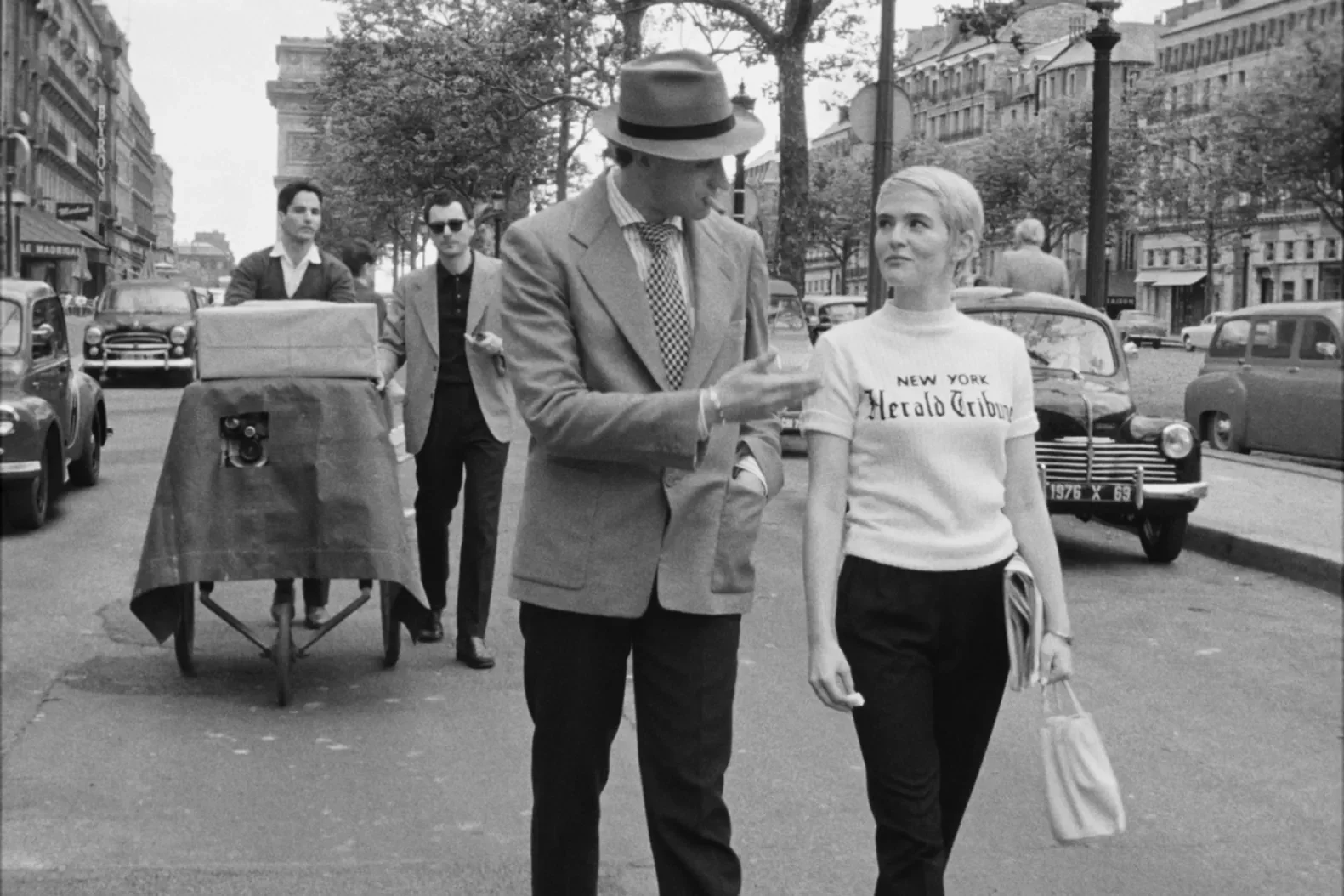
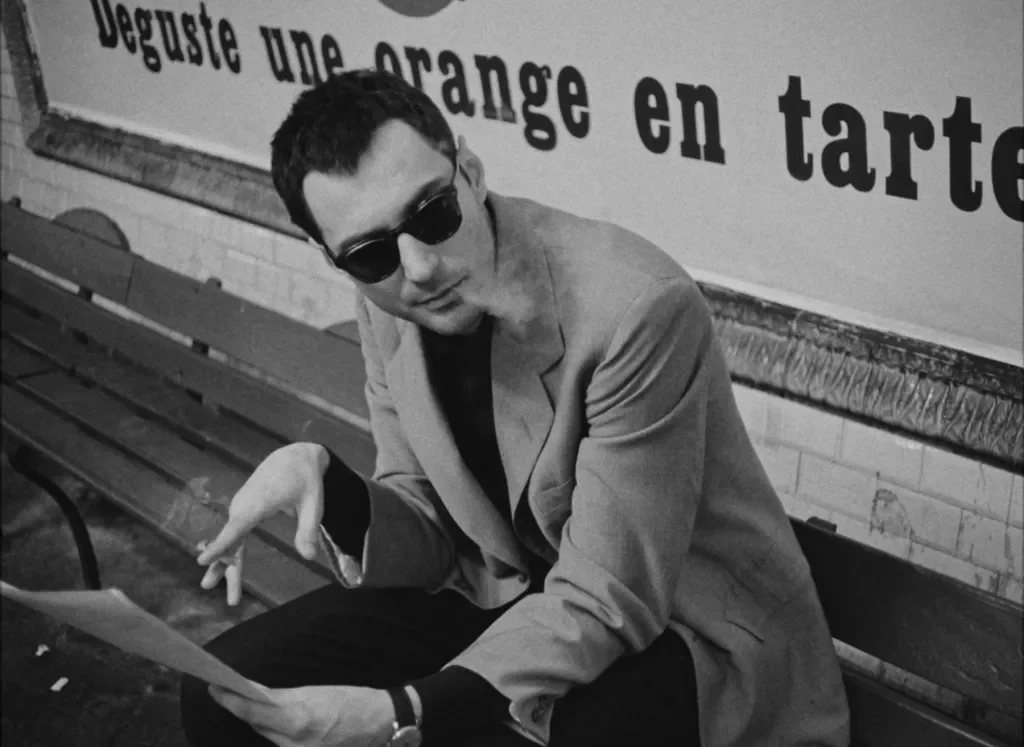
Richard Linklater’s latest film, Nouvelle Vague, is a sentimental love letter to the French New Wave—that brief postwar period in cinema when a group of young critics with nerve and conviction just about altered every rule about how movies could look and how we should think about them. In celebrating these filmmakers, Linklater offers a pleasant and affectionate reminder of their originality.

The film opens in 1959, as Francois Truffaut’s The 400 Blows makes its Cannes debut, and a restless Jean-Luc Godard, still a critic at Cahiers du Cinema, is itching to direct his first feature film. Cahiers is now known as the breeding ground for these insolent critics-turned-directors that punctured the French film establishment. As critic David Kehr wrote, it was the start of “film criticism as a contact sport.”

To Godard, his role as a filmmaker was a continuation of his role as critic. He didn’t see them as two separate pursuits; rather, his films were his criticism too, just imparted differently. And soon enough, he got his shot at making that film with a script from Truffaut, allegedly based on a real crime story pulled from the newspaper. The eventual result, Breathless, is restless, improvised, and spectacularly alive.

Linklater succinctly captures Godard’s taut vision and stubbornness as a director. A significant portion of the film takes place in Parisian bistros, where the cast and crew lounge around, waiting for their cue from Godard. Jean-Paul Belmondo (Aubry Dullin) and Jean Seberg (Zoey Deutch) don’t rehearse their lines because there are no lines to rehearse in advance. Some days on set last just two hours. His peculiar and erratic filmmaking approach causes Seberg to doubt whether he has any overarching vision at all. She wants to call it quits at one point.

While some or all of these historical facts about the making of the movie may be familiar to cinephiles, it’s a pleasure to watch it all unfold on the big screen and in the hands of these actors. Guillaume Marbeck gives a brooding and very focused Godard, but Deutch steals the screen as Seberg. She is sharp, radiant, and elusive. You can immediately understand why Godard wanted to capture her unguarded, candid self.

And the rest of the Godard checklist, Linklater crosses off: his use of the handheld camera, on-location shooting, disregard for continuity editing, and his insistence on capturing spontaneity. The critic Armond White wrote in 2007 that half a century of familiarity with Breathless has bred “a certain kind of nonchalance” about the wildly original and trailblazing film. “The excitement of discovery is almost gone,” White writes, “meaning it’s time for rediscovery.”

Linklater succeeds at doing just that, allowing a modern audience to see it anew—to feel, perhaps for the first time, how pioneering and defiant these young filmmakers once were and how strange their perspective once seemed. We meet and spend a little time with other filmmakers, including Truffaut, Jacques Rivette, Éric Rohmer, and Robert Bresson.

But in rediscovering Godard and his cohort of iconoclasts, Linklater inevitably folds something once radical into a consumable product with duller edges. This paradox is inevitable for the project he’s after, that of sincerely celebrating the New Wave’s pioneering achievements. Nevertheless, it risks feeling like one of those “vintage” t-shirts sold online—retro and unique in spirit, but mass-produced in reality.

Still, none of this diminishes the pleasure of watching this film. I loved every minute. The wood-fire crackling of the film reel, the warmth and ebullience of Deutch’s embodiment of Seberg, the beautiful imitations of original shots from Breathless—it’s all undeniably, intensely pleasurable.

But to truly honor Godard would mean scandalizing us again, making something unruly instead of sweet and digestible. Nouvelle Vague isn’t any fresher than convenience store candy, but it does taste just as nice and is impossible to resist.

Read An Interview Of Jingyi Li On Craft, Culture And Feminism

 
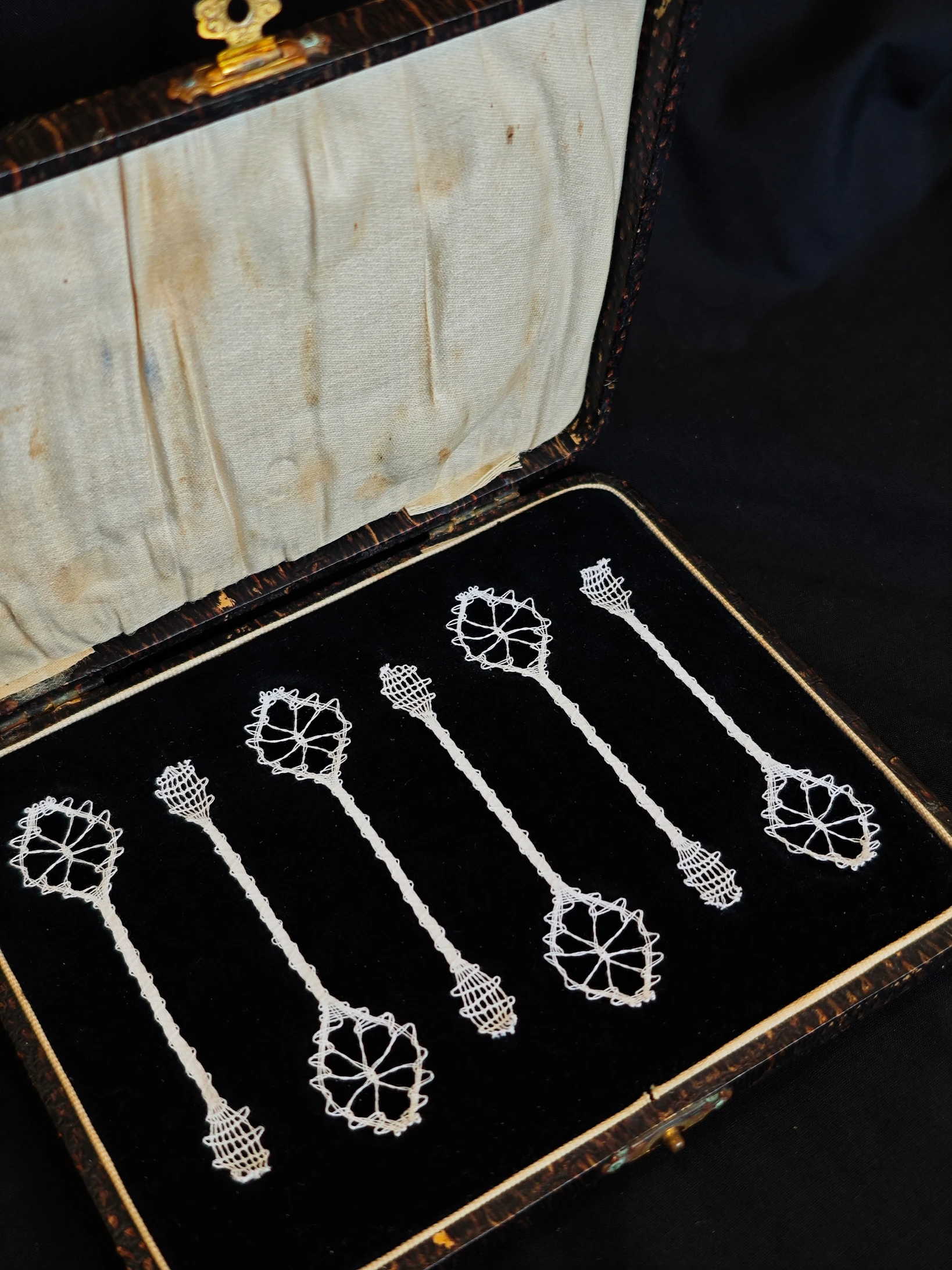
The hidden drawer tea spoon set

Jingyi Li. The Hidden Drawer-Tea Spoon, 2024. 16x26x2.5cm, Bobbin Lace, antique tea spoon case.


interview by Lola Titilayo

At the center of feminist practice, soft-spoken materials, and Asian heritage, Jingyi Li is defining contemporary artistry through storytelling. Drawing on her PhD in anthropology, she weaves research, memory, and cultural narrative into delicate, hand-crafted lace and other tactile materials, transforming everyday objects into installations that explore emotion, identity, and history. From intimate cutlery sets in The Hidden Drawer to larger immersive works like The Oyster Pail, Li’s work unlocks the expressive potential of unconventional materials, creating spaces where Asian women’s stories are told. Read more.

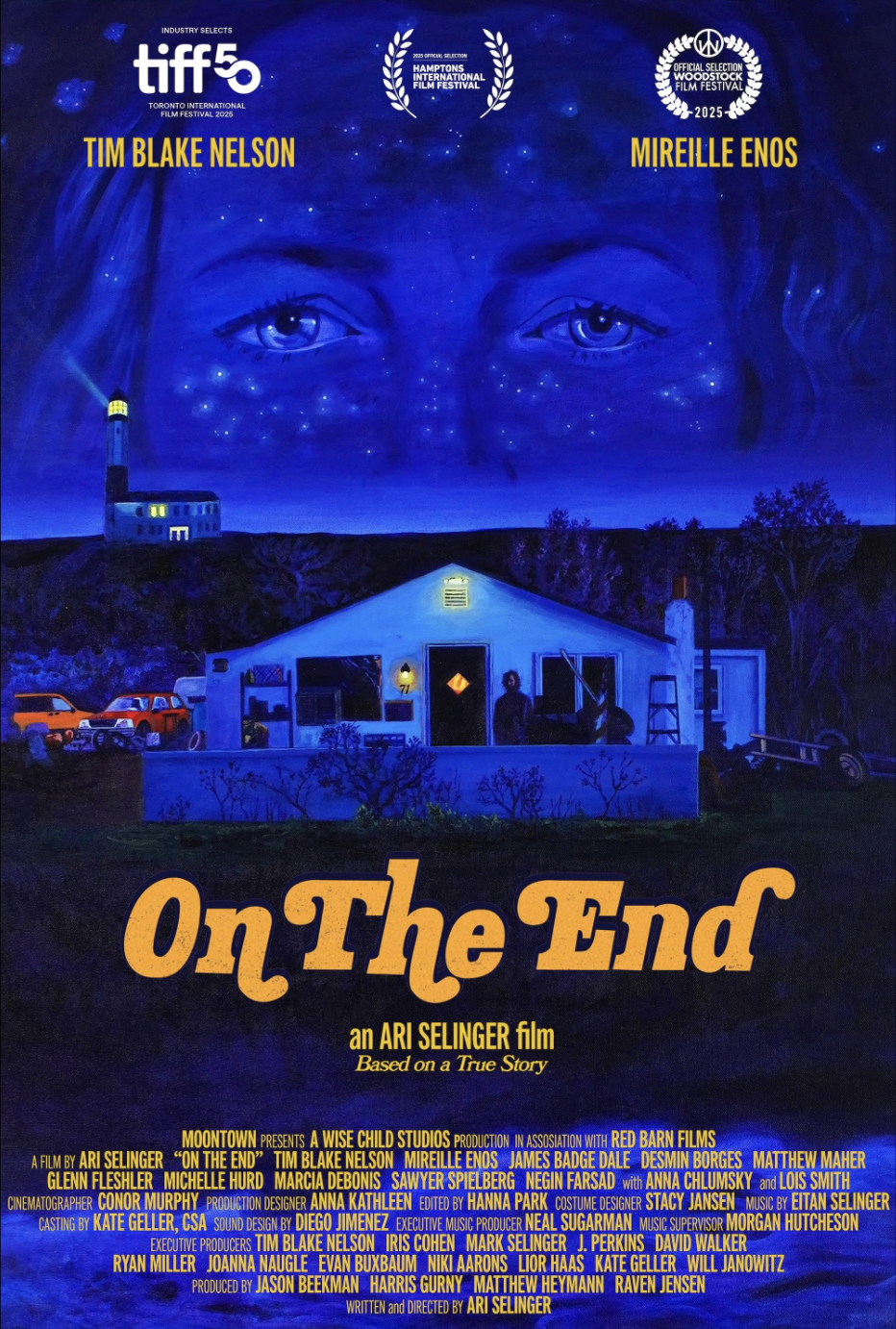
An Interview of Ari and Eitan Selinger on Their New Film 'On The End'

“He must have had a really bizarre experience. He was sitting on his porch watching the movie of his life.”


interview by Poppy Baring

On The End, directed by Ari Selinger and scored by Eitan Selinger, tells the story of Tom Ferreira, a mechanic living in Montauk at the end of the glamorized Hamptons town. The film, which is heavily based on a true story and was made within feet of the home that inspired it, is a highly emotional chronicle of a contestable yet ultimately good-hearted man being bullied by property developers. The film not only reveals issues of greed and corruption, but it also tells the story of love and loss between Tom and fellow outcast Freckles. With local actors Tim Blake Nelson playing the former and Mireille Enos as the latter, a certain intimacy with the community lends the film a sense of sincerity. In this interview, Ari Selinger and his brother Eitan Selinger discuss their fraternal dynamic, their choices behind the score, and they reflect on the real Tom who inspired the film and passed shortly after it was made. Read More.

Dawn Williams Boyd Inverts America's Racial Narrative @ Fort Gansevoort

Dawn Williams Boyd
Abduction, 2025
Assorted fabrics and cotton embroidery floss
45 x 67.5 inches

text by Hank Manning

In FEAR at Fort Gansevoort, Dawn Williams Boyd inverts American history, imagining a parallel universe where Black oppressors imported white slaves and have maintained an economy predicated on race-based exploitation for centuries. Her cloth paintings, made with textiles imported from Africa, all closely resemble canonical American ephemera, including historical photographs and advertisements. Maintaining this color-inverting framework, the gallery, for its third solo exhibition with Boyd, has painted its typically white walls black. 

The exhibition quickly succeeds in making us hyperaware of our racial biases. The scenes depicted—enslaved people chained together on ships, hooded horsemen celebrating lynchings, peaceful protestors attacked by police and civilians—are so ingrained in our memories that we instinctively assign roles before noticing Boyd has reversed them. Even knowing the artist’s intent, standing before these explicit works, our minds still resist the uncanny world she constructs. 

 

Dawn Williams Boyd
Brainwashed, 2025
Assorted fabrics and cotton embroidery floss
66 x 43.5 inches


In addition to these violent scenes, Boyd highlights the psychological violence that racism perpetuates in relation to the commercialization of cultural tropes. In a piece titled Brainwashed, a young Black girl, holding a black bar of soap, asks a white slave, “Why doesn’t your mamma wash you with Fairy Soap?” We are directly confronted with the immediate qualities we assign to the colors black and white, as well as how these perceptions affect one’s feelings of self-worth, particularly when learned at a young age.

Dawn Williams Boyd
Cultural Appropriation, 2025
Assorted fabrics and cotton embroidery floss
47 x 58 inches

More than 150 years after the de jure end of slavery in America, economic and social inequalities persist. In keeping with this reality, Boyd’s textile works generally proceed chronologically through history, but they offer no hint of progress toward integration or equality; the racial divide remains unambiguous. She further underscores the role of seemingly benevolent industries, like entertainment and medicine, in perpetuating racial inequality. We see white subjects forced into society’s most exploited roles, from dancing in banana skirts in service of the hegemonic class (at a Prohibition era nightclub in Harlem), to being the subjects of gruesome gynecological research (imitating the work of Marion Sims, the “father of gynecology” who performed studies on enslaved Black women). In the real world, Black patients disproportionately lack access to the advances their exploitation made possible.

Dawn Williams Boyd
The Lost Cause Mythos, 2025
Assorted fabrics and cotton embroidery floss
56 x 70.5 inches

In The Lost Cause Mythos, a reframed Gone With the Wind features a white mammy serving a Black Scarlett O’Hara. Boyd addresses the power of art in shaping and reinforcing societal myths, however, she refuses to entertain the “happy slave” stereotype, instead portraying a despondent attendant. White characters lose their individuality; in settings from the beginning of the slave trade to the present day, men and women sport identical short blond hair and appear either nearly nude or in plain white garments. This homogenization dehumanizes them, treating them as props devoid of personality. Their Black counterparts, by contrast, have diverse hairstyles and elaborate clothing in a variety of colors, with red—here a symbol of power—especially prevalent.

Today, the US federal government and many state governments are attacking DEI initiatives, legal protections secured by the Civil Rights movement, and the honest teaching of American history, denigrating attempts to right historical wrongs as “reverse racism.” Boyd’s stark work puts these unsubstantiated claims into perspective. It asserts the degree to which most Americans underestimate the ongoing legacy of systemic racism and emphasizes the role of emotion in our material world. We see fear in the eyes of everyone, from those experiencing the horrors below deck on slave ships to a fragile ruling class who feels existentially entitled to their privilege and is terrified of losing it. 

Dawn Williams Boyd: FEAR is on view through January 24 at Fort Gansevoort, 5 Ninth Avenue, New York

AI Epistemicide


Can you show me AI’s soul? prompt ChatGPT 2025


text by Perry Shimon

The wholesale expropriation of human energies on the internet under the guise of “Artificial Intelligence” signals one of the most significant enclosures in human history, as well as a radical restructuring of how knowledge is produced and accessed. In his 2014 Epistemologies of the South, sociologist Boaventura de Sousa Santos offers the concept of epistemicide to describe the annihilation of systems of knowledge and their supporting cultures. Another kind of epistemicide is currently underway today because a small group of profit-motivated private companies—mostly based in Silicon Valley and with global ambitions—have expropriated the collectively produced knowledge commons available on the internet (with all its questionable content) and created an epistemic regime that operates opaquely, producing the illusion of intelligence while habituating—even addicting—its users to its protocols with sophisticated psychological manipulation and design.

It is inconceivable to imagine a version of corporate AI that prioritizes anything besides the maximization and concentration of profits at the expense of its users, the environment, and the social good. Time and again the algorithmic-like functioning, laws, and fiduciary duties of capitalism have proven this outcome. This is especially true in Silicon Valley, where a handful of companies control nearly the entirety of the internet, making fortunes from our now-impoverished experiences of inquiry and sociality—and becoming ever more transactional, cunning, costly, and pathological.

We are witnessing, under the banner of “AI,” the capitulation of entire traditions of education and knowledge production, surrendering themselves to this new regime. Within the usual “move fast break things” velocities of internet capitalism it’s impossible to keep up with the rate people who are adopting these new technologies and schools that are restructuring themselves to accommodate them. The early figures are staggering and point towards a further acceleration of attentional and analytic incapacitation. 

Artificial intelligence functions by finding patterns in massive amounts of data and then predicting similar chains of words based on repetition in the dataset. This, of course, reproduces biases and effectively makes the question of “truth” a question of statistical probability. This also suggests a susceptibility to the manipulation of truth with the production of affirmative or operational data, amounting to the most repetitive insistence of data-fied knowledge winning the game of truth.

Image courtesy of Growtika, Unsplash

It should go without saying that machines stringing together probabilistic chains of language does not equate to wisdom or knowledge in any meaningful sense. It stands to reason that without people doing the intellectual work of adding to—and often overturning—conventional thinking, these models will simply deteriorate into a warm, static dribble of historical ignorance largely bound to the narrow historical window and contemporaneous data in which it was conceived. Any emerging contribution to our knowledge commons will have to compete in arenas of attention and repetition to become statistically significant as an analytically incapacitated public increasingly relies on regurgitated probabilities. 

It seems inevitable that Silicon Valley—the same industry that has devalued nearly every other form of creative and intellectual production—will not fairly remunerate those responsible for producing the data which it appropriates into its epistemic regime. It is also crucial to point out how many forms of knowledge do not make themselves available to binary, computational logic—the outgrowth of the same regime responsible for the epistemicide acknowledged by de Sousa Santos.

Within military applications, the camouflage of “AI” allows a level of impunity, for example, in the targeted killing of civilians in operations carried out by states using these automated technologies. Israel’s “Lavender” and “Daddy’s Home” are two horrifying recent examples of how AI can be used for indiscriminate murder in larger political projects—in this case, the genocide in Palestine. So-called AI is also being used by formations of power around the world to automate and optimize many kinds of lesser disciplinary and punitive relations on vulnerable populations, including predictive policing, traffic enforcement, bail decisions, public benefits, and the targeting of political activists.

The excessive focus on AI is a form of misdirection that serves to distract the general public from the near-total monopoly capitalism of the current internet. It produces a new imaginative frontier, filled with scary monsters and geopolitical urgencies that shift focus away from the small cabal of monopolists who control our collective knowledge and means of using it—often in collusion with oppressive and violent states. Most of the terms of the debate—the stakes, framing, fears, and so on—are produced by the same industry that profits from them. This is a strategy to limit and steer the conversation while enrolling new users, generating hype, raising capital, soliciting government subsidies, evading regulation, and generally increasing their control. The Silicon Valley model is one of wild speculation, driven by utterly deceitful rhetorical claims, massive environmental costs, and the end goal of monopolization and endless growth.

This is not an inevitability and the time to act otherwise is now. There are existing models, both on and offline, that offer a clear path forward: Wikipedia and the library are as good as any. Wikipedia is a massive nonprofit, collectively-produced form of knowledge commons which everyone benefits from. Without the burden of a profit incentive, it continues to help the world better understand itself within a system of transparency and accountability. The library is our oldest and most sustained example of a socialist good for all, and much of the internet should be reconfigured in its image. Search, social platforms, mapping, and, to some extent, the minor technological affordances of generative and predictive LLMs should all be reimagined as nonprofit utilities for the collective benefit of the entire world, as we remediate our social and ecological conditions.

Criterion Collection and Dover Street Market launch Holiday Curation In Los Angeles and New York

This holiday season, Criterion steps out from the living room and into the city, partnering with Dover Street Market to transform film history into a tactile, immersive experience. For two days only, December 13–14, dedicated installation spaces at DSM New York and DSM Los Angeles will host a carefully curated selection from the Criterion Collection—inviting visitors to browse, discover, and linger among some of cinema’s most enduring works.

At the heart of the program is a reverence for authorship and atmosphere. Collector sets spanning the radical tenderness of Agnès Varda, the baroque spectacle of Fellini, the aching romanticism of Wong Kar Wai, and the existential weight of Bergman anchor the offering, alongside Criterion milestones and cult-defining epics like Godzilla: The Showa-Era Films. Single editions punctuate the selection with sharp contrasts: the icy ritualism of Eyes Wide Shut, the restless rebellion of Breathless, the intimate spectacle of Grey Gardens, and the cultural urgency of Do the Right Thing.

The films and merchandise will remain available throughout December, extending the invitation to revisit, rewatch, and reframe the season through the language of film.

Diesel’s SS26 Collection Is Leading the Way in Democratizing Fashion


text by Alper Kurtul

Rather than presenting a collection this season, Diesel launched a game. . Milan’s streets, clubs, bars, hotels, galleries, and even its hidden corners were transformed into a giant egg hunt, turning the city into a living fashion map. Fifty-five looks appeared inside transparent capsules waiting to be found, with the first five people to discover them all receiving full Diesel looks before Christmas. 

Inside the transparent capsules, the clothes confront the city without fear. One of the looks features a pastel-printed top paired with a skirt made from soft, furry textures, cut into oval openings that reveal the hips with a mischievous wink. The long floral skirt that completes the silhouette suggests a memory of domestic comfort., Yet the futuristic enclosure and the glowing circular platform beneath the model’s feet transform that memory into a performance. This tension between intimacy and spectacle is pure Diesel. It is softness that dares to provoke.


Another look turns fragility into armor. A cloud-like explosion of fiber surrounds the shoulders and chest, as if the model had grown wings. The muted velvet skirt and floral tights extend the body like vines reaching for streetlights. A small handle bag hangs from her wrist like a treasured secret. The gaze is direct and unshaken. Diesel understands that beauty has teeth and that elegance can be a weapon.

SS26 proudly carries this attitude. Denim on denim is back in full form. The courage of the 2000s and the freedom of the 1970s meet in the same silhouettes. Bleached effects and visible seams bring the fabric’s raw essence to the surface. Distressed satin denim pulls you in with a single touch. Grey skirts, hair clips clipped into bags, leather cuffs, and metallic footwear celebrate experimentation as identity.

Accessories become characters in this story. Bags sit at a midpoint between sculpture and utility, and some are treated almost like wearable secrets with compact shapes that ask the viewer to come closer. Silver shoes and buckled heels ground the looks in a crisp present tense while futuristic jewelry sits high on the collarbone like talismans from a world where fashion and survival share the same language. Every piece is a reminder that attitude requires an object to anchor itself in the real. Diesel offers those anchors with confidence and mischief.

Jumpsuits appear as if psychedelic animal skins were taken apart and rebuilt again. Knit pieces wrap the body while refusing every expected rule. Punk-like defiance blends with pop-like shine in a single movement. Diesel chooses to redefine luxury rather than hide beneath its shadow. Fashion is a participatory act. That is why the collection is not restricted. It is shareable. People are hunting for these looks, because fashion is finally for everyone.

timo fahler’s TERMINAL CLASSIC Meditates on Personal Upheaval & Collective Uncertainty @ Sebastian Gladstone Gallery


timo fahler, SKYBEARER, 2025, Steel, stained glass, lead, found object, 62" H x 42" W x 4" D


text by Caia Cupolo

timo fahler’s TERMINAL CLASSIC is a series of eight sculptural wall works that combine images from ancient Maya culture with symbols of America power, meditating on memory, the weight of ancestry, personal upheaval and collective uncertainty. Its title refers to the period between 250-900 CE, when many of the great Maya city-states in the southern lowlands experienced a socio-political collapse and abandonment that is often referred to as the Maya Collapse. Created while the artist was moving from Los Angeles to Amsterdam, these works mark a major life change as his family expanded and emigrated.

fahler’s “SKYBEARER” in stained glass is set behind rusting window bars. This is one of the four deities responsible for holding up the sky, separating it from Earth, and making mortal life possible. His incarceration might explain what has gone so terribly wrong with the cosmic order.

In “IDYLLIC, IDEALIC, IDEA LICK, I’D EEL LICK, I DEAL ICK,” the White House is presented “like a stage prop or an empty shell, holding only the idea of something.” It serves as a potent symbol of the crumbling face of American capitalism, particularly in juxtaposition with “FLAG,” which is seen directly ahead when you enter the gallery. This buckling discarded bedspring that sat in the artist’s studio for months revealed itself as an American flag when fahler discovered that it was composed of thirteen rows. It was the very last piece he created before leaving Los Angeles.


timo fahler, flag, 2025, Steel, stained glass, lead, found object, 73" H x 50" w x 8" D


Because fahler is of mixed heritage, his work often touches on what it feels like to be caught between his Mexican and American cultures. This inner conflict is further articulated by the delicate friction between fragile, colorful glass held by rough, industrial materials, like rusted steel fences, metal bed springs, and rebar. This skillful balance of strength and fragility gives the work an almost animist sense of emotional stability.

When the light hits the stained glass, it casts vivid, colorful shadows on the wall, creating an ethereal extension to the work that is constantly transforming as the day passes. In effect, these shadows act as a performative counterpart to works that are initially perceived as purely visual. Within the changing environment, the integrity of the work and the narrative it portrays persist.

TERMINAL CLASSIC is on view through December 13 @ Sebastian Gladstone Gallery 36 White Street, New York